Fill out charitable giving forms
with AI.
Charitable giving forms are the essential administrative bridge between philanthropic intent and financial execution. These documents ensure that contributions—whether they originate from individual donors, corporate entities, or retirement accounts—are properly recorded for tax purposes and directed to the intended non-profit organizations. By formalizing the donation process, these forms help maintain the legal integrity of donor-advised funds and ensure that every contribution qualifies for the maximum allowable tax benefits under current regulations.
By continuing, you acknowledge Instafill's Privacy Policy and agree to get occasional product update and promotional emails.
About charitable giving forms
This category of forms is primarily used by individual philanthropists, corporate social responsibility officers, and financial advisors managing charitable portfolios. For example, a business might utilize an Organizational Giving Account Application to establish a structured corporate giving program, while an individual might need an IRA Letter of Instruction to facilitate a direct charitable rollover. These documents are most frequently needed during annual tax planning, when establishing new endowments, or when nominating an investment advisor to manage assets within a charitable account.
Completing these documents with precision is vital to avoid processing delays or compliance issues that could impact tax deductions. Tools like Instafill.ai use AI to fill these charitable giving forms in under 30 seconds, handling complex data accurately and securely. This streamlines the administrative side of philanthropy, allowing donors and advisors to spend less time on paperwork and more time focusing on the impact of their generosity.
Every form on this page can be completed without typing. Instafill is form filling software that reads a PDF and fills it for you — including flat and scanned documents that carry no fillable fields at all.
Forms in This Category
The forms in this category have a median Form Complexity Index of 64/100 (Complex), measured across 3 forms by field count, input difficulty, length, conditional logic and structure. See how it is calculated.
| Form Name | Pages | FCI | |
|---|---|---|---|
| 1. | Fidelity Charitable Investment Advisor Program Application | 1 | Complex 64 |
| 2. | Organizational Giving Account® Application | 1 | Complex 63 |
| 3. | St. Jude Children’s Research Hospital IRA Sample Letter of Instruction | 1 | – |
- Enterprise-grade security & data encryption
- 99%+ accuracy powered by AI
- 1,000+ forms from all industries
- Complete forms in under 60 seconds
How to Choose the Right Form
Selecting the right charitable giving form depends on the legal structure of the donor and the specific financial vehicle being used for the contribution. Whether you are an individual donor, a business entity, or a retiree using tax-advantaged accounts, choosing the correct documentation ensures your contribution is processed efficiently and your tax benefits are preserved.
For Corporate and Business Philanthropy
If you are representing a business entity or non-profit organization looking to establish a donor-advised fund, you should use the Organizational Giving Account® Application. This form is specifically designed for corporate philanthropy, allowing entities to make irrevocable contributions of cash or securities and recommend grants to qualified charities over time. It is the primary document needed to open a Fidelity Charitable account for a company rather than an individual.
For Managed Investment Accounts
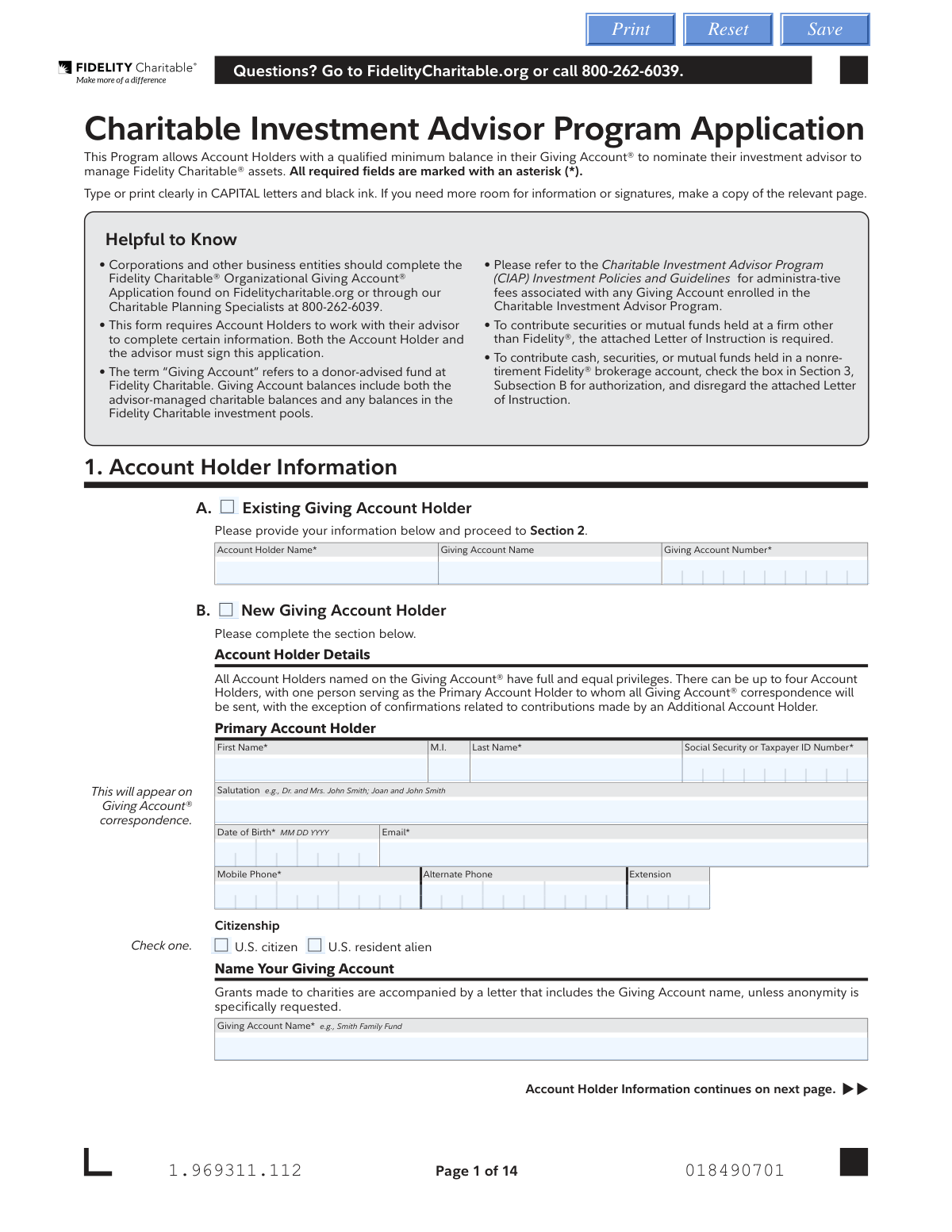
If you are an individual donor who already holds a Fidelity Giving Account® but prefers to have your own financial professional manage the assets, the Fidelity Charitable Investment Advisor Program Application is the appropriate choice. This application bridges the gap between your charitable giving and your personal investment strategy, allowing your nominated advisor to manage the assets within the Giving Account according to your goals.
For Retirement Account Distributions
For individuals looking to make a gift directly from their retirement savings, the St. Jude Children’s Research Hospital IRA Sample Letter of Instruction is the right tool. This document is specifically for those wishing to perform a Qualified Charitable Distribution (QCD). By using this letter to instruct your IRA administrator, you can authorize a direct transfer to the hospital, which may allow the distribution to be excluded from your taxable income—a common strategy for donors meeting their Required Minimum Distribution (RMD) requirements.
By identifying whether your gift is coming from a corporation, a managed investment account, or a retirement fund, you can quickly select the form that aligns with your financial strategy.
Form Comparison
| Form | Primary Purpose | Who Files It | Key Action |
|---|---|---|---|
| Fidelity Charitable Investment Advisor Program Application | Enables professional investment management of assets within a Fidelity Charitable Giving Account. | Individual donors who have professional investment advisors. | Authorize an advisor to manage charitable account assets. |
| Organizational Giving Account® Application | Opens a donor-advised fund specifically for corporate philanthropy and tax-deductible contributions. | Corporations, business entities, and other organizational donors. | Establish a corporate-owned donor-advised fund. |
| St. Jude Children’s Research Hospital IRA Sample Letter of Instruction | Directs an IRA administrator to send a tax-free distribution to St. Jude. | Individual IRA owners making a Qualified Charitable Distribution. | Instruct IRA custodian to transfer funds directly to charity. |
Tips for charitable giving forms
Ensure you have the correct Employer Identification Number (EIN) and the full legal name of the charitable organization. Small errors in these identification details can lead to significant delays in processing your contribution or grant recommendation.
When setting up investment advisor programs or IRA rollovers, share copies of the completed forms with your advisor immediately. This ensures that assets are moved correctly and that your charitable giving remains aligned with your overall investment strategy.
AI-powered tools like Instafill.ai can complete these complex charitable forms in under 30 seconds with high accuracy. Your sensitive financial data stays secure during the process, providing a practical way to manage multiple philanthropic documents efficiently.
If you are opening a giving account for a corporation or non-profit, keep your articles of incorporation or trust documents nearby. These forms often require specific details about the entity's legal structure and authorized signers that are not always easily memorized.
Always save a digital copy of your signed charitable giving forms and letters of instruction. These documents serve as critical records to support your tax deductions and provide a clear audit trail for your year-end financial reporting.
For IRA rollovers or security transfers, verify the receiving account numbers and routing instructions twice before submission. Providing incorrect transfer details can result in assets being returned or held in suspense accounts, delaying your intended gift.
Charitable forms frequently require signatures from both the donor and an authorized representative or financial advisor. Review the signature blocks carefully to ensure every necessary party has signed, as missing signatures are a leading cause of form rejection.
Frequently Asked Questions
Charitable giving forms are legal and administrative documents used to facilitate donations, establish philanthropic accounts, or direct assets to non-profit organizations. They ensure that contributions are accurately tracked for tax purposes and that the donor's instructions for fund management are clearly documented.
These forms are used by a variety of parties, including individual donors, corporate entities setting up philanthropy programs, and financial advisors managing assets on behalf of clients. Each form is tailored to a specific giving strategy, such as a donor-advised fund or a direct IRA distribution.
Yes, AI tools like Instafill.ai can be used to fill out charitable giving forms efficiently. These tools can accurately extract data from your source documents and place it into the correct fields in under 30 seconds, significantly reducing the manual effort involved.
While manual completion can take 15 to 30 minutes depending on the complexity of the data, using an AI-powered service like Instafill.ai allows you to complete these forms in less than 30 seconds. The AI automates the data entry process while maintaining a high level of accuracy.
Most forms require the donor's personal or business identification, account numbers, and specific details about the assets being contributed. If you are nominating a professional to manage the funds, you will also need the contact and licensing information for your investment advisor.
While these forms can be submitted year-round, many donors complete them before the end of the calendar year to ensure their contributions are eligible for tax deductions in that specific tax year. It is advisable to check with your financial institution for their specific year-end processing cut-off dates.
An individual giving account is managed by a person or family for personal philanthropy, while an organizational account is designed for business entities, such as corporations or partnerships. The organizational forms often require additional documentation regarding the legal structure of the business and its authorized representatives.
To authorize a distribution, you typically need to submit a formal letter of instruction to your IRA administrator. This document specifies the amount to be transferred and the details of the qualified charity, ensuring the transaction is treated as a Qualified Charitable Distribution (QCD) for tax purposes.
Completed forms are usually submitted directly to the financial institution or the specific charitable organization managing the fund. Many modern organizations provide secure online portals for digital submission, though some may still require a physical copy with an original signature.
Yes, many charitable giving forms involve irrevocable contributions, meaning once the assets are transferred, they cannot be returned to the donor. It is important to review the terms and conditions of the specific fund or account before finalizing the submission.
Glossary
- Form Complexity Index
- Instafill’s 0–100 measure of how much effort a form takes to complete, calculated deterministically from the form’s own structure rather than estimated. It combines the number of fillable fields (the largest factor), how difficult those fields are to complete based on their type, the number of pages that contain fields, the amount of conditional “fill-only-if” logic, and how many sections the form is divided into, then adds modifiers for tables and repeating lists, bundled instruction pages, and dense page layouts. A higher score means the form is harder to fill out by hand. The forms in this category have a median Form Complexity Index of 64/100 (Complex). See exactly how it is calculated.
- Donor-Advised Fund (DAF)
- A private fund managed by a third party that allows donors to make a charitable contribution, receive an immediate tax benefit, and then recommend grants from the fund to charities over time.
- Qualified Charitable Distribution (QCD)
- A direct transfer of funds from an IRA custodian to a qualified charity that can satisfy required minimum distribution (RMD) rules and is excluded from the donor's taxable income.
- Irrevocable Contribution
- A donation that cannot be taken back or refunded once it is made, which is a legal requirement for the donor to claim a tax deduction for the gift.
- Grant Recommendation
- A formal request made by a donor to the organization managing their charitable account to distribute a specific amount of money to a chosen non-profit organization.
- Giving Account®
- A brand-specific name for a donor-advised fund account, such as those offered by Fidelity Charitable, used to manage and distribute charitable assets.
- IRA Charitable Rollover
- A tax provision that allows individuals aged 70½ or older to transfer money directly from their IRA to a charity without including the distribution in their adjusted gross income.
- Qualified Charity
- A non-profit organization that meets specific IRS requirements, typically under section 501(c)(3), making it eligible to receive tax-deductible donations.
- Investment Advisor Program
- A service that enables a donor to nominate a professional financial advisor to manage the investment of assets held within a charitable giving account.