Fill out civil litigation forms
with AI.
Civil litigation forms are the official documents used to initiate, manage, and resolve legal disputes in court. In California, most of these forms are standardized by the Judicial Council to ensure consistency across all Superior Courts in the state. They cover every stage of a civil case — from filing a complaint and serving the opposing party, to recording the court's final decision. Among the most consequential of these documents is the judgment form (JUD-100), which officially records who prevailed in a case and the exact amounts awarded, and serves as the enforceable order for post-judgment collection.
By continuing, you acknowledge Instafill's Privacy Policy and agree to get occasional product update and promotional emails.
About civil litigation forms
These forms are used by a wide range of people: individuals pursuing or defending against civil claims, attorneys handling litigation matters, self-represented litigants navigating small claims court, and parties seeking to enforce or satisfy a court judgment. Because errors in case numbers, party names, or dollar amounts can create serious legal complications, getting these documents right the first time matters.
Tools like Instafill.ai use AI to fill these forms accurately in under 30 seconds, making it easier for both legal professionals and everyday users to complete California Judicial Council forms without the risk of common mistakes or the hassle of manually deciphering dense legal formatting.
Every form on this page can be completed without typing. Instafill is form filling software that reads a PDF and fills it for you — including flat and scanned documents that carry no fillable fields at all.
Forms in This Category
The forms in this category have a median Form Complexity Index of 38/100 (Basic), measured across 9 forms by field count, input difficulty, length, conditional logic and structure. See how it is calculated.
| Form Name | Pages | FCI | |
|---|---|---|---|
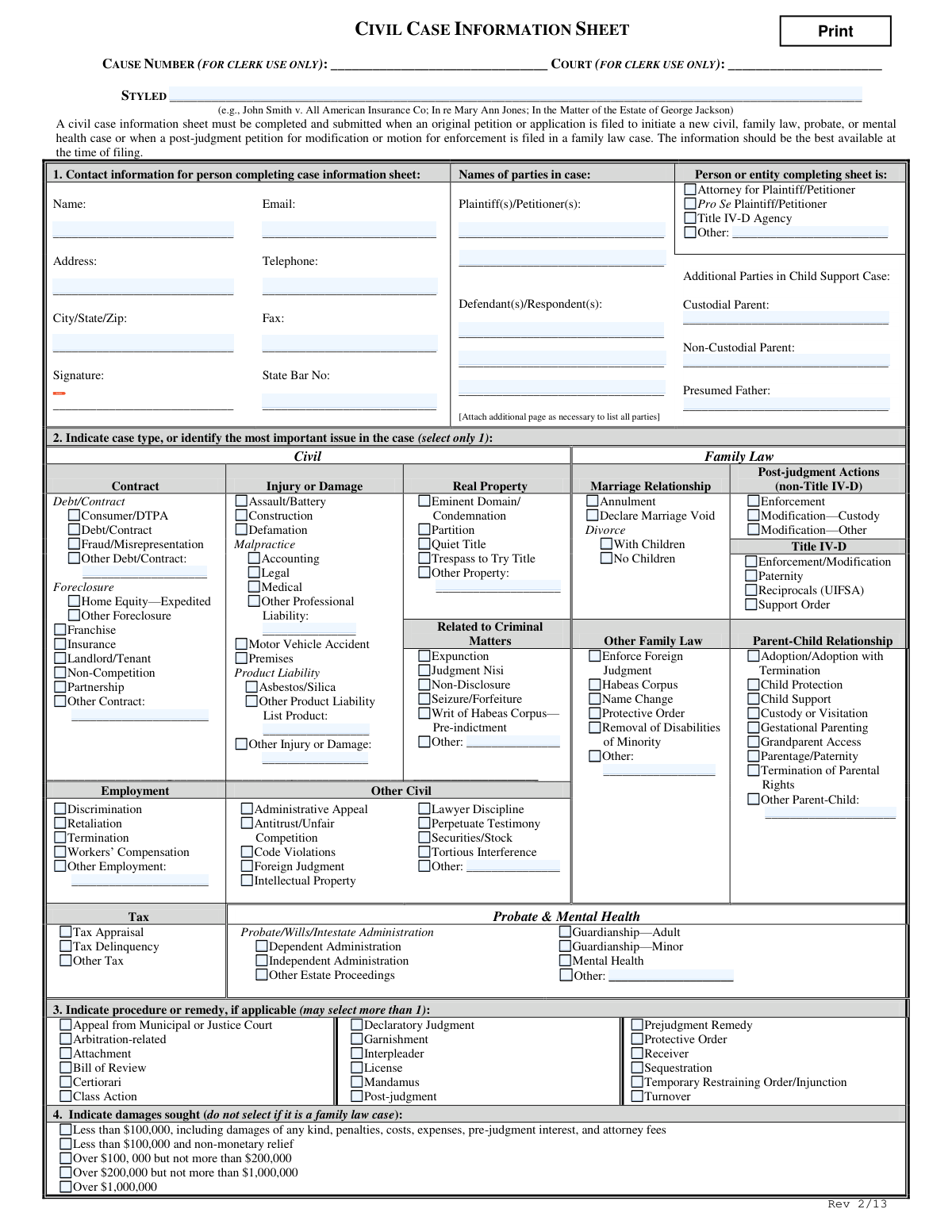
| 1. | Civil Case Information Sheet | 1 | Moderate 52 |
| 2. | CV-GENERIC-200 Generic Civil Order | 1 | Basic 29 |
| 3. | Form CV-GENERIC-100, Generic Civil Motion | 1 | Basic 42 |
| 4. | Form DISC-004, Form Interrogatories—Limited Civil Cases (Economic Litigation) | 1 | Basic 40 |
| 5. | Form N461: Claim for judicial review | 17 | Moderate 62 |
| 6. | PR-DJ-110, Certificate of Last Known Mailing Address | 1 | Basic 30 |
| 7. | PR-DJ-111 Military Status Affidavit | 1 | Basic 35 |
| 8. | Superior Court of Arizona, Maricopa County - Motion for More Time to Serve the Other Party | 1 | Basic 38 |
| 9. | Waiver of Right to Delay or Overturn Court Action Under the Service Members Civil Relief Act | 1 | Simple 25 |
- Enterprise-grade security & data encryption
- 99%+ accuracy powered by AI
- 1,000+ forms from all industries
- Complete forms in under 60 seconds
How to Choose the Right Form
Both forms in this category are versions of the same official document — Judicial Council of California Form JUD-100, Judgment — used to record a court's final decision in a civil case. Here's how to determine which version fits your situation:
If You Need the Standard Civil Judgment Form
- Form JUD-100 (Judgment) is the general-purpose version for memorializing a final civil judgment in California Superior Court.
- Use this when your case involves a default judgment, stipulated judgment, or judgment after court trial.
- It captures all essential details: winning and losing parties, monetary awards (damages, interest, attorney fees, costs), and includes signature blocks for the judge or clerk.
If Your Case Cites Specific Code Sections
- Form JUD-100 (Code of Civil Procedure, §§ 585, 664.6) is the same core form but explicitly references the statutory authority under which the judgment is entered.
- This version is particularly relevant when your judgment is entered by default (§ 585) or on stipulation (§ 664.6) — the two most common non-trial judgment pathways.
- If your attorney or the court has directed you to cite these code sections, use this version.
Bottom Line
For most users, either version will serve the same purpose — they are functionally identical judgment forms. The key difference is the statutory citation in the title, which may matter for specific procedural contexts.
> Tip: Regardless of which version you choose, accuracy is critical. Errors in party names, case numbers, or dollar amounts can affect enforceability. Use Instafill.ai to fill out either form quickly with AI-powered guidance and avoid common mistakes.
Form Comparison
| Form | Purpose | Who Files It | When to Use |
|---|---|---|---|
| Judicial Council of California Form JUD-100, Judgment | Memorialize court's final civil judgment and amounts awarded | Prevailing party or clerk of court | After default, stipulation, or court trial judgment is reached |
| Judicial Council of California Form JUD-100, Judgment (Code of Civil Procedure, §§ 585, 664.6) | Enter enforceable final judgment citing specific CCP statutes | Prevailing party or clerk of court | When judgment basis falls under CCP §§ 585 or 664.6 |
Tips for civil litigation forms
On civil litigation forms like the JUD-100, even minor discrepancies in party names or case numbers can cause a judgment to be rejected or create enforcement problems down the line. Always copy names exactly as they appear on the original complaint or summons, and verify the case number against your court filing receipt.
California judgment forms require you to break out damages, interest, attorney fees, and costs as distinct line items — not a single lump sum. Failing to separate these amounts can complicate post-judgment collection efforts, such as wage garnishments or liens, which rely on specific figures from the judgment.
The JUD-100 supports different bases for judgment: by default, on stipulation, or after a court trial. Checking the wrong box can invalidate the judgment or require you to refile. Review the procedural history of your case carefully before selecting the appropriate pathway on the form.
AI-powered tools like Instafill.ai can complete California civil litigation forms like the JUD-100 quickly and accurately, saving significant time especially when dealing with multiple forms in a case. Your data stays secure throughout the process, and Instafill.ai can even convert non-fillable PDF versions into interactive forms you can fill online.
California Superior Courts often have separate divisions (civil, family, probate) with different filing counters and requirements. Submitting a civil judgment form to the wrong division can cause delays or rejection, so call ahead or check your court's website to confirm exactly where to file.
Once a judgment is entered, you will likely need certified copies to pursue collection remedies like bank levies, wage garnishments, or abstract of judgment filings. Request at least two certified copies at the time of filing to avoid making additional trips to the courthouse later.
Courts frequently reject civil litigation forms that have blank required fields or missing signatures. Before submitting, go through every section of the JUD-100 systematically — including the judicial officer signature block and clerk certification area — to ensure nothing is left incomplete.
Frequently Asked Questions
California Judicial Council civil litigation forms are standardized, court-approved documents used in California Superior Courts to initiate, manage, and conclude civil cases. They are created and maintained by the Judicial Council of California to ensure consistency across all California courts. Using the correct, up-to-date Judicial Council form is typically required for your filing to be accepted by the court clerk.
Form JUD-100 is used by parties in California civil cases — including plaintiffs, defendants, and their attorneys — whenever a final judgment needs to be formally entered by the court. It applies whether the judgment results from a default, a stipulation between parties, or a court trial. Attorneys, self-represented litigants, and court clerks all interact with this form as part of closing out a civil case.
Both forms in this category are versions of the official Judicial Council Form JUD-100 used to memorialize a civil judgment in California. They serve the same purpose and support the same judgment pathways (default, stipulation, or court trial). Minor differences may reflect updated editions or formatting variations, so it is best to confirm you are using the most current version accepted by your specific court.
Form JUD-100 is filed at the conclusion of a civil case, once the court is ready to enter a final, enforceable judgment. This typically occurs after a default is entered, parties reach a settlement agreement, or a trial verdict is rendered. The completed form becomes the official court record of who prevailed and what amounts are owed.
A completed JUD-100 form is submitted to the clerk of the California Superior Court where your civil case is pending. Each county courthouse may have specific filing procedures, so it is advisable to check with your local court — such as Los Angeles, San Diego, or San Francisco Superior Court — for their current submission requirements, whether in person, by mail, or electronically.
The judgment form becomes the enforceable court order that allows the winning party to pursue post-judgment remedies such as wage garnishment, bank levies, or property liens. Errors in party names, case numbers, or monetary amounts can delay enforcement, require costly corrections, or even invalidate the judgment. Courts may reject or return forms that contain inaccuracies or are incomplete.
Yes — AI-powered tools like Instafill.ai can fill out California civil litigation forms, including Form JUD-100, in under 30 seconds by accurately extracting and placing data from your source documents. This reduces the risk of manual entry errors that could affect the enforceability of your judgment. Instafill.ai can also convert non-fillable PDF versions of these forms into interactive, fillable documents.
Manually completing Form JUD-100 can take anywhere from 15 to 45 minutes depending on the complexity of the case and the number of parties or monetary figures involved. Using an AI-assisted service like Instafill.ai, the same form can be populated accurately in under 30 seconds by pulling data directly from existing case documents.
An attorney is not strictly required to complete and file Form JUD-100 in California — self-represented (pro per) litigants may file the form themselves. However, because the judgment is a legally binding, enforceable order, consulting with a California-licensed attorney is advisable if you are unsure about any of the legal elements, amounts, or procedures involved.
Yes, Judicial Council forms are standardized for use throughout all California Superior Courts, which is one of the primary reasons they exist — to create uniformity across the state's 58 counties. However, individual courts may have local rules or supplemental requirements, so it is always a good idea to check your specific court's website or clerk's office before filing.
Form JUD-100 generally requires the names and roles of all parties, the court and case number, the basis for the judgment (default, stipulation, or trial), and the specific monetary amounts awarded including damages, interest, attorney fees, and costs. Signature blocks for the judicial officer and/or clerk certification must also be completed. Gathering all case documents and financial calculations before starting will make the process much smoother.
Yes — once entered by the court, the JUD-100 judgment form is the legal foundation for all post-judgment collection efforts in California, such as wage garnishments, bank account levies, and real property liens. The judgment remains enforceable for a period set by California law and can generally be renewed. Accuracy in the original form is therefore essential to ensure smooth enforcement.
Glossary
- Form Complexity Index
- Instafill’s 0–100 measure of how much effort a form takes to complete, calculated deterministically from the form’s own structure rather than estimated. It combines the number of fillable fields (the largest factor), how difficult those fields are to complete based on their type, the number of pages that contain fields, the amount of conditional “fill-only-if” logic, and how many sections the form is divided into, then adds modifiers for tables and repeating lists, bundled instruction pages, and dense page layouts. A higher score means the form is harder to fill out by hand. The forms in this category have a median Form Complexity Index of 38/100 (Basic). See exactly how it is calculated.
- Judicial Council
- The policymaking body of California's court system, responsible for creating and approving standardized forms (like JUD-100) that must be used in California Superior Courts. Forms bearing the Judicial Council seal are the official, court-accepted versions.
- Default Judgment
- A judgment entered against a defendant who failed to respond to a lawsuit within the required time. On the JUD-100, this is one of the selectable bases for how the judgment was obtained.
- Stipulated Judgment
- A judgment entered by agreement of both parties, rather than after a contested trial. It is legally binding and enforceable just like a judgment issued after a full court hearing.
- Post-Judgment Remedies
- Legal tools available to the winning party after a judgment is entered, such as wage garnishment, bank levies, or liens on property, used to actually collect the money awarded by the court.
- Code of Civil Procedure (CCP)
- The California statute that governs how civil lawsuits are filed, conducted, and resolved. Sections cited on forms like JUD-100 (e.g., §§ 585, 664.6) indicate the specific legal authority under which the judgment is entered.
- Clerk-Entered Judgment
- A judgment that the court clerk, rather than a judge, is authorized to enter in straightforward cases (such as uncontested defaults for a specific dollar amount). This is faster than waiting for a judicial officer to sign off.
- Judgment Creditor / Judgment Debtor
- The judgment creditor is the party who won the court judgment and is owed money; the judgment debtor is the party ordered to pay. These designations replace 'plaintiff' and 'defendant' once a judgment is entered.
- Prejudgment Interest
- Interest that accrues on the amount owed from the date a claim arose (or was filed) up to the date judgment is entered. It is calculated separately from post-judgment interest and must be specified on the judgment form.