Fill out Colorado judicial forms
with AI.
Colorado judicial forms are official court documents required throughout the state's legal proceedings, covering everything from family law matters to civil litigation. These forms serve as the foundation for how courts gather and evaluate information, and completing them correctly is essential — errors or omissions can delay your case or affect the outcome. Family law proceedings in particular rely heavily on detailed financial and personal disclosures to ensure fair rulings on support, maintenance, and asset division.
By continuing, you acknowledge Instafill's Privacy Policy and agree to get occasional product update and promotional emails.
About Colorado judicial forms
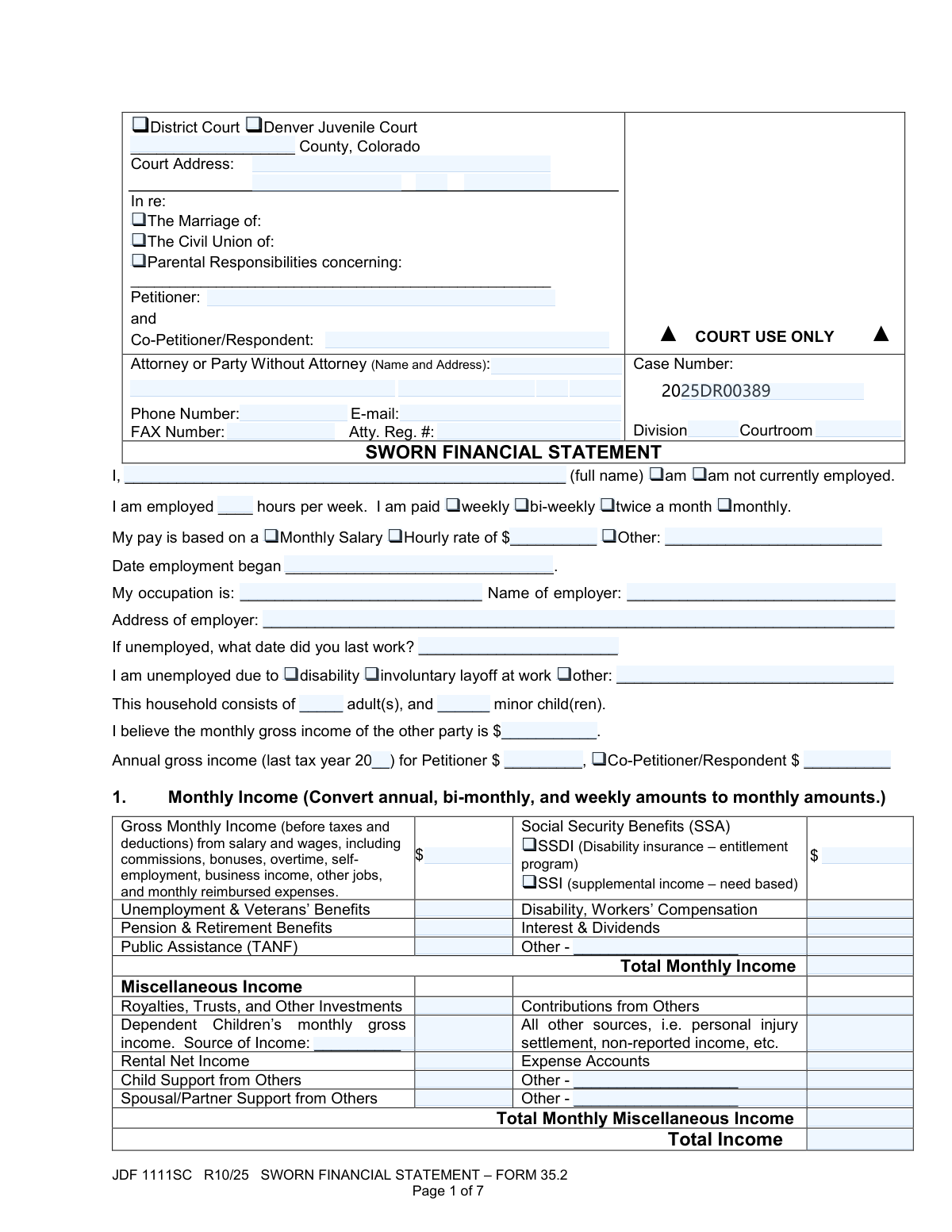
People going through divorce, civil union dissolution, or disputes over parental responsibilities and child support are among the most common users of these forms. A key example is the Sworn Financial Statement (JDF 1111SC), which requires a thorough accounting of income, expenses, debts, and assets — all signed under penalty of perjury. Whether you're working with an attorney or navigating the process on your own, accuracy and completeness are critical, since courts and opposing parties rely on this information to make significant decisions.
Because many of these forms involve detailed, structured data entry, tools like Instafill.ai use AI to help fill them out accurately in under 30 seconds — a practical option for anyone who wants to reduce errors and save time when dealing with an already stressful legal process.
Every form on this page can be completed without typing. Instafill is form filling software that reads a PDF and fills it for you — including flat and scanned documents that carry no fillable fields at all.
Forms in This Category
The forms in this category have a median Form Complexity Index of 74/100 (Complex), measured across 1 forms by field count, input difficulty, length, conditional logic and structure. See how it is calculated.
| Form Name | Pages | FCI | |
|---|---|---|---|
| 1. | Colorado Judicial Department Form JDF 1111SC (Form 35.2), Sworn Financial Statement | 7 | Complex 74 |
- Enterprise-grade security & data encryption
- 99%+ accuracy powered by AI
- 1,000+ forms from all industries
- Complete forms in under 60 seconds
How to Choose the Right Form
With only one form in this category, the decision is straightforward — but knowing *when* and *why* you need it is just as important.
Who Needs the Colorado Sworn Financial Statement (JDF 1111SC / Form 35.2)?
This form is required in Colorado District Court proceedings that involve financial decisions between parties. You'll need it if you are:
- Going through a divorce or civil union dissolution — both parties typically must file this form so the court can assess spousal maintenance and divide marital assets fairly
- Involved in a parental responsibilities or child support case — the court uses your financial data to calculate appropriate support amounts
- Responding to a motion to modify support or maintenance — if circumstances have changed, an updated JDF 1111SC may be required before new orders are entered
What the Form Covers
Before you start, know that JDF 1111SC is comprehensive. You'll need to gather:
- Income details — monthly gross income, pay stubs, and all income sources
- Payroll deductions — taxes, insurance, retirement contributions
- Monthly living expenses — housing, utilities, transportation, childcare, etc.
- Unsecured debts — credit cards, personal loans, medical bills
- Full asset inventory — real estate, vehicles, bank accounts, retirement accounts, and more
Important Reminders
- This form is signed under penalty of perjury, so accuracy is critical — errors or omissions can have serious legal consequences
- You may need to refile an updated version if your financial situation changes before the court issues final orders
- If you received a non-fillable PDF version, tools like Instafill.ai can convert it into an interactive form and use AI to help you complete it accurately
If you're unsure whether this form applies to your specific case, consult a Colorado family law attorney before filing.
Form Comparison
| Form | Purpose | Who Files It | When to Use |
|---|---|---|---|
| Colorado Judicial Department Form JDF 1111SC (Form 35.2), Sworn Financial Statement | Disclose income, expenses, debts, and assets under oath | Either spouse or party in family law proceedings | Divorce, civil union dissolution, or child support cases |
Tips for Colorado judicial forms
Before starting the Sworn Financial Statement, collect recent pay stubs, bank statements, tax returns, mortgage or lease agreements, and debt statements. Having these on hand prevents guesswork and ensures the figures you swear to are accurate and verifiable.
The JDF 1111SC asks for monthly income and expense amounts, not annual totals. If you are paid bi-weekly or receive irregular income, take time to calculate a true monthly average rather than simply dividing an annual salary by 12, as different pay schedules can skew the numbers.
Colorado courts expect every section of the Sworn Financial Statement to be addressed. If a category does not apply to you, enter '0' rather than leaving it empty, so it is clear you considered the item and it is not an oversight that could raise questions or delay your case.
Because the JDF 1111SC is a sworn document, inaccuracies — even unintentional ones — can have serious legal consequences. Double-check every figure against your source documents before signing, and disclose all assets and income sources, including side income, rental income, or investment returns.
If your income, expenses, or assets change significantly after you file the Sworn Financial Statement but before final orders are entered, you may need to file an updated version. Failing to reflect material changes can undermine your credibility with the court and affect support or property division outcomes.
AI-powered tools like Instafill.ai can fill out Colorado judicial forms such as the JDF 1111SC quickly and accurately, saving significant time — especially when you are managing multiple court filings at once. Your data stays secure throughout the process, making it a practical and trustworthy option for time-pressed filers.
Always save a copy of your completed Sworn Financial Statement along with the supporting documents you used to calculate each figure. Courts may request documentation to verify your disclosures, and having an organized file makes it easy to respond quickly or prepare updates if needed.
The JDF 1111SC distinguishes between gross income and net income after specific deductions, so read each line carefully before entering a number. Mixing up gross and net figures is one of the most common mistakes on financial disclosure forms and can significantly misrepresent your financial picture to the court.
Frequently Asked Questions
Colorado judicial forms are official documents issued by the Colorado Judicial Department for use in state courts. They cover a wide range of legal matters, including divorce, civil union dissolution, child support, parental responsibilities, and other family law proceedings. Using the correct, up-to-date form is essential for your case to be processed properly by the court.
Any party involved in a Colorado divorce, civil union dissolution, or case involving child support or parental responsibilities is typically required to file a Sworn Financial Statement. Both parties are generally expected to submit the form so the court has a complete picture of each person's financial situation. It is used by the court to make fair decisions about support, maintenance, and the division of assets.
The Sworn Financial Statement (JDF 1111SC / Form 35.2) captures detailed financial information including monthly income, payroll deductions, living expenses, unsecured debts, and a full inventory of assets and liabilities. Because the form is signed under penalty of perjury, all information must be accurate and complete. Incomplete or inaccurate submissions can negatively impact your case.
Colorado judicial forms are generally filed with the Colorado District Court handling your case, or the appropriate jurisdiction depending on your matter. You should check with your specific court clerk's office for filing instructions, accepted formats, and any local requirements. Some courts may also accept electronic filings through the Colorado Courts E-Filing system.
While hiring an attorney is always an option, many individuals in Colorado choose to represent themselves (pro se) and complete judicial forms on their own. The Colorado Judicial Department provides official forms to help self-represented litigants navigate the process. However, for complex financial situations or contested matters, consulting a family law attorney is advisable.
Yes — AI-powered tools like Instafill.ai can fill out Colorado judicial forms such as the Sworn Financial Statement (JDF 1111SC) in under 30 seconds by accurately extracting and placing data from your source documents. This significantly reduces the time and effort required compared to filling out forms manually. Instafill.ai can also convert non-fillable PDF versions of these forms into interactive, fillable formats.
Manually completing the Sworn Financial Statement can take considerable time because it requires gathering detailed financial data across income, expenses, debts, and assets. Using AI-powered services like Instafill.ai, the form can be filled out in under 30 seconds by automatically extracting relevant information from your documents. This helps reduce errors and ensures all required fields are addressed.
Because the Sworn Financial Statement is filed under penalty of perjury, you may be required to update and refile the form if your financial circumstances change significantly before the court enters final orders. It is important to keep the information current and accurate throughout your proceedings. Consult your attorney or the court clerk if you are unsure whether an update is necessary.
Some Colorado judicial forms, like the Sworn Financial Statement (JDF 1111SC), are used across multiple types of family law matters including divorce, civil union dissolution, and child support or parental responsibility cases. However, different proceedings may require additional or different forms depending on the specific issues involved. Always verify which forms are required for your particular case type with the court or a legal professional.
Court filings in Colorado, including financial statements, are generally part of the public court record unless the court orders them sealed. If privacy is a concern, you may wish to consult an attorney about whether any protections are available in your case. Be aware that the information you disclose is reviewed by the other party, their counsel, and the court.
Official Colorado judicial forms are available on the Colorado Judicial Department's website (coloradojudicial.gov), where they are organized by case type and form number. You can also obtain forms directly from your local courthouse. Make sure you are using the most current version of any form, as outdated versions may be rejected by the court.
Glossary
- Form Complexity Index
- Instafill’s 0–100 measure of how much effort a form takes to complete, calculated deterministically from the form’s own structure rather than estimated. It combines the number of fillable fields (the largest factor), how difficult those fields are to complete based on their type, the number of pages that contain fields, the amount of conditional “fill-only-if” logic, and how many sections the form is divided into, then adds modifiers for tables and repeating lists, bundled instruction pages, and dense page layouts. A higher score means the form is harder to fill out by hand. The forms in this category have a median Form Complexity Index of 74/100 (Complex). See exactly how it is calculated.
- JDF (Judicial Department Form)
- The prefix used by the Colorado Judicial Department to identify official court forms. JDF numbers, such as JDF 1111SC, help users locate the correct standardized form required for specific legal proceedings.
- Sworn Financial Statement
- A court-required document in which a party discloses their complete financial picture—income, expenses, debts, and assets—under oath. Providing false information on a sworn statement can result in perjury charges.
- Penalty of Perjury
- A legal declaration that the information provided in a document is true and accurate to the best of the signer's knowledge. Knowingly providing false information on such a document is a criminal offense.
- Maintenance (Spousal Maintenance)
- Financial support paid by one spouse to the other after separation or divorce, sometimes called alimony. Colorado courts use financial disclosures to determine whether maintenance is appropriate and in what amount.
- Equitable Division
- Colorado's legal standard for dividing marital property in a divorce, meaning assets and debts are divided fairly but not necessarily equally. The court uses each party's financial statement to assess what a fair division looks like.
- Parental Responsibilities
- The Colorado legal term covering both decision-making authority and physical care (parenting time) for a child after separation or divorce. Financial disclosures are often required in cases involving parental responsibilities to calculate child support.
- Civil Union Dissolution
- The legal process of ending a civil union in Colorado, which follows procedures similar to divorce. Parties in a civil union dissolution are typically required to file the same financial disclosure forms as divorcing spouses.
- Unsecured Debt
- Debt not backed by collateral, such as credit card balances, medical bills, or personal loans. Courts review unsecured debts listed on financial statements when dividing marital obligations.
- Payroll Deductions
- Amounts withheld from a paycheck before the employee receives it, including taxes, health insurance premiums, and retirement contributions. These are reported separately on the financial statement because they affect the amount of income actually available to a party.
- Final Orders
- The court's conclusive rulings on all issues in a family law case, such as property division, support, and parenting arrangements. Financial statements must remain accurate and current until final orders are entered by the judge.