Fill out company registration forms
with AI.
Company registration forms are the official documents used to establish, update, and maintain a business's legal standing with the relevant government authority. In South Africa, these forms are primarily administered through the Companies and Intellectual Property Commission (CIPC) and cover everything from initial incorporation to amendments of a company's registered details. Whether you are starting a new business, restructuring an existing one, or updating official records, submitting the correct form accurately and on time is essential to staying compliant with the law.
By continuing, you acknowledge Instafill's Privacy Policy and agree to get occasional product update and promotional emails.
About company registration forms
These forms are commonly needed by business owners, company secretaries, attorneys, and accountants who manage corporate compliance on behalf of their clients. A typical example is Form CK2, used under the Close Corporations Act to record amendments to a close corporation's founding statement — such as a change in the corporation's name, membership details, or financial year-end. Getting these details right matters, as errors or omissions can result in rejected submissions or legal complications down the line.
Filling out corporate registration forms can be tedious, especially when dealing with dense legal language or non-fillable PDF versions. Tools like Instafill.ai use AI to complete these forms accurately in under 30 seconds, and can even convert static PDFs into interactive fillable documents — making the process significantly faster and less error-prone for individuals and professionals alike.
Every form on this page can be completed without typing. Instafill is form filling software that reads a PDF and fills it for you — including flat and scanned documents that carry no fillable fields at all.
Forms in This Category
The forms in this category have a median Form Complexity Index of 67/100 (Complex), measured across 1 forms by field count, input difficulty, length, conditional logic and structure. See how it is calculated.
| Form Name | Pages | FCI | |
|---|---|---|---|
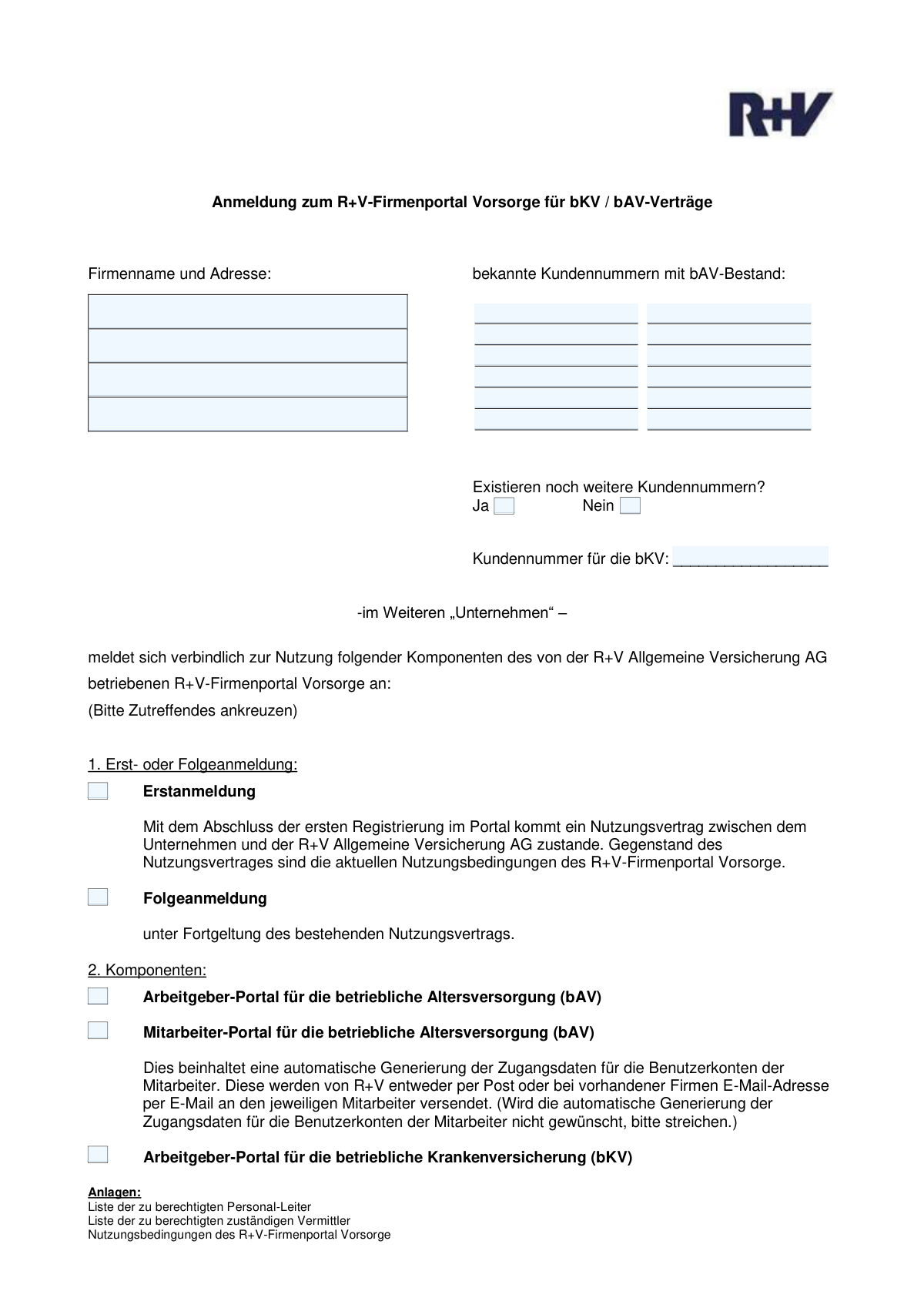
| 1. | Anmeldung zum R+V-Firmenportal Vorsorge (Registration for the R+V Company Portal for Pensions) | 4 | Complex 67 |
- Enterprise-grade security & data encryption
- 99%+ accuracy powered by AI
- 1,000+ forms from all industries
- Complete forms in under 60 seconds
How to Choose the Right Form
With only one form in this category, choosing is straightforward — but understanding when and why to use it is key to getting your submission right.
Updating an Existing Close Corporation
If your business is a close corporation (CC) registered under the Close Corporations Act, 1984, and you need to record any changes to its official details, Form CK2 (Amended Founding Statement) is the form you need.
Use Form CK2 when any of the following have changed:
- Corporation name or registered business description
- Financial year-end date
- Number of members or their percentage interests
- Aggregate member contributions
- Member details — including members joining or ceasing to be members (captured in Part B)
Who Should Use This Form?
- Close corporation owners or members who need to update CIPC records after an internal change
- Accountants or attorneys acting on behalf of a CC, provided they hold the relevant power of attorney
- Anyone whose CC's registered particulars no longer reflect the current, legally valid situation
Important Things to Know Before You Start
- This form is not for new registrations — it only amends an already-registered close corporation's founding statement
- Certain Part A changes attract a filing fee payable to CIPC
- All signatures must confirm correctness; incomplete or non-compliant submissions may be rejected
- The form references specific sections (13, 15, 24, 29, 47, and 60) and regulations (2 and 16) of the Act — make sure the changes you're recording fall under the correct section
Filling It Out
Form CK2 can be complex, especially if the original PDF is non-fillable. Tools like Instafill.ai can convert it into an interactive form and use AI to help you complete it accurately, reducing the risk of rejection by CIPC.
Form Comparison
| Form | Purpose | Who Files It | When to Use |
|---|---|---|---|
| Form CK2 (Close Corporations Act, 1984) — Amended Founding Statement | Register changes to a close corporation's official particulars | Members or authorized representatives of a close corporation | When amending name, members, contributions, or other registered details |
Tips for company registration forms
Form CK2 is divided into Part A (corporation-level details like name, business description, and financial year-end) and Part B (member details). Only complete the sections relevant to the specific changes you are registering — leaving irrelevant sections blank helps avoid confusion and potential rejection by CIPC.
Certain Part A amendments, such as a change of corporation name, attract a prescribed fee at the time of submission. Confirm the current CIPC fee schedule before lodging your form to avoid delays caused by incorrect or missing payments.
Every member affected by the amendment must sign the form, or a valid power of attorney must accompany the submission on their behalf. Missing signatures are one of the most common reasons CIPC rejects amended founding statements, so verify this before submitting.
AI-powered tools like Instafill.ai can complete Form CK2 quickly and accurately, even converting non-fillable PDF versions into interactive forms you can edit online. Your data stays secure throughout the process, making it a practical time-saver whether you're handling one amendment or several.
After lodging your amended founding statement, retain a certified copy alongside CIPC's acknowledgement of receipt. This paper trail is essential if disputes arise about when a change was officially registered or if a resubmission is ever required.
Before completing the form, obtain a current copy of your close corporation's registered particulars from CIPC to confirm exactly what is on record. Amendments that contradict or duplicate existing registered information are likely to be queried or rejected.
When a member is leaving the close corporation, Part B must clearly capture their details and the date they ceased to be a member. Incomplete or ambiguous cessation information can create legal and administrative complications for the corporation going forward.
Changes to a close corporation's particulars only become legally effective once registered by CIPC, not when the members agree to them internally. Avoid operating under unregistered changes by lodging your CK2 as soon as members have signed off on the amendment.
Frequently Asked Questions
Company registration forms are official documents used to register, update, or amend a business's legal particulars with the relevant government authority. In South Africa, forms like the CIPC's Form CK2 are used to record changes to a close corporation's registered information, ensuring the public record remains accurate and legally valid.
Form CK2, known as the Amended Founding Statement, is prescribed under the Close Corporations Act, 1984, and must be filed by close corporations (CCs) in South Africa whenever certain registered particulars change. This includes changes to the corporation's name, business description, financial year-end, number of members, or member contributions.
A close corporation should file Form CK2 whenever there is a change to its registered particulars, such as a change in membership, the corporation's name, or its principal business activities. Filing promptly ensures the official record held by the CIPC (Companies and Intellectual Property Commission) remains current and legally compliant.
In South Africa, forms such as Form CK2 are submitted to the Companies and Intellectual Property Commission (CIPC), which is the official body responsible for registering and maintaining records of close corporations and companies. Submissions can typically be made online through the CIPC's e-services portal or in person at a CIPC office.
Some amendments to a close corporation's registered particulars attract a filing fee payable to the CIPC, while others may not. For example, certain Part A changes on Form CK2 require a fee. It is advisable to check the current CIPC fee schedule before submitting, as fees can change over time.
Form CK2 requires details about the close corporation itself (such as its registered name and registration number) as well as the specific changes being made, which are divided into Part A (corporation-level changes) and Part B (member details). Signatures from the relevant members or authorized representatives are also required, and in some cases a power of attorney may be needed.
Failing to update a close corporation's registered particulars can result in the official public record being inaccurate, which may cause legal and administrative complications. Non-compliant or incomplete submissions may also be rejected by the CIPC, potentially delaying important business transactions or legal processes.
Yes, AI-powered tools like Instafill.ai can fill out forms such as Form CK2 in under 30 seconds by accurately extracting and placing data from your source documents. Instafill.ai can also convert non-fillable PDF versions of these forms into interactive, fillable formats, making the process faster and reducing the risk of errors.
Manually completing forms like Form CK2 can take anywhere from several minutes to over an hour, depending on the complexity of the changes and the information on hand. Using AI-powered services like Instafill.ai, the same forms can be completed in under 30 seconds, with data accurately extracted and populated from your existing documents.
The signing requirements for Form CK2 depend on the nature of the changes being recorded. Generally, the relevant members or their authorized representatives must sign to confirm the correctness of the information, and a power of attorney may be required where a representative is signing on behalf of a member. Always refer to the current CIPC guidelines to confirm the exact requirements for your specific amendment.
Currently, this category features Form CK2 (Amended Founding Statement) under the Close Corporations Act, 1984. This form specifically covers amendments to an existing close corporation's registered particulars, so businesses looking to register a new entity or handle other corporate changes may need to consult the CIPC for the appropriate additional forms.
Glossary
- Form Complexity Index
- Instafill’s 0–100 measure of how much effort a form takes to complete, calculated deterministically from the form’s own structure rather than estimated. It combines the number of fillable fields (the largest factor), how difficult those fields are to complete based on their type, the number of pages that contain fields, the amount of conditional “fill-only-if” logic, and how many sections the form is divided into, then adds modifiers for tables and repeating lists, bundled instruction pages, and dense page layouts. A higher score means the form is harder to fill out by hand. The forms in this category have a median Form Complexity Index of 67/100 (Complex). See exactly how it is calculated.
- Close Corporation (CC)
- A simplified business entity in South Africa, governed by the Close Corporations Act of 1984, designed for small businesses with a maximum of 10 members who hold membership interests rather than shares.
- CIPC
- The Companies and Intellectual Property Commission — the South African government body responsible for registering companies, close corporations, and intellectual property rights, and maintaining their official records.
- Founding Statement
- The foundational registration document of a close corporation that records its core details, such as its name, principal business, registered office, members, and their contributions; equivalent to a company's memorandum of incorporation.
- Amended Founding Statement
- A formal update to a close corporation's original Founding Statement, filed with CIPC whenever key registered particulars (such as the corporation's name, members, or financial year-end) change.
- Membership Interest
- The percentage of ownership that a member holds in a close corporation, expressed as a number out of 100; it determines voting rights and profit share, similar to shares in a company.
- Aggregate Members' Contribution
- The total monetary value of all contributions made by members to a close corporation, which must be recorded in the Founding Statement and updated when members join, leave, or alter their contributions.
- Registered Office
- The official physical address of a close corporation as recorded with CIPC, to which all legal notices and official correspondence are sent; this address must always be kept current.
- Power of Attorney (POA)
- A signed legal document authorising a representative (such as an accountant or attorney) to act on behalf of a close corporation member when submitting or signing registration documents.
- Financial Year-End
- The date on which a close corporation's annual accounting period closes, as registered with CIPC; changes to this date must be formally recorded on the Amended Founding Statement.
- Close Corporations Act, 1984
- South African legislation (Act 69 of 1984) that governs the formation, registration, operation, and dissolution of close corporations, prescribing the official forms and procedures used for all CC-related filings.