Fill out custodial account forms
with AI.
Custodial account forms are essential legal and financial documents used to manage assets on behalf of a minor. These accounts, often established under the Uniform Gifts to Minors Act (UGMA) or the Uniform Transfers to Minors Act (UTMA), allow adults to hold and protect investments—such as stocks, bonds, or cash—until the beneficiary reaches the legal age of majority. Managing these forms correctly is crucial for ensuring that the transition of ownership is legally sound and that the specific tax advantages associated with custodial accounts are preserved for the minor's benefit.
By continuing, you acknowledge Instafill's Privacy Policy and agree to get occasional product update and promotional emails.
About custodial account forms
These forms are typically required by parents, grandparents, or legal guardians who wish to provide a financial head start for a child without the administrative burden of setting up a formal trust. You might encounter these documents when opening a new savings vehicle, transferring existing assets, or requesting a change of account registration, such as converting a standard brokerage account into a custodial one. Because these documents often require precise personal and financial data for both the adult custodian and the minor, accuracy is paramount to avoid processing delays with financial institutions like Fidelity or other brokerage firms.
To simplify this process, tools like Instafill.ai use AI to complete these custodial forms in under 30 seconds, handling your data accurately and securely. This technology eliminates the tedious work of manual data entry, allowing you to finalize important financial transitions quickly and without the usual paperwork headaches.
Every form on this page can be completed without typing. Instafill is form filling software that reads a PDF and fills it for you — including flat and scanned documents that carry no fillable fields at all.
Forms in This Category
The forms in this category have a median Form Complexity Index of 48/100 (Moderate), measured across 6 forms by field count, input difficulty, length, conditional logic and structure. See how it is calculated.
| Form Name | Pages | FCI | |
|---|---|---|---|
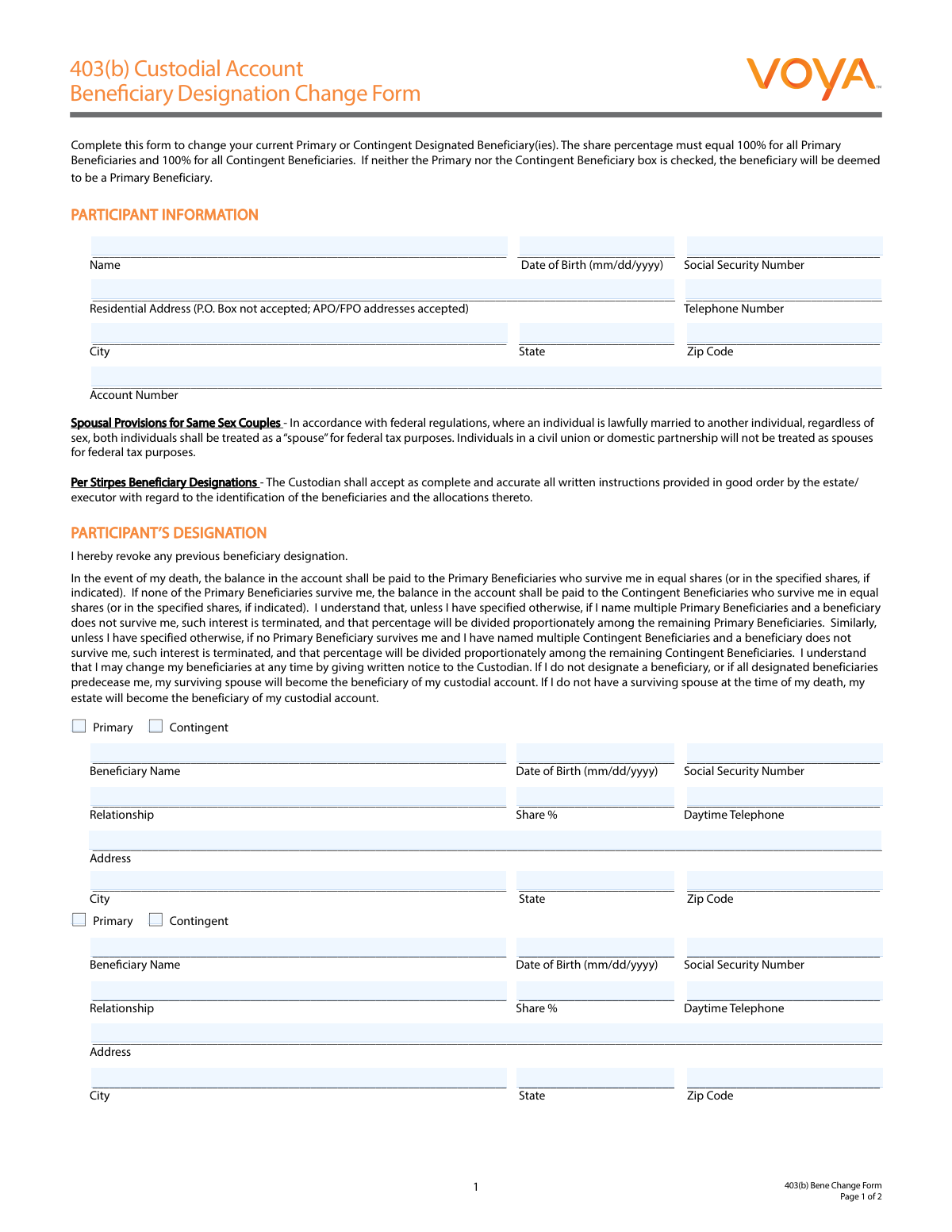
| 1. | 403(b) Custodial Account Beneficiary Designation Change Form | 1 | Basic 40 |
| 2. | Custodial Account – Transfer of Ownership Form | 1 | Basic 30 |
| 3. | Fidelity Change of Account Registration: Changing to an Individual, Joint, or Custodial Brokerage Account | 1 | Moderate 59 |
| 4. | Fidelity Investments 403(b) Custodial Account Application | 1 | Moderate 48 |
| 5. | Fidelity Roth Individual Retirement Account Custodial Agreement and Disclosure Statement | 1 | – |
| 6. | Qualified Retirement Plan and 403(b)(7) Custodial Account Distribution Request Form | 1 | Moderate 59 |
- Enterprise-grade security & data encryption
- 99%+ accuracy powered by AI
- 1,000+ forms from all industries
- Complete forms in under 60 seconds
How to Choose the Right Form
Choosing the right custodial account form depends primarily on whether you are opening a brand-new account or modifying an existing one. In this category, the focus is on transitioning or updating current Fidelity brokerage accounts to meet the needs of minors or multiple owners.
Transitioning to a Custodial Account
If you already hold a Fidelity non-retirement brokerage account and need to transition it to a minor's benefit, the Fidelity Change of Account Registration: Changing to an Individual, Joint, or Custodial Brokerage Account is the primary document you need. This form is specifically designed for:
- Setting up UGMA/UTMA Accounts: Use this form when you want to convert a standard account into a Uniform Gifts to Minors Act (UGMA) or Uniform Transfers to Minors Act (UTMA) account.
- Adding or Removing Owners: If you need to change the legal ownership structure of an existing brokerage account, this form facilitates those updates.
Identifying Your Use Case
Before selecting this form, ensure your situation matches one of these specific scenarios:
- Custodial Ownership: You are a legal guardian or parent managing assets for a minor and want the account registered in their name under your custodianship.
- Registration Updates: You are moving from a single owner (Individual) to a shared ownership (Joint) or vice versa, alongside custodial changes.
Requirements for Completion
To successfully process the Fidelity Change of Account Registration, you will need to provide detailed information to ensure the IRS and financial regulators recognize the new ownership status. This includes:
- Full personal details and Social Security numbers for all current and new account owners.
- Specific supporting documentation (such as birth certificates or legal guardianship papers) depending on the nature of the change.
- Precise designations for the minor’s information if selecting the UGMA/UTMA path.
Using Instafill.ai allows you to navigate these complex registration changes efficiently. Our AI-powered tools help you turn the standard PDF into a fillable format, ensuring that all required fields for 'Custodial' registration are completed correctly to avoid processing delays with Fidelity.
Form Comparison
| Form | Primary Purpose | Supported Account Types | Key Requirements |
|---|---|---|---|
| Fidelity Change of Account Registration: Changing to an Individual, Joint, or Custodial Brokerage Account | Modify ownership structure or convert non-retirement brokerage accounts to new registration types. | Individual, Joint, and Custodial (UGMA/UTMA) brokerage account registrations. | Detailed information for all owners and supporting documentation based on the change. |
Tips for custodial account forms
Custodial account changes often require specific proof of identity or age for the minor, such as a birth certificate or Social Security number. Having these digital copies ready before you start filling out the form will prevent delays during the submission process.
Before selecting a custodial registration, check which standard applies to your state as it affects what assets can be held and when the minor gains control. Choosing the wrong type can lead to administrative errors that require a completely new form submission.
Changing an account registration usually requires signatures from both the current account owners and the new custodians or owners. Ensure everyone is available to sign to avoid the form being rejected for incomplete authorization.
AI-powered tools like Instafill.ai can complete custodial account forms in under 30 seconds with high accuracy by extracting data from your existing documents. This process ensures your sensitive financial data stays secure while significantly reducing the time spent on manual data entry.
Errors in Social Security Numbers or Taxpayer Identification Numbers are a common reason for registration delays. Verify these digits against official documents for every person listed on the form to ensure the brokerage can process the change correctly.
When setting up or changing a custodial account, it is often wise to name a successor custodian who can manage the assets if the primary custodian is unable to do so. This ensures the account remains managed for the minor's benefit without requiring additional legal paperwork later.
Ensure that the addresses provided for the new owners or custodians match the records already on file with the financial institution. Any discrepancies in contact information can trigger additional security verification steps that slow down the registration process.
Frequently Asked Questions
Custodial account forms are used to establish or modify financial accounts managed by an adult for the benefit of a minor. These forms ensure that assets are legally held under the Uniform Gifts to Minors Act (UGMA) or Uniform Transfers to Minors Act (UTMA) until the beneficiary reaches legal age.
This form is necessary when you want to convert an existing individual or joint brokerage account into a custodial account, or vice versa. It is also used when you need to add or remove owners or change the designated custodian for a minor's assets.
UGMA accounts are typically limited to bank deposits, stocks, bonds, and mutual funds, while UTMA accounts can hold a wider variety of assets, including real estate and fine art. The choice between them often depends on the specific state laws governing the account and the types of assets being transferred.
Yes, AI tools like Instafill.ai can be used to fill out custodial account forms in under 30 seconds. The AI accurately extracts necessary data from your source documents and places it into the correct fields, reducing the risk of manual entry errors.
Generally, all current account owners must sign the form to authorize the change in registration. If you are moving assets from a joint account to a custodial account, both joint owners must usually provide their consent and signatures to complete the transfer.
While manual completion can take significant time due to the detailed personal and financial information required, using an AI-powered service can complete the process in less than 30 seconds. This technology automates the data mapping from your identification or existing account statements directly into the form.
Common requirements include the Social Security numbers and dates of birth for both the custodian and the minor beneficiary. Depending on the institution, you may also need to provide legal identification or specific court documents if the change involves a legal guardianship.
Once the minor reaches the legal age of majority—which is usually 18 or 21 depending on the state—the custodian is legally required to transfer control of the account to the beneficiary. The beneficiary then becomes the sole owner of the assets and can manage the account independently.
Yes, income generated in a custodial account is generally taxable. While a portion of the income may be taxed at the child's lower tax rate, amounts exceeding certain thresholds may be subject to the 'kiddie tax' rules, where they are taxed at the parents' marginal tax rate.
Financial institutions often require a Medallion Signature Guarantee if you are transferring a high value of assets or removing an existing owner from an account. This is a specific type of certification that protects against fraud and is different from a standard notary public seal.
Changing a custodial account back to a joint or individual account for the adult is generally restricted because gifts made to a custodial account are irrevocable. Once assets are placed in a UGMA or UTMA account, they legally belong to the minor and can only be used for their benefit.
Completed forms should be submitted directly to the brokerage firm or financial institution holding the account, such as Fidelity. Most institutions provide a secure online portal for document uploads, though some may require physical copies to be sent via mail if original signatures are mandated.
Glossary
- Form Complexity Index
- Instafill’s 0–100 measure of how much effort a form takes to complete, calculated deterministically from the form’s own structure rather than estimated. It combines the number of fillable fields (the largest factor), how difficult those fields are to complete based on their type, the number of pages that contain fields, the amount of conditional “fill-only-if” logic, and how many sections the form is divided into, then adds modifiers for tables and repeating lists, bundled instruction pages, and dense page layouts. A higher score means the form is harder to fill out by hand. The forms in this category have a median Form Complexity Index of 48/100 (Moderate). See exactly how it is calculated.
- Custodian
- The adult responsible for managing the assets in a custodial account on behalf of a minor until they reach the legal age of majority.
- Account Registration
- The legal title or ownership structure of a financial account, which determines who has authority over the assets and how they are taxed.
- UGMA (Uniform Gifts to Minors Act)
- A state law that allows an adult to manage financial gifts for a minor, typically restricted to cash, stocks, and insurance policies.
- UTMA (Uniform Transfers to Minors Act)
- An extension of UGMA that allows for a wider range of assets, including real estate and physical property, to be held in a custodial account for a minor.
- Age of Majority
- The legal age, usually 18 or 21 depending on the state, at which the minor gains full control of the custodial account and the custodian's authority ends.
- Successor Custodian
- A person designated to take over the management of a custodial account if the primary custodian becomes unable to serve due to death or resignation.
- Medallion Signature Guarantee
- A certification stamp used by financial institutions to verify that a signature authorizing a transfer of securities is genuine and legally binding.
- Joint Tenancy with Right of Survivorship (JTWROS)
- A type of account ownership where two or more people own the assets equally, and if one owner dies, their share passes automatically to the surviving owner.