Fill out equipment authorization forms
with AI.
Equipment authorization forms are official documents required to obtain approval before certain types of equipment can be developed, procured, or operated — particularly when that equipment interacts with regulated systems, frequencies, or government infrastructure. These forms ensure that proposed equipment meets established technical, safety, and compatibility standards before resources are committed or operations begin. A prominent example in this category is DD Form 1494, the Application for Equipment Frequency Allocation, which the Department of Defense requires before any funds can be obligated for equipment that emits radio frequency energy. It's a detailed, multi-section form reviewed across all stages of a program's lifecycle, from conceptual development through full operation.
By continuing, you acknowledge Instafill's Privacy Policy and agree to get occasional product update and promotional emails.
About equipment authorization forms
These forms are typically needed by defense contractors, military program managers, federal agency personnel, and engineers working on systems that involve radio frequency emissions or other regulated equipment. Whether you're in the early planning stages of a new communications system or preparing for operational deployment, completing the correct authorization form accurately — and on time — is essential to keeping projects compliant and on schedule.
Given the technical complexity and length of many equipment authorization forms, tools like Instafill.ai use AI to fill them out in under 30 seconds, handling the data accurately and securely so you can focus on the work that matters.
Every form on this page can be completed without typing. Instafill is form filling software that reads a PDF and fills it for you — including flat and scanned documents that carry no fillable fields at all.
Forms in This Category
The forms in this category have a median Form Complexity Index of 54/100 (Moderate), measured across 1 forms by field count, input difficulty, length, conditional logic and structure. See how it is calculated.
| Form Name | Pages | FCI | |
|---|---|---|---|
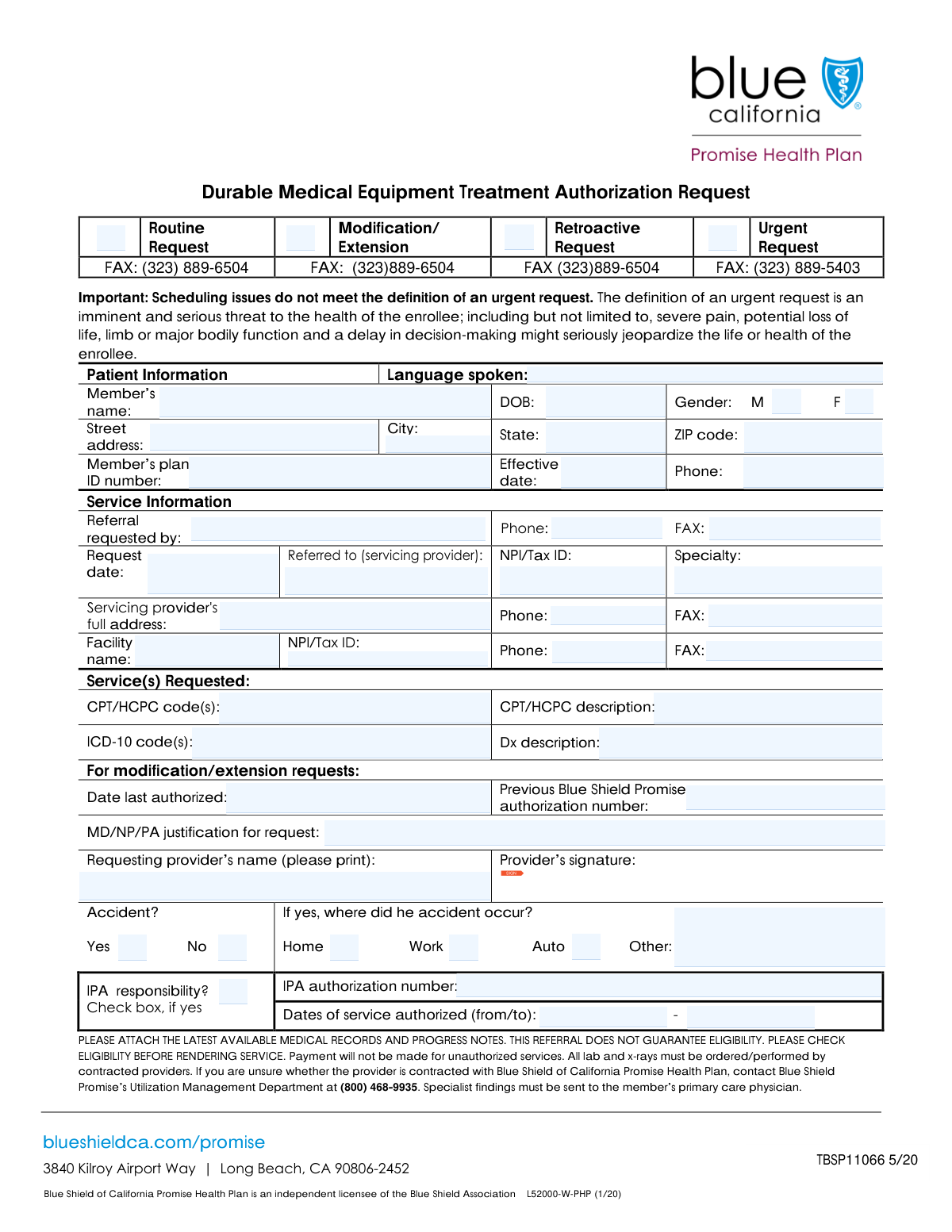
| 1. | Blue Shield Promise Durable Medical Equipment (DME) Treatment Authorization Request Form | 1 | Moderate 54 |
- Enterprise-grade security & data encryption
- 99%+ accuracy powered by AI
- 1,000+ forms from all industries
- Complete forms in under 60 seconds
How to Choose the Right Form
If you've landed on this page, you're likely looking for help with radio frequency (RF) equipment authorization in a Department of Defense context. Here's what you need to know to confirm you're in the right place.
The Only Form in This Category
DD Form 1494, Application for Equipment Frequency Allocation is the standard DoD form for obtaining spectrum authorization before funds are committed to developing or procuring RF-emitting equipment.
You need this form if you are:
- A DoD program manager or contractor preparing to develop or procure equipment that transmits, receives, or emits radio frequency energy
- Seeking review by DoD or NTIA (National Telecommunications and Information Administration) for electromagnetic compatibility (EMC)
- Working through any of the four authorization stages — conceptual, developmental, experimental, or operational
What the form covers:
- General program and system information
- Technical characteristics of transmitters, receivers, and antennas
- Electromagnetic compatibility data for national and international standards review
Is This the Right Form for You?
- ✅ Yes — if your equipment emits RF energy and DoD funding or procurement is involved at any stage
- ❌ No — if you're seeking commercial FCC equipment authorization (you'd need FCC forms instead) or if your equipment does not emit RF energy
Tips Before You Start
DD Form 1494 is a complex, multi-section document. Gather your equipment's full technical specifications — including frequency ranges, power output, and antenna details — before beginning. Using an AI-powered tool like Instafill.ai can help you complete the form accurately and convert non-fillable PDF versions into interactive formats, reducing errors and saving time.
Form Comparison
| Form | Purpose | Who Files It | When to Use |
|---|---|---|---|
| DD Form 1494, Application for Equipment Frequency Allocation | Request radio frequency spectrum allocation for RF-emitting equipment | DoD program managers and equipment developers | Before obligating funds for RF equipment development or procurement |
Tips for equipment authorization forms
Before filling out an equipment frequency allocation form, gather all transmitter, receiver, and antenna technical specifications in advance. Missing or incomplete technical data is one of the most common reasons these applications are delayed or returned for correction.
DD Form 1494 covers four stages — from conceptual through operational — and the stage you select affects which sections must be completed. Submitting under the wrong stage can invalidate your application, so confirm your program's current development phase before filling anything out.
Electromagnetic compatibility (EMC) information is a critical part of the review process for both DoD and NTIA evaluators. Be specific and thorough when describing how your equipment avoids interference with existing spectrum users — vague responses are a frequent cause of application rejections.
AI-powered tools like Instafill.ai can complete highly technical forms like the DD Form 1494 in under 30 seconds with high accuracy, even converting non-fillable PDF versions into interactive forms. Your data stays secure throughout the process, making it a practical time-saver when managing multi-stage frequency allocation applications.
Because frequency allocation applications may be updated across multiple development stages, maintaining organized records of each previously submitted version is essential. This allows you to track changes, respond to reviewer questions, and ensure consistency across resubmissions.
These forms require coordination with your organization's spectrum manager before funds can be obligated for RF-emitting equipment. Looping them in early in the process can prevent costly procurement delays and ensure the application reflects current DoD and NTIA requirements.
Errors in reported frequency ranges, emission bandwidths, or power output values are among the most consequential mistakes on equipment authorization forms. Double-check all numeric entries against your equipment's official technical documentation before submitting.
Frequently Asked Questions
Equipment authorization forms are used to obtain official approval before developing, procuring, or operating equipment that emits radio frequency (RF) energy. In the Department of Defense context, these forms ensure that RF-emitting equipment is evaluated for electromagnetic compatibility (EMC) and does not interfere with existing spectrum users. They are required at multiple stages of a program's lifecycle, from conceptual design through full operational deployment.
This category currently features DD Form 1494, Application for Equipment Frequency Allocation, which is the primary DoD form for requesting spectrum use authorization for RF-emitting equipment. It covers transmitters, receivers, and antennas and is reviewed by both DoD and the National Telecommunications and Information Administration (NTIA).
Any DoD program office, contractor, or military branch that plans to develop, procure, or operate equipment that emits radio frequency energy must file DD Form 1494 before funds can be obligated. This applies to a wide range of equipment including radios, radars, jammers, and other RF-emitting systems used across all branches of the armed forces.
The application should be submitted as early as possible in the equipment development or procurement process — ideally at the conceptual stage — since spectrum authorization must be obtained before funds are obligated. DD Form 1494 is required at all four stages of a program: conceptual, developmental, experimental, and operational. Early submission helps avoid costly program delays.
Applicants generally need detailed technical specifications for their RF equipment, including transmitter power levels, frequency ranges, antenna characteristics, emission types, and receiver sensitivity data. General program information such as the purpose of the equipment, intended operational environment, and program timeline is also required. Having engineering documentation and system specifications on hand before starting the form is strongly recommended.
Completed DD Form 1494 applications are submitted through the appropriate DoD spectrum management office, which then coordinates review with the relevant military department and, when necessary, the National Telecommunications and Information Administration (NTIA) for national-level spectrum coordination. The specific submission path may vary depending on the branch of service and the stage of the program.
Electromagnetic compatibility refers to the ability of electronic equipment to operate in its intended environment without causing or experiencing harmful interference from other RF-emitting devices. DoD equipment authorization forms like DD Form 1494 require EMC evaluation to ensure that new systems will not disrupt existing military or civilian spectrum users. Failing to address EMC concerns can result in denial of spectrum authorization or costly redesigns.
Yes — AI-powered tools like Instafill.ai can fill out complex forms such as DD Form 1494 in under 30 seconds by accurately extracting and placing data from your source documents. This is especially useful for multi-section technical forms where manual entry is time-consuming and error-prone. Instafill.ai can also convert non-fillable PDF versions of these forms into interactive, fillable formats.
Manually completing a detailed multi-section form like DD Form 1494 can take hours, given the volume of technical data required. However, using AI-assisted tools like Instafill.ai, the form can be populated in under 30 seconds by automatically extracting relevant information from uploaded source documents. This significantly reduces the administrative burden on program managers and engineers.
Yes, DD Form 1494 must be filed at each of the four program stages: conceptual, developmental, experimental, and operational. Each stage may require updated or additional technical information as the equipment design matures. This staged review process ensures that spectrum authorization keeps pace with program development and that any EMC issues are identified and resolved early.
Obligating funds for RF-emitting equipment without first obtaining frequency allocation authorization is not permitted under DoD regulations. Doing so can result in program non-compliance, potential halting of procurement, and the need for costly retrofits or redesigns if the equipment is later found to cause interference. Submitting DD Form 1494 early in the program lifecycle helps avoid these risks.
Yes, DD Form 1494 and the associated review process consider not only domestic spectrum regulations but also international spectrum standards and agreements. DoD equipment intended for use in foreign countries or international waters must still comply with applicable international frequency coordination requirements, which are evaluated as part of the NTIA and DoD review process.
Glossary
- Form Complexity Index
- Instafill’s 0–100 measure of how much effort a form takes to complete, calculated deterministically from the form’s own structure rather than estimated. It combines the number of fillable fields (the largest factor), how difficult those fields are to complete based on their type, the number of pages that contain fields, the amount of conditional “fill-only-if” logic, and how many sections the form is divided into, then adds modifiers for tables and repeating lists, bundled instruction pages, and dense page layouts. A higher score means the form is harder to fill out by hand. The forms in this category have a median Form Complexity Index of 54/100 (Moderate). See exactly how it is calculated.
- Frequency Allocation
- The official assignment of a specific range of radio frequencies to a particular use or service, ensuring different systems do not interfere with one another. Government agencies like the NTIA and FCC manage frequency allocations in the United States.
- RF (Radio Frequency)
- Electromagnetic energy in the frequency range used for wireless communication and radar, typically from 3 kHz to 300 GHz. Any equipment that emits RF energy must be evaluated and authorized before procurement or development.
- EMC (Electromagnetic Compatibility)
- The ability of electronic equipment to operate in its intended environment without causing or suffering interference from other devices. DD Form 1494 is used to evaluate proposed equipment for EMC compliance before spectrum use is approved.
- NTIA (National Telecommunications and Information Administration)
- The U.S. federal agency within the Department of Commerce responsible for managing the federal government's use of the radio frequency spectrum. NTIA reviews DD Form 1494 submissions alongside DoD to authorize spectrum use.
- Spectrum Authorization
- Official approval granted to operate a device or system within a designated radio frequency band. Without spectrum authorization, funds cannot be obligated for the development or procurement of RF-emitting equipment.
- DoD (Department of Defense)
- The U.S. federal department overseeing the military, which requires DD Form 1494 to be submitted before any RF-emitting equipment can be funded, developed, or procured. DoD has its own spectrum management policies that must be satisfied alongside national standards.
- Transmitter
- A device that generates and emits radio frequency signals into the air or through a medium. DD Form 1494 requires detailed technical characteristics of transmitters, including power output, frequency, and modulation type.
- Conceptual Through Operational Stages
- The four lifecycle phases of RF equipment development covered by DD Form 1494, ranging from initial concept and design through testing, fielding, and full operational deployment. A separate submission or update may be required at each stage.
- Obligate Funds
- The formal commitment of government money to a specific contract or procurement action. DD Form 1494 must be approved before funds can be obligated for any equipment that emits radio frequency energy.