Fill out export forms
with AI.
Export forms are the backbone of international trade documentation, ensuring that goods move across borders legally, efficiently, and in compliance with U.S. and destination-country regulations. These forms capture critical shipment details — from commodity descriptions and harmonized tariff codes to consignee information and declared values — that customs authorities, freight forwarders, and carriers rely on to process and clear cargo. Getting them right matters: errors or omissions can lead to shipment delays, fines, or export compliance violations.
By continuing, you acknowledge Instafill's Privacy Policy and agree to get occasional product update and promotional emails.
About export forms
Anyone involved in sending goods internationally may encounter export paperwork, including small business owners shipping products abroad for the first time, logistics coordinators managing regular freight movements, and trade compliance teams handling high-volume exports. A foundational document in this category is the U.S. Shipper's Letter of Instruction (SLI), which consolidates the key details a freight forwarder needs to prepare export documentation and, where required, file Electronic Export Information (EEI) through the Automated Export System (AES).
Because export forms often require precise data entry across many fields, mistakes are common when filling them out manually under time pressure. Tools like Instafill.ai use AI to fill these forms accurately in under 30 seconds, helping exporters and logistics professionals move faster without sacrificing compliance or data security.
Every form on this page can be completed without typing. Instafill is form filling software that reads a PDF and fills it for you — including flat and scanned documents that carry no fillable fields at all.
Forms in This Category
The forms in this category have a median Form Complexity Index of 53/100 (Moderate), measured across 1 forms by field count, input difficulty, length, conditional logic and structure. See how it is calculated.
| Form Name | Pages | FCI | |
|---|---|---|---|
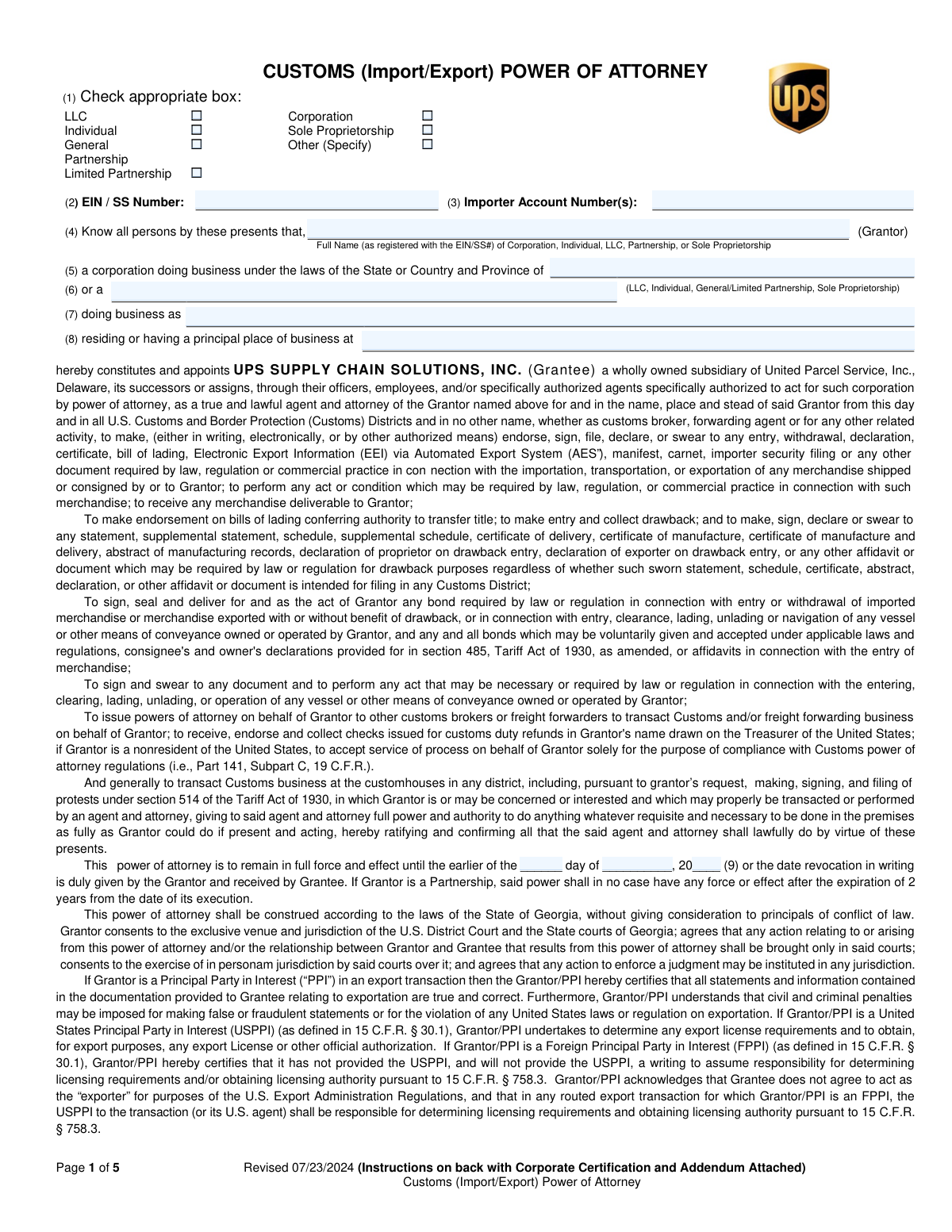
| 1. | Customs (Import/Export) Power of Attorney | 5 | Moderate 53 |
- Enterprise-grade security & data encryption
- 99%+ accuracy powered by AI
- 1,000+ forms from all industries
- Complete forms in under 60 seconds
How to Choose the Right Form
With only one form in this category, the decision is straightforward — but it's worth understanding when and why you need the U.S. Shipper's Letter of Instruction (SLI) and what it covers.
Who Needs the U.S. Shipper's Letter of Instruction?
The U.S. Shipper's Letter of Instruction (SLI) is the right form if you are:
- A U.S.-based exporter shipping goods internationally through a freight forwarder or agent
- A logistics coordinator who needs to communicate routing, handling, and compliance details to a third party
- A shipper whose goods require Electronic Export Information (EEI) filing in the Automated Export System (AES)
What the SLI Covers
The SLI is a multi-purpose document, so check whether your situation requires all or part of what it provides:
- Export documentation prep — Captures the data your forwarder needs to generate shipping and customs paperwork
- AES/EEI transmission — Authorizes and instructs your forwarder to file Electronic Export Information on your behalf
- Insurance & declared value — Includes optional fields to specify cargo insurance preferences and shipment value
- Power of attorney substitute — Can grant your forwarder limited authorization when a separate POA is not in place; also provides air cargo screening consent for air shipments
When You Might Need Additional Forms
The SLI does *not* replace all export documents. Depending on your shipment, you may also need:
- A Commercial Invoice or Packing List (separate documents)
- An Export License for controlled goods
- A Certificate of Origin for trade agreement purposes
If your shipment is straightforward international freight, the U.S. Shipper's Letter of Instruction is your starting point — fill it out completely and accurately to avoid customs delays and compliance issues.
Form Comparison
| Form | Purpose | Who Files It | When to Use |
|---|---|---|---|
| U.S. Shipper's Letter of Instruction (SLI) | Conveys export and shipping instructions to freight forwarder or agent | U.S. exporters and shippers sending international cargo | Before international shipment when preparing export documentation |
Tips for export forms
Errors in shipper, consignee, or notify party information are among the most common — and costly — mistakes on export forms like the SLI. Verify legal names, addresses, and contact details against source documents before filling anything in, as discrepancies can cause customs delays or compliance issues.
The Shipper's Letter of Instruction can serve as a limited power of attorney, authorizing your freight forwarder to act on your behalf and file Electronic Export Information (EEI) in AES. Make sure you understand exactly what permissions you are granting before signing, and confirm with your forwarder whether a separate power of attorney is also required.
Commodity classification codes (Schedule B or HTS) must be accurate for proper export documentation and AES filing. Using an incorrect code can trigger compliance violations — use the U.S. Census Bureau's Schedule B search tool or consult a trade compliance specialist if you are unsure of the correct classification.
The SLI includes fields for declared value and optional cargo insurance instructions — don't leave these blank or guess. Understand the difference between declared value for carriage (which affects carrier liability) and declared value for customs, and decide in advance whether you need additional cargo insurance coverage.
AI-powered tools like Instafill.ai can complete export forms such as the SLI in under 30 seconds with high accuracy, pulling in your shipment details and reducing the risk of manual entry errors. Your data stays secure throughout the process, making it a practical time-saver when you're coordinating multiple shipments or working against tight freight deadlines.
If you ship similar goods to the same destinations regularly, save a completed SLI as a reusable template. This reduces repetitive data entry, minimizes errors on routine shipments, and helps ensure consistency across your export documentation.
Not every shipment requires Electronic Export Information to be filed in AES, but many do — particularly for goods valued over $2,500 or items subject to export licenses. Review the current Foreign Trade Regulations to determine your filing obligation before completing the SLI, so your forwarder has the correct instructions from the start.
U.S. export regulations require that export records be kept for a specified period after the shipment date. File your completed SLI and any related documents (commercial invoice, packing list, AES filing confirmation) together in an organized system so they are easy to retrieve for audits or compliance reviews.
Frequently Asked Questions
Export forms are official documents used to communicate shipment details, comply with customs regulations, and ensure goods move legally across international borders. They capture information such as shipper and consignee details, commodity descriptions, and declared values that customs authorities and freight forwarders require to process your shipment.
A Shipper's Letter of Instruction (SLI) is a document provided by the exporter (shipper) to their freight forwarder or agent that outlines all the key details needed to prepare export documentation and arrange transportation. It serves as the primary instruction sheet for international shipments and can also authorize the forwarder to file Electronic Export Information (EEI) in the Automated Export System (AES) on the shipper's behalf.
Any U.S.-based exporter or shipper sending goods internationally through a freight forwarder or customs broker typically needs to complete an SLI. It is especially important when the forwarder is responsible for preparing export documentation or filing EEI with U.S. Customs and Border Protection.
The SLI should be completed and submitted to your freight forwarder well in advance of your shipment's departure — ideally as soon as your export details are confirmed. Submitting it early gives your forwarder enough time to prepare accurate export documentation and meet any regulatory filing deadlines.
Export forms generally require details such as the shipper's and consignee's contact information, a description of the goods being exported, Schedule B or Harmonized System (HS) commodity codes, shipment value, country of origin, and routing or carrier instructions. The SLI may also include insurance instructions and, when applicable, authorization for the forwarder to act on the shipper's behalf.
In some cases, yes — the SLI can include authorization language that grants the forwarder the right to prepare and file export documents on the shipper's behalf, effectively serving the same purpose as a separate Power of Attorney for that shipment. However, if your forwarder requires a standalone Power of Attorney for ongoing or complex transactions, you may need to provide both documents.
Electronic Export Information (EEI) is the data filed in the U.S. Census Bureau's Automated Export System (AES) for shipments that meet certain value or commodity thresholds. The SLI captures the data elements needed to file EEI and can authorize the freight forwarder to submit that filing on the shipper's behalf, helping ensure compliance with U.S. export regulations.
The completed SLI is submitted directly to your freight forwarder or export agent — it is not filed with a government agency by the shipper. Your forwarder uses the information in the SLI to prepare official export documents and, if required, to file EEI in AES with U.S. Customs and Border Protection.
Yes — AI-powered tools like Instafill.ai can fill out export forms such as the SLI in under 30 seconds by accurately extracting and placing data from your source documents, such as invoices or packing lists. This reduces manual data entry errors and helps ensure your export documentation is consistent and complete.
Manually completing an SLI can take anywhere from 10 to 30 minutes depending on the complexity of the shipment and how readily available your export data is. Using an AI tool like Instafill.ai, the process can be completed in under 30 seconds by automatically pulling relevant details from your existing shipping or commercial documents.
Errors on export forms like the SLI can lead to shipment delays, incorrect customs filings, or potential compliance issues with U.S. export regulations. It's important to double-check commodity codes, declared values, and consignee information before submitting the form to your forwarder, as inaccuracies can result in costly corrections or regulatory penalties.
While not every international shipment legally requires an SLI, most freight forwarders request one as a standard part of their process to ensure they have accurate instructions and authorization from the shipper. Shipments that require EEI filing in AES — generally those exceeding certain value thresholds or involving controlled goods — particularly benefit from a completed SLI.
Glossary
- Form Complexity Index
- Instafill’s 0–100 measure of how much effort a form takes to complete, calculated deterministically from the form’s own structure rather than estimated. It combines the number of fillable fields (the largest factor), how difficult those fields are to complete based on their type, the number of pages that contain fields, the amount of conditional “fill-only-if” logic, and how many sections the form is divided into, then adds modifiers for tables and repeating lists, bundled instruction pages, and dense page layouts. A higher score means the form is harder to fill out by hand. The forms in this category have a median Form Complexity Index of 53/100 (Moderate). See exactly how it is calculated.
- Electronic Export Information (EEI)
- The electronic data submitted to the U.S. government for most export shipments, replacing the old paper Shipper's Export Declaration (SED). It is required for most commercial exports valued over $2,500 per Schedule B commodity.
- Automated Export System (AES)
- The U.S. Census Bureau's electronic system used to collect and process Electronic Export Information (EEI) for exports leaving the United States. Filing through AES (or AESDirect) is mandatory for most international shipments.
- Freight Forwarder
- A licensed agent or company that arranges the transportation, documentation, and customs clearance of international shipments on behalf of the shipper. The SLI is typically completed by the shipper and handed to the freight forwarder to act upon.
- Schedule B Number
- A 10-digit commodity classification code used by U.S. exporters to identify goods being shipped internationally, maintained by the U.S. Census Bureau. It is required for filing EEI and determines applicable export regulations and duties.
- Harmonized System (HS) Code
- An internationally standardized numerical code used to classify traded products for customs purposes worldwide. While Schedule B codes are used for U.S. export filings, HS codes are used by foreign customs authorities to assess duties and taxes on arriving goods.
- Power of Attorney (POA)
- A legal authorization granted by the shipper to a freight forwarder or customs broker allowing them to act on the shipper's behalf in preparing and filing export documents. An SLI can sometimes serve this function when a separate POA is not on file.
- Incoterms
- Standardized international trade terms (e.g., FOB, CIF, DDP) published by the International Chamber of Commerce that define the responsibilities of buyers and sellers for shipping costs, risk, and insurance. The agreed Incoterm affects how the SLI is completed regarding freight and insurance charges.
- Declared Value
- The shipper-stated monetary value of a shipment used to determine liability limits and insurance coverage in the event of loss or damage. On an SLI, the shipper chooses between carrier liability limits or a higher declared value, which may incur additional charges.
- Export Control Classification Number (ECCN)
- An alphanumeric code found in the Commerce Control List (CCL) that identifies items subject to U.S. export controls administered by the Bureau of Industry and Security (BIS). Knowing a product's ECCN helps determine whether an export license is required.
- Consignee
- The person, company, or entity designated to receive the shipment at the destination. The consignee's details are required on the SLI and all export documents to ensure proper delivery and customs clearance in the destination country.