Fill out federal government forms
with AI.
Federal government forms are the official documents used to interact with U.S. federal agencies — whether you're filing a legal claim, nominating an employee for recognition, or fulfilling a regulatory requirement. These forms are standardized across agencies to ensure that submissions are complete, consistent, and legally valid. Getting them right matters: missing a required field or failing to meet a specific requirement (like stating a "sum certain" dollar amount on a tort claim) can delay processing, invalidate a claim, or cause you to forfeit important legal rights.
By continuing, you acknowledge Instafill's Privacy Policy and agree to get occasional product update and promotional emails.
About federal government forms
The people who need these forms span a wide range — private citizens who've experienced property damage or injury due to a federal employee's actions, federal workers and managers handling internal HR processes, legal professionals representing clients in administrative proceedings, and agency staff responsible for compliance and recordkeeping. For example, Standard Form 95 is commonly used by individuals filing claims under the Federal Tort Claims Act, while EEOC Form 453 is an internal tool for agency supervisors recommending staff awards.
Because many of these forms are dense, technical, and available only as non-interactive PDFs, completing them accurately can be time-consuming. Tools like Instafill.ai use AI to fill these forms in under 30 seconds, handling the data accurately and securely — a practical option whether you're dealing with a one-time legal claim or routine agency paperwork.
Every form on this page can be completed without typing. Instafill is form filling software that reads a PDF and fills it for you — including flat and scanned documents that carry no fillable fields at all.
Forms in This Category
The forms in this category have a median Form Complexity Index of 39/100 (Basic), measured across 1 forms by field count, input difficulty, length, conditional logic and structure. See how it is calculated.
| Form Name | Pages | FCI | |
|---|---|---|---|
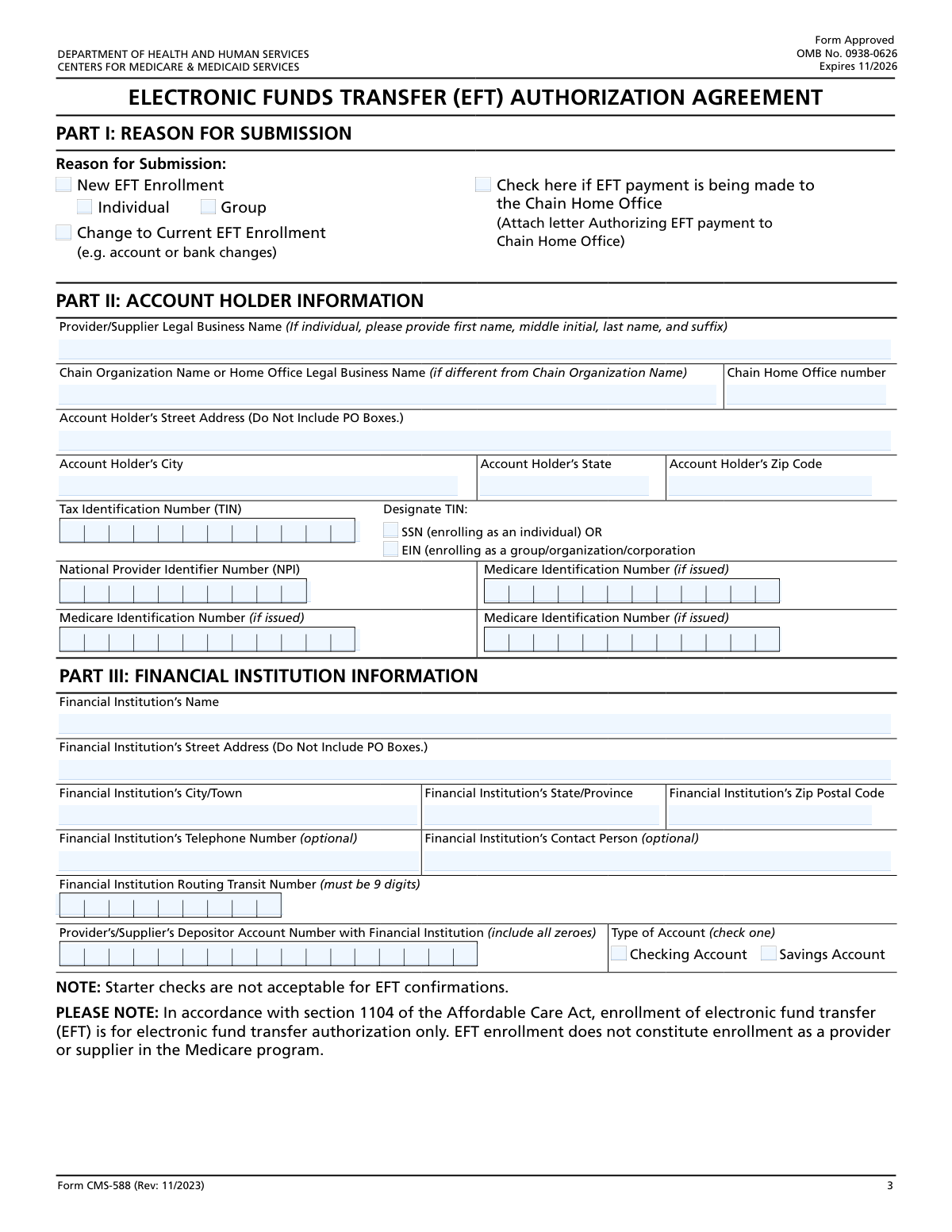
| 1. | Form CMS-588, Electronic Funds Transfer (EFT) Authorization Agreement | 1 | Basic 39 |
- Enterprise-grade security & data encryption
- 99%+ accuracy powered by AI
- 1,000+ forms from all industries
- Complete forms in under 60 seconds
How to Choose the Right Form
This category contains two distinct federal government forms, each serving a very different purpose. Here's how to quickly identify which one you need.
Filing a Claim Against the Federal Government?
If a federal employee or agency caused you property damage, personal injury, or wrongful death, you need:
- Standard Form 95 (SF 95), Claim for Damage, Injury, or Death — This is the U.S. Department of Justice–prescribed form for filing an administrative tort claim under the Federal Tort Claims Act. Use this form if:
- A federal employee's actions damaged your vehicle, property, or belongings
- You suffered a personal injury due to a federal agency's negligence
- You are filing a wrongful death claim involving a federal employee
> ⚠️ Important: SF 95 requires you to state a specific "sum certain" dollar amount and must be filed within a two-year deadline. Missing or incomplete amounts can invalidate your claim.
Nominating a Federal Employee for an Award?
If you work at the U.S. Equal Employment Opportunity Commission (EEOC) and want to recognize an employee's contributions, you need:
- EEOC Form 453, Recommendation for Recognition — This is an internal EEOC form used to nominate individuals or groups for awards such as Special Act/Achievement Awards, Cash-In-Your-Account Awards, Time-Off Awards, and QSIs. Use this form if:
- You are a supervisor or manager nominating an employee for a performance award
- You need to document award justification, estimated benefits, and obtain required approval signatures
- You are processing a group or Chair-level recognition
Quick Summary
| Your Situation | Form to Use |
|---|---|
| Claiming damages caused by a federal employee | Standard Form 95 (SF 95) |
| Nominating an EEOC employee for an award | EEOC Form 453 |
Both forms can be filled out quickly using Instafill.ai's AI-powered tools, even if you only have a non-fillable PDF version.
Form Comparison
| Form | Purpose | Who Files It | When to Use |
|---|---|---|---|
| Standard Form 95 (Rev. 2/2007), Claim for Damage, Injury, or Death | File administrative tort claim against a federal agency | Individuals alleging harm caused by federal employees | Within two years of incident causing damage, injury, or death |
| U.S. Equal Employment Opportunity Commission (EEOC) Form 453, Recommendation for Recognition | Nominate and approve employee recognition awards | EEOC supervisors and nominating officials | When recommending staff for awards or special recognition |
Tips for federal government forms
When filing a tort claim on Standard Form 95, you must include a 'sum certain' — an exact dollar figure for your claimed damages. Vague or missing amounts can invalidate your claim entirely. Add up all property damage, medical expenses, lost wages, and other losses before you begin filling out the form.
Federal tort claims generally must be filed within two years of the incident, but don't wait until the last minute. Gathering documentation like police reports, medical records, and repair estimates takes time, and submitting an incomplete form can be just as damaging as missing the deadline.
SF 95 claims must be filed with the specific federal agency whose employee or activity caused the harm — not a central clearinghouse. Sending your claim to the wrong agency can delay or derail the process, so confirm the correct recipient before submitting.
Both SF 95 and EEOC forms require detailed supporting information — witness names, incident dates, narrative justifications, and financial figures. Collect all relevant records, receipts, and notes in advance so you can fill out the form completely and accurately in one sitting.
AI-powered tools like Instafill.ai can complete federal government forms like SF 95 and EEOC Form 453 in under 30 seconds with high accuracy, reducing the risk of errors or omissions. Your data stays secure throughout the process, making it a practical time-saver whether you're handling one form or several.
EEOC Form 453 requires a written narrative that directly ties the employee's accomplishments to the award criteria — generic praise is not sufficient. Be specific about measurable outcomes, timeframes, and organizational impact to ensure the nomination meets approval thresholds.
Federal forms like EEOC Form 453 require signatures from multiple officials at different levels — nominating, recommending, reviewing, and approving. Routing the form without all required sign-offs will cause delays, so map out the approval chain before you begin the process.
Always retain a complete copy of any federal form you submit, along with any supporting documents and proof of submission. This protects you if there are disputes about whether a claim was filed on time or if the agency requests additional information later.
Frequently Asked Questions
This category includes Standard Form 95 (SF 95) for filing administrative tort claims against federal agencies, and EEOC Form 453 for recommending employee recognition and awards within the Equal Employment Opportunity Commission. Together, these forms cover two distinct federal processes: legal claims for damages and internal HR award nominations.
Anyone who believes they suffered property damage, personal injury, or the wrongful death of a family member caused by a federal employee or federal agency activity should file SF 95. This form is the standard mechanism required under the Federal Tort Claims Act to formally present a claim to the appropriate federal agency before pursuing further legal action.
Generally, tort claims under the Federal Tort Claims Act must be filed within two years of the date the claim accrues. Missing this deadline or submitting an incomplete form — such as omitting the required 'sum certain' dollar amount — can invalidate your claim, so it's important to file promptly and accurately.
A 'sum certain' means you must state a specific, exact dollar amount for the damages you are claiming — not a range or estimate. Federal regulations require this specific amount for the claim to be considered properly presented; failing to include it can result in the claim being rejected or your rights being forfeited.
SF 95 should be submitted to the federal agency whose employee or activity allegedly caused the harm, not to a central government office. Each agency has its own claims office or legal department responsible for receiving and evaluating administrative tort claims, so you should identify the correct agency before submitting.
EEOC Form 453 is used exclusively by EEOC employees and supervisors to nominate individuals or groups for recognition under the EEOC Employee Recognition and Awards Program. It supports various award types including cash awards, time-off awards, and quality step increases, and requires signatures from multiple approving officials.
SF 95 requires incident details, witness information, insurance data, and specific dollar amounts for claimed damages. EEOC Form 453 requires employee identifiers, the award type and amount, estimated first-year benefits, a narrative justification, and signatures from nominating, reviewing, and approving officials. Having all relevant documentation ready before you begin will speed up the process.
Yes — AI-powered tools like Instafill.ai can fill out forms such as SF 95 and EEOC Form 453 in under 30 seconds by accurately extracting and placing data from your source documents. Instafill.ai can also convert non-fillable PDF versions of these forms into interactive, fillable formats, making the process faster and less error-prone.
Manually completing federal forms like SF 95 can take 20–40 minutes depending on the complexity of your claim and how much documentation you need to gather. Using an AI-powered service like Instafill.ai, the same forms can be filled out accurately in under 30 seconds once your source information is available.
Some versions of federal government forms like SF 95 are available as fillable PDFs from official government sources, while others may only be available as flat, non-fillable PDFs. Services like Instafill.ai can convert non-fillable versions into interactive forms, allowing you to complete and submit them digitally.
You are not legally required to have an attorney to file an administrative tort claim using SF 95, and many claimants file on their own. However, given that errors like missing the 'sum certain' requirement or the two-year filing deadline can forfeit your rights, consulting a legal professional for complex or high-value claims is advisable.
Yes, federal forms are periodically revised — for example, SF 95 carries a revision date of February 2007, indicating it has been updated from earlier versions. Always ensure you are using the most current version of a form, as agencies may reject outdated versions, and check official government sources or platforms like Instafill.ai for the latest editions.
Glossary
- Form Complexity Index
- Instafill’s 0–100 measure of how much effort a form takes to complete, calculated deterministically from the form’s own structure rather than estimated. It combines the number of fillable fields (the largest factor), how difficult those fields are to complete based on their type, the number of pages that contain fields, the amount of conditional “fill-only-if” logic, and how many sections the form is divided into, then adds modifiers for tables and repeating lists, bundled instruction pages, and dense page layouts. A higher score means the form is harder to fill out by hand. The forms in this category have a median Form Complexity Index of 39/100 (Basic). See exactly how it is calculated.
- Federal Tort Claims Act (FTCA)
- A federal law that allows private citizens to sue the U.S. government for damages caused by the negligent or wrongful acts of federal employees acting within the scope of their employment. Filing an administrative claim (typically via SF 95) with the responsible agency is a required first step before any lawsuit can be filed.
- Sum Certain
- A specific, exact dollar amount that a claimant must state when filing a tort claim against the federal government. Submitting a vague or unspecified amount can invalidate the claim entirely, so claimants must calculate and declare a precise figure for each type of damage (property, injury, or death).
- Administrative Claim
- A formal demand for money damages submitted directly to a federal agency before pursuing any court action. The agency has six months to respond, and only after a denial or non-response can the claimant proceed to file a lawsuit.
- Standard Form (SF)
- A standardized form prescribed by the U.S. General Services Administration (GSA) or other federal authorities for use across multiple government agencies. Standard Forms ensure consistent collection of information for common government processes, such as filing damage or injury claims.
- GSA (General Services Administration)
- The federal agency responsible for managing government property, procurement, and administrative services, including the creation and maintenance of standard government forms used across federal agencies.
- Two-Year Filing Deadline
- The statute of limitations under the FTCA that requires a claimant to present their administrative tort claim to the appropriate federal agency within two years of the date the claim accrues (i.e., when the damage, injury, or death occurred). Missing this deadline typically bars the claimant from any legal recovery.
- QSI (Quality Step Increase)
- A federal employee award that accelerates an employee's advancement to the next pay step within their grade, granted for sustained high-quality performance. It is one of several award types that can be nominated through the EEOC Form 453 recognition process.
- Tangible vs. Intangible Benefits
- In federal employee award nominations, tangible benefits are measurable cost savings or revenue gains resulting from an employee's contribution, while intangible benefits are improvements that cannot be easily quantified, such as increased morale or improved public relations. Award amounts may be calculated differently depending on which type of benefit is claimed.
- ECI (Employee Control Identifier)
- A unique identifier assigned to each federal employee used in HR and payroll systems to track personnel records and transactions. It is required on forms like EEOC Form 453 to ensure award nominations are linked to the correct employee record.
- 28 CFR Part 14
- The section of the Code of Federal Regulations that governs the administrative claims process under the Federal Tort Claims Act, outlining how claims must be presented, what information is required, and how agencies must respond. SF 95 is designed to satisfy the presentment requirements outlined in this regulation.