Fill out financial distribution forms
with AI.
Financial distribution forms are essential documents used to authorize the release of funds from retirement accounts, investment portfolios, or insurance contracts. These forms act as the formal request for moving money, whether it is for a direct cash payment, a rollover into a new account, or a transfer between financial institutions. Because these documents involve significant assets and potential tax implications, accuracy is critical to ensure funds are handled correctly and in accordance with regulatory requirements.
By continuing, you acknowledge Instafill's Privacy Policy and agree to get occasional product update and promotional emails.
About financial distribution forms
These forms are typically required by plan participants, contract owners, or beneficiaries who have reached a specific milestone, such as retirement, severance from employment, or a required minimum distribution age. For example, a contract owner might use a Lincoln Financial Group distribution form when transitioning to a new job and needing to roll over a 401(k), or when a beneficiary needs to claim assets from an inherited account. Navigating these requests often happens during major life transitions, where speed and clarity are paramount to maintaining financial stability and avoiding processing delays.
Completing these documents manually can be tedious and prone to clerical errors that might hold up your funds. Modern tools like Instafill.ai use AI to accurately populate these forms in under 30 seconds, ensuring that sensitive data is handled securely while saving you the hassle of manual data entry. This streamlined approach allows you to focus on your financial planning rather than the paperwork, making the distribution process significantly more efficient.
Every form on this page can be completed without typing. Instafill is form filling software that reads a PDF and fills it for you — including flat and scanned documents that carry no fillable fields at all.
Forms in This Category
The forms in this category have a median Form Complexity Index of 47/100 (Moderate), measured across 4 forms by field count, input difficulty, length, conditional logic and structure. See how it is calculated.
| Form Name | Pages | FCI | |
|---|---|---|---|
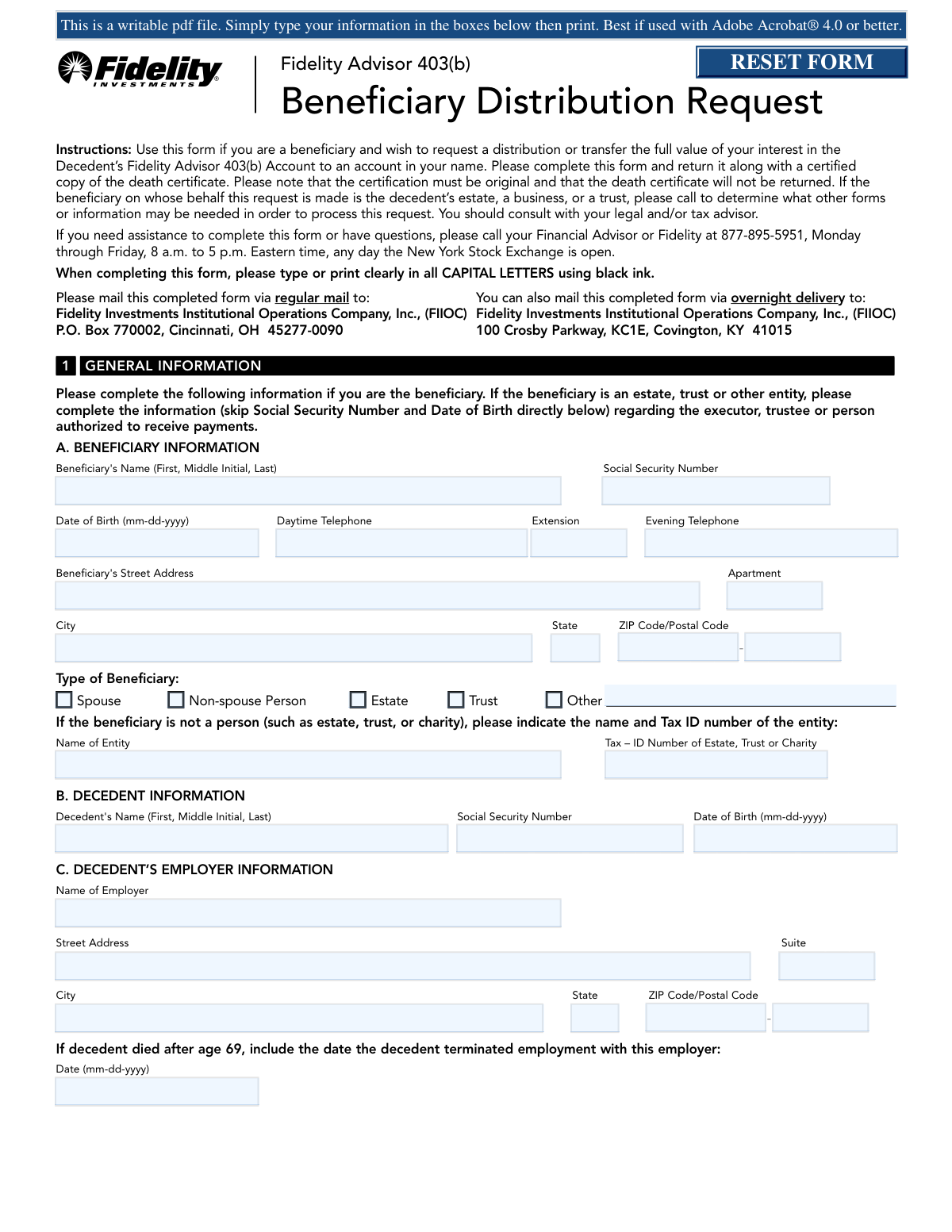
| 1. | Fidelity Advisor 403(b) Beneficiary Distribution Request | 1 | – |
| 2. | Lincoln Financial Group Requesting a distribution | 1 | Moderate 57 |
| 3. | Merrill Lynch One-Time Non-Retirement Distribution Form | 1 | Basic 43 |
| 4. | SIMPLE Individual Retirement Account (IRA) Distribution Request Form | 1 | Moderate 47 |
- Enterprise-grade security & data encryption
- 99%+ accuracy powered by AI
- 1,000+ forms from all industries
- Complete forms in under 60 seconds
How to Choose the Right Form
Navigating financial distributions can be complex, especially when dealing with retirement accounts. While this category currently focuses on a primary document from a major provider, understanding your specific financial goal is key to ensuring your request is processed correctly and efficiently.
For Lincoln Financial Group Accounts
If your retirement plan, annuity, or contract is managed by Lincoln Financial, the Lincoln Financial Group Requesting a distribution form is your primary tool for accessing your funds. This document is versatile and covers several critical financial scenarios:
- Standard Cash Distributions: Use this if you need a direct payment from your account due to retirement or reaching a specific age (such as age 59½ or for Required Minimum Distributions).
- Rollovers to Other Providers: If you are moving your retirement savings to a different financial institution (like an IRA or a new employer's 401(k)), this form facilitates the "Direct Rollover" process to help you avoid immediate tax penalties.
- Employment Changes: If you have recently left an employer (severance of employment) and need to decide what to do with your vested balance, this is the correct document to submit to initiate that transfer or payout.
- Beneficiary Claims: This form is also used by beneficiaries who need to request a distribution from a deceased participant's account.
Key Considerations Before You Start
Before filling out the Lincoln Financial Group Requesting a distribution form, ensure you have your contract or account number ready. You should also consult with a tax advisor, as distributions often have significant tax implications, including mandatory withholding and potential early withdrawal penalties.
Using Instafill.ai to complete this form ensures that every field—from personal identification to complex rollover instructions—is legible and accurate, reducing the risk of your request being rejected by the provider due to manual errors or illegible handwriting.
Form Comparison
| Form | Purpose | Who Files It | Distribution Types |
|---|---|---|---|
| Lincoln Financial Group Requesting a distribution | Withdraw or transfer funds from a Lincoln Financial retirement plan. | Contract owners, plan participants, or designated beneficiaries of the account. | Cash payments, direct rollovers to other plans, or account transfers. |
Tips for financial distribution forms
Financial distributions are often subject to mandatory federal and state tax withholding which can significantly impact your final payout. Selecting the wrong percentage can result in an unexpected tax bill at year-end, so it is vital to confirm the specific requirements for your distribution type before submitting.
To ensure your funds reach the correct account without delay, double-check your bank's routing number and your personal account number. Small typos in these fields are common mistakes that can lead to significant processing delays or funds being returned to the financial institution.
Most forms require you to select a specific trigger, such as separation from service, reaching age 59.5, or a financial hardship. Choosing the incorrect reason can affect the tax treatment of your distribution and may cause the plan administrator to reject your request entirely.
Many retirement distribution forms require a spouse’s signature or a notary public’s seal to be legally valid. Review the signature section early to determine if you need to arrange a meeting with a notary, as missing these authorizations is one of the most frequent causes for form rejection.
Using AI-powered tools like Instafill.ai can help you complete complex financial distribution forms in under 30 seconds with high accuracy. Your sensitive financial data stays secure during the process, making it a highly efficient and safe way to handle paperwork for multiple accounts.
If you are moving funds to another retirement account, ensure you specify whether it is a direct rollover to a new custodian or an indirect distribution to yourself. Direct rollovers typically avoid immediate taxation, whereas indirect rollovers have strict 60-day windows and mandatory withholding rules.
Always save a digital or physical copy of the final, signed form before submitting it to the financial institution. Having a record of exactly what you requested helps you resolve discrepancies quickly if the processed amount or destination does not match your expectations.
Frequently Asked Questions
Financial distribution forms are used to request the withdrawal or transfer of funds from a retirement account, annuity, or investment plan. They allow contract owners, participants, or beneficiaries to specify how they want their assets distributed, whether as a cash payment, a rollover, or a transfer.
These forms are typically filed when a plan participant reaches retirement age, leaves their current employer, or experiences a qualifying life event. They are also used by beneficiaries to claim assets from a deceased owner's account or when an individual needs to move funds between different financial institutions.
A direct rollover moves funds directly from one retirement plan to another, such as an IRA or a new employer's 401k, to maintain tax-deferred status. A cash distribution involves the provider sending a payment directly to the account holder, which may be subject to immediate income tax and potential early withdrawal penalties.
Generally, the primary account holder or contract owner must sign the form to authorize the movement of funds. In specific cases, such as the death of the owner, a legally recognized beneficiary or an executor of the estate may be required to sign and provide supporting legal documentation.
Depending on the reason for the distribution, you may need to provide a copy of your government-issued ID or legal documents such as a death certificate or divorce decree. Some financial institutions also require a signature guarantee or notarization to verify the identity of the person requesting the funds.
Yes, many distribution forms include sections specifically for plan-to-plan transfers or rollovers. This allows you to consolidate your retirement assets or move them to a different financial institution without liquidating the account into cash and incurring taxes.
Most distributions from tax-advantaged accounts are considered taxable income unless they are processed as a direct rollover to another eligible plan. Financial institutions often withhold a mandatory percentage for federal taxes, so it is important to review the tax withholding section of the form carefully.
Completed forms are usually submitted directly to the financial institution or plan administrator managing the account. Many companies allow for submission via secure online portals, though some may still require the original document to be sent via traditional mail or fax for security purposes.
Yes, AI-powered tools like Instafill.ai can be used to fill out financial distribution forms accurately by extracting data from your existing source documents. These tools can automatically place the required information into the correct fields, significantly reducing the risk of manual entry errors.
While manually filling out complex financial forms can be time-consuming, using an AI service like Instafill.ai allows you to complete these documents in under 30 seconds. The AI quickly maps your data to the form's requirements, making the process much more efficient than traditional methods.
If you have a static PDF version of a distribution form, AI services can often convert these non-fillable documents into interactive, fillable forms. This allows you to type your information directly into the document on your device rather than printing and filling it out by hand.
Many retirement plans, especially those governed by federal law, require spousal consent if the participant is married and requesting a distribution. This usually requires the spouse to sign the form in the presence of a notary public to acknowledge the waiver of their rights to the account benefits.
Glossary
- Form Complexity Index
- Instafill’s 0–100 measure of how much effort a form takes to complete, calculated deterministically from the form’s own structure rather than estimated. It combines the number of fillable fields (the largest factor), how difficult those fields are to complete based on their type, the number of pages that contain fields, the amount of conditional “fill-only-if” logic, and how many sections the form is divided into, then adds modifiers for tables and repeating lists, bundled instruction pages, and dense page layouts. A higher score means the form is harder to fill out by hand. The forms in this category have a median Form Complexity Index of 47/100 (Moderate). See exactly how it is calculated.
- Direct Rollover
- A transfer of retirement assets directly from one plan or provider to another, which avoids immediate taxes and penalties.
- Required Minimum Distribution (RMD)
- The specific amount that the IRS requires you to withdraw from your retirement account annually once you reach a certain age.
- Severance from Employment
- The official termination of a working relationship with an employer, which often qualifies a participant to receive a full distribution of their plan balance.
- Early Withdrawal Penalty
- An additional 10% tax usually imposed by the IRS on distributions taken from a retirement account before the participant reaches age 59½.
- In-Service Withdrawal
- A distribution taken from a retirement plan while the participant is still actively employed by the company providing the plan.
- Withholding
- The portion of a distribution that is withheld by the financial institution to pay federal or state income taxes on behalf of the recipient.
- Qualified Distribution
- A withdrawal from a retirement account that meets specific IRS criteria—such as age or disability—making it tax-free or exempt from certain penalties.
- Contract Owner
- The individual or entity that holds the legal rights to a retirement annuity or insurance-based investment product.