Fill out Florida vehicle forms
with AI.
Florida vehicle forms are the official documents required by the Florida Department of Highway Safety and Motor Vehicles (FLHSMV) to handle everything from vehicle ownership transfers and title applications to legally mandated disclosures during the buying and selling process. These forms ensure that transactions are properly recorded, that consumer protections are upheld, and that vehicle history is accurately documented in the state's records. Whether you're a private seller, a buyer, or a licensed dealer, completing the right paperwork is a legal requirement — not just a formality.
By continuing, you acknowledge Instafill's Privacy Policy and agree to get occasional product update and promotional emails.
About Florida vehicle forms
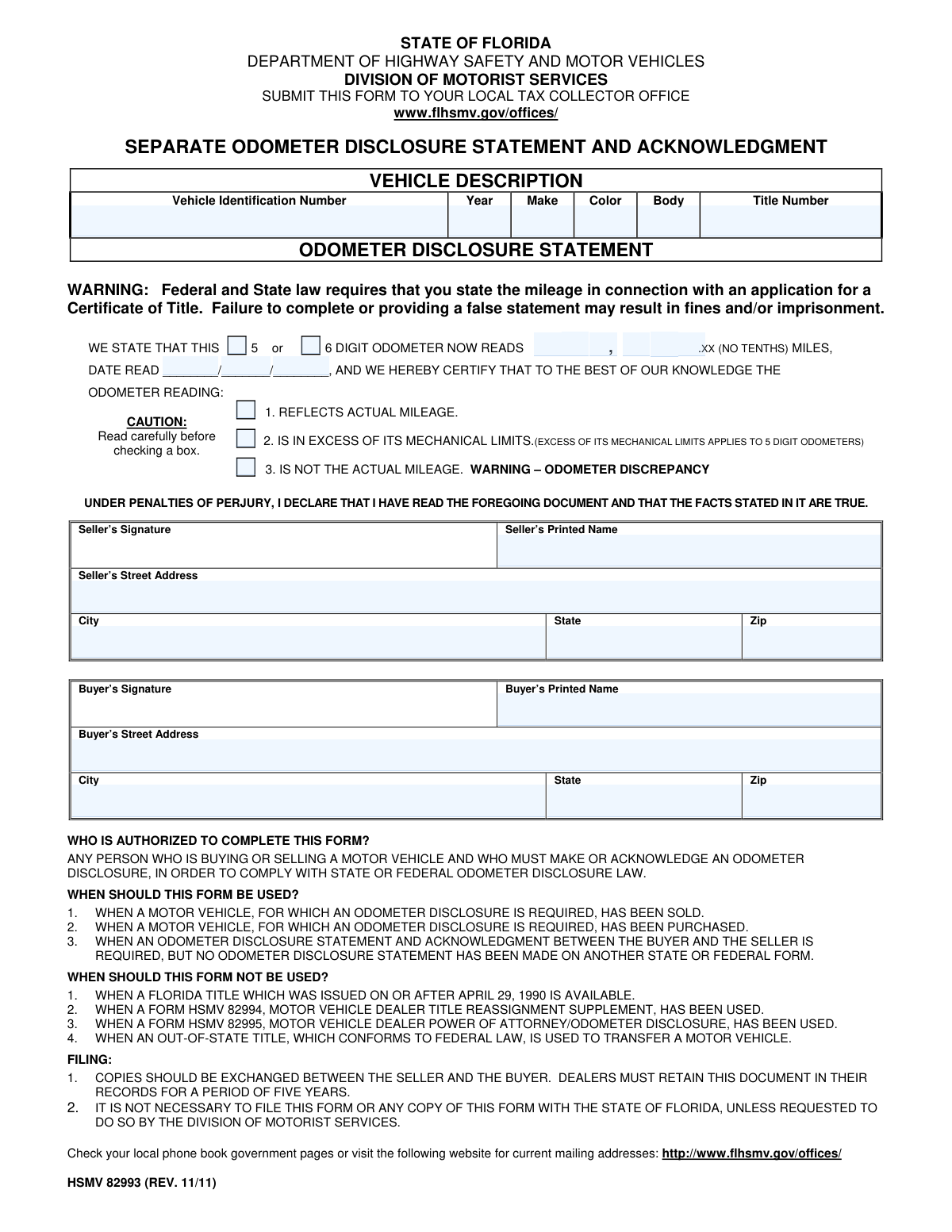
One of the most common situations that brings people to this category is a private vehicle sale or purchase, where specific disclosures must be made before a Certificate of Title can be issued. For example, Form HSMV 82993, the Separate Odometer Disclosure Statement and Acknowledgment, is required when a vehicle's mileage needs to be certified and that disclosure hasn't been captured on another approved form. Both the buyer and seller must sign under penalty of perjury, making accuracy critical. Errors or omissions can delay the title process or even result in legal consequences.
For anyone navigating these requirements, tools like Instafill.ai use AI to fill out Florida vehicle forms in under 30 seconds, helping ensure the information is entered accurately without the hassle of deciphering form instructions on your own.
Every form on this page can be completed without typing. Instafill is form filling software that reads a PDF and fills it for you — including flat and scanned documents that carry no fillable fields at all.
Forms in This Category
The forms in this category have a median Form Complexity Index of 39/100 (Basic), measured across 1 forms by field count, input difficulty, length, conditional logic and structure. See how it is calculated.
- Enterprise-grade security & data encryption
- 99%+ accuracy powered by AI
- 1,000+ forms from all industries
- Complete forms in under 60 seconds
How to Choose the Right Form
With only one form currently in this category, choosing is straightforward — but knowing when and why to use it is just as important.
Documenting Odometer Readings During a Vehicle Sale
Form HSMV 82993 – Separate Odometer Disclosure Statement and Acknowledgment is the form you need if you are buying or selling a motor vehicle in Florida and need to formally record the vehicle's mileage as part of the title transfer process.
Use this form if:
- You are a seller or buyer completing a private vehicle sale and the odometer disclosure has not already been recorded on another state or federal form
- The vehicle title does not include a built-in odometer disclosure section, or the existing title lacks space for the required information
- You need a standalone document to satisfy Florida and federal mileage disclosure requirements when applying for a Certificate of Title
You likely do NOT need this form if:
- The odometer disclosure has already been completed directly on a qualifying Florida title
- A licensed dealer has handled the disclosure using an approved dealer-specific form
- The vehicle is exempt from odometer disclosure requirements (e.g., vehicles over a certain age or weight)
A Few Things to Keep in Mind
- Both the seller and buyer must sign the form under penalty of perjury, so have all parties present or coordinate signatures carefully
- The form requires accurate vehicle identification details, including the VIN and year/make/model
- False mileage statements can result in fines or imprisonment under federal and state law — accuracy is essential
If you are unsure whether this form applies to your specific transaction, check with your county tax collector's office or a licensed Florida dealer before proceeding.
Form Comparison
| Form | Purpose | Who Files It | When to Use |
|---|---|---|---|
| State of Florida Department of Highway Safety and Motor Vehicles (FLHSMV) Form HSMV 82993, Separate Odometer Disclosure Statement and Acknowledgment | Document odometer reading during vehicle sale or purchase | Seller and buyer both sign under penalty of perjury | When odometer disclosure not made on another state or federal form |
Tips for Florida vehicle forms
Enter the odometer mileage exactly as it appears on the vehicle's odometer at the time of sale — do not round up or estimate. Even a small discrepancy between what you write and the actual reading can raise red flags or create legal complications. Double-check the reading before signing.
Form HSMV 82993 is only used when an odometer disclosure has not already been made on another qualifying state or federal form, such as a Florida title. Using it unnecessarily or in the wrong situation can cause delays in your title application. Confirm with your county tax collector's office if you are unsure whether this form applies to your transaction.
The form requires you to certify one of three mileage statuses: actual mileage, mileage that exceeds the odometer's mechanical limits, or mileage that is not the actual reading. Choosing the wrong option — even unintentionally — can be considered a false statement under federal and state law, which carries serious penalties. Review each option carefully before marking your selection.
This form requires signatures from both the seller and the buyer, and both parties are signing under penalties of perjury. Make sure all parties are present or have reviewed the form before signing, and that all signature fields are completed before submitting to the FLHSMV. An incomplete form will likely be rejected.
The Vehicle Identification Number (VIN), year, make, and model must be entered exactly as they appear on the vehicle's title or registration. Errors in VIN entry are one of the most common reasons title applications are delayed or returned. Cross-reference the VIN on the dashboard and existing title documents before filling out the form.
AI-powered tools like Instafill.ai can complete Florida vehicle forms like HSMV 82993 in under 30 seconds with high accuracy, reducing the risk of manual entry errors. Your data stays secure throughout the process, making it a safe option even for sensitive vehicle and personal information. This is especially helpful if you are managing multiple vehicle transactions at once.
After completing and submitting the form, retain a copy for both the buyer and the seller. This documentation can be valuable if any dispute arises about the vehicle's mileage after the sale. Store it alongside your bill of sale and title transfer paperwork.
Form HSMV 82993 is typically submitted as part of a Certificate of Title application — it is not a standalone document. Make sure you have all required supporting documents ready, such as proof of insurance and applicable fees, so your title application is processed without delays.
Frequently Asked Questions
Form HSMV 82993 is an official Florida Department of Highway Safety and Motor Vehicles form used to document a vehicle's odometer reading during a sale or transfer of ownership. It certifies whether the mileage shown reflects the actual reading, has exceeded the odometer's mechanical limits, or is otherwise not the actual mileage. Both the seller and buyer must sign the form under penalties of perjury.
Both the seller and buyer of a motor vehicle are required to complete this form when an odometer disclosure is needed in connection with a Florida Certificate of Title application. The seller certifies the odometer reading, and the buyer acknowledges receipt of that disclosure. It applies to private sales as well as certain dealer transactions where odometer disclosure hasn't been captured on another approved form.
This form is used specifically when an odometer disclosure is legally required but has not already been made on another state or federal form, such as directly on the title itself. You would not use this form if the disclosure is already included on a qualifying Florida title or on certain official dealer forms. It serves as a standalone, separate disclosure document for situations where those other options are unavailable or inapplicable.
Both federal and Florida state law mandate odometer disclosures to protect buyers from odometer fraud, which involves rolling back or misrepresenting a vehicle's mileage to inflate its value. Accurate mileage disclosure helps ensure transparency in the used vehicle market and is a prerequisite for obtaining a Certificate of Title in Florida. Making a false statement on this form can result in significant fines or even imprisonment.
Yes, certain vehicles may be exempt from federal and state odometer disclosure requirements, such as vehicles over a certain model year age or those with a gross vehicle weight rating above a specified threshold. However, exemptions can vary, so it's advisable to check current FLHSMV guidelines or consult a licensed dealer to confirm whether your specific vehicle qualifies for an exemption before skipping this step.
The completed form is typically submitted to a Florida tax collector's office or a licensed tag agency as part of the title transfer and vehicle registration process. It should accompany the application for a Certificate of Title and any other required documents. Some transactions may allow submission through a licensed motor vehicle dealer if they are handling the title work on your behalf.
You will need the vehicle's identification details, including the Vehicle Identification Number (VIN), make, model, year, and the current odometer reading at the time of sale. Both the seller and buyer must provide their names, addresses, and signatures. Having the vehicle title and a valid photo ID on hand will help ensure you can complete the form accurately.
Yes, AI-powered tools like Instafill.ai can fill out Florida vehicle forms such as HSMV 82993 in under 30 seconds by accurately extracting and placing data from your source documents. This reduces the risk of errors and saves time compared to filling out the form manually. Once completed, you can review the auto-filled form before printing or submitting it.
Manually filling out the form typically takes only a few minutes since it captures a focused set of vehicle and party information. However, using an AI tool like Instafill.ai can reduce that time to under 30 seconds by automatically pulling relevant data from uploaded documents. This is especially helpful when completing multiple forms as part of a vehicle title transfer.
Providing a false or inaccurate odometer reading on this form is a violation of both federal and Florida state law, and can result in serious penalties including fines and imprisonment. The form is signed under penalties of perjury, meaning both the seller and buyer are legally accountable for the accuracy of the information they certify. If you're unsure of the exact mileage, the form provides options to indicate that the reading may not reflect actual mileage.
Yes, the buyer's signature on the form serves as an acknowledgment that they have received and reviewed the seller's odometer disclosure. By signing, the buyer confirms they understand the certified mileage status of the vehicle they are purchasing. Both parties share responsibility for ensuring the information on the form is accurate and complete.
Glossary
- Form Complexity Index
- Instafill’s 0–100 measure of how much effort a form takes to complete, calculated deterministically from the form’s own structure rather than estimated. It combines the number of fillable fields (the largest factor), how difficult those fields are to complete based on their type, the number of pages that contain fields, the amount of conditional “fill-only-if” logic, and how many sections the form is divided into, then adds modifiers for tables and repeating lists, bundled instruction pages, and dense page layouts. A higher score means the form is harder to fill out by hand. The forms in this category have a median Form Complexity Index of 39/100 (Basic). See exactly how it is calculated.
- Odometer Disclosure
- A legally required statement by the seller of a motor vehicle certifying the vehicle's mileage at the time of sale. Federal law (the Truth in Mileage Act) mandates this disclosure to protect buyers from odometer fraud.
- Certificate of Title
- An official government document that identifies the legal owner of a vehicle. In Florida, this document must be transferred when a vehicle is sold, and an odometer disclosure is typically required as part of that process.
- FLHSMV
- Abbreviation for the Florida Department of Highway Safety and Motor Vehicles, the state agency responsible for vehicle titles, registrations, and driver licenses in Florida.
- HSMV
- Abbreviation used in Florida form numbers to indicate forms issued by the Department of Highway Safety and Motor Vehicles. For example, HSMV 82993 is the form number for the Separate Odometer Disclosure Statement.
- Actual Mileage
- The true, accumulated distance a vehicle has traveled as shown on the odometer. On odometer disclosure forms, the seller must certify whether the reading reflects actual mileage or if there is reason to believe it does not.
- Exceeds Mechanical Limits
- A disclosure status indicating that the odometer has rolled over and the displayed mileage is higher than the vehicle's true total mileage. This typically occurs when an older odometer maxes out and resets to zero.
- Not Actual Mileage
- A disclosure status indicating that the odometer reading is known to be incorrect or has been tampered with, and should not be relied upon as an accurate representation of the vehicle's true mileage.
- Penalties of Perjury
- A legal declaration signed by the form's participants affirming that all information provided is true and accurate. Providing false information under this declaration can result in criminal charges, fines, or imprisonment.
- Separate Odometer Disclosure Statement
- A standalone form used to document odometer mileage when the disclosure has not already been made on another state or federal title document. In Florida, Form HSMV 82993 serves this purpose when no other qualifying form captures the required mileage certification.