Fill out health savings account forms
with AI.
Health Savings Account (HSA) forms are essential documents for managing the tax-advantaged accounts associated with high-deductible health plans. These forms serve two primary purposes: reporting account activity to the IRS and facilitating the movement of funds between different financial institutions. Because HSAs offer significant tax benefits—including tax-deductible contributions and tax-free withdrawals for qualified medical expenses—accurate documentation is critical to avoid penalties and ensure you receive the full financial advantages of your plan.
By continuing, you acknowledge Instafill's Privacy Policy and agree to get occasional product update and promotional emails.
About health savings account forms
Individual taxpayers typically encounter these forms during tax season, particularly when filing IRS Form 8889 to report contributions or distributions. Additionally, employees moving between jobs or individuals seeking better investment options often need transfer and consolidation forms to move assets between custodians, such as moving funds from a Fidelity HSA or a Schwab brokerage account. These documents ensure that transfers remain non-reportable events, protecting your savings from unnecessary tax implications while keeping your health-related funds organized.
Managing these technical documents can be time-consuming, but tools like Instafill.ai use AI to fill these forms in under 30 seconds while ensuring data accuracy and security. This allows you to handle complex paperwork, like HSA transfer requests or tax reporting forms, with minimal effort and greater precision.
Every form on this page can be completed without typing. Instafill is form filling software that reads a PDF and fills it for you — including flat and scanned documents that carry no fillable fields at all.
Forms in This Category
The forms in this category have a median Form Complexity Index of 34/100 (Basic), measured across 5 forms by field count, input difficulty, length, conditional logic and structure. See how it is calculated.
| Form Name | Pages | FCI | |
|---|---|---|---|
| 1. | Form 8889, Health Savings Accounts | 1 | Basic 35 |
| 2. | Form 8889, Health Savings Accounts (HSAs) | 1 | Basic 34 |
| 3. | Group Transfer Form Fidelity Health Savings Account (HSA) | 1 | – |
| 4. | Health Savings Account (HSA) Transfer Request | 1 | Basic 33 |
| 5. | Schwab Health Savings Brokerage Account (HSBA) to HSA Invest Choice Account Transfer Form | 1 | – |
- Enterprise-grade security & data encryption
- 99%+ accuracy powered by AI
- 1,000+ forms from all industries
- Complete forms in under 60 seconds
How to Choose the Right Form
Tax Reporting and IRS Compliance
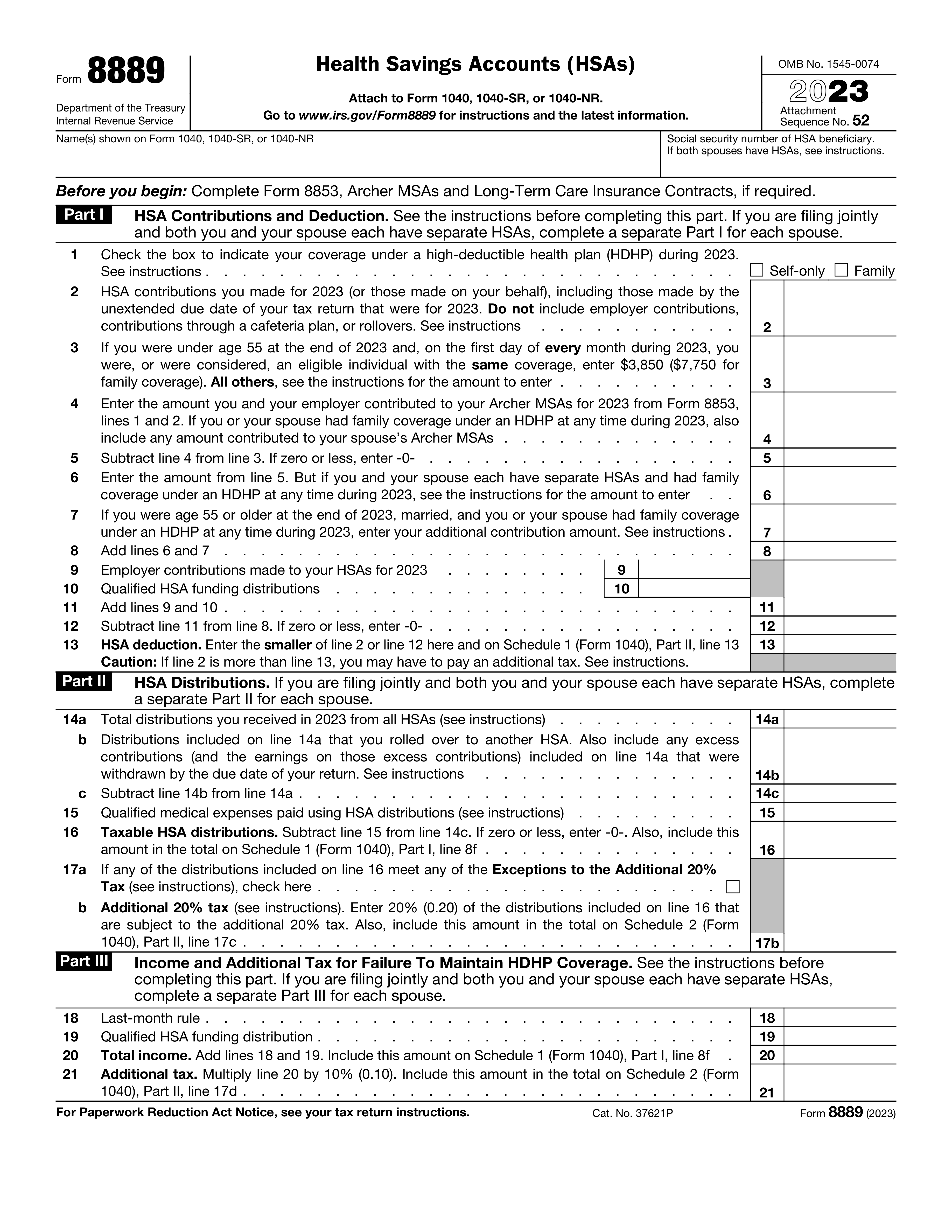
If you are filing your annual tax return, you likely need Form 8889, Health Savings Accounts (HSAs). This is the standard IRS document used to report your HSA activity for the year. You should choose this form if you need to:
- Report contributions: Document the money you (or your employer) put into your account to claim your tax deduction.
- Report distributions: Detail the funds you withdrew to pay for qualified medical expenses.
- Calculate penalties: Determine if any non-qualified withdrawals are subject to additional taxes.
Note: The list includes several variations of Form 8889, which are essentially the same IRS document provided for different tax years or via different instructional formats. Ensure you select the version that matches your current filing year.
Moving Funds Between Custodians
If you are not filing taxes but instead want to consolidate your savings or switch providers, you will need a transfer form specific to your new financial institution:
- Fidelity HSA Users: Use the Group Transfer Form Fidelity Health Savings Account (HSA) if you are moving assets from a previous employer’s plan or another custodian directly into a Fidelity account. This facilitates a trustee-to-trustee transfer, which avoids tax penalties.
- Voya Financial Users: Select the Health Savings Account (HSA) Transfer Request if you are consolidating funds from an old HSA, an Archer Medical Savings Account (MSA), or even an IRA into your Voya account.
- Schwab and HSA Bank Users: The Schwab Health Savings Brokerage Account (HSBA) to HSA Invest Choice Account Transfer Form is a specialized document for moving investment-heavy accounts between Schwab and DriveWealth/HSA Bank. Use this specifically for liquidating and transferring brokerage-linked HSA assets.
Quick Selection Tip
Before you begin, have your current account numbers and the name of your current HSA custodian ready. If you are simply trying to prove to the IRS that your medical spending was tax-free, stick with Form 8889.
Form Comparison
| Form | Purpose | Recipient | Key Requirement |
|---|---|---|---|
| Form 8889, Health Savings Accounts | Report annual HSA contributions, distributions, and calculate tax deductions. | Internal Revenue Service (IRS) | Details of contributions and qualified medical expense distributions. |
| Form 8889, Health Savings Account (HSA) | Calculate allowable deductions and identify any taxable HSA distributions. | Internal Revenue Service (IRS) | Must be filed alongside personal income tax Form 1040. |
| Form 8889, Health Savings Accounts (HSAs) | Report HSA activity to determine tax benefits or penalties owed. | Internal Revenue Service (IRS) | Summary of all HSA transactions for the fiscal year. |
| Group Transfer Form Fidelity Health Savings Account (HSA) | Authorize trustee-to-trustee asset transfers from a previous custodian to Fidelity. | Fidelity Investments | Previous custodian account details and signature for asset movement. |
| Health Savings Account (HSA) Transfer Request | Request asset transfers from an existing HSA, MSA, or IRA to Voya. | Voya Financial | Source and destination account numbers for consolidation of funds. |
| Schwab Health Savings Brokerage Account (HSBA) to HSA Invest Choice Account Transfer Form | Facilitate full transfer of brokerage assets to an HSA Invest Choice account. | HSA Bank and DriveWealth | Liquidation of non-transferable securities before submitting the transfer request. |
Tips for health savings account forms
AI-powered tools like Instafill.ai can complete complex HSA forms in under 30 seconds with high accuracy, ensuring all data stays secure during the process. This is a significant time-saver for users managing multiple transfers or tax filings across different accounts.
When filling out IRS Form 8889, remember to report both the money added to your account and any funds withdrawn. Failing to document distributions used for medical expenses may cause the IRS to treat those funds as taxable income, leading to unnecessary penalties.
When moving funds between providers like Fidelity or Voya, ensure the form specifies a 'trustee-to-trustee' transfer. This method ensures the transaction is non-reportable and non-taxable, preventing the funds from being misidentified as a personal distribution.
If you are moving a Schwab Health Savings Brokerage Account, you must liquidate any non-transferable securities into cash before submitting the request. This step is crucial for a smooth transfer to a new custodian and prevents the form from being rejected due to illiquid assets.
A common mistake on Form 8889 is neglecting to include contributions made by your employer in the total annual amount. These contributions count toward your yearly limit and must be reported to ensure your tax deduction calculations are correct.
HSA transfer requests are often delayed or rejected due to simple typos in account or routing numbers. Carefully verify the existing custodian’s details and your new account number to ensure the funds are routed to the correct institution without issue.
Frequently Asked Questions
Health savings account (HSA) forms are used to manage, report, and transfer funds within an HSA for tax and administrative purposes. They help users report tax-deductible contributions to the IRS, document distributions for medical expenses, and authorize the movement of assets between financial institutions.
You must file Form 8889 if you or someone on your behalf made contributions to your HSA, or if you received any distributions from the account during the tax year. It is also required if you acquired an interest in an HSA due to the death of the account holder or have a remaining interest in a spouse's HSA.
To move funds between providers, you typically use a Transfer Request form or a Group Transfer Form. These documents authorize a trustee-to-trustee transfer, which allows you to consolidate your health savings into a single account without incurring the taxes or penalties associated with a standard withdrawal.
Yes, you can use AI tools like Instafill.ai to fill out various health savings account forms quickly. These tools accurately extract and place data from your source documents into the correct fields, ensuring your tax and transfer forms are completed with high precision.
Filling out HSA forms online using AI is extremely efficient, often taking under 30 seconds to complete. By automating the data entry process, tools like Instafill.ai eliminate the need for manual typing and reduce the time spent on complex tax reporting or transfer requests.
Contributions are the funds you or your employer put into the account, which are often tax-deductible or made pre-tax. Distributions are the funds you take out of the account, which remain tax-free if used for qualified medical expenses but may be taxable if used for other purposes.
Yes, even if your distributions were used entirely for qualified medical expenses, you must still report them on IRS Form 8889. This filing allows the IRS to verify that the funds were used for eligible costs and ensures you are not incorrectly taxed on those withdrawals.
Most HSA transfer forms require your current account number, the name of the existing custodian, and the specific dollar amount or percentage you wish to move. You will also need to provide the details of the receiving institution to ensure the trustee-to-trustee transfer is handled properly according to IRS guidelines.
IRS Form 8889 is generally filed as an attachment to your Form 1040, so it follows the standard individual tax filing deadline, usually April 15th. It is important to complete this form annually if any activity occurred in your HSA to maintain compliance with federal tax laws.
Direct trustee-to-trustee transfers, such as those facilitated by Fidelity or Schwab transfer forms, are generally non-reportable and non-taxable events. As long as the assets move directly from one financial institution to another, the transaction does not count as a distribution or a new contribution.
Glossary
- Form Complexity Index
- Instafill’s 0–100 measure of how much effort a form takes to complete, calculated deterministically from the form’s own structure rather than estimated. It combines the number of fillable fields (the largest factor), how difficult those fields are to complete based on their type, the number of pages that contain fields, the amount of conditional “fill-only-if” logic, and how many sections the form is divided into, then adds modifiers for tables and repeating lists, bundled instruction pages, and dense page layouts. A higher score means the form is harder to fill out by hand. The forms in this category have a median Form Complexity Index of 34/100 (Basic). See exactly how it is calculated.
- HSA (Health Savings Account)
- A tax-advantaged savings account available to individuals with a high-deductible health insurance plan, used specifically to pay for healthcare costs.
- HDHP (High Deductible Health Plan)
- A health insurance plan with a higher deductible than a traditional plan, which is a legal requirement for being eligible to open or contribute to an HSA.
- Qualified Medical Expenses
- Specific healthcare costs defined by the IRS that can be paid for using HSA funds without being subject to income tax or penalties.
- Trustee-to-Trustee Transfer
- A direct movement of funds from one HSA financial institution to another that is not reported as a taxable distribution or a new contribution.
- Distribution
- The withdrawal of money from your HSA, which must be reported on IRS Form 8889 to show whether the funds were used for medical expenses.
- Custodian
- The bank or financial institution responsible for holding your HSA assets, managing the account, and providing tax reporting documents.
- HSBA (Health Savings Brokerage Account)
- An investment-focused sub-account that allows you to move your HSA funds into stocks, bonds, or mutual funds rather than just keeping them in a standard savings account.
- Archer MSA
- An older type of medical savings account for self-employed individuals and small businesses that can be rolled over or transferred into a modern HSA.