
Yes! You can use AI to fill out Form 8889, Health Savings Accounts (HSAs)
Don't type 27 fields by hand. Tell our AI about yourself, or upload your insurance card, and it fills every field in seconds. You check it, then download, print or sign.
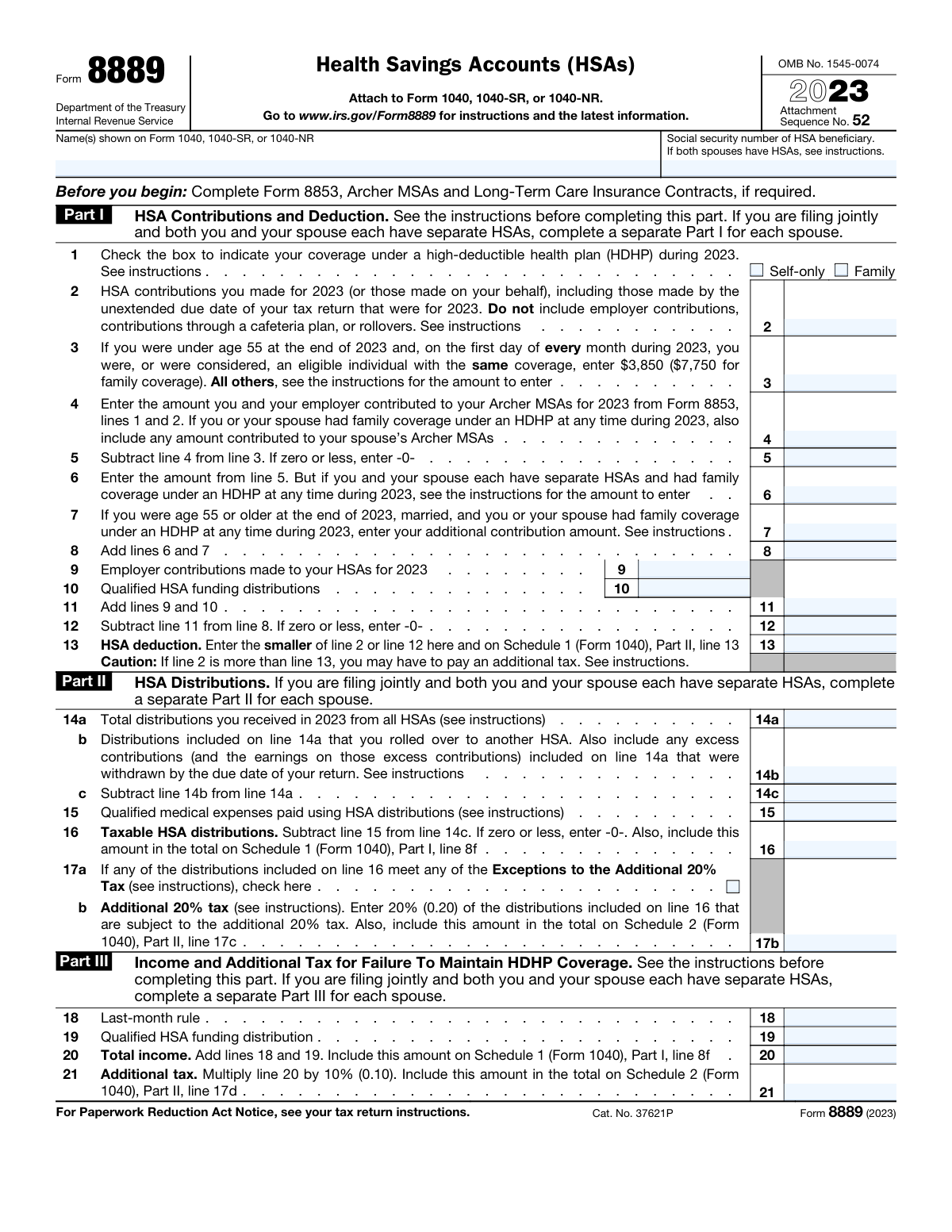
The AI does the filling. You just check it.
No typing into boxes, nothing to install.
What this form asks for
The AI fills all of it, from your answers or your documents.
The AI checks your answers before you download
13 checks built for this form, so a wrong date or a missing answer is caught before anyone else sees it.
This check validates that the 'Social security number of HSA beneficiary' field is entered in a valid format, such as XXX-XX-XXXX or XXXXXXXXX. It ensures the number contains exactly nine digits. This is critical for correctly identifying the taxpayer's account with the IRS and preventing processing delays or rejections.
Verifies that for Line 1, the user has selected either 'Self-only' or 'Family' coverage, but not both. A selection is mandatory to determine contribution limits. This check prevents ambiguity and ensures the correct contribution path is followed in subsequent calculations.
Ensures the value on Line 5 is correctly calculated as the amount on Line 3 minus the amount on Line 4. The validation also confirms that if the result is a negative number, the value is set to zero as instructed. This prevents negative values from being carried forward, which would invalidate the rest of the form's calculations.
Validates that Line 12 is the result of subtracting Line 11 from Line 8, and that the value is floored at zero. This calculation determines the maximum allowable HSA deduction before considering the taxpayer's actual contributions. An incorrect value here would lead to an incorrect final deduction amount on Line 13.
This check confirms that the value entered on Line 13 (HSA deduction) is the smaller of the values from Line 2 (contributions made) or Line 12 (calculated deduction limit). This is a fundamental rule of the form, ensuring the taxpayer does not deduct more than they contributed or more than the law allows. Failure would result in an incorrect tax deduction.
Triggers a warning if the amount on Line 2 (HSA contributions) is greater than the amount on Line 13 (HSA deduction). This reflects the 'Caution' note on the form, alerting the user that they may have an excess contribution. This is important because excess contributions are typically subject to an additional tax unless withdrawn.
And 7 more checks
- Line 14c Net Distributions Calculation
- Rollover Amount Consistency
- Line 16 Taxable Distributions Calculation and Floor
- Qualified Expenses vs. Net Distributions
- Line 17b Additional Tax Calculation
- Line 21 Additional Tax Calculation
- Age-Based Additional Contribution Eligibility
Let AI fill out your Form 8889
No typing. Every field filled in seconds, checked, ready to sign.
How to Fill Out Form 8889 Online for Free in 2026
What the AI walks you through.
- Navigate to Instafill.ai and upload your PDF of Form 8889 or select it from the form library.
- Provide your personal information, including your name and the Social Security number of the HSA beneficiary, as it appears on your Form 1040.
- Complete Part I by entering your HDHP coverage type, HSA contributions, and any Archer MSA contributions to calculate your allowable HSA deduction.
- Fill out Part II to report total distributions from your HSA, separating qualified medical expenses from taxable distributions and calculating any additional tax owed.
- Complete Part III only if you failed to maintain HDHP coverage under the last-month rule, calculating the resulting income and additional tax.
- Review the entire form generated by the AI, verifying all calculations for contributions, deductions, and distributions are correct.
- Download, print, or e-file the completed Form 8889 to attach to your Form 1040, 1040-SR, or 1040-NR.
Common Mistakes in Completing Form 8889
The ones the AI is built to catch.
Incorrectly Reporting Personal Contributions on Line 2
Using the Wrong Contribution Limit on Line 3
Omitting Employer Contributions from Line 9
Ignoring Excess Contribution Penalties
Miscalculating Taxable Distributions on Line 16
Failing to Keep Records for Qualified Medical Expenses
Overlooking the 20% Additional Tax on Taxable Distributions
Incorrectly Filing for Spouses with Separate HSAs
Misunderstanding the 'Last-Month Rule' Testing Period
Forgetting the Age 55+ Catch-Up Contribution
Mishandling Rollovers vs. Distributions
Frequently Asked Questions About Form 8889
Is it really free for 7 days?
Can I fill other forms too?
How do I cancel?
How does the AI fill out Form 8889?
What happens to my information?
How complex is Form 8889 to fill out?
What is the purpose of Form 8889?
Who needs to file Form 8889?
What information do I need to complete Form 8889?
My spouse and I both have HSAs. How do we file?
What contributions should I report on line 2?
What happens if I use my HSA for non-medical expenses?
What is the 'last-month rule' in Part III?
I am over 55. Can I contribute more to my HSA?
Where do I report contributions my employer made to my HSA?
What should I do if I contributed more than the annual HSA limit?
Can AI tools help me fill out Form 8889?
How can I fill out Form 8889 online using Instafill.ai?
The PDF version of Form 8889 I have is not fillable. What can I do?
Get your Form 8889 filled out by AI
$0 today. Cancel before Nov 3 and you pay nothing.
Other forms like this one
HSA forms: Form 1099-SA, Distributions from HSA/MSA, Transfer Due to Divorce — IRA/HSA/529, Group Transfer Form Fidelity Health Savings Account (HSA), Fidelity Beneficiaries — IRA /HSA, IRA/HSA Beneficiary Designation, HSA Bank Investment Account Transfer Form, Schwab Health Savings Brokerage Account (HSBA) to HSA Invest Choice Account Transfer Form, Health Savings Account (HSA) Transfer Request, Form 1099-SA, Distributions From an HSA, Archer MSA, or Medicare Advantage MSA, Form 8889, Health Savings Accounts
health savings forms: Form 8889, Health Savings Accounts, Group Transfer Form Fidelity Health Savings Account (HSA), Schwab Health Savings Brokerage Account (HSBA) to HSA Invest Choice Account Transfer Form, Health Savings Account (HSA) Transfer Request, New York State Department of Health Medicare Savings Program Application
health forms: Form 1095-A, Health Insurance Marketplace Statement, Form 8889, Health Savings Accounts, Form WH-380-E, Certification of Health Care Provider, Form 7206, Self-Employed Health Ins. Ded., Form 8885, Health Coverage Tax Credit, Form WH-380-F, Certification of Health Care Provider, Form 1095-C, Employer-Provided Health Insurance Offer and Coverage, Form 1095-B, Health Coverage, Form I-905, Application for Authorization to Issue Certification for Health Care Workers, Form BHVH, Outpatient Behavioral Health – ABA Treatment Request, Form SHA, Separation Health Assessment, DHS-6696-ENG, Minnesota Health Care Programs Application (MNsure/DHS), Geisinger Health Plan Behavioral Health Professional Services Questionnaire, Priority Health Small Group Renewal Decision Form, Form CH-006: PA-BH-Res-PCS, Oregon Behavioral Health Support Program Plan of Care Authorization (Plan of Care Request for Behavioral Health Residential or Personal Care Services), Form 7206 (2025), Self-Employed Health Insurance Deduction, HIPAA Authorization Form, Authorization for the Release of Protected Health Information, Prior Authorization (PA) Request Form – Adult Palliative Care (Alameda Alliance for Health), Medicare Enrolment Application (Australia) – Enrol in Medicare, Re-enrol/Extend Eligibility, Enrol a Newborn, and Register for My Health Record, Alameda Alliance for Health Prior Authorization (PA) Request Form – Adult Palliative Care
savings account forms: Form 8889, Health Savings Accounts, Group Transfer Form Fidelity Health Savings Account (HSA), Schwab Health Savings Brokerage Account (HSBA) to HSA Invest Choice Account Transfer Form, The Vanguard 529 College Savings Plan Transfer Due to Death of Account Owner Form, AbbVie Savings Plan 401(k) Account Transfer Notice, Health Savings Account (HSA) Transfer Request
health savings account forms: Health Savings Account (HSA) Transfer Request, Form 8889, Health Savings Accounts, Group Transfer Form Fidelity Health Savings Account (HSA), Schwab Health Savings Brokerage Account (HSBA) to HSA Invest Choice Account Transfer Form
Let AI fill out your Form 8889
Your trial starts once a card is added. You pay nothing before Nov 3.
Our AI already knows this form, all 27 fields of it. Skip the typing: tell it about yourself, or upload what you have, and it fills the whole form in seconds.
- AI fills every field on the form, checkboxes included
- No typing into boxes: answer a few questions, or upload your insurance card, an old copy of this form, a photo of a document
- The AI checks the answers; you review and change anything before you download
- Download the finished PDF, print it, or sign it online
- Encrypted, and never used to train AI
Cancel before Nov 3 and you pay nothing.
A card is needed to start the trial. Cancel in two clicks from your account.
Terms · Privacy