Fill out savings account forms
with AI.
Savings account forms encompass a wide range of financial documents used to manage, transfer, or report on specialized savings vehicles. These aren't just for standard bank accounts; they frequently include tax-advantaged accounts like Health Savings Accounts (HSAs), 529 College Savings Plans, and retirement-linked savings plans. These forms are essential for maintaining the tax-exempt status of your contributions, documenting distributions for the IRS, and ensuring that funds are correctly allocated toward their intended purposes, such as medical expenses or higher education.
By continuing, you acknowledge Instafill's Privacy Policy and agree to get occasional product update and promotional emails.
About savings account forms
Typically, these forms are required by individuals navigating major life transitions or managing their annual tax obligations. For example, you might need an HSA Transfer Request when changing employers or consolidating multiple health accounts into a single custodian. Similarly, forms like the Vanguard 529 Transfer Due to Death are necessary for estate executors or beneficiaries seeking to maintain the continuity of educational savings. Whether you are reporting HSA activity on IRS Form 8889 or moving assets between brokerage accounts, these documents serve as the legal and financial bridge between different institutions and regulatory bodies.
Managing these complex financial documents can be time-consuming, but tools like Instafill.ai use AI to fill these forms in under 30 seconds while ensuring that sensitive data is handled accurately and securely. This allows you to focus on your financial planning rather than the manual entry of repetitive information.
Every form on this page can be completed without typing. Instafill is form filling software that reads a PDF and fills it for you — including flat and scanned documents that carry no fillable fields at all.
Forms in This Category
The forms in this category have a median Form Complexity Index of 35/100 (Basic), measured across 7 forms by field count, input difficulty, length, conditional logic and structure. See how it is calculated.
| Form Name | Pages | FCI | |
|---|---|---|---|
| 1. | Form 8889, Health Savings Accounts | 1 | Basic 35 |
| 2. | AbbVie Savings Plan 401(k) Account Transfer Notice | 1 | – |
| 3. | Form 8889, Health Savings Accounts (HSAs) | 1 | Basic 34 |
| 4. | Group Transfer Form Fidelity Health Savings Account (HSA) | 1 | – |
| 5. | Health Savings Account (HSA) Transfer Request | 1 | Basic 33 |
| 6. | Schwab Health Savings Brokerage Account (HSBA) to HSA Invest Choice Account Transfer Form | 1 | – |
| 7. | The Vanguard 529 College Savings Plan Transfer Due to Death of Account Owner Form | 1 | Basic 36 |
- Enterprise-grade security & data encryption
- 99%+ accuracy powered by AI
- 1,000+ forms from all industries
- Complete forms in under 60 seconds
How to Choose the Right Form
Navigating financial paperwork can be complex, especially when dealing with tax-advantaged accounts. To select the correct document, first identify whether you are reporting activity to the IRS or moving funds between institutions.
IRS Tax Reporting for HSAs
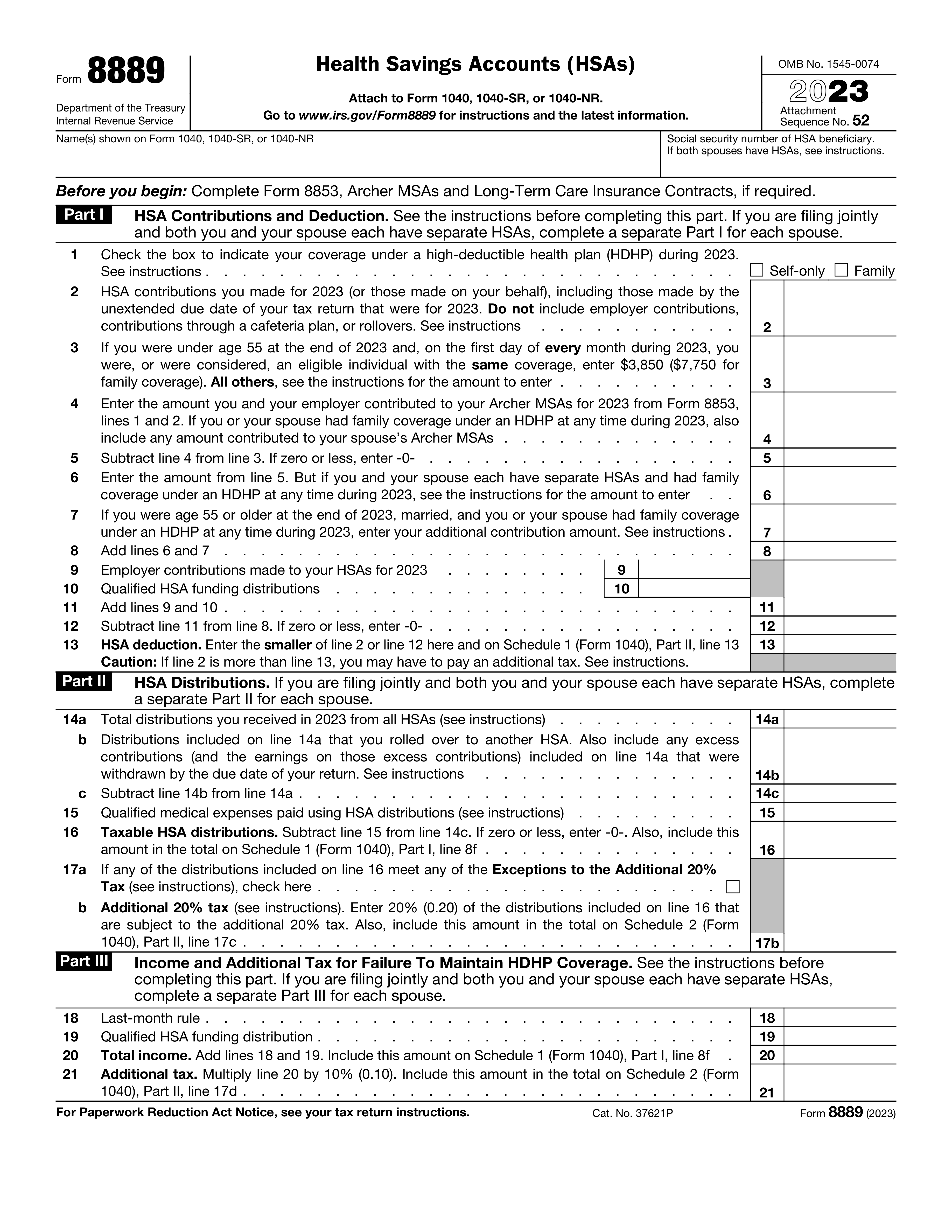
If you are filing your annual tax return (Form 1040) and need to report contributions, distributions, or calculate your allowable deduction, you must use Form 8889, Health Savings Accounts. This form is essential for ensuring your medical expenses remain tax-free and for avoiding penalties on unqualified distributions.
Consolidating or Transferring HSA Funds
If you are moving existing health savings to a new provider to consolidate your assets, choose the form specific to your new custodian:
- Fidelity Accounts: Use the Group Transfer Form Fidelity Health Savings Account (HSA) for trustee-to-trustee transfers that avoid tax implications.
- Voya Financial: Use the Health Savings Account (HSA) Transfer Request to move assets from an existing HSA, Archer MSA, or IRA into a Voya account.
- Schwab/HSA Bank: If you are moving a brokerage-based HSA to an HSA Invest Choice account, use the Schwab Health Savings Brokerage Account (HSBA) to HSA Invest Choice Account Transfer Form. Note that you may need to liquidate certain securities before this transfer.
Education and Retirement Account Transitions
Savings forms also cover specialized accounts like 529 plans and 401(k)s during major life or corporate changes:
- 529 College Savings: If an account owner has passed away, The Vanguard 529 College Savings Plan Transfer Due to Death of Account Owner Form is required to legally transfer ownership to a successor.
- Employer Retirement Plans: For AbbVie employees whose retirement accounts are transitioning from Fidelity to Empower, the AbbVie Savings Plan 401(k) Account Transfer Notice provides the necessary roadmap for investment mapping and blackout periods.
By matching the form to your specific financial institution and your current goal—whether that is tax compliance or asset consolidation—you can ensure your savings remain protected and properly managed.
Form Comparison
| Form | Primary Purpose | Account Type | Key Action Required |
|---|---|---|---|
| Form 8889, Health Savings Accounts | Report contributions and distributions to the IRS for tax purposes. | Health Savings Account (HSA) | File annually with your federal income tax return. |
| Group Transfer Form Fidelity Health Savings Account (HSA) | Authorize movement of HSA assets from a previous custodian to Fidelity. | Health Savings Account (HSA) | Provide previous trustee details for a non-reportable transfer. |
| Form 8889, Health Savings Account (HSA) | Calculate allowable tax deductions and report qualified medical expenses. | Health Savings Account (HSA) | Used to determine taxable distributions or additional penalties. |
| Schwab Health Savings Brokerage Account (HSBA) to HSA Invest Choice Account Transfer Form | Consolidate brokerage investments into an HSA Invest Choice account. | HSA Brokerage Account | Liquidate non-transferable securities before submitting the transfer request. |
| The Vanguard 529 College Savings Plan Transfer Due to Death of Account Owner Form | Transfer account ownership to a successor after the owner's death. | 529 College Savings Plan | Submit legal documentation identifying the authorized successor or estate. |
| AbbVie Savings Plan 401(k) Account Transfer Notice | Guide participants through a plan transition from Fidelity to Empower. | 401(k) Retirement Plan | Review investment mapping and observe the scheduled blackout period. |
| Health Savings Account (HSA) Transfer Request | Request a trustee-to-trustee transfer of assets into a Voya HSA. | HSA, MSA, or IRA | Consolidate various health savings or retirement funds into one account. |
Tips for savings account forms
The most common reason for rejected financial transfers is a simple typo in the account or routing numbers. Always cross-reference the numbers on your form with a recent bank statement or a voided check to ensure the funds reach the correct destination.
When filling out tax-related forms like Form 8889 for HSAs, be careful to separate contributions made through payroll from those you made individually. Correctly categorizing these ensures you claim the proper tax deductions and avoid exceeding annual contribution limits.
Managing multiple account transfers or tax forms can be overwhelming, but AI-powered tools like Instafill.ai can complete these forms in under 30 seconds with high accuracy. Your sensitive financial data stays secure during the process, making it a highly efficient way to handle complex paperwork.
If you are moving a brokerage-linked savings account, check if your current holdings can be transferred 'in-kind.' Many institutions require you to sell specific stocks or mutual funds and convert them to cash before they can process the transfer to a new custodian.
Forms involving the death of an account owner or a change in successor usually require external proof, such as a certified death certificate or letters of testamentary. Having digital copies of these documents ready to attach will prevent significant delays in the transition of funds.
When moving funds between employer-sponsored plans, take note of any mentioned 'blackout periods' where account access is restricted. Time your form submission to either finish well before the blackout begins or wait until it concludes to maintain liquidity of your savings.
Frequently Asked Questions
Savings account forms are documents used to manage, transfer, or report on specialized financial accounts like Health Savings Accounts (HSAs), 529 college savings plans, or employer-sponsored retirement plans. They ensure that contributions, distributions, and transfers are recorded correctly for tax compliance and financial tracking.
You generally must file Form 8889 if you or someone on your behalf made contributions to an HSA, or if you received distributions from an HSA during the tax year. This form helps the IRS determine your allowable tax deduction and ensures that distributions were used for qualified medical expenses.
To move funds between providers, you typically need to complete a transfer request or group transfer form provided by the new financial institution. These forms authorize a trustee-to-trustee transfer, which allows you to consolidate your savings without incurring taxes or early withdrawal penalties.
In the event of an account owner's death, a specific transfer form is required to move ownership to a designated successor or an individual authorized by the estate. This process ensures the funds remain available for the beneficiary's education expenses while maintaining the account's tax-advantaged status.
Yes, AI-powered tools like Instafill.ai can be used to complete various savings account and financial forms. These tools can accurately extract data from your existing documents and place it into the correct fields in under 30 seconds, significantly reducing the risk of manual entry errors.
While manually filling out complex financial forms can be time-consuming, using AI services like Instafill.ai allows you to complete them in less than 30 seconds. The AI automates the data entry process by pulling information from your source files, making it much faster to prepare documents for submission.
A distribution involves taking money out of a savings account for use, which may be taxable depending on the account type and the purpose of the spend. A transfer, specifically a trustee-to-trustee transfer, moves funds directly between financial institutions and is generally a non-taxable event.
Submission instructions vary by form: tax-related forms like the 8889 are filed with your annual tax return to the IRS. Transfer and account maintenance forms are typically submitted directly to the financial institution managing the account, such as Fidelity, Schwab, or Vanguard.
Yes, if your HSA includes a brokerage component, you often need to liquidate non-transferable securities into cash before initiating a transfer. This ensures that the assets can be moved seamlessly to the new custodian without technical errors or rejected transfers.
Reporting distributions is essential to verify that the funds were used for qualified medical expenses, which keeps the withdrawal tax-free. If distributions are not reported correctly or are used for non-qualified expenses, they may be subject to standard income tax plus additional penalties.
Many transfer forms are designed specifically for consolidation, allowing you to move assets from various previous trustees into a single new account. Consolidating your accounts can make it easier to manage your investments and track your total healthcare savings in one place.
Glossary
- Form Complexity Index
- Instafill’s 0–100 measure of how much effort a form takes to complete, calculated deterministically from the form’s own structure rather than estimated. It combines the number of fillable fields (the largest factor), how difficult those fields are to complete based on their type, the number of pages that contain fields, the amount of conditional “fill-only-if” logic, and how many sections the form is divided into, then adds modifiers for tables and repeating lists, bundled instruction pages, and dense page layouts. A higher score means the form is harder to fill out by hand. The forms in this category have a median Form Complexity Index of 35/100 (Basic). See exactly how it is calculated.
- HSA (Health Savings Account)
- A tax-advantaged savings account available to individuals with a high-deductible health plan, used specifically to pay for healthcare costs with pre-tax dollars.
- Trustee-to-Trustee Transfer
- A direct transfer of funds between two financial institutions that allows the account holder to move assets without the transaction being reported as a taxable distribution.
- Custodian
- The bank or financial institution responsible for holding and managing the assets within your health, education, or retirement savings account.
- 529 Plan
- A state-sponsored investment account designed to encourage saving for future education costs, offering tax-free growth and withdrawals for qualified expenses.
- Qualified Medical Expenses
- Specific healthcare costs defined by the IRS that can be paid for using HSA funds without incurring income tax or additional penalties.
- Blackout Period
- A temporary window of time during a plan transition where account holders are restricted from making changes, trades, or withdrawals.
- SDBA (Self-Directed Brokerage Account)
- An investment option within a savings plan that allows the owner to invest in a wider range of stocks, bonds, and mutual funds beyond the standard plan options.
- Successor Owner
- An individual designated to take over ownership of a savings account, such as a 529 plan, upon the death of the original account holder.