Fill out healthcare authorization forms
with AI.
Healthcare authorization forms are essential documents used to bridge the gap between medical providers and insurance companies. They ensure that specific treatments, procedures, or medications are medically necessary before they are performed or dispensed. Without these authorizations, patients may face unexpected out-of-pocket costs, and providers risk denied claims. These forms, such as Prior Authorization Requests or Precertification Information Requests, act as a critical layer of verification in the modern healthcare system to ensure that care aligns with insurance policy coverage.
By continuing, you acknowledge Instafill's Privacy Policy and agree to get occasional product update and promotional emails.
About healthcare authorization forms
Typically, healthcare professionals, administrative staff, and patients themselves need to navigate these forms when seeking coverage for specialized care. For instance, a physician might use a Molina Healthcare or UnitedHealthcare Prior Authorization form to justify a specific drug or surgical procedure based on a patient’s medical history. These documents require precise clinical data, including diagnosis codes and treatment rationales, to satisfy the strict criteria set by insurance carriers. Providing accurate information is vital to prevent delays in treatment or administrative bottlenecks.
Filling out these detailed forms manually can be time-consuming and prone to errors that delay patient care. Tools like Instafill.ai use AI to fill these healthcare authorization forms in under 30 seconds, handling sensitive data accurately and securely to streamline the approval process. By automating the data entry, providers can focus more on patient outcomes rather than administrative paperwork, ensuring that necessary medical services are approved as quickly as possible.
Every form on this page can be completed without typing. Instafill is form filling software that reads a PDF and fills it for you — including flat and scanned documents that carry no fillable fields at all.
Forms in This Category
The forms in this category have a median Form Complexity Index of 63/100 (Complex), measured across 4 forms by field count, input difficulty, length, conditional logic and structure. See how it is calculated.
| Form Name | Pages | FCI | |
|---|---|---|---|
| 1. | Form GR-68831, Precertification Information Request Form | 8 | Moderate 57 |
| 2. | Molina Healthcare Prior Authorization Request Form | 2 | Complex 67 |
| 3. | Optum Rx / UnitedHealthcare Prior Authorization Request Form | 1 | Moderate 55 |
| 4. | UnitedHealthcare Prior Authorization Request Form | 1 | Complex 63 |
- Enterprise-grade security & data encryption
- 99%+ accuracy powered by AI
- 1,000+ forms from all industries
- Complete forms in under 60 seconds
How to Choose the Right Form
Selecting the correct healthcare authorization form is essential for ensuring that medical services and prescriptions are covered by insurance. To choose the right document, you must first identify the insurance carrier and the specific stage of the authorization process.
Identify the Insurance Carrier
The most direct way to filter your choice is by the patient’s insurance provider:
- Aetna: If your patient is covered by Aetna and you are responding to a request for more clinical data, use Form GR-68831, Precertification Information Request Form.
- Molina Healthcare: For any medical services, procedures, or medications requiring pre-approval for Molina members, utilize the Molina Healthcare Prior Authorization Request Form.
- UnitedHealthcare: For members under UHC, select either the standard UnitedHealthcare Prior Authorization Request Form or the specialized Optum Rx / UnitedHealthcare Prior Authorization Request Form for pharmacy-specific needs.
New Requests vs. Follow-Up Documentation
It is critical to distinguish whether you are initiating a new request or responding to an existing one:
- Starting a New Authorization: Use the Molina Healthcare Prior Authorization Request Form or the UnitedHealthcare Prior Authorization Request Form to establish medical necessity for a service or drug before it is provided.
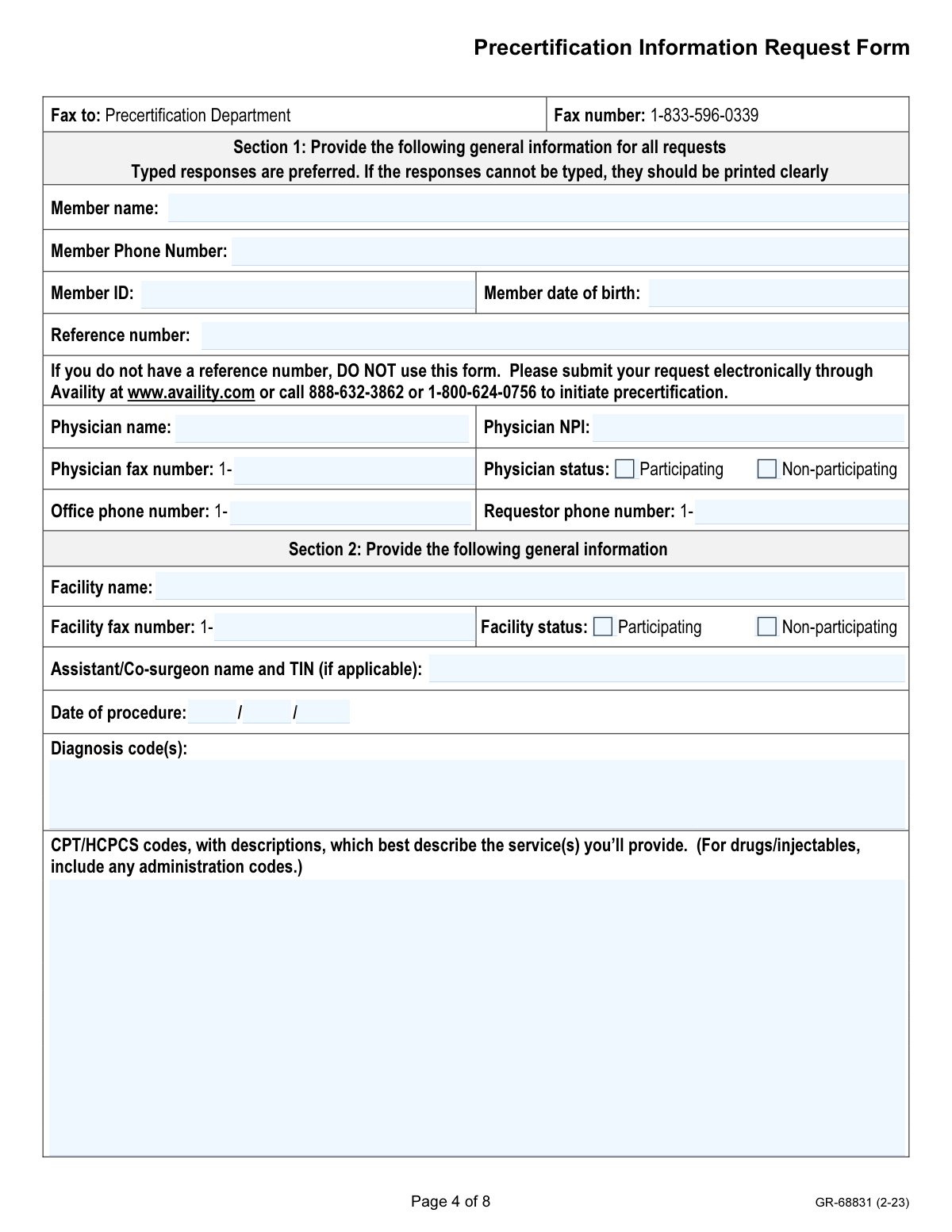
- Providing Supplemental Information: If a request has already been initiated with Aetna but requires further clinical justification or treatment rationale, use Form GR-68831, Precertification Information Request Form. This form is specifically for providing additional details rather than starting a new file.
Medication and Pharmacy Benefits
If the authorization is specifically for a prescription drug not on a preferred list:
- Optum Rx / UnitedHealthcare Prior Authorization Request Form: This is the preferred choice when the patient’s pharmacy benefits are managed specifically through Optum Rx.
- UnitedHealthcare Prior Authorization Request Form: Use this for general medication necessity justifications where pharmacy benefit management is handled directly by UnitedHealthcare.
Form Comparison
| Form | Primary Purpose | Request Timing | Coverage Focus |
|---|---|---|---|
| Form GR-68831, Precertification Information Request Form | Supplies additional clinical findings to support an existing precertification request. | After a precertification request has already been initiated with Aetna. | Supplemental medical history and treatment rationale for proposed services. |
| Molina Healthcare Prior Authorization Request Form | Secures approval for services or medications to ensure insurance coverage. | Before medical services, procedures, or medications are rendered. | Broad medical services, procedures, and various prescription medications. |
| Optum Rx / UnitedHealthcare Prior Authorization Request Form | Obtains pre-approval for prescribed medications through pharmacy benefit management. | Prior to dispensing a medication not automatically covered. | Specifically for pharmacy benefits and clinical drug justification. |
| UnitedHealthcare Prior Authorization Request Form | Demonstrates medical necessity for drugs not on the preferred list. | Before filling a prescription that requires clinical review. | Prescription medications requiring diagnosis and treatment history. |
Tips for healthcare authorization forms
To prevent immediate administrative denials, ensure the patient's name, date of birth, and member ID exactly match their current insurance card. Even minor discrepancies in spelling or ID numbers can cause the authorization system to reject the request automatically before it even reaches a clinical reviewer.
Insurance carriers require proof of medical necessity, so always include relevant ICD-10 codes and a summary of failed treatments or alternative medications. Providing clear clinical rationale up front reduces the likelihood of 'Request for Information' (RFI) delays that can stall patient care.
Many authorizations for specialty drugs or procedures require supporting documentation like recent lab work, biopsy results, or imaging reports. Ensure these are attached as clear files to the main authorization form to provide a complete clinical picture for the insurance medical director.
Incorrect billing or rendering provider information is a common cause for authorization delays. Double-check that the National Provider Identifier (NPI) and Tax Identification Number (TIN) are accurate for the specific facility or clinician performing the service to ensure proper claim processing later.
When managing multiple authorization requests, AI-powered tools like Instafill.ai can complete these complex forms in under 30 seconds with high accuracy. This process keeps your sensitive data secure while significantly reducing the administrative burden of repetitive data entry across different insurer templates.
Be careful not to submit a new authorization form if you are simply providing additional information for an existing request, such as with Aetna Form GR-68831. Using the correct supplemental form ensures the data is linked to the open case rather than creating a confusing duplicate file.
Before submitting a pharmacy authorization for Optum Rx or UnitedHealthcare, verify the medication's current status on the plan's formulary. If the drug is 'non-preferred,' your documentation must specifically explain why the preferred alternatives were ineffective or are contraindicated for the patient.
Frequently Asked Questions
These forms are used to request approval from an insurance carrier before a specific medical service, procedure, or medication is provided. They ensure that the treatment is medically necessary and covered under the patient's specific health plan to avoid unexpected billing issues.
In most cases, the healthcare provider or their administrative staff is responsible for filling out and submitting these forms to the insurance company. However, patients should stay informed and follow up with both their doctor and insurer to ensure the request is processed in a timely manner.
While the terms are often used interchangeably, 'prior authorization' usually refers to obtaining approval for medications or specific outpatient services. 'Precertification' is often specific to hospital admissions or complex procedures where the insurer reviews the clinical rationale before the event occurs.
For prescription medications managed through UnitedHealthcare's pharmacy benefit manager, you should use the Optum Rx / UnitedHealthcare Prior Authorization Request Form. For other medical services or non-pharmacy requests, the general UnitedHealthcare Prior Authorization form is typically required.
These forms generally require patient demographics, provider details, specific diagnosis codes, and procedure codes. Additionally, providers must often include clinical notes, lab results, or a history of previous treatments to justify the medical necessity of the request.
Yes, AI tools like Instafill.ai can be used to fill out these forms by accurately extracting data from source documents and placing it into the correct fields. This technology can even convert static, non-fillable PDF versions of these forms into interactive, digital documents.
Using traditional manual entry, these forms can take 15 to 30 minutes to complete depending on the complexity of the medical history. With AI-powered tools like Instafill.ai, the process can be completed in under 30 seconds by automating the data entry process.
If a request is denied, the insurance company will provide a reason, often related to a lack of clinical evidence or the availability of a preferred alternative treatment. Providers can typically appeal the decision by submitting additional medical records or a letter of medical necessity.
This specific form is used when Aetna requires supplemental medical information for a precertification request that has already been initiated. It is designed to provide detailed clinical findings and treatment rationale to support a pending request rather than starting a new one.
Completed forms are typically submitted directly to the insurance carrier's authorization department via fax, a secure provider portal, or mail. Specific submission instructions, including fax numbers or digital upload links, are usually found on the form itself or the insurer's official website.
Generally, prior authorization is not required for emergency medical services where a delay could cause immediate harm to the patient. However, once the patient is stabilized, the facility may need to notify the insurer or seek authorization for any ongoing inpatient care.
Glossary
- Form Complexity Index
- Instafill’s 0–100 measure of how much effort a form takes to complete, calculated deterministically from the form’s own structure rather than estimated. It combines the number of fillable fields (the largest factor), how difficult those fields are to complete based on their type, the number of pages that contain fields, the amount of conditional “fill-only-if” logic, and how many sections the form is divided into, then adds modifiers for tables and repeating lists, bundled instruction pages, and dense page layouts. A higher score means the form is harder to fill out by hand. The forms in this category have a median Form Complexity Index of 63/100 (Complex). See exactly how it is calculated.
- Prior Authorization (PA)
- A requirement by health insurance companies for patients to obtain approval for a medical service or medication before it is provided to ensure it will be covered.
- Medical Necessity
- The standard used by insurers to determine if a specific treatment, service, or drug is appropriate and essential for the diagnosis or treatment of a patient's condition.
- Precertification
- A process where a healthcare provider notifies the insurance company in advance to verify that a planned medical service, such as a surgery or hospital stay, is covered.
- Formulary
- A list of prescription drugs covered by a health insurance plan; medications not on this list often require a prior authorization form for coverage.
- Pharmacy Benefit Manager (PBM)
- A third-party company, like Optum Rx, that manages prescription drug programs for insurers and processes medication-related authorization requests.
- Clinical Justification
- The medical evidence, such as lab results, diagnosis codes, and treatment history, provided by a doctor to support the need for a specific healthcare service.
- ICD-10 Code
- A standardized alphanumeric code used by healthcare providers to identify a specific diagnosis or medical condition on insurance forms.
- CPT Code
- A set of five-digit codes used to describe the specific medical, surgical, or diagnostic procedures being requested for authorization.