Fill out humanitarian forms
with AI.
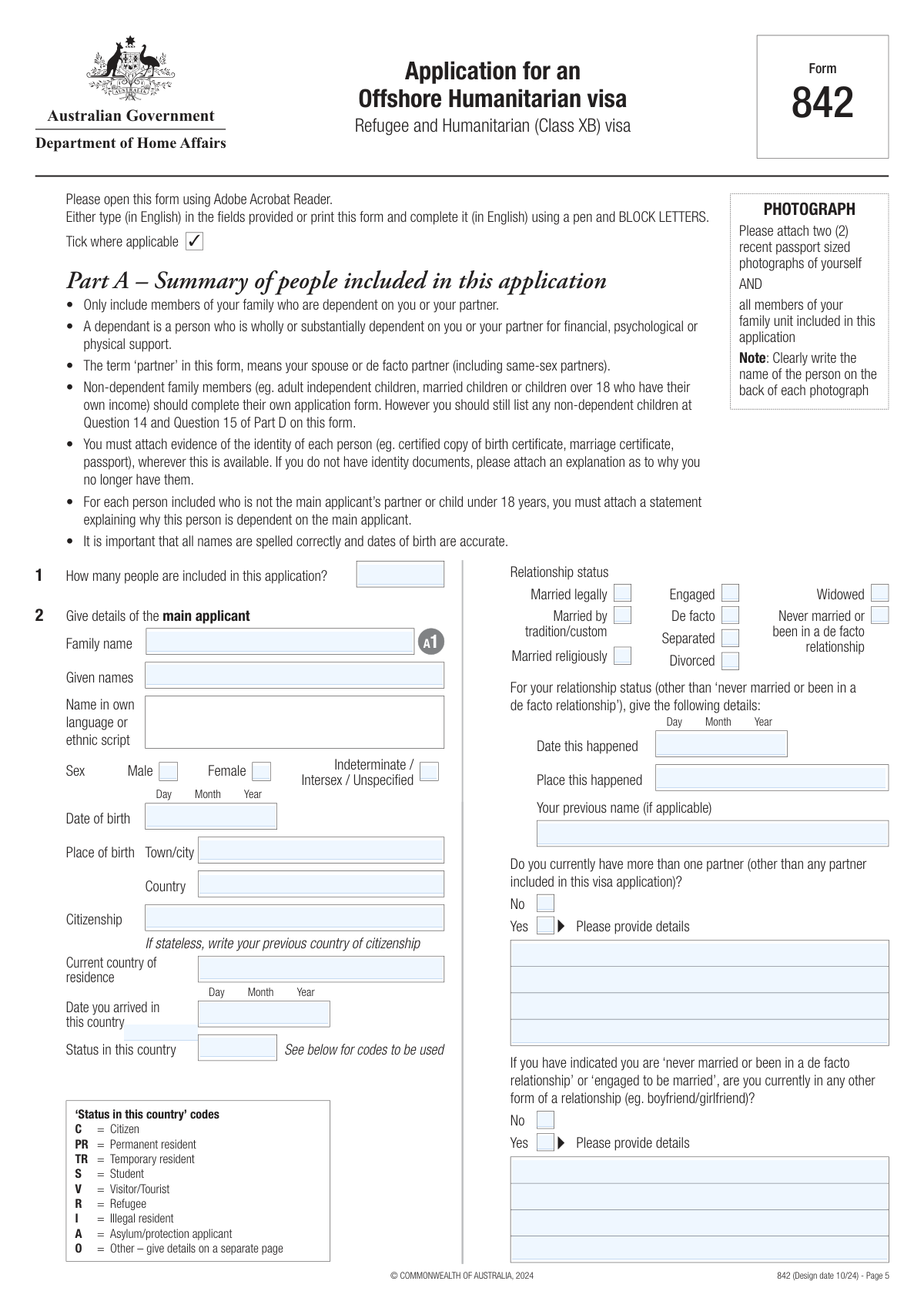
Humanitarian forms are official government documents used to apply for protection, resettlement, or entry on humanitarian grounds. In the Australian context, these forms are part of a process designed to help people fleeing persecution, conflict, or serious human rights violations find safety through a structured legal pathway. The Refugee and Humanitarian (Class XB) visa — applied for using Form 842 — is a key example, covering categories such as the Refugee visa, Emergency Rescue, and Woman at Risk subclasses. These applications require detailed personal, family, and background information, along with supporting documentation that must be carefully compiled and certified.
By continuing, you acknowledge Instafill's Privacy Policy and agree to get occasional product update and promotional emails.
About humanitarian forms
People who typically need these forms include individuals and families living outside Australia who are in vulnerable situations and seeking protection or resettlement. Sponsors, migration agents, and humanitarian organizations also work with these documents regularly on behalf of applicants. Because the stakes are high and errors or omissions can delay processing or result in refusal, accuracy is critically important when completing these forms.
Given the complexity and length of forms like Form 842, tools like Instafill.ai use AI to help applicants fill them out accurately in under 30 seconds, reducing the risk of mistakes and making an already difficult process a little more manageable.
Every form on this page can be completed without typing. Instafill is form filling software that reads a PDF and fills it for you — including flat and scanned documents that carry no fillable fields at all.
Forms in This Category
The forms in this category have a median Form Complexity Index of 79/100 (Complex), measured across 1 forms by field count, input difficulty, length, conditional logic and structure. See how it is calculated.
| Form Name | Pages | FCI | |
|---|---|---|---|
| 1. | Form 842, Application for an Offshore Humanitarian visa (Refugee and Humanitarian (Class XB) visa) | 34 | Complex 79 |
- Enterprise-grade security & data encryption
- 99%+ accuracy powered by AI
- 1,000+ forms from all industries
- Complete forms in under 60 seconds
How to Choose the Right Form
With only one form in this category, the decision is straightforward — but understanding when and how to use it correctly is essential.
Who Should Use Form 842?
Form 842 (Application for an Offshore Humanitarian Visa) is specifically for people who are:
- Located outside Australia and seeking entry on humanitarian or refugee grounds
- Applying under the Refugee and Humanitarian (Class XB) visa, which covers five distinct subclasses:
- Subclass 200 — Refugee (for people facing persecution)
- Subclass 201 — In-country Special Humanitarian (for people in their home country)
- Subclass 202 — Global Special Humanitarian (requires an Australian proposer)
- Subclass 203 — Emergency Rescue (urgent, life-threatening situations)
- Subclass 204 — Woman at Risk (women without male protection facing danger)
Which Subclass Applies to You?
- If you are fleeing persecution and outside your home country → Subclass 200
- If you face serious discrimination in your home country and have an Australian proposer → Subclass 202 (attach Form 681 or Form 1417)
- If you are a woman in a vulnerable or dangerous situation → Subclass 204
- For emergency or urgent humanitarian situations → Subclass 203
Before You Fill Out Form 842
- Ensure you are currently outside Australia — this form is not for onshore applicants
- Gather certified copies of identity documents, travel documents, and supporting evidence of your humanitarian claims
- Check whether a proposal form (Form 681 or Form 1417) is required for your subclass
- Incomplete or inconsistent information can cause delays or refusal, so accuracy is critical
Using an AI-powered tool like Instafill.ai can help you complete Form 842 accurately, even if you're working with a non-fillable PDF version.
Form Comparison
| Form | Purpose | Who Files It | When to Use |
|---|---|---|---|
| Form 842, Application for an Offshore Humanitarian visa (Refugee and Humanitarian (Class XB) visa) | Apply for Australian entry on humanitarian or refugee grounds | People outside Australia needing humanitarian protection | When seeking refuge, resettlement, or emergency rescue to Australia |
Tips for humanitarian forms
Ensure that names, dates of birth, and passport details on your Form 842 match exactly what appears on your identity and travel documents. Even minor spelling differences between your application and supporting documents can trigger delays or requests for further information. Double-check every family member's details individually, not just the main applicant's.
Form 842 covers five distinct visa subclasses (200, 201, 202, 203, and 204), each with different eligibility criteria. Review which subclass applies to your situation before filling out the form, as your humanitarian claim and supporting evidence should align with the specific subclass you are applying under. Applying under the wrong subclass can result in refusal even if you are genuinely in need.
Certain subclasses, particularly the Global Special Humanitarian (202) visa, require a proposer in Australia to lodge a separate form such as Form 681 or Form 1417. Confirm whether your application requires one of these proposal forms and ensure it is submitted alongside your Form 842. Missing a required proposal form is a common reason for applications being returned or delayed.
Your humanitarian claim section is the most critical part of the application — provide a detailed, chronological account of the harm or persecution you have faced or fear. Vague or incomplete claims are a leading cause of refusals, so include specific dates, locations, and the identity of those responsible where possible. Supporting evidence such as police reports, medical records, or witness statements can significantly strengthen your claim.
All copies of identity documents, birth certificates, and other supporting materials must be certified by an authorised person — not just photocopied. Check the Australian Department of Home Affairs guidelines for who is authorised to certify documents in your country of residence. Uncertified copies are a frequent cause of processing delays.
AI-powered tools like Instafill.ai can complete Form 842 in under 30 seconds with high accuracy, reducing the risk of errors that come from manually filling out lengthy, complex forms. This is especially helpful when you have multiple family members to include, as the tool handles repetitive data entry efficiently. Your data stays secure throughout the process, making it a practical time-saver for one of the most important applications you may ever submit.
Form 842 requires a detailed history of your addresses and employment or education over a significant period. Leaving gaps in this history — even for periods when you were displaced or had no fixed address — can raise concerns during assessment. Note any periods of displacement clearly and explain the circumstances rather than leaving sections blank.
Form 842 requires signatures in multiple places, including the Australian values statement, biometrics consent, and the formal declaration — and dependent applicants over a certain age must also sign. A missing signature on any required section can invalidate the entire application. Before submitting, go through the form page by page to confirm every signature field has been completed by the correct person.
Frequently Asked Questions
Humanitarian forms are official application documents used by people outside Australia who are seeking protection or entry on humanitarian grounds, such as refugees or individuals facing persecution. In the Australian immigration system, the primary form in this category is Form 842, which is used to apply for a Refugee and Humanitarian (Class XB) visa through the Department of Home Affairs.
People who are outside Australia and believe they face persecution, significant discrimination, or are in urgent need of protection may need to apply using Form 842. This includes refugees, people in refugee-like situations, women at risk, and those requiring emergency rescue, as well as their dependent family members who are included in the same application.
The Class XB visa covers five subclasses: Subclass 200 (Refugee), Subclass 201 (In-country Special Humanitarian), Subclass 202 (Global Special Humanitarian), Subclass 203 (Emergency Rescue), and Subclass 204 (Woman at Risk). Each subclass is designed for a different humanitarian circumstance, so applicants should identify which subclass best fits their situation before applying.
For certain subclasses, such as the Global Special Humanitarian (Subclass 202) visa, you generally need an Australian citizen, permanent resident, or eligible organization to propose or sponsor your application using a form such as Form 681 or Form 1417. Other subclasses, like the Refugee (Subclass 200) and Emergency Rescue (Subclass 203), may not require a proposer. It is important to check the specific requirements for the subclass you are applying under.
Completed humanitarian visa applications are typically submitted to the Australian Department of Home Affairs, often through an Australian embassy, high commission, or consulate in the country where you are located. Submission procedures can vary depending on your location, so it is advisable to check the Department of Home Affairs website or contact the nearest Australian mission for guidance.
Applicants are generally required to attach certified copies of identity documents (such as passports or birth certificates), evidence supporting their humanitarian claims, travel documents, and any required proposal or sponsorship forms. Documents not in English typically need to be accompanied by certified translations. Incomplete documentation is one of the most common reasons for processing delays or refusals.
Yes, dependent family members can generally be included in the main applicant's Form 842 application. The form collects detailed information about each family member, and all included individuals will need to meet health and character requirements. Including dependents in one application can simplify the process compared to submitting separate applications.
Processing times for offshore humanitarian visa applications can vary significantly depending on the subclass, the complexity of the case, and the volume of applications being handled by the Department of Home Affairs. Some applications may take months or even years to process, particularly for subclasses that involve detailed assessments of humanitarian claims.
Yes, AI-powered tools like Instafill.ai can fill out humanitarian visa forms such as Form 842 in under 30 seconds by accurately extracting and placing data from your source documents. These tools can also convert non-fillable PDF versions of the form into interactive fillable formats, making the process faster and reducing the risk of errors or omissions.
Using an AI-powered service like Instafill.ai, Form 842 can be completed in under 30 seconds, as the AI automatically extracts relevant information from your documents and populates the correct fields. This is significantly faster than filling out the form manually, which can take hours given the extensive personal, family, and humanitarian information required.
Incomplete or inconsistent information in a humanitarian visa application can lead to processing delays or, in some cases, outright refusal of the application. It is critical to answer all relevant questions fully, ensure that information provided is consistent across all sections and supporting documents, and attach all required certified documents before submitting.
Australian offshore humanitarian visas, including those under the Refugee and Humanitarian (Class XB) class, are generally free of application charges, reflecting the humanitarian nature of the program. However, applicants should verify current fee information directly with the Australian Department of Home Affairs, as policies can change.
Glossary
- Form Complexity Index
- Instafill’s 0–100 measure of how much effort a form takes to complete, calculated deterministically from the form’s own structure rather than estimated. It combines the number of fillable fields (the largest factor), how difficult those fields are to complete based on their type, the number of pages that contain fields, the amount of conditional “fill-only-if” logic, and how many sections the form is divided into, then adds modifiers for tables and repeating lists, bundled instruction pages, and dense page layouts. A higher score means the form is harder to fill out by hand. The forms in this category have a median Form Complexity Index of 79/100 (Complex). See exactly how it is calculated.
- Refugee and Humanitarian (Class XB) visa
- An Australian visa class that allows people outside Australia to enter on humanitarian or refugee grounds. It encompasses five subclasses covering refugees, people in humanitarian need, and women at risk.
- Offshore Humanitarian visa
- A visa granted to people who are outside Australia and need protection or humanitarian assistance. 'Offshore' means the applicant must be outside Australia when they apply and when the visa is decided.
- Subclass 200 (Refugee)
- A visa subclass for people who are subject to persecution in their home country and are outside that country, meeting the United Nations definition of a refugee.
- Subclass 202 (Global Special Humanitarian)
- A visa subclass for people outside their home country who have suffered substantial discrimination amounting to gross violation of human rights, and who are proposed by an Australian citizen, resident, or eligible organisation.
- Subclass 204 (Woman at Risk)
- A visa subclass for women outside their home country who are in danger of victimisation, harassment, or serious abuse because they are women, and who lack the protection of a male relative.
- Proposer
- An Australian citizen, permanent resident, or eligible organisation who formally supports a humanitarian visa applicant by lodging a proposal form (such as Form 681 or Form 1417) on their behalf.
- Form 681 / Form 1417
- Australian Department of Home Affairs proposal forms submitted by a proposer to support a humanitarian visa application. Form 681 is used for individual proposers, while Form 1417 is used by organisations.
- Australian Values Statement
- A declaration signed by visa applicants committing to respect Australian laws, democratic beliefs, and the rights and freedoms of others. It is a mandatory component of the Form 842 application.
- Biometrics
- Physical identifiers such as fingerprints and facial photographs collected from visa applicants to verify identity. Applicants must consent to biometric collection as part of the humanitarian visa process.
- Department of Home Affairs (Australia)
- The Australian government department responsible for immigration, visas, citizenship, and border control. It is the authority that assesses and decides humanitarian visa applications submitted on Form 842.