Fill out joint account forms
with AI.
Joint account forms are essential tools for managing shared financial responsibilities and establishing legal ownership between two or more parties. These documents define how funds are accessed, who has the authority to initiate transactions, and how assets are treated in the event of an account holder's death. Whether you are merging finances with a spouse, assisting an elderly parent, or setting up a shared investment strategy, these forms provide the necessary legal framework to ensure all parties are protected and their intentions are clearly documented.
By continuing, you acknowledge Instafill's Privacy Policy and agree to get occasional product update and promotional emails.
About joint account forms
This category includes a variety of documents used by major institutions like Merrill Lynch, Fidelity, and Navy Federal Credit Union. You will find forms for adding a joint owner to an existing account, establishing joint brokerage agreements, or setting up specific designations like Transfer on Death (TOD) to streamline estate planning. These forms are frequently required when changing account registrations or applying for specialized trading privileges, such as options trading, where financial objectives and risk tolerance must be disclosed for all account holders.
Completing these multi-page documents can be time-consuming, but tools like Instafill.ai use AI to fill these forms in under 30 seconds while ensuring the data is handled accurately and securely. This automation simplifies the administrative side of financial management, allowing you to finalize your joint account arrangements with minimal manual effort.
Every form on this page can be completed without typing. Instafill is form filling software that reads a PDF and fills it for you — including flat and scanned documents that carry no fillable fields at all.
Forms in This Category
The forms in this category have a median Form Complexity Index of 56/100 (Moderate), measured across 5 forms by field count, input difficulty, length, conditional logic and structure. See how it is calculated.
| Form Name | Pages | FCI | |
|---|---|---|---|
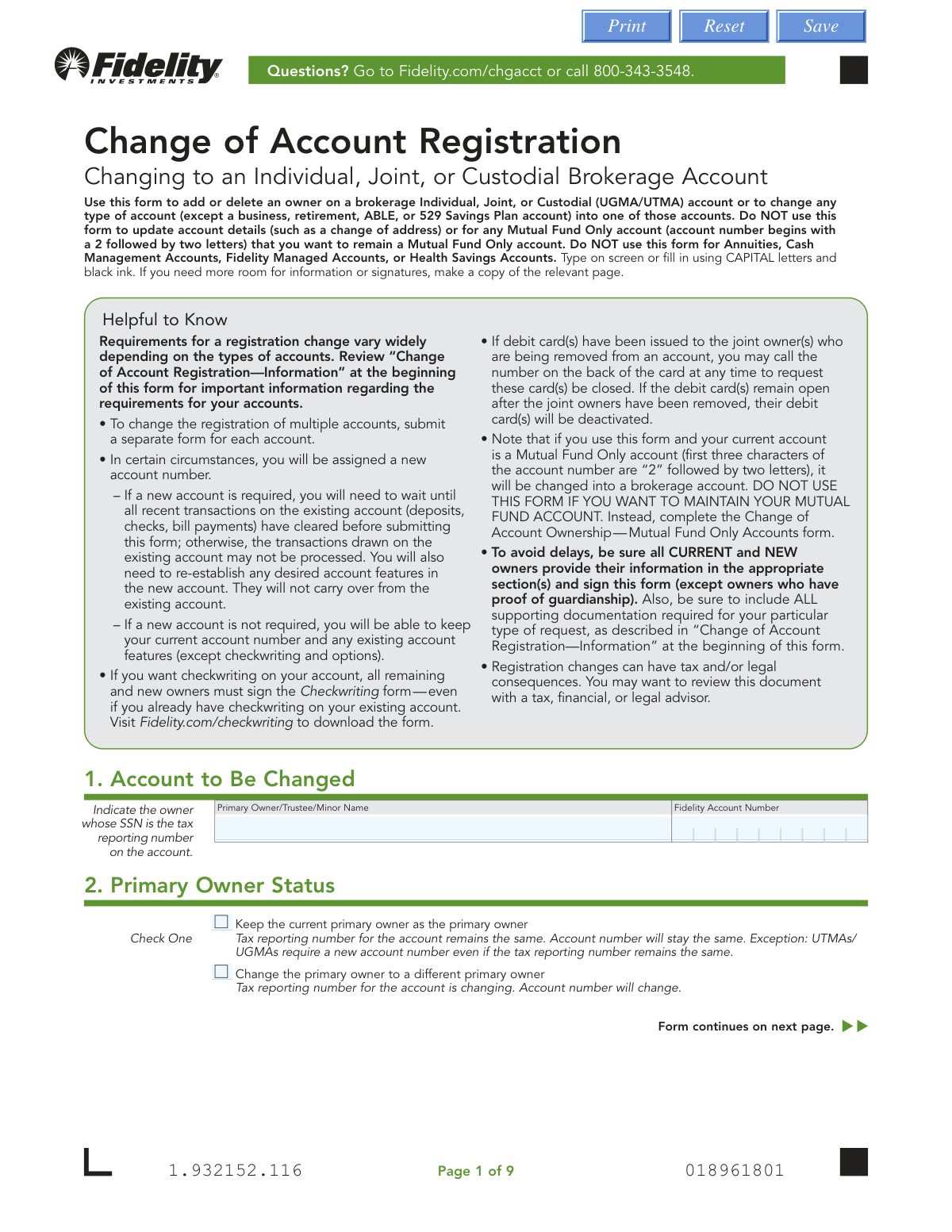
| 1. | Fidelity Change of Account Registration: Changing to an Individual, Joint, or Custodial Brokerage Account | 1 | Moderate 59 |
| 2. | Joint Account Agreement - Merrill Lynch | 1 | Simple 20 |
| 3. | Navy Federal Change of Information/Add Joint Owner (for primary account holders 18 and over) | 3 | Moderate 56 |
| 4. | Option Information — Individual, Joint and Trust Accounts | 1 | Moderate 56 |
| 5. | TIAA Brokerage Joint Transfer on Death Account Agreement | 1 | – |
- Enterprise-grade security & data encryption
- 99%+ accuracy powered by AI
- 1,000+ forms from all industries
- Complete forms in under 60 seconds
How to Choose the Right Form
Selecting the right joint account form depends on your specific financial institution and whether you are setting up a new account, modifying an existing one, or adding specialized features like investment permissions.
Adding a Co-Owner or Changing Account Type
If you already have an account and want to add a spouse or partner, or if you need to convert an individual account into a joint one, look for registration-specific forms:
- Navy Federal Change of Information/Add Joint Owner: Use this if you are a credit union member (18+) looking to update personal details or add a secondary owner to your existing Navy Federal accounts.
- Fidelity Change of Account Registration: Choose this form to transition a Fidelity brokerage account between Individual, Joint, or Custodial (UGMA/UTMA) statuses, or to add/remove owners from a non-retirement account.
Defining Legal Ownership and Rules
When opening a new brokerage account or formalizing how assets are managed between two people, you need a legal framework for the partnership:
- Joint Account Agreement - Merrill Lynch: This is the primary document for Merrill Lynch clients to define ownership types (such as Joint Tenants with Rights of Survivorship) and establish who is authorized to execute transactions.
Estate Planning and Beneficiaries
To ensure your joint assets pass directly to heirs without going through the probate process, you must designate specific beneficiaries:
- TIAA Brokerage Joint Transfer on Death Account Agreement: Use this for TIAA accounts to name primary and contingent beneficiaries. This ensures that assets are transferred directly to your loved ones upon the death of the last surviving account owner.
Specialized Trading Permissions
Joint accounts often require additional disclosures if you plan to engage in advanced investment strategies:
- Option Information — Individual, Joint and Trust Accounts: This form is required for any joint account holders who wish to be approved for options trading. It collects financial data and experience levels for all parties to determine risk suitability.
Form Comparison
| Form | Primary Purpose | Key Requirements | Account Type Focus |
|---|---|---|---|
| Fidelity Change of Account Registration: Changing to an Individual, Joint, or Custodial Brokerage Account | Modifying existing account registration to add or remove owners or change types. | Requires signatures from all current and new owners plus supporting legal documentation. | Non-retirement brokerage accounts including individual, joint, and custodial (UGMA/UTMA) types. |
| Joint Account Agreement - Merrill Lynch | Defining legal ownership rules and transaction authorization for multiple account holders. | Selection of ownership structure such as JTWROS or Tenants in Common (TIC). | Merrill Lynch joint investment and brokerage accounts. |
| Navy Federal Change of Information/Add Joint Owner (for primary account holders 18 and over) | Updating personal contact details or adding a joint owner to existing accounts. | Current personal information, SSN, and signatures for primary and new joint owners. | Credit union banking, savings, and checking accounts for adult members. |
| Option Information — Individual, Joint and Trust Accounts | Assessing investor suitability and risk tolerance for trading complex options contracts. | Detailed financial status, investment experience, and specific trading objectives. | Brokerage accounts held by individuals, joint owners, or legal trusts. |
| TIAA Brokerage Joint Transfer on Death Account Agreement | Designating beneficiaries to ensure smooth asset transfer and avoid the probate process. | Identification of primary and contingent beneficiaries and signatures from all joint owners. | Joint brokerage accounts specifically intended for Transfer on Death (TOD) registration. |
Tips for joint account forms
Choosing between Joint Tenants with Rights of Survivorship (JTWROS) and Tenants in Common (TIC) is a critical step. JTWROS typically ensures assets pass directly to the survivor, while TIC allows for specific ownership percentages that may pass to heirs, so clarify your preference before starting.
When adding a joint owner, double-check that names, addresses, and Social Security numbers match official government IDs exactly. Discrepancies between the primary and joint owner's data are a leading cause of processing delays or account freezes.
Most financial institutions require copies of government-issued IDs or proof of residency for all account holders listed on the form. Having these digital files ready before you start filling out the PDF will streamline the entire submission process.
AI-powered tools like Instafill.ai can complete these forms in under 30 seconds with high accuracy, and the data stays secure during the process. This is a practical time-saver for people managing multiple registrations or complex brokerage agreements.
Joint account forms often ask whether each owner can act independently or if both signatures are required for transactions. Carefully select the option that fits your partnership's needs to avoid future logistical hurdles when managing or moving funds.
For joint accounts, TOD instructions typically take effect only after the last surviving owner passes away. Be sure to clearly list both primary and contingent beneficiaries to ensure a smooth transition of assets and avoid the probate process.
Joint account forms almost always require signatures from every person being added, removed, or modified on the registration. Ensure all parties are available to sign the document, as missing signatures are the most common reason for form rejection.
Frequently Asked Questions
These forms are used to establish or modify legal ownership of a financial account between two or more individuals. They define how assets are managed, who has the authority to authorize transactions, and how ownership is handled in the event that one account holder passes away.
JTWROS is common for spouses because the surviving owner automatically inherits the deceased owner's share. In contrast, Tenants in Common allows owners to specify a percentage of ownership, and that share becomes part of the deceased owner's estate rather than transferring directly to the other account holder.
Yes, many institutions like Navy Federal and Fidelity provide specific forms to add an owner or change the account registration. You will typically need to provide the new owner's personal information, Social Security number, and a valid signature to complete the update.
Most agreements require the full names, physical addresses, dates of birth, and Social Security numbers for all parties involved. Depending on the institution, you may also need to provide government-issued identification or employment details for the new account holder.
Yes, forms such as a Transfer on Death (TOD) Agreement allow joint owners to name primary and contingent beneficiaries. This designation ensures that assets transfer directly to heirs upon the death of the last surviving owner, which can help your estate bypass the probate process.
AI tools like Instafill.ai can fill these forms in under 30 seconds by accurately extracting and placing data from your source documents. This technology helps ensure that complex fields are completed correctly without the need for manual data entry.
Brokerage firms are legally required to assess the risk tolerance and investment experience of all account owners before approving options trading. Forms like the Option Information document help the institution determine which levels of trading strategies are suitable for the joint account holders based on their collective financial profile.
Generally, all current and prospective account owners must sign the documents to authorize changes or the creation of a new account. For institutional forms from firms like Merrill Lynch or Fidelity, signatures must typically be original or verified through a secure electronic signature platform.
While manually filling out these multi-page documents can take 15 to 20 minutes, using an AI-powered service like Instafill.ai allows you to complete the process in under 30 seconds. The AI identifies the required fields and maps your information to the PDF accurately.
The outcome depends on the ownership type selected during the application process. In a JTWROS account, the assets typically transfer to the surviving owner; in a TIC account, the deceased's share is distributed according to their will or state law.
Adding a minor usually requires a Custodial Account (UGMA/UTMA) registration rather than a standard joint account. Financial institutions provide specific registration forms to handle these cases, ensuring the account is managed by an adult for the benefit of the minor.
Completed forms should be submitted directly to the financial institution that holds the account, such as Fidelity, Merrill Lynch, or Navy Federal. Many institutions allow for secure digital uploads through their member portals, while others may require the forms to be mailed or delivered to a local branch.
Glossary
- Form Complexity Index
- Instafill’s 0–100 measure of how much effort a form takes to complete, calculated deterministically from the form’s own structure rather than estimated. It combines the number of fillable fields (the largest factor), how difficult those fields are to complete based on their type, the number of pages that contain fields, the amount of conditional “fill-only-if” logic, and how many sections the form is divided into, then adds modifiers for tables and repeating lists, bundled instruction pages, and dense page layouts. A higher score means the form is harder to fill out by hand. The forms in this category have a median Form Complexity Index of 56/100 (Moderate). See exactly how it is calculated.
- JTWROS (Joint Tenants with Right of Survivorship)
- The most common form of joint ownership where, upon the death of one owner, their share of the account automatically passes to the surviving owner without going through probate.
- TIC (Tenants in Common)
- A joint account structure where each owner holds a specific percentage of the assets; if one owner dies, their portion is passed to their heirs rather than the other account holder.
- TOD (Transfer on Death)
- A legal designation that allows an account holder to name beneficiaries who will receive the account assets directly upon the death of the last surviving owner.
- Account Registration
- The legal title or name on an account that defines the ownership structure, such as whether it is held individually, jointly, or in a trust.
- UGMA/UTMA (Uniform Gifts/Transfers to Minors Act)
- Types of custodial accounts that allow an adult to manage assets for a minor until the minor reaches the legal age of majority in their state.
- Contingent Beneficiary
- A secondary person or entity designated to receive assets in the event that the primary beneficiary is deceased or unable to accept the transfer.
- Option Suitability
- A set of financial criteria, including risk tolerance and investment experience, used by brokers to determine if an account holder is qualified to trade complex financial derivatives.
- Primary Account Holder
- The lead individual on a joint account who is typically the main point of contact and whose tax identification information is often used for IRS reporting.