Fill out Massachusetts labor forms
with AI.
Massachusetts labor forms cover the official documents used to manage workplace rights, benefits, and disputes under state law. These forms are administered by agencies like the Department of Industrial Accidents (DIA) and are designed to ensure that workers, employers, and insurers follow proper legal procedures when issues arise on the job. Whether the matter involves a workplace injury, a compensation dispute, or a claim for survivor benefits, submitting the correct form — filled out completely and accurately — is essential to keeping the process moving forward.
By continuing, you acknowledge Instafill's Privacy Policy and agree to get occasional product update and promotional emails.
About Massachusetts labor forms
The forms in this category are most commonly needed by employees who have been injured at work, their dependents, or legal representatives acting on their behalf. For example, DIA Form 110 (Employee's Claim) is used to formally initiate a disputed workers' compensation claim, capturing everything from injury details and wage information to the specific benefits being sought. Getting these details right matters — incomplete or illegible submissions can delay or derail a claim entirely.
For anyone who finds government forms time-consuming or confusing, tools like Instafill.ai use AI to fill these forms accurately in under 30 seconds, and can even convert non-fillable PDFs into interactive forms, making the process significantly more manageable.
Every form on this page can be completed without typing. Instafill is form filling software that reads a PDF and fills it for you — including flat and scanned documents that carry no fillable fields at all.
Forms in This Category
The forms in this category have a median Form Complexity Index of 64/100 (Complex), measured across 1 forms by field count, input difficulty, length, conditional logic and structure. See how it is calculated.
| Form Name | Pages | FCI | |
|---|---|---|---|
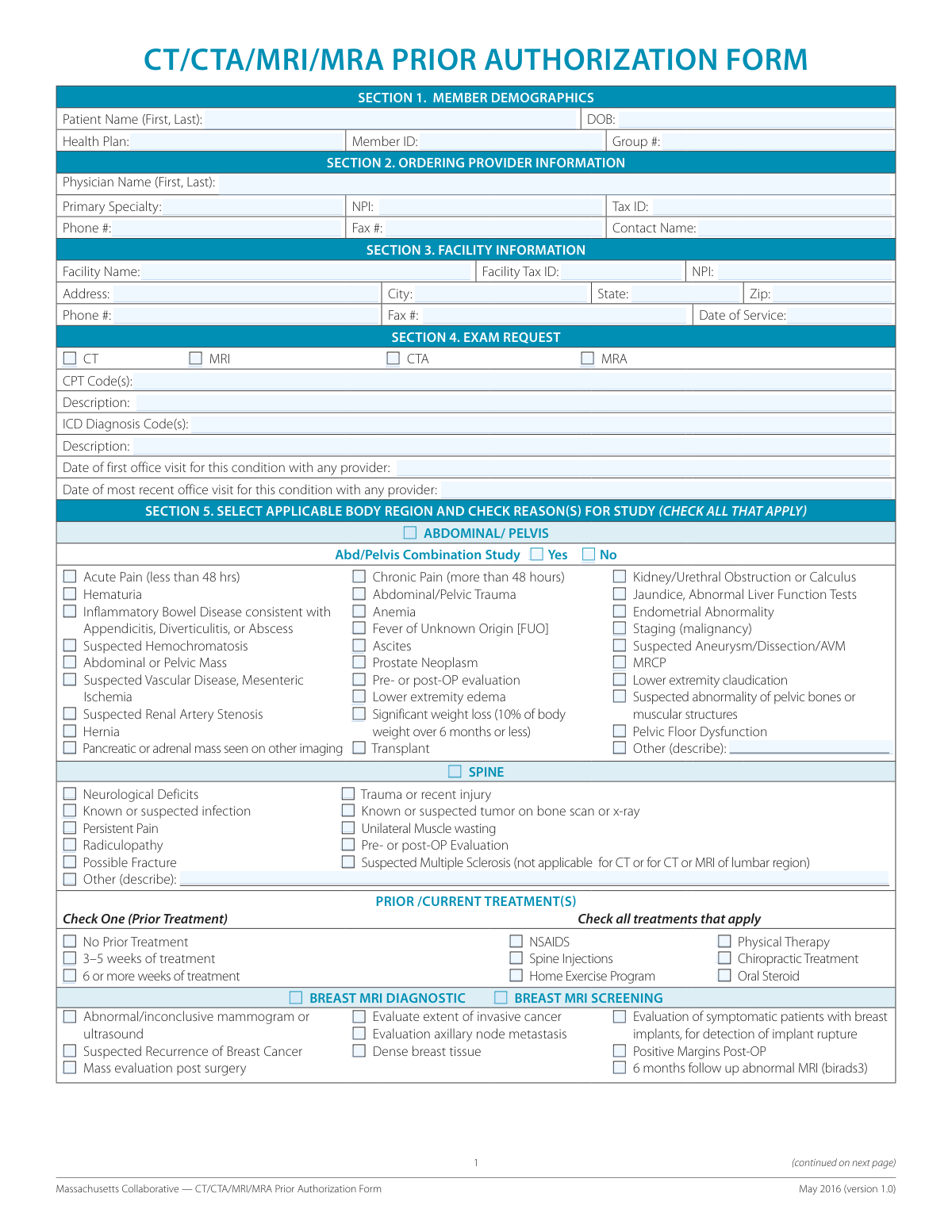
| 1. | Massachusetts Collaborative — CT/CTA/MRI/MRA Prior Authorization Form | 2 | Complex 64 |
- Enterprise-grade security & data encryption
- 99%+ accuracy powered by AI
- 1,000+ forms from all industries
- Complete forms in under 60 seconds
How to Choose the Right Form
Navigating Massachusetts labor and workplace requirements often involves coordinating medical care, especially in cases involving workers' compensation or occupational health. When advanced diagnostic imaging is required, having the correct documentation is essential to ensure that procedures are approved by insurance carriers without delay.
Diagnostic Imaging and Prior Authorization
If your situation involves a medical necessity for advanced imaging, you will likely need the Massachusetts Collaborative — CT/CTA/MRI/MRA Prior Authorization Form. This document is the standard tool used by healthcare providers across the Commonwealth to request approval for:
- CT and CTA Scans: Often required for detailed bone injuries or vascular assessments following a workplace accident.
- MRI and MRA Scans: Essential for soft tissue injuries, such as ligament tears or neurological evaluations.
Who Should Use This Form?
- Healthcare Providers: Physicians and clinical staff must complete this form to provide clinical evidence and medical necessity to a patient’s health plan. This is the primary document used to avoid the administrative burden of claim denials.
- Patients and Employees: While typically initiated by a doctor, patients involved in labor-related injury claims may need to ensure this form is submitted to their employer's insurance carrier to guarantee that specialized diagnostic tests are covered.
Why Accuracy Matters
Filling out the Massachusetts Collaborative — CT/CTA/MRI/MRA Prior Authorization Form incorrectly can lead to immediate claim denials, delayed treatment, and complicated billing disputes. Because these forms require specific clinical data and CPT codes, using an AI-powered tool like Instafill.ai can help ensure that all fields are populated accurately. Whether you are dealing with a standard PDF or a non-fillable scan, our platform converts these documents into interactive, easy-to-complete forms, saving significant time for busy medical offices and HR departments managing labor-related health claims.
Form Comparison
| Form | Primary Purpose | Service Coverage | Who Completes It |
|---|---|---|---|
| Massachusetts Collaborative — CT/CTA/MRI/MRA Prior Authorization Form | Obtaining medical insurance authorization for advanced diagnostic imaging procedures. | Advanced imaging services including CT, CTA, MRI, and MRA scans. | Medical professionals or administrative staff at a healthcare provider's office. |
Tips for Massachusetts labor forms
Ensure all entries for pay rates and hours worked align with the Massachusetts Minimum Wage Act. Errors in these numeric fields are the leading cause of processing delays and can trigger unnecessary state audits.
Massachusetts law generally requires employers to keep payroll and labor records for a minimum of three years. Having these documents organized makes it significantly easier to verify the information you input into state labor forms.
Massachusetts has strict criteria for classifying workers as independent contractors versus employees. Before filing labor-related insurance or tax forms, confirm your worker classifications to avoid misfiling penalties and legal complications.
Many labor forms, such as workers' compensation reports or wage complaints, require signatures from multiple parties. Incomplete signatures are a primary reason forms are returned or rejected by the Department of Labor Relations.
Managing high volumes of employment paperwork can be overwhelming, but AI-powered tools like Instafill.ai can complete these forms in under 30 seconds with high accuracy. Your data stays secure during the process, making it a reliable way to streamline your HR or legal workflows.
Most labor and workforce forms require your specific state-issued employer account number (EAN). Omitting this or using your Federal EIN instead can lead to the form being filed under the wrong entity or being rejected entirely.
Ensure that the data provided on Massachusetts labor forms matches your federal filings, such as the W-2 or Form 941. Discrepancies between state and federal records can trigger reconciliation requests from tax authorities.
Frequently Asked Questions
Common forms include wage and hour complaints, unemployment insurance applications, and workplace safety reports. These documents are generally managed by state agencies like the Massachusetts Department of Labor Standards or the Department of Unemployment Assistance to ensure regulatory compliance.
Responsibility varies depending on the document; employers typically handle tax and insurance filings, while employees may need to file specific forms for wage disputes or leave requests. It is important to review the specific instructions for each form to determine who is legally required to sign and submit it.
Submission locations depend on the specific form type, ranging from online portals managed by state agencies to physical mail-in addresses. Many modern Massachusetts labor forms are now processed through centralized digital systems to ensure faster review and tracking.
The required form usually depends on the nature of the employment issue, such as a wage claim, a request for family leave, or a workplace injury report. Reviewing the guidance provided by the Massachusetts Executive Office of Labor and Workforce Development can help clarify which document fits your current needs.
Yes, employees can use specific complaint forms to report violations regarding minimum wage, overtime, or unsafe working conditions. These forms are typically reviewed by the Attorney General’s Fair Labor Division to ensure that state workplace rights are being upheld.
Filing frequency depends on the specific requirement; some forms are one-time submissions for specific incidents, while others, like quarterly tax or payroll reports, follow a strict recurring schedule. Always refer to the official filing instructions to avoid missing important deadlines.
Yes, you can fill out Massachusetts labor forms using AI technology. AI tools like Instafill.ai can fill these forms in under 30 seconds by accurately extracting and placing data from your source documents directly into the correct fields.
Using traditional manual methods, these forms can take a significant amount of time to complete accurately. However, with AI-powered automation, the process is streamlined, allowing users to finish even complex labor forms in less than half a minute.
Submitting inaccurate information can lead to processing delays, claim denials, or potential legal complications. It is vital to double-check all data before submission to ensure it matches your official records and source documentation.
Most Massachusetts state agencies now accept electronic signatures on labor and employment documents to facilitate faster digital processing. This allows for a completely paperless workflow from the initial completion of the form to the final submission.
The most current versions are usually hosted on official state websites like Mass.gov or through authorized digital document platforms. Using an online tool that maintains an updated library ensures you are not submitting an outdated version of a required form.
Glossary
- Form Complexity Index
- Instafill’s 0–100 measure of how much effort a form takes to complete, calculated deterministically from the form’s own structure rather than estimated. It combines the number of fillable fields (the largest factor), how difficult those fields are to complete based on their type, the number of pages that contain fields, the amount of conditional “fill-only-if” logic, and how many sections the form is divided into, then adds modifiers for tables and repeating lists, bundled instruction pages, and dense page layouts. A higher score means the form is harder to fill out by hand. The forms in this category have a median Form Complexity Index of 64/100 (Complex). See exactly how it is calculated.
- Prior Authorization
- A mandatory process where a healthcare provider obtains approval from an insurance payer or workers' compensation board before a specific procedure is performed to ensure coverage.
- Medical Necessity
- The clinical documentation and evidence provided by a physician to prove that a specific diagnostic test is required to treat or diagnose a patient's condition.
- CPT Code
- Current Procedural Terminology codes are five-digit numeric sequences used to identify and bill for specific medical, surgical, and diagnostic services.
- ICD-10 Code
- A standardized system of diagnostic codes used to classify every disease, injury, and symptom, which justifies why a specific imaging test is being requested.
- NPI (National Provider Identifier)
- A unique 10-digit identification number issued to healthcare providers in the United States, required for identification on all administrative and financial forms.
- Referring Provider
- The physician or clinician who initially evaluated the patient and recommended the advanced imaging study to be performed by a specialist.
- CTA/MRA
- Specialized imaging techniques (Computed Tomography Angiography and Magnetic Resonance Angiography) that focus specifically on viewing the body's blood vessels.
- Massachusetts Collaborative
- A group of Massachusetts health plans and provider organizations that developed standardized forms to simplify and unify the prior authorization process across the state.