Fill out network provider forms
with AI.
Network provider forms are the essential gateway for healthcare professionals—specifically dentists and specialists—to join insurance networks. These documents facilitate the credentialing process, ensuring that providers meet the necessary qualifications, licensure, and safety standards required by insurance carriers. By completing these applications, practices can expand their patient base by becoming "in-network," which often leads to increased patient volume and streamlined billing processes. Notable examples include applications for the Aetna Dental Provider Network or the GEHA Connection Dental Network.
By continuing, you acknowledge Instafill's Privacy Policy and agree to get occasional product update and promotional emails.
About network provider forms
Typically, these forms are required by dental practice owners, individual practitioners, and office administrators during the onboarding phase of a new insurance partnership or during periodic re-credentialing. The process involves detailing professional history, education, malpractice insurance coverage, and practice location specifics. Whether you are a new graduate setting up a practice or an established clinic looking to join a network like Ameritas, accuracy is paramount. Incomplete or incorrect data can lead to significant delays in approval, potentially affecting your ability to treat certain insured patients.
Managing the administrative burden of these multi-page documents can be time-consuming for busy medical offices. Tools like Instafill.ai use AI to fill these forms in under 30 seconds, ensuring that data is handled accurately and securely while saving staff hours of manual entry. This allows providers to focus more on patient care rather than the complexities of insurance paperwork.
Every form on this page can be completed without typing. Instafill is form filling software that reads a PDF and fills it for you — including flat and scanned documents that carry no fillable fields at all.
Forms in This Category
The forms in this category have a median Form Complexity Index of 76/100 (Complex), measured across 4 forms by field count, input difficulty, length, conditional logic and structure. See how it is calculated.
| Form Name | Pages | FCI | |
|---|---|---|---|
| 1. | Aetna Dental Provider Network Application (CAQH) | 2 | Basic 33 |
| 2. | Ameritas Dental Network Application (Form AM 202) | 4 | Complex 76 |
| 3. | Connection Dental Network – Provider Application | 7 | Very Complex 92 |
| 4. | Connection Dental Network – Provider Application (GEHA Connection Dental Network) and Participating Provider Agreement | 14 | Moderate 46 |
- Enterprise-grade security & data encryption
- 99%+ accuracy powered by AI
- 1,000+ forms from all industries
- Complete forms in under 60 seconds
How to Choose the Right Form
Selecting the correct network provider form is the first step toward expanding your patient base and becoming an in-network provider. Because each insurance carrier has unique credentialing requirements, your choice depends on the specific network you wish to join and whether you are submitting a simple application or a full contractual agreement.
Carrier-Specific Network Applications
If you are looking to join a specific national network, choose the application that matches the insurance carrier:
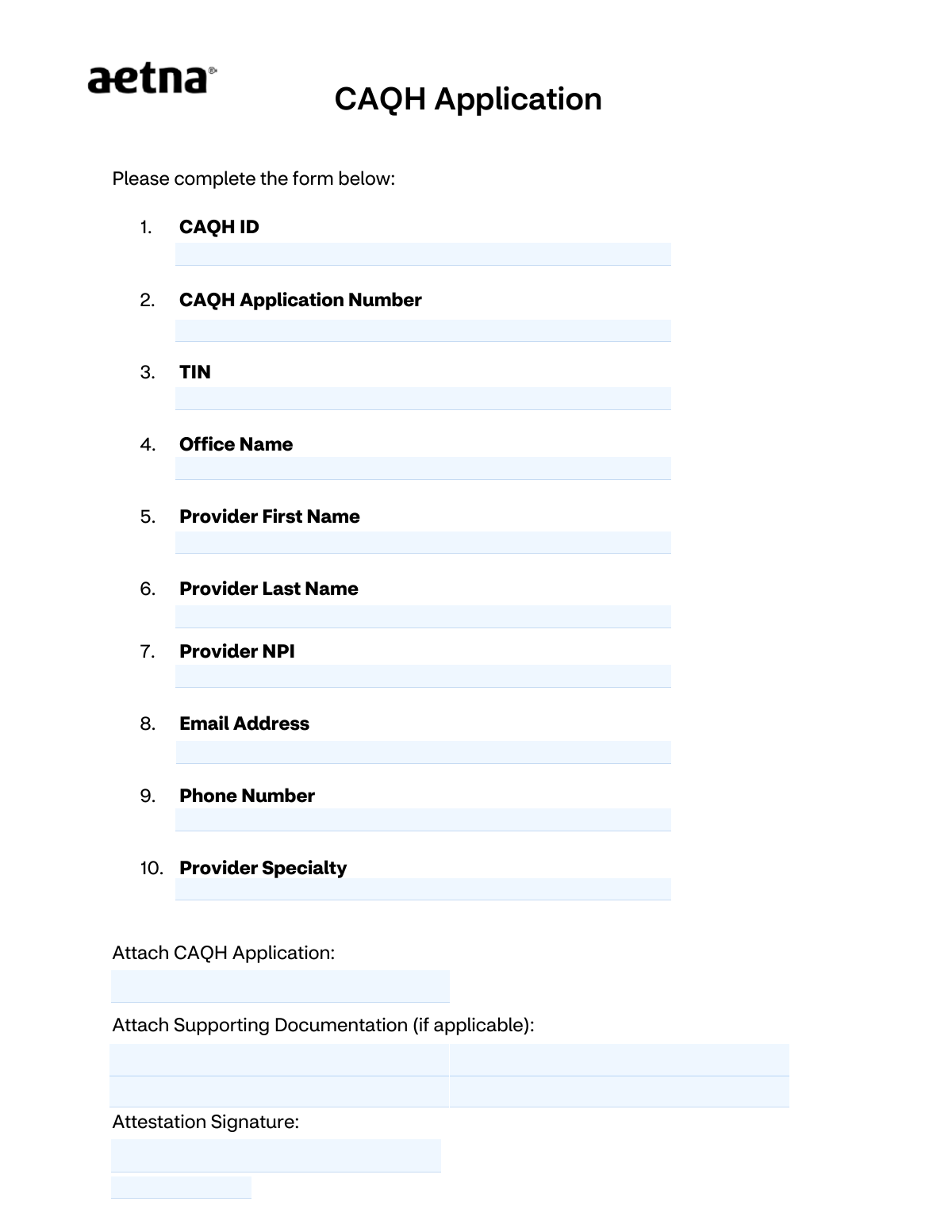
- Aetna Dental Provider Network Application (CAQH): Select this form if you are applying to the Aetna network. It is designed to streamline the process for providers who use the CAQH system, focusing on your NPI, TIN, and existing credentialing data.
- Ameritas Dental Network Application (Form AM 202): Use this document for joining the Ameritas provider network. This is a practice-level application that requires detailed information regarding practice ownership, office locations, and staff credentials.
GEHA and Connection Dental Network Options
If you are applying to the GEHA Connection Dental Network, you must decide between a standalone application and a full enrollment packet:
- Connection Dental Network – Provider Application: This is the standard choice for dentists and specialists who need to submit their education, licensure, and five-year work history for credentialing review.
- Connection Dental Network – Provider Application (GEHA Connection Dental Network) and Participating Provider Agreement: Choose this version if you are ready to finalize your participation. This comprehensive packet includes the Participating Provider Agreement, which outlines the legal and financial terms of your contract, including reimbursement schedules and compliance obligations.
Tips for a Faster Credentialing Process
Regardless of the form you choose, ensure you have your NPI, state license details, and malpractice insurance coverage information ready. Using Instafill.ai can help you accurately populate complex sections—such as the five-year work history or practice location data—ensuring your submission is complete and reducing the risk of processing delays.
Form Comparison
| Form | Network Focus | Primary Requirements | Included Components |
|---|---|---|---|
| Aetna Dental Provider Network Application (CAQH) | Aetna Dental network | Requires CAQH ID, National Provider Identifier (NPI), and Tax ID. | Standard application for network credentialing and contracting processes. |
| Ameritas Dental Network Application (Form AM 202) | Ameritas Dental network | Includes practice owner info, office locations, and quality assurance standards. | Detailed practice application for becoming an in-network provider. |
| Connection Dental Network – Provider Application | GEHA Connection Dental Network | Focuses on education, licensure, and a five-year work history. | Comprehensive credentialing form for dentists and dental specialists. |
| Connection Dental Network – Provider Application (GEHA Connection Dental Network) and Participating Provider Agreement | GEHA Connection Dental Network | Requires malpractice coverage details and signed attestation for verification. | Dual-purpose packet containing both credentialing application and legal provider agreement. |
Tips for network provider forms
Before starting, gather your National Provider Identifier (NPI), Tax Identification Number (TIN), and CAQH provider ID. Having these numbers ready prevents interruptions and ensures the core data points used for credentialing are consistent across multiple network applications.
Many network applications require a continuous five-year work history without any unexplained breaks. If you took time off for education or personal reasons, include a brief note to account for those periods to avoid manual review delays.
Ensure your professional liability insurance is current and meets the specific coverage limits required by the dental network. You will need to provide the policy number and expiration date exactly as they appear on your certificate of insurance.
AI-powered tools like Instafill.ai can complete these complex provider forms in under 30 seconds with high accuracy. Your practice data stays secure during the process, providing a massive time-saving advantage when applying to multiple networks like Aetna and Ameritas.
If you practice at multiple offices, ensure the contact information and billing details for each site are clearly distinguished. Errors in office addresses can lead to incorrect provider directory listings and significant issues with future claim reimbursements.
Ensure the information you provide matches what is currently listed in your CAQH profile and the NPI registry. Discrepancies between your application and these national databases can trigger secondary audits and slow down your network approval process.
The packet often includes a legal agreement that defines reimbursement rules and compliance obligations. Carefully read the fee schedule and termination provisions before signing the attestation to ensure the contract aligns with your practice's operational goals.
Frequently Asked Questions
Network provider forms are used by healthcare professionals, such as dentists and specialists, to apply for participation in an insurance company's provider network. These documents facilitate the credentialing process by verifying the provider's education, licensing, and professional history to ensure they meet the network's standards.
Typically, the individual healthcare provider or a practice administrator on their behalf must complete these forms. Every practitioner who intends to treat patients under a specific insurance plan as an 'in-network' provider must submit their own application and agreement to the payer.
The form you need depends on the specific insurance company or network you wish to join, such as Aetna, Ameritas, or GEHA. You should select the form that corresponds to the specific payer network your practice intends to accept or the contract you have been invited to join.
Most network applications require your National Provider Identifier (NPI), Tax Identification Number (TIN), state dental license details, and professional liability insurance coverage. You may also need to provide a comprehensive education history and details regarding all current practice locations.
The Council for Affordable Quality Healthcare (CAQH) provides a centralized database where providers can store their credentialing information. Many insurance networks use this ID to pull your data automatically, which can significantly reduce the amount of manual entry required on the network's specific application form.
Many networks, such as the Connection Dental Network, require a continuous five-year work history. If you have any gaps in employment or practice during that period, you are usually required to provide a brief written explanation for those gaps to satisfy credentialing requirements.
Completed forms are generally submitted to the credentialing or provider relations department of the respective insurance company. Submission methods vary by company and may include secure online portals, encrypted email, or traditional mail.
Yes, network provider forms can be filled out using AI tools like Instafill.ai. These tools can accurately extract data from your source documents—like your CV, licenses, or insurance certificates—and place it into the correct fields on the PDF application, reducing manual entry errors.
While manual completion of these complex forms can take an hour or more, AI-powered services can fill them in under 30 seconds. This technology automates the data mapping process, allowing you to review the information and finalize the document much faster.
A Participating Provider Agreement is a legal contract included with some applications that outlines the terms of your relationship with the insurance network. It covers important details like reimbursement rates, fee schedules, and the legal obligations of both the provider and the insurance network.
Yes, proof of active professional liability (malpractice) insurance is a standard requirement for all network provider applications. You will typically need to provide the policy number, coverage limits, and expiration dates to prove you meet the network's minimum coverage requirements.
After submission, the insurance company's credentialing committee will review your information and verify your background through primary sources. Once approved, you will receive a notification and an effective date for when you can begin seeing patients as an in-network provider.
Glossary
- Form Complexity Index
- Instafill’s 0–100 measure of how much effort a form takes to complete, calculated deterministically from the form’s own structure rather than estimated. It combines the number of fillable fields (the largest factor), how difficult those fields are to complete based on their type, the number of pages that contain fields, the amount of conditional “fill-only-if” logic, and how many sections the form is divided into, then adds modifiers for tables and repeating lists, bundled instruction pages, and dense page layouts. A higher score means the form is harder to fill out by hand. The forms in this category have a median Form Complexity Index of 76/100 (Complex). See exactly how it is calculated.
- NPI (National Provider Identifier)
- A unique 10-digit identification number issued to health care providers in the United States by the Centers for Medicare and Medicaid Services (CMS).
- Credentialing
- The formal process of verifying a healthcare professional's education, training, experience, and license to ensure they meet the standards for participation in a provider network.
- CAQH (Council for Affordable Quality Healthcare)
- A non-profit alliance that maintains a centralized database where providers can upload and share their professional information with multiple insurance companies simultaneously.
- TIN (Tax Identification Number)
- A nine-digit number used by the IRS to identify a business entity or individual for tax purposes, often required for processing insurance reimbursements.
- Participating Provider Agreement
- A legally binding contract between a healthcare provider and an insurance network that outlines the terms of service, reimbursement rates, and compliance obligations.
- PPO (Preferred Provider Organization)
- A type of health insurance plan that contracts with a network of doctors and hospitals to provide services at a reduced rate to the plan's members.
- DEA Number
- A registration number assigned to a healthcare provider by the U.S. Drug Enforcement Administration that allows them to write prescriptions for controlled substances.
- Attestation
- A formal statement or signature on an application where the provider certifies that all information provided is true, accurate, and complete to the best of their knowledge.