Fill out odometer disclosure forms
with AI.
Odometer disclosure forms are legally required documents used during the sale or transfer of a motor vehicle to certify the vehicle's mileage at the time of the transaction. Federal law mandates this disclosure to protect buyers from odometer fraud — a practice that costs consumers billions of dollars annually. These forms establish whether the odometer reading reflects the vehicle's actual mileage, whether the odometer has exceeded its mechanical limits, or whether the reading is known to be inaccurate. Falsifying this information can result in serious penalties, including fines and imprisonment.
By continuing, you acknowledge Instafill's Privacy Policy and agree to get occasional product update and promotional emails.
About odometer disclosure forms
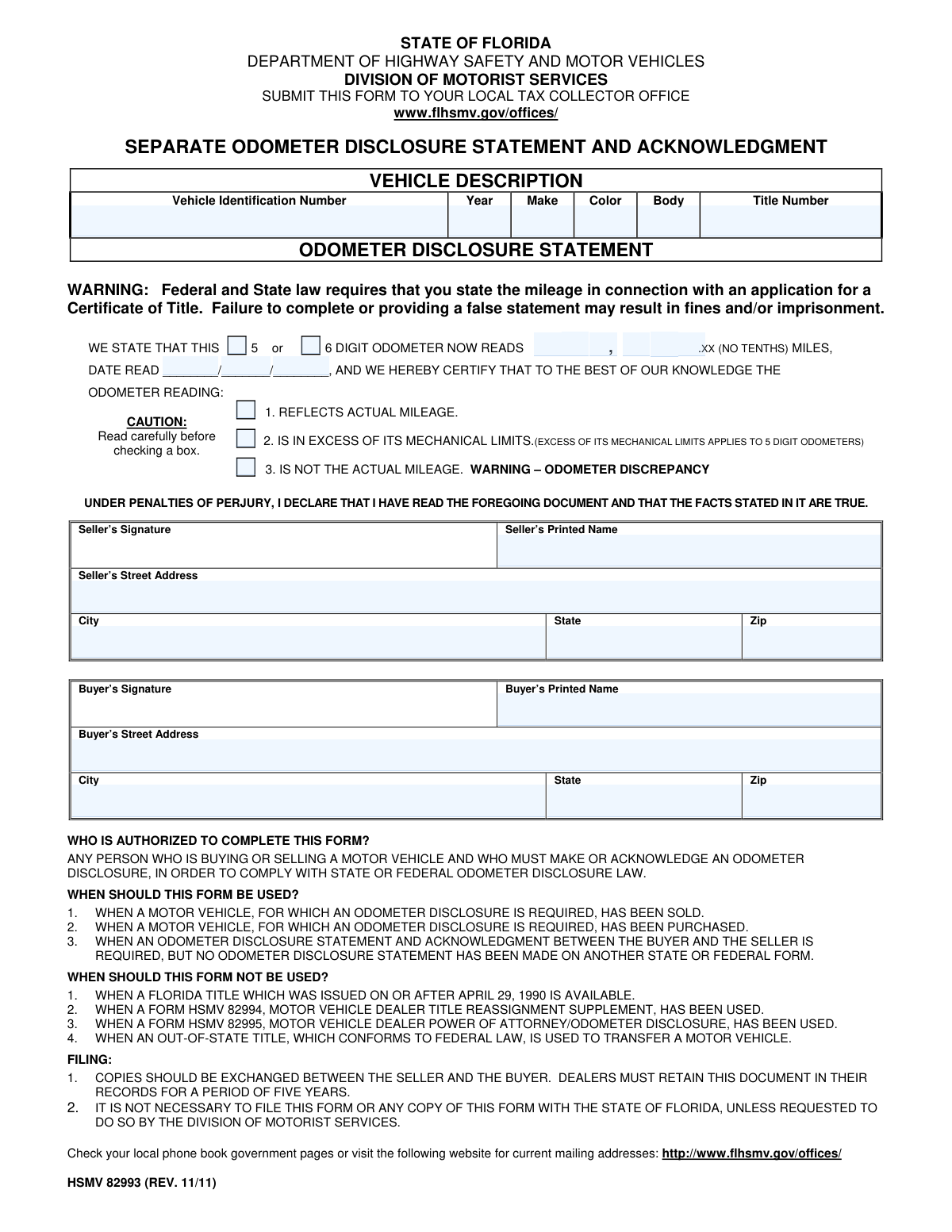
Anyone buying or selling a motor vehicle in Florida may need to complete an odometer disclosure as part of the title transfer process. The FLHSMV Form HSMV 82993, for example, is specifically used in Florida when an odometer disclosure hasn't been captured on another qualifying state or federal form. Private sellers, dealerships, and buyers alike should understand when and how to use these documents correctly, as they are typically required when applying for a Certificate of Title.
Filling out these forms accurately is important — errors or omissions can delay a title transfer or create legal complications. Tools like Instafill.ai use AI to complete odometer disclosure forms in under 30 seconds, helping sellers and buyers get the paperwork right without the hassle.
Every form on this page can be completed without typing. Instafill is form filling software that reads a PDF and fills it for you — including flat and scanned documents that carry no fillable fields at all.
Forms in This Category
The forms in this category have a median Form Complexity Index of 39/100 (Basic), measured across 1 forms by field count, input difficulty, length, conditional logic and structure. See how it is calculated.
- Enterprise-grade security & data encryption
- 99%+ accuracy powered by AI
- 1,000+ forms from all industries
- Complete forms in under 60 seconds
How to Choose the Right Form
In the state of Florida, documenting a vehicle’s mileage is a legal requirement during any transfer of ownership. Failure to provide an accurate reading can result in significant delays with the Florida Department of Highway Safety and Motor Vehicles (FLHSMV) or even legal penalties.
When to Use Form HSMV 82993
The primary document in this category is Form HSMV 82993, Separate Odometer Disclosure Statement and Acknowledgment. You should choose this form if:
- The Title is Missing Disclosure Space: You are buying or selling a motor vehicle and the mileage disclosure was not already completed on the back of the vehicle's Certificate of Title or a federal form.
- Standalone Certification is Required: You are applying for a new Certificate of Title and need a separate, dedicated document to certify the mileage to the FLHSMV.
- Correcting Records: You need a formal acknowledgment signed by both the buyer and seller to verify the odometer reading under penalties of perjury.
Understanding Mileage Statuses
When filling out Form HSMV 82993, you must accurately categorize the mileage under one of three specific statuses to ensure the vehicle title is processed correctly:
1. Actual Mileage: The odometer reflects the true distance the vehicle has traveled.
2. Exceeds Mechanical Limits: The odometer has rolled over (common in older vehicles with five-digit displays).
3. Not Actual Mileage: The odometer reading is known to be incorrect, broken, or has been tampered with.
When This Form is Not Necessary
You generally do not need to use this separate form if the odometer disclosure has already been recorded on a qualifying Florida title or specific dealer forms. This document serves as a supplement to ensure federal and state disclosure laws are met when other primary documents lack the necessary certification space.
Before you begin, ensure you have the Vehicle Identification Number (VIN), the current odometer reading, and the contact information for both the buyer and the seller ready for input.
Form Comparison
| Form | Primary Purpose | Key Requirements | When to Use |
|---|---|---|---|
| State of Florida Department of Highway Safety and Motor Vehicles (FLHSMV) Form HSMV 82993, Separate Odometer Disclosure Statement and Acknowledgment | Documents and certifies vehicle mileage accuracy during a sale for title applications. | Requires signatures from both seller and buyer under penalty of perjury. | Used specifically when odometer disclosure is not already recorded on other title documents. |
Tips for odometer disclosure forms
Before completing the form, double-check that the Vehicle Identification Number (VIN) matches the physical plate on the vehicle's dashboard. A single character error can lead to the rejection of your title application by the Florida DMV.
Correctly identify if the mileage is 'Actual,' 'Exceeds Mechanical Limits,' or 'Not Actual.' Checking the wrong box can cause legal complications or decrease the perceived value of the vehicle during future resale.
Only use Form HSMV 82993 if the odometer disclosure has not already been recorded on the vehicle's title or other official state forms. Using this separate statement when the title already contains the disclosure may be considered redundant by the FLHSMV.
An odometer disclosure is an agreement between the buyer and seller. Ensure both the transferor and transferee sign and print their names clearly; missing signatures are the most common reason for processing delays.
Manually typing vehicle details is prone to errors. AI-powered tools like Instafill.ai can complete these forms in under 30 seconds with high accuracy, and your data stays secure during the process, making it a major time-saver for dealerships or frequent sellers.
The Florida DMV typically will not accept odometer forms that contain strike-throughs, white-out, or alterations in the mileage section. If a mistake is made, it is best practice to start over with a clean form to maintain the document's integrity.
Always make a digital or physical copy of the signed disclosure for your personal files. This provides a vital paper trail in case of future disputes regarding the vehicle's mileage or condition at the time of sale.
Frequently Asked Questions
These forms serve as a legal certification of a vehicle's mileage at the time of a sale or title transfer. They are mandated by both federal and state laws to prevent odometer fraud and ensure that buyers have an accurate record of a vehicle's history.
In Florida, a separate form like the HSMV 82993 is used when the odometer disclosure has not already been recorded on the vehicle's title or another qualifying state or federal document. It is typically required during an application for a Certificate of Title to ensure all mileage data is officially documented.
Both the seller (transferor) and the buyer (transferee) must participate in completing the form. The seller is responsible for providing the current odometer reading and certifying its accuracy, while the buyer must sign to acknowledge the disclosure.
The disclosure form includes specific checkboxes to indicate the status of the mileage. You can specify if the reading reflects the actual mileage, if it exceeds the mechanical limits of the odometer (such as a rollover), or if the reading is not the actual mileage and should not be relied upon.
Once the form is signed by both parties, it should be submitted to the Florida Department of Highway Safety and Motor Vehicles (FLHSMV) or your local county tax collector's office. It is usually filed as part of the documentation package when applying for a new vehicle title.
Yes, providing false statements on an odometer disclosure form is a violation of state and federal law. Because these forms are signed under penalties of perjury, inaccuracies can lead to severe legal consequences, including fines and potential imprisonment.
Yes, AI tools like Instafill.ai can be used to fill out these forms efficiently. The AI can accurately extract vehicle identification numbers and mileage data from your source documents and place them into the correct fields on the form automatically.
Using an AI-powered tool, you can complete odometer disclosure forms in under 30 seconds. The technology streamlines the process by identifying necessary data points from your documents, which minimizes manual typing and reduces the risk of errors.
While most motor vehicles require a disclosure, certain exemptions may apply based on the vehicle's age, weight, or type. You should consult the latest FLHSMV guidelines to determine if your specific vehicle is exempt from federal and state mileage reporting requirements.
To accurately complete the form, you will need the vehicle's year, make, body type, and Vehicle Identification Number (VIN). You must also provide the current odometer reading exactly as it appears on the dashboard at the time of the transfer.
Glossary
- Form Complexity Index
- Instafill’s 0–100 measure of how much effort a form takes to complete, calculated deterministically from the form’s own structure rather than estimated. It combines the number of fillable fields (the largest factor), how difficult those fields are to complete based on their type, the number of pages that contain fields, the amount of conditional “fill-only-if” logic, and how many sections the form is divided into, then adds modifiers for tables and repeating lists, bundled instruction pages, and dense page layouts. A higher score means the form is harder to fill out by hand. The forms in this category have a median Form Complexity Index of 39/100 (Basic). See exactly how it is calculated.
- Actual Mileage
- The true distance a vehicle has traveled, as recorded by a functioning odometer that has not been tampered with or rolled over.
- Exceeds Mechanical Limits
- A status used when a vehicle's odometer has reached its maximum display capacity, such as 99,999 miles, and has restarted at zero.
- Not Actual Mileage (NAM)
- A certification indicating the odometer reading is inaccurate due to a mechanical malfunction, odometer replacement, or other known discrepancies.
- FLHSMV
- The Florida Department of Highway Safety and Motor Vehicles, the state agency that oversees vehicle titles, registrations, and odometer disclosures.
- Transferor
- The person or business selling or giving away the vehicle who is legally required to disclose the current mileage.
- Transferee
- The person or business buying or receiving the vehicle who must sign the form to acknowledge the mileage disclosed by the seller.
- VIN (Vehicle Identification Number)
- A unique 17-digit serial number found on the vehicle and used to identify it on all state and federal disclosure forms.
- Certificate of Title
- A state-issued legal document that proves ownership of a vehicle and is the primary record for mileage updates during a transfer.