Fill out Pennsylvania court forms
with AI.
Pennsylvania court forms, particularly those issued by the Administrative Office of Pennsylvania Courts (AOPC), serve as the essential bridge between citizens and the judicial system. These documents are necessary for initiating legal actions, such as filing a civil complaint to recover damages or requesting fee waivers due to financial hardship. Whether you are dealing with a Magisterial District Court or the Court of Common Pleas, using the correct standardized forms ensures that your case is processed without administrative delays and that all necessary legal disclosures are met.
By continuing, you acknowledge Instafill's Privacy Policy and agree to get occasional product update and promotional emails.
About Pennsylvania court forms
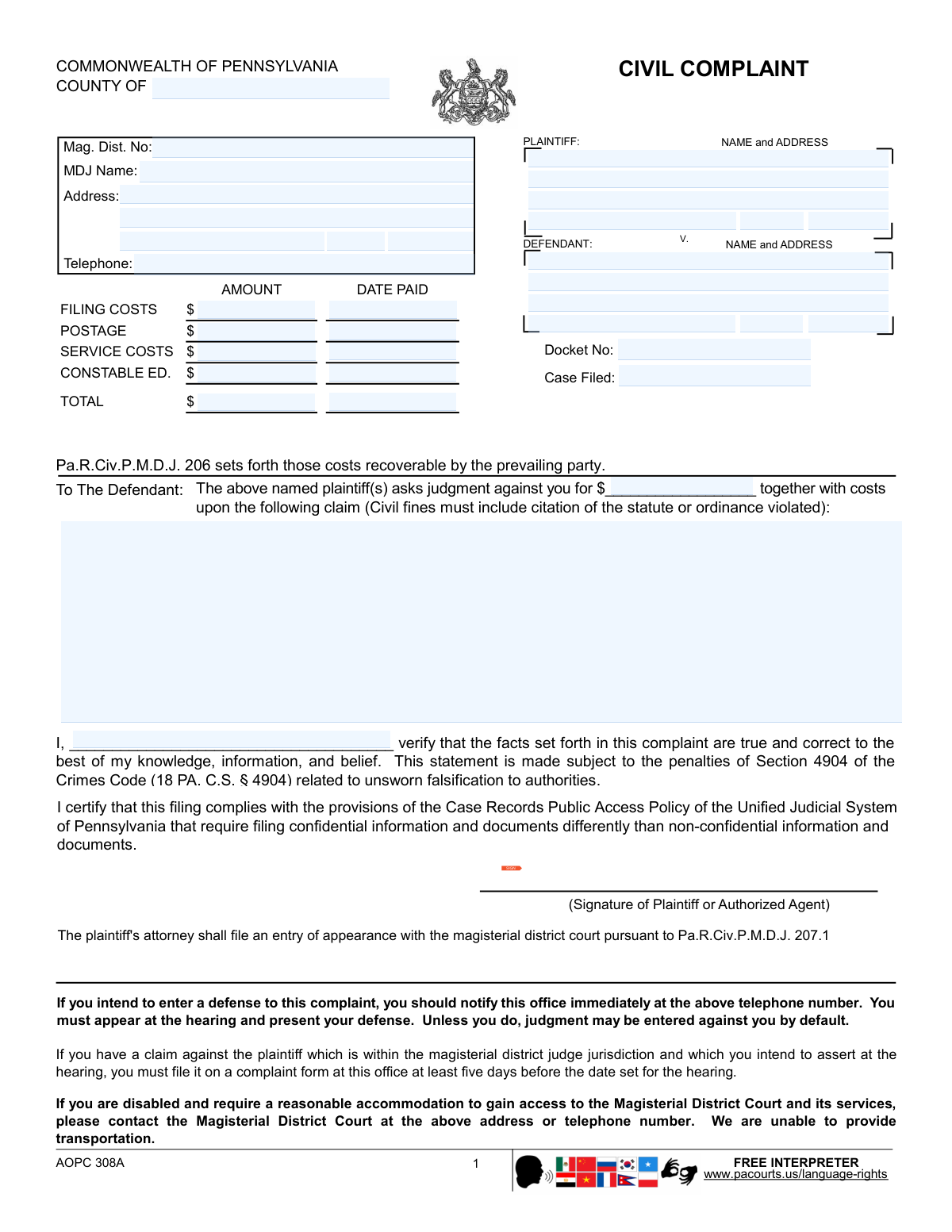
These forms are typically utilized by self-represented litigants, small business owners, and individuals navigating civil disputes. For instance, a plaintiff might use a Civil Complaint (Form AOPC 308A) to start a lawsuit, while those facing financial constraints often file an In Forma Pauperis petition to request a waiver of filing fees. Because these documents often require detailed financial disclosures or precise legal claims, accuracy is paramount to avoid penalties for unsworn falsification or having a petition denied.
Navigating the complexities of legal paperwork can be daunting, but digital tools have made the process significantly more efficient. Tools like Instafill.ai use AI to fill these Pennsylvania court forms in under 30 seconds, ensuring data is handled accurately and securely while saving you the time of manual entry. This allows you to focus on the merits of your legal situation rather than the technicalities of document preparation.
Every form on this page can be completed without typing. Instafill is form filling software that reads a PDF and fills it for you — including flat and scanned documents that carry no fillable fields at all.
Forms in This Category
The forms in this category have a median Form Complexity Index of 76/100 (Complex), measured across 4 forms by field count, input difficulty, length, conditional logic and structure. See how it is calculated.
| Form Name | Pages | FCI | |
|---|---|---|---|
| 1. | AOPC 308A, Civil Complaint | 1 | Moderate 51 |
| 2. | In Forma Pauperis Affidavit Petition (AOPC 622A) — Pennsylvania Magisterial District Court | 7 | Complex 76 |
| 3. | In Forma Pauperis Affidavit/Petition (AOPC 622A) – Pennsylvania Magisterial District Court | 7 | Complex 78 |
| 4. | Petition for Leave to Proceed In Forma Pauperis (Court of Common Pleas of Lehigh County, Pennsylvania, Civil Division) | 5 | Moderate 55 |
- Enterprise-grade security & data encryption
- 99%+ accuracy powered by AI
- 1,000+ forms from all industries
- Complete forms in under 60 seconds
How to Choose the Right Form
Navigating the Pennsylvania court system requires selecting the correct Administrative Office of Pennsylvania Courts (AOPC) forms based on your legal objectives and the specific court level where your case is heard.
Initiating a Civil Lawsuit
If you are a plaintiff seeking to begin a legal action against a defendant for damages in a Magisterial District Court, you will need the AOPC 308A, Civil Complaint. This is the primary form used to outline your claim, state the amount of money you are seeking, and provide the court with essential contact information for all parties involved. It is commonly used for small claims and minor civil disputes.
Requesting a Filing Fee Waiver
Court costs can be expensive. If you are experiencing financial hardship and cannot afford the filing fees, you must submit a petition to proceed "In Forma Pauperis" (IFP). Choosing the right IFP form depends on your specific court location:
- Statewide Magisterial District Courts: For most lower-level court cases across the Commonwealth, use the In Forma Pauperis Affidavit Petition (AOPC 622A). This form requires you to disclose income, debts, and assets so the judge can determine if you qualify for a waiver.
- Lehigh County Court of Common Pleas: If your case is being heard specifically in the Civil Division of the Lehigh County higher court, you must use the Petition for Leave to Proceed In Forma Pauperis (Court of Common Pleas of Lehigh County). This version is tailored to local county requirements.
Which Form is Right for You?
When selecting your form, consider these two factors:
1. The Action: Are you starting a case (AOPC 308A) or asking the court to waive costs (AOPC 622A)?
2. The Venue: Is your case in a local Magisterial District Court or the Lehigh County Court of Common Pleas?
Accurate completion of these forms is critical, as they often include verifications under penalty of law regarding the truthfulness of your financial or legal claims.
Form Comparison
| Form | Purpose | Court Level | Key Information Required |
|---|---|---|---|
| AOPC 308A, Civil Complaint | Initiates a civil lawsuit and outlines damages sought by the plaintiff. | Magisterial District Court | Plaintiff and defendant contact information plus specific claim details. |
| In Forma Pauperis Affidavit Petition (AOPC 622A) — Pennsylvania Magisterial District Court | Requests a waiver of court filing fees due to financial hardship. | Magisterial District Court | Personal income, assets, debts, and household financial status. |
| In Forma Pauperis Affidavit/Petition (AOPC 622A) – Pennsylvania Magisterial District Court | Requests permission to proceed without paying mandatory court filing fees. | Magisterial District Court | Employment status, income sources, and number of dependents. |
| Petition for Leave to Proceed In Forma Pauperis (Court of Common Pleas of Lehigh County, Pennsylvania, Civil Division) | Requests a fee waiver for civil litigation specifically in Lehigh County. | Court of Common Pleas (Lehigh County) | Detailed financial affidavit regarding income, property, and household contributions. |
Tips for Pennsylvania court forms
Double-check that all names, addresses, and phone numbers for both the plaintiff and defendant are written exactly as they appear on official documents. Errors in this section can lead to failed service of process or significant delays in receiving court notices regarding your case.
When filing In Forma Pauperis (IFP) petitions, disclose all sources of income, assets, and debts as required by the AOPC 622A form. Courts review these details strictly to determine eligibility, and providing incomplete information may result in your request for a fee waiver being denied.
Navigating complex legal paperwork can be time-consuming and stressful. AI-powered tools like Instafill.ai can complete these forms in under 30 seconds with high accuracy, ensuring your data stays secure while saving you the hassle of manual data entry for multiple court documents.
Most Pennsylvania AOPC forms include a verification statement under 18 Pa. C.S. § 4904. Signing these forms is a formal legal declaration that the information provided is true; providing false data can lead to penalties for unsworn falsification to authorities.
Before filing a civil complaint, verify that you are submitting your forms to the specific Magisterial District Court or Court of Common Pleas that has jurisdiction over the defendant. Filing in the wrong district can lead to your case being dismissed or transferred, costing you extra time.
If your civil complaint references specific contracts, receipts, or correspondence, keep organized copies ready to present. Having your evidence indexed and matched to the claims in your AOPC 308A form makes the filing process smoother and helps you stay prepared for your hearing.
If you are granted In Forma Pauperis status, you have an ongoing duty to inform the court if your financial situation improves significantly. Failing to update the court as required by the petition could lead to a revocation of your fee waiver and a requirement to pay back original filing costs.
Frequently Asked Questions
Pennsylvania court forms are official documents used to initiate legal actions, respond to lawsuits, or request specific court orders within the Commonwealth's judicial system. These forms, often standardized by the Administrative Office of Pennsylvania Courts (AOPC), ensure that all necessary legal information is presented uniformly across different districts.
The filing location depends on the type of case and the amount of money involved. Minor civil claims are typically filed in the Magisterial District Court, while more complex cases or those involving higher dollar amounts are filed in the Court of Common Pleas for the relevant county.
To begin a civil action for a smaller claim, you generally need to fill out and file a Civil Complaint form, such as the AOPC 308A. This form identifies the parties involved and outlines the specific facts of the case and the amount of damages you are seeking.
If you are experiencing financial hardship, you can file an In Forma Pauperis (IFP) petition, such as form AOPC 622A. This document requires you to disclose your income, assets, and expenses so a judge can determine if you qualify for a fee waiver.
Yes, you can use AI tools to simplify the preparation of these documents. AI services like Instafill.ai can complete Pennsylvania court forms in under 30 seconds by accurately extracting data from your source documents and placing it into the correct fields on the PDF.
While manual entry can be time-consuming, using an online AI tool allows you to finish the process in less than a minute. The technology automatically maps your information to the specific requirements of the AOPC or county-specific forms.
Magisterial District Courts handle smaller civil disputes, typically involving amounts up to $12,000, and follow more simplified procedures. The Courts of Common Pleas are trial courts of general jurisdiction that handle larger civil suits, appeals, and specialized divisions like family or probate law.
Many forms, such as the AOPC series, are standardized for use throughout the entire Commonwealth. However, some individual counties, like Lehigh County, may have their own specific versions of certain petitions or local rules that require unique documentation.
The plaintiff is the person or business entity that is initiating the lawsuit and filing the complaint. The individual or business being sued is referred to as the defendant.
You must provide detailed financial information, including your current employment status, monthly income, household expenses, and any property or debts you hold. This information is submitted under penalty of law to ensure that fee waivers are only granted to those with genuine financial need.
You are generally allowed to represent yourself (pro se) in Pennsylvania courts, especially in Magisterial District Court. However, you must still follow all court rules and procedures, and consulting with a lawyer is often recommended for complex civil matters.
After the form is filed and the fee is processed, the court will serve the complaint upon the defendant. The defendant then has a specific timeframe to respond, after which a hearing or trial date is usually scheduled by the court.
Glossary
- Form Complexity Index
- Instafill’s 0–100 measure of how much effort a form takes to complete, calculated deterministically from the form’s own structure rather than estimated. It combines the number of fillable fields (the largest factor), how difficult those fields are to complete based on their type, the number of pages that contain fields, the amount of conditional “fill-only-if” logic, and how many sections the form is divided into, then adds modifiers for tables and repeating lists, bundled instruction pages, and dense page layouts. A higher score means the form is harder to fill out by hand. The forms in this category have a median Form Complexity Index of 76/100 (Complex). See exactly how it is calculated.
- AOPC
- The Administrative Office of Pennsylvania Courts, the agency responsible for overseeing the state's judicial system and providing standardized legal forms.
- Magisterial District Court
- The first level of the Pennsylvania court system that handles small civil claims, landlord-tenant disputes, and minor criminal matters.
- In Forma Pauperis (IFP)
- A legal status that allows a person with financial hardship to file court documents without paying the standard filing fees or costs.
- Court of Common Pleas
- The general trial courts in Pennsylvania that handle more complex civil lawsuits and major criminal cases beyond the jurisdiction of local district courts.
- Civil Complaint
- The formal legal document filed by a plaintiff to initiate a lawsuit, outlining the facts of the case and the specific relief or money requested from the defendant.
- Affidavit
- A written statement of facts that the signer swears is true, often used to disclose financial information or provide evidence to the court.
- Unsworn Falsification to Authorities
- A reference to Pennsylvania law (18 Pa. C.S. § 4904) stating that providing false information on official court forms is a punishable criminal offense.
- Plaintiff
- The individual or entity who starts a lawsuit by filing a complaint against another party.
- Verification
- A signed statement at the end of a court form where the filer confirms that the information provided is true and correct to the best of their knowledge.