Fill out provider network forms
with AI.
Provider network forms are the essential documents used by healthcare professionals to apply for participation in insurance networks and managed care organizations. These forms serve as the foundation for the credentialing and contracting process, allowing insurance carriers to verify a provider's qualifications, licensure, and practice history. Successfully completing these documents is critical for practitioners who want to offer in-network services, as they ensure that patients can access care while the provider remains eligible for reimbursement at contracted rates.
By continuing, you acknowledge Instafill's Privacy Policy and agree to get occasional product update and promotional emails.
About provider network forms
Typically, these forms are required by individual dentists, medical specialists, and healthcare groups when they are establishing a new practice or expanding their reach into new insurance panels. Whether you are submitting a Letter of Intent to Blue Shield of California or completing a comprehensive Provider Application for the Connection Dental Network, accuracy is paramount. These applications often demand exhaustive details, including NPI numbers, CAQH identifiers, and multi-year work histories. Even small errors or omissions in these documents can lead to significant delays in the credentialing timeline, potentially stalling a provider's ability to see new patients.
Managing this volume of paperwork manually can be a significant administrative burden for busy medical offices. Tools like Instafill.ai use AI to fill these provider network forms in under 30 seconds, handling complex data accurately and securely to help you avoid processing delays. This technology allows healthcare teams to spend less time on repetitive data entry and more time focusing on patient outcomes.
Every form on this page can be completed without typing. Instafill is form filling software that reads a PDF and fills it for you — including flat and scanned documents that carry no fillable fields at all.
Forms in This Category
The forms in this category have a median Form Complexity Index of 62/100 (Moderate), measured across 4 forms by field count, input difficulty, length, conditional logic and structure. See how it is calculated.
| Form Name | Pages | FCI | |
|---|---|---|---|
| 1. | Aetna Dental Provider Network Application (CAQH) | 2 | Basic 33 |
| 2. | Blue Shield of California Network Participation Letter of Intent | 2 | Moderate 62 |
| 3. | Connection Dental Network – Provider Application | 7 | Very Complex 92 |
| 4. | Connection Dental Network – Provider Application (GEHA Connection Dental Network) and Participating Provider Agreement | 14 | Moderate 46 |
- Enterprise-grade security & data encryption
- 99%+ accuracy powered by AI
- 1,000+ forms from all industries
- Complete forms in under 60 seconds
How to Choose the Right Form
Navigating the credentialing and contracting process requires selecting the specific form that aligns with your specialty and the insurance carrier you wish to join. Use the following breakdown to identify the correct document for your practice.
Dental Network Enrollment
If you are a dentist or dental specialist, your choice depends on the specific network and your current credentialing status:
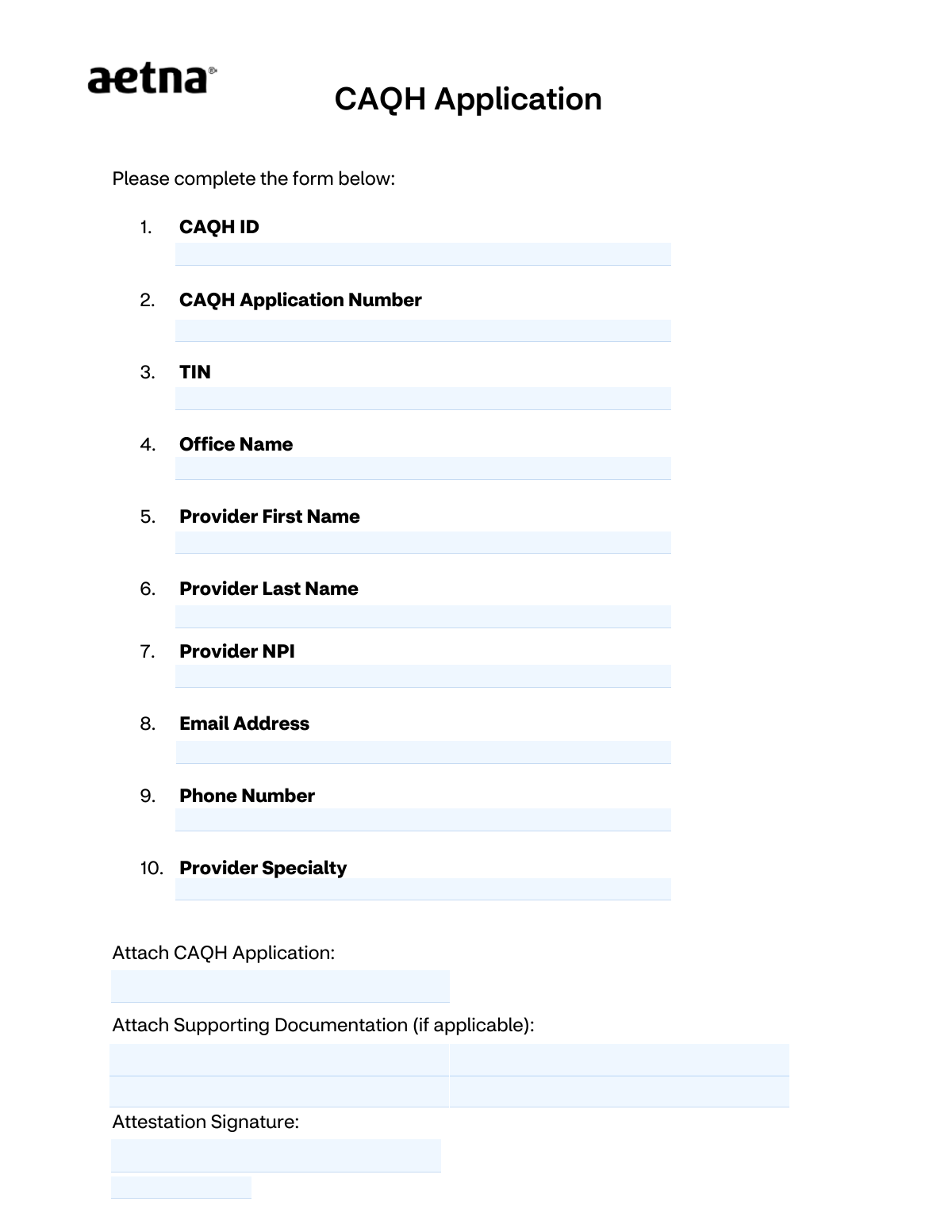
- Aetna Dental Provider Network Application (CAQH): Select this form if you are applying specifically to the Aetna network. This application is streamlined for providers who already utilize the CAQH database for their professional data.
- Connection Dental Network – Provider Application: Choose this if you are seeking to join the GEHA Connection Dental Network. It focuses primarily on the detailed professional history and practice data required for credentialing.
- Connection Dental Network – Provider Application (GEHA Connection Dental Network) and Participating Provider Agreement: This is the most comprehensive option. Choose this if you need to complete both the credentialing application and the legal contract (the Participating Provider Agreement) in one package to finalize your participation terms.
Medical and General Healthcare Networks
For non-dental providers or those looking to initiate a relationship with a major California carrier, the process often starts with a statement of interest rather than a full application:
- Blue Shield of California Network Participation Letter of Intent: This is a "first-step" document. Use this form if you are an individual or group provider looking to express interest in joining the Blue Shield of California network. It helps the carrier determine if there is a need for your specialty in your specific geographic region before you proceed to full credentialing.
Key Considerations for Selection
- Stage of Process: If you are just starting with Blue Shield, use the Letter of Intent. If you are ready to commit to GEHA/Connection Dental, use the Participating Provider Agreement version.
- Carrier Specification: Ensure the form name matches the payer (e.g., Aetna vs. GEHA) to avoid processing delays in the credentialing department.
Form Comparison
| Form | Primary Purpose | Provider Type | Key Requirement |
|---|---|---|---|
| Aetna Dental Provider Network Application (CAQH) | Initial application for joining the Aetna dental network and beginning credentialing. | Dentists and dental specialists seeking Aetna network participation. | Requires a valid CAQH ID, NPI, and Tax Identification Number. |
| Blue Shield of California Network Participation Letter of Intent | Expressing interest to join the Blue Shield of California network as a first step. | Individual or group healthcare providers located in California. | Basic demographic and specialty data to determine eligibility for a specific region. |
| Connection Dental Network – Provider Application | Facilitating the credentialing process for the GEHA Connection Dental Network. | Dentists and dental specialists seeking to join the GEHA network. | Comprehensive professional history including education, licensure, and practice locations. |
| Connection Dental Network – Provider Application (GEHA Connection Dental Network) and Participating Provider Agreement | Combined credentialing application and legal contract for PPO network participation. | Dentists seeking to formalize reimbursement terms and compliance obligations. | Includes a signed participation agreement, fee schedules, and malpractice insurance details. |
Tips for provider network forms
Most provider network forms require your National Provider Identifier (NPI) and Tax Identification Number (TIN) for primary verification. Having these numbers ready before you start will prevent interruptions and ensure your application matches official registry records.
Credentialing committees look closely at your work history, often requiring a continuous five-year record. Be prepared to explain any employment gaps of 30 days or more directly on the form to avoid follow-up questions that could stall your enrollment.
AI-powered tools like Instafill.ai can complete these complex provider forms in under 30 seconds with high accuracy. Your sensitive professional data stays secure during the process, making it a reliable way to manage multiple network applications efficiently.
Many networks, such as Aetna, use CAQH ProView to pull provider data for credentialing. Ensure your CAQH profile is re-attested and up-to-date before filling out these forms so that the information provided to the network remains consistent across all platforms.
Network applications usually require specific details from your state license, DEA certificate, and malpractice insurance face sheet. Organizing these documents digitally beforehand allows you to quickly reference expiration dates and policy numbers while filling out the forms.
If you practice at multiple locations, ensure you have the specific suite numbers, office hours, and billing addresses for each site. Accurate practice location data is essential for ensuring you are correctly listed in the provider directory for patient referrals.
Frequently Asked Questions
Provider network forms are used by healthcare professionals and dental practices to apply for participation in an insurance carrier's network. These documents initiate the credentialing process, which is necessary for providers to treat insured members and receive direct reimbursement from the payer.
These forms are typically completed by individual dentists, medical doctors, or administrative staff on behalf of a healthcare group. They are essential for any practitioner who wants to become an 'in-network' provider for plans like Aetna, Blue Shield of California, or the GEHA Connection Dental Network.
Yes, you can use AI tools like Instafill.ai to complete these complex forms in under 30 seconds. The AI accurately extracts data from your source documents and places it into the correct fields, eliminating the need for manual data entry.
A Letter of Intent (LOI) is usually a preliminary step used to express interest in joining a network and to see if the network is currently open to new providers in your area. A full application is a more comprehensive document that includes detailed professional history, education, and licensing information required for formal credentialing.
While manually filling out these multi-page applications can take an hour or more, using an AI-powered service like Instafill.ai can reduce that time to less than 30 seconds. The tool handles the heavy lifting of mapping your professional history to the specific format required by the insurer.
Most applications require your National Provider Identifier (NPI), Tax Identification Number (TIN), state license details, and professional liability insurance information. You may also need to provide a comprehensive work history, including explanations for any gaps in employment over the last five years.
The Council for Affordable Quality Healthcare (CAQH) maintains a centralized database of provider information that many insurers, such as Aetna, use to streamline credentialing. Providing your CAQH ID on these forms allows the insurance company to pull verified data directly, reducing the amount of manual paperwork you need to submit.
Submission methods vary by insurance carrier and may include secure email, fax, or dedicated online provider portals. Always check the specific instructions provided on the form or the carrier's provider relations website to ensure your application is sent to the correct credentialing department.
Submitting an application does not guarantee acceptance into a provider network. The insurance company will evaluate your credentials and determine if there is a need for additional providers in your specialty and geographic region before offering a formal contract.
A Participating Provider Agreement is a legal contract that outlines the terms of the relationship between the provider and the insurance network. It covers important details such as reimbursement rates, fee schedules, billing requirements, and the duration of the contract.
Insurers require a continuous work history to verify professional stability and ensure there are no periods of unmonitored practice or disciplinary issues. If there are gaps in your history, you are generally required to provide a written explanation to satisfy the credentialing board's requirements.
It is helpful to have your current CV, medical or dental licenses, DEA registration, and proof of malpractice insurance (Certificate of Insurance) on hand. Having these documents available digitally allows AI tools to quickly scan and populate your application accurately.
Glossary
- Form Complexity Index
- Instafill’s 0–100 measure of how much effort a form takes to complete, calculated deterministically from the form’s own structure rather than estimated. It combines the number of fillable fields (the largest factor), how difficult those fields are to complete based on their type, the number of pages that contain fields, the amount of conditional “fill-only-if” logic, and how many sections the form is divided into, then adds modifiers for tables and repeating lists, bundled instruction pages, and dense page layouts. A higher score means the form is harder to fill out by hand. The forms in this category have a median Form Complexity Index of 62/100 (Moderate). See exactly how it is calculated.
- NPI (National Provider Identifier)
- A unique 10-digit identification number issued to healthcare providers in the United States by the Centers for Medicare & Medicaid Services (CMS).
- CAQH (Council for Affordable Quality Healthcare)
- An online database and platform used by healthcare providers to store and share their professional information with multiple insurance companies for credentialing.
- Credentialing
- The formal process of verifying a healthcare provider's qualifications, including their education, training, licensure, and work history, to ensure they meet network standards.
- TIN (Tax Identification Number)
- A nine-digit number used by the IRS to identify a business or individual, which is required on provider forms for tax reporting and reimbursement purposes.
- Letter of Intent (LOI)
- A formal document submitted by a provider to an insurance company expressing interest in joining their network and requesting the start of the application process.
- Participating Provider Agreement
- A legally binding contract between a healthcare provider and an insurance network that outlines reimbursement rates, billing rules, and service obligations.
- DEA Number
- A registration number assigned by the U.S. Drug Enforcement Administration that allows a healthcare professional to legally prescribe controlled substances.
- PPO (Preferred Provider Organization)
- A type of health insurance plan that contracts with a network of medical or dental professionals to provide services at reduced rates to plan members.