Fill out securities transfer forms
with AI.
Securities transfer forms are essential legal documents used to move assets like stocks, bonds, or mutual funds between financial accounts or entities. These documents are crucial for maintaining accurate ownership records and ensuring that brokerage firms execute transfers according to the owner's specific instructions. Whether you are consolidating your investment portfolio or facilitating a charitable contribution, these forms provide the formal authorization required to move high-value assets across different institutions securely.
By continuing, you acknowledge Instafill's Privacy Policy and agree to get occasional product update and promotional emails.
About securities transfer forms
Investors, financial advisors, and donors typically use these forms when managing wealth or executing philanthropic goals. Common scenarios include moving assets between brokerages, such as a J.P. Morgan Account Transfer Request, or authorizing the gift of securities through platforms like TIAA. Because these transactions often involve technical details like DTC codes and specific account identifiers, precision is vital to prevent processing delays or unintended tax consequences. Tools like Instafill.ai use AI to fill these securities transfer forms in under 30 seconds, handling your data accurately and securely to streamline the administrative process.
Every form on this page can be completed without typing. Instafill is form filling software that reads a PDF and fills it for you — including flat and scanned documents that carry no fillable fields at all.
Forms in This Category
The forms in this category have a median Form Complexity Index of 29/100 (Basic), measured across 4 forms by field count, input difficulty, length, conditional logic and structure. See how it is calculated.
| Form Name | Pages | FCI | |
|---|---|---|---|
| 1. | Intra-Brokerage Securities Transfer | 1 | Basic 29 |
| 2. | J.P. Morgan Securities LLC Account Transfer Request | 1 | Complex 64 |
| 3. | Securities Transfer Request and Notification Form | 1 | Simple 28 |
| 4. | TIAA Brokerage Authorization To Gift Securities | 1 | – |
- Enterprise-grade security & data encryption
- 99%+ accuracy powered by AI
- 1,000+ forms from all industries
- Complete forms in under 60 seconds
How to Choose the Right Form
Navigating securities transfers can be complex, as the correct form depends on whether you are donating to a charity, gifting to an individual, or simply moving assets between your own brokerage accounts. Use the following categories to identify the document that fits your specific financial goal.
For Charitable Donations and Philanthropy
If you are transferring stocks or bonds as a gift to a specific non-profit organization, your choice depends on the recipient institution:
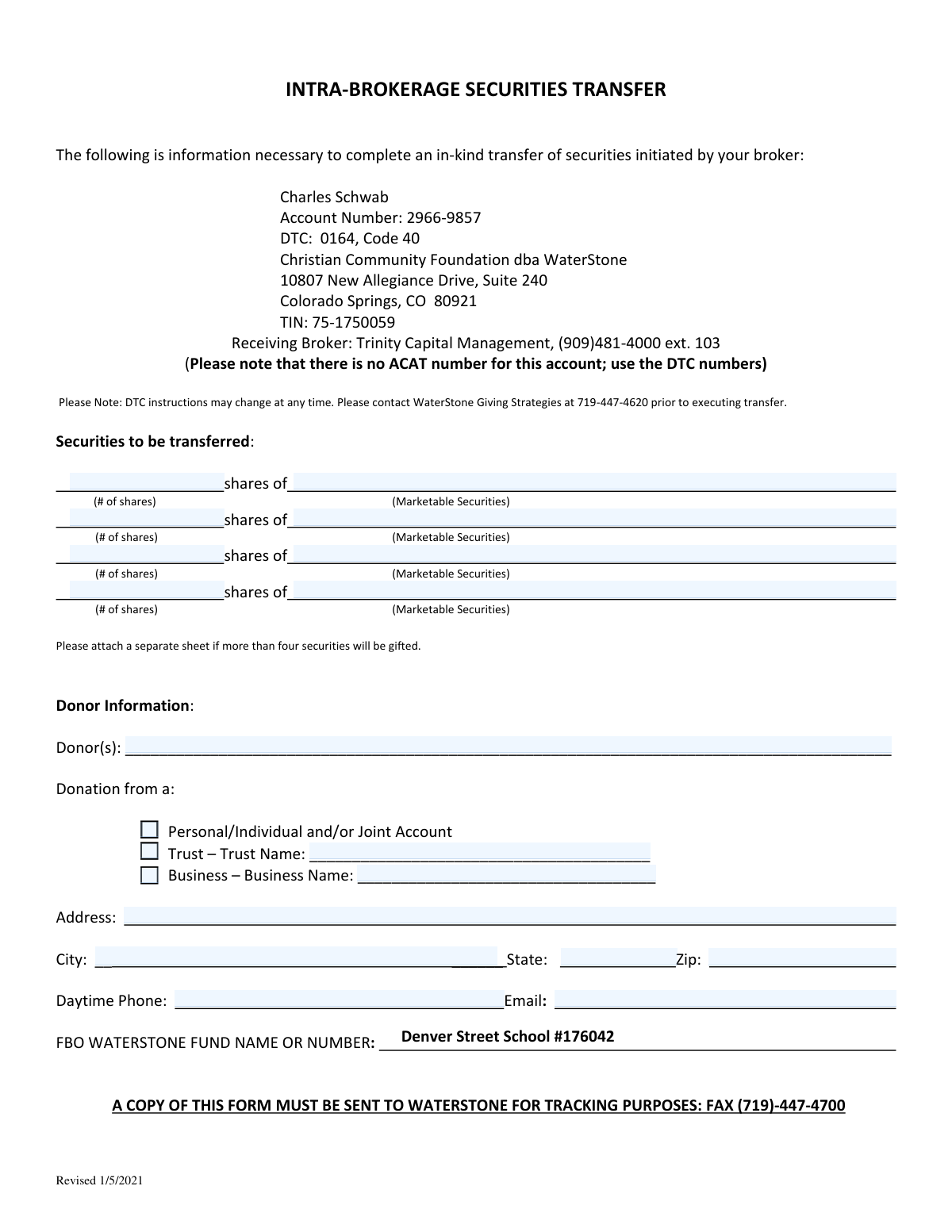
- WaterStone / Christian Community Foundation: Use the Intra-Brokerage Securities Transfer form. This document provides specific instructions for donors to move securities from their personal brokerage into the WaterStone account held at Charles Schwab.
- Catawba Lands Conservancy: Select the Securities Transfer Request and Notification Form. This serves as a formal letter of authorization to your broker to execute a transfer specifically benefiting the conservancy.
For Personal Asset Consolidation
If you are not making a gift but rather consolidating your own investments under a single provider, look for account-specific transfer requests:
- J.P. Morgan Securities LLC Account Transfer Request: Choose this form if you are moving cash, securities, or mutual funds from an external financial institution into your J.P. Morgan account. This is the standard document used to centralize your portfolio management.
For Gifting from a TIAA Account
- TIAA Brokerage Authorization To Gift Securities (Form F11514): This is the required Letter of Authorization (LOA) for individuals holding a taxable TIAA brokerage account. Use this form if you intend to gift ownership of stocks or bonds to either a person or an organization. It ensures that TIAA has the legal permission to move assets out of your account and into the recipient's name.
By using Instafill.ai, you can complete these forms quickly by letting our AI guide you through the required fields, ensuring that critical details like DTC codes and account numbers are entered accurately before you submit them to your financial institution.
Form Comparison
| Form | Primary Purpose | Target Recipient | Asset Types Covered |
|---|---|---|---|
| Intra-Brokerage Securities Transfer | Transfer securities to the WaterStone foundation for charitable giving purposes. | WaterStone (Christian Community Foundation) | Stocks and non-cash securities |
| J.P. Morgan Securities LLC Account Transfer Request | Consolidate assets from external financial institutions into a J.P. Morgan account. | The user's personal J.P. Morgan Securities account | Cash, securities, and mutual funds |
| Securities Transfer Request and Notification Form | Instruct a brokerage firm to transfer securities to a specific non-profit. | Catawba Lands Conservancy or other designated non-profits | Specified quantities of stocks or securities |
| TIAA Brokerage Authorization To Gift Securities | Authorize the gifting of securities from a taxable TIAA account to others. | Third-party individuals or charitable organizations | Stocks, bonds, and other securities |
Tips for securities transfer forms
The Depository Trust Company (DTC) number is the most critical piece of information for inter-brokerage transfers. Always cross-reference this number with the receiving institution to prevent assets from being sent to the wrong clearing house or held in a suspense account.
When listing securities, use the full legal name of the asset and its ticker symbol to avoid ambiguity. Clearly specify whether you are transferring 'all assets' or a specific number of shares, as even a minor discrepancy can cause the brokerage to reject the request.
AI-powered tools like Instafill.ai can complete these complex securities forms in under 30 seconds with high accuracy. The data stays secure during the process, providing a fast and reliable way to manage multiple transfer requests without manual data entry errors.
Many high-value securities transfers require a Medallion Signature Guarantee rather than a standard notary or electronic signature. Review the form's instructions early to determine if you need to visit a physical financial institution to obtain this specific validation.
Keep a copy of the completed form and the fair market value of the securities on the day of the transfer. This documentation is essential for accurate tax reporting and helps the recipient or the new brokerage establish the correct cost basis for future sales.
Ensure that the names and titles on the sending and receiving accounts are identical, such as transferring from an individual account to another individual account. Discrepancies in account registration, such as moving assets from a personal account to a trust, often require additional specialized documentation.
Frequently Asked Questions
These forms are used to move ownership of financial assets like stocks, bonds, or mutual funds from one account or institution to another. They are essential for consolidating accounts, gifting assets to individuals, or making non-cash donations to non-profit organizations.
Transferring securities directly is often preferred for gifting or charitable donations because it may provide tax advantages, such as avoiding capital gains tax on appreciated assets. It is also used when moving your entire portfolio to a new brokerage without liquidating your positions.
You will generally need your account number, the receiving institution's name and DTC number, and specific details about the securities being moved, such as the ticker symbol and number of shares. Accurate donor or account holder information is also required to verify the authorization.
The correct form depends on whether you are moving assets between accounts at the same firm, transferring into a new brokerage like J.P. Morgan, or gifting assets to a charity. You should select the form provided by the receiving institution or the specific brokerage holding your assets.
Yes, several forms in this category are specifically designed for gifting securities to non-profit organizations or community foundations. Using these forms ensures that the transfer is handled correctly for tax acknowledgment purposes and that the charity receives the assets directly.
Completed forms are usually submitted to your current brokerage firm's transfer department or the receiving institution, depending on the specific instructions on the form. Many institutions allow for digital submission via their secure portals, though some may require a physical signature or a Medallion Signature Guarantee.
A Depository Trust Company (DTC) number is a unique four-digit identifier assigned to financial institutions to facilitate the electronic clearing and settlement of securities. Including the correct DTC number on your transfer form ensures that the assets are routed to the correct brokerage firm without delays.
Yes, AI tools like Instafill.ai can fill out these forms in under 30 seconds by accurately extracting and placing data from your source documents. This technology ensures that complex information like account numbers and DTC codes are entered correctly without manual typing.
When using automated tools, the process is extremely efficient and can be completed in less than 30 seconds. AI-powered services can even convert non-fillable PDF versions of these forms into interactive documents, making the submission process much faster.
Common errors include providing incorrect account numbers, missing the recipient's DTC number, or failing to specify the exact number of shares to be transferred. It is also important to ensure that the names on both the sending and receiving accounts match or are clearly explained in the authorization.
Glossary
- Form Complexity Index
- Instafill’s 0–100 measure of how much effort a form takes to complete, calculated deterministically from the form’s own structure rather than estimated. It combines the number of fillable fields (the largest factor), how difficult those fields are to complete based on their type, the number of pages that contain fields, the amount of conditional “fill-only-if” logic, and how many sections the form is divided into, then adds modifiers for tables and repeating lists, bundled instruction pages, and dense page layouts. A higher score means the form is harder to fill out by hand. The forms in this category have a median Form Complexity Index of 29/100 (Basic). See exactly how it is calculated.
- DTC Number
- A unique four-digit identification code assigned to financial institutions that allows for the electronic clearing and settlement of securities transfers.
- Letter of Authorization (LOA)
- A formal document signed by an account holder that provides specific instructions and legal permission for a brokerage firm to move assets to another party.
- Medallion Signature Guarantee
- A special certification stamp used by financial institutions to verify that a signature authorizing a securities transfer is authentic and that the signer has the legal capacity to sign.
- CUSIP Number
- A unique nine-character identification code assigned to all North American stocks and registered bonds to facilitate clear and accurate trading and tracking.
- In-Kind Transfer
- The process of moving investments from one account to another exactly as they are, without selling them and converting them to cash first.
- Cost Basis
- The original value of an asset for tax purposes, which is usually required to be transferred alongside the security to ensure accurate capital gains reporting for the new owner.
- ACATS
- Standing for Automated Customer Account Transfer Service, this is the standardized system used by the financial industry to electronically move assets between brokerage firms.
- Contra Firm
- The financial institution that currently holds the assets and is being requested to deliver them to a different brokerage or organization.