Fill out small estate forms
with AI.
Small estate forms are essential legal documents designed to simplify the distribution of assets after someone passes away. In many states, including California, these forms allow heirs and successors to bypass the lengthy and often expensive formal probate court process. By using specific affidavits and declarations, families can collect personal property, such as bank accounts or vehicles, provided the total value of the estate falls below a certain legal threshold. These forms are critical because they provide a streamlined path to settling affairs, ensuring that beneficiaries receive their inheritance more quickly and with fewer administrative hurdles.
By continuing, you acknowledge Instafill's Privacy Policy and agree to get occasional product update and promotional emails.
About small estate forms
Typically, these forms are needed by family members, legal representatives, or small estate claimants who are managing the transition of a decedent's assets. You might encounter these requirements when dealing with financial institutions that require a formal Affidavit for Collection of Personal Property or when filing an Inventory and Appraisal to provide a clear record of the estate’s value to the court. Whether you are a successor trying to close a bank account or a representative fulfilling a fiduciary duty, having the correct paperwork is the first step in complying with state probate codes and California court forms.
Managing legal paperwork during a difficult time can be overwhelming, but modern technology helps simplify the process. Tools like Instafill.ai use AI to accurately fill these small estate forms in under 30 seconds, ensuring data security while saving hours of manual entry. This allows you to focus on managing the estate rather than navigating complex PDF fields.
Every form on this page can be completed without typing. Instafill is form filling software that reads a PDF and fills it for you — including flat and scanned documents that carry no fillable fields at all.
Forms in This Category
The forms in this category have a median Form Complexity Index of 38/100 (Basic), measured across 2 forms by field count, input difficulty, length, conditional logic and structure. See how it is calculated.
- Enterprise-grade security & data encryption
- 99%+ accuracy powered by AI
- 1,000+ forms from all industries
- Complete forms in under 60 seconds
How to Choose the Right Form
Small estate forms are designed to simplify the transfer of assets after someone passes away, allowing heirs to avoid the time and expense of a full California probate proceeding. Choosing the right document depends on whether you are simply collecting property or if you need an official valuation for the court.
For Collecting Assets Directly
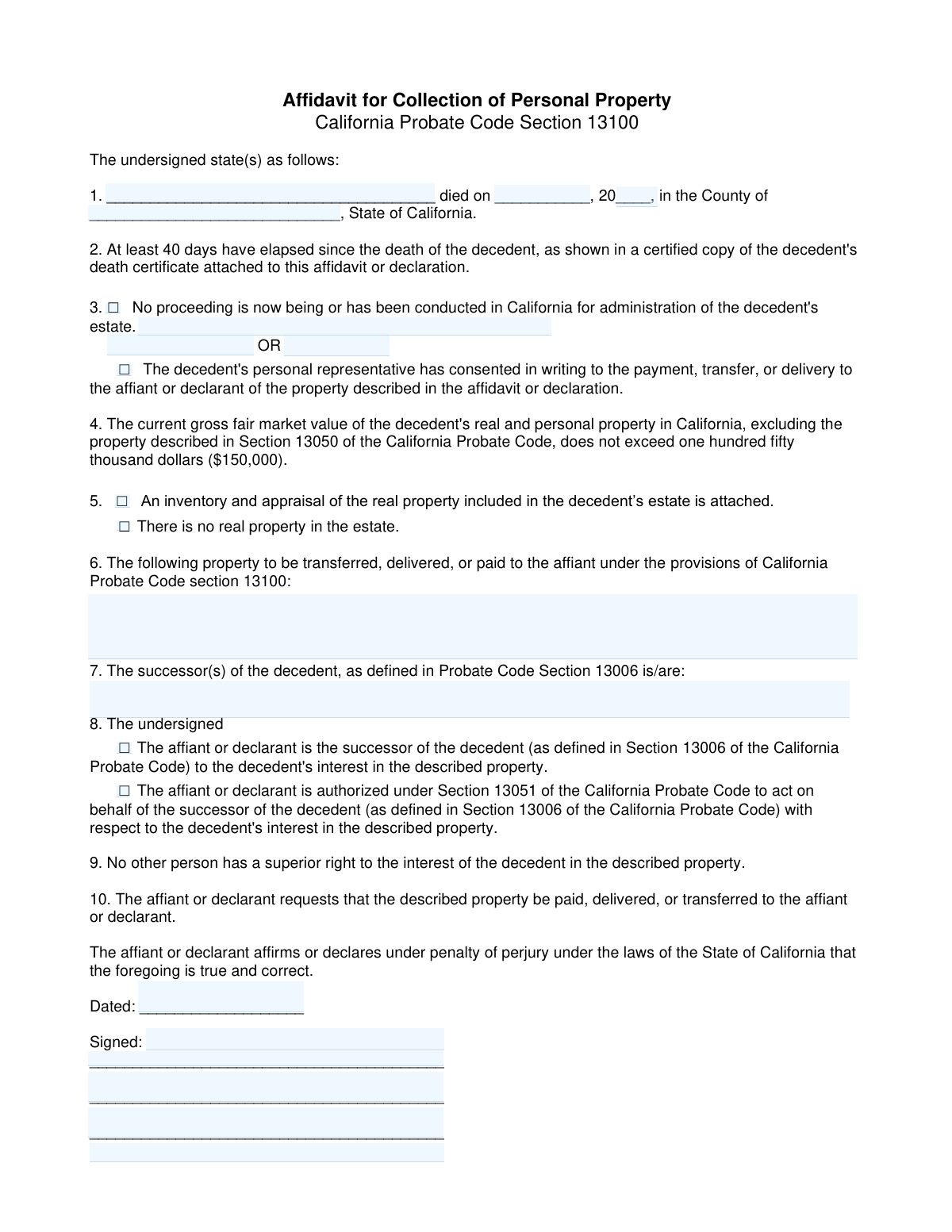
If the total value of the decedent’s California estate is below the current legal threshold, you likely need the Affidavit for Collection of Personal Property California Probate Code Section 13100. This is the primary tool for "summary probate."
- Use case: Use this form to claim money from bank accounts, stocks, or other personal property held by third parties like banks or financial institutions.
- Requirement: You must typically wait 40 days after the death before presenting this affidavit to the institution holding the assets. It is used when no formal probate proceeding is being conducted in court.
For Valuing and Reporting Assets
If you are in the process of administering a small estate or if the court requires a formal list of assets to verify the estate's value, you will need Form DE-160/GC-040, Inventory and Appraisal.
- Use case: This form provides a comprehensive list of all estate assets and their fair market value. It serves as the official record for court oversight and tax reporting.
- Probate Referees: This document is unique because it separates assets you can value yourself (Attachment 1, such as cash or checks) from assets that must be appraised by an official Probate Referee (Attachment 2, such as real estate, vehicles, or jewelry).
- Compliance: This is often a mandatory step to prove the estate actually qualifies as a "small estate" under California law.
Quick Selection Guide
- Choose the Section 13100 Affidavit if your primary goal is to get a bank to release funds to you quickly without a court order.
- Choose Form DE-160/GC-040 if you need to establish the official value of the estate for legal records, bond adjustments, or if a probate referee must be involved in the appraisal process.
Form Comparison
| Form | Primary Purpose | Who Files It | Key Requirement | Probate Involvement |
|---|---|---|---|---|
| Affidavit for Collection of Personal Property California Probate Code Section 13100 | Transfer personal property to heirs without formal probate court proceedings. | Heirs or legal successors of the deceased person. | Total estate value must be below the specific California threshold. | Avoids formal probate entirely for the specified assets. |
| Form DE-160/GC-040, Inventory and Appraisal (Declaration of Representative/Guardian/Conservator or Small Estate Claimant and Declaration of Probate Referee) | Establish an official list and valuation of all estate assets. | Personal representative, guardian, conservator, or small estate claimant. | Certain assets must be appraised by a court-appointed probate referee. | Used within formal probate or court-supervised administration. |
Tips for small estate forms
Before using a small estate affidavit, ensure the total value of the decedent's assets falls below the current California legal limit for small estates. This threshold is subject to periodic adjustments, and exceeding it may require you to undergo a full, formal probate process instead of the simplified procedure.
Under California Probate Code Section 13100, you generally must wait at least 40 days after the decedent's passing before you can use an affidavit to collect personal property. Filing or presenting the form to a financial institution before this period has elapsed will likely result in a rejection of your claim.
On Form DE-160, carefully separate assets like cash and bank accounts, which the representative can appraise on Attachment 1, from items like real estate or jewelry on Attachment 2. Items on Attachment 2 must be valued by a court-appointed probate referee to ensure the valuation is legally binding for the court.
Managing multiple probate documents can be overwhelming, but AI-powered tools like Instafill.ai can complete these forms in under 30 seconds with high accuracy. Your sensitive data stays secure throughout the process, providing a fast and reliable way to generate professional-grade court documents without manual data entry.
Most financial institutions and the court will require a certified copy of the death certificate to accompany your small estate forms. Obtaining multiple certified copies early in the process prevents delays when you are ready to submit your Inventory and Appraisal or present your affidavit to banks.
When you sign a small estate affidavit, you are claiming the property on behalf of all rightful successors. You are legally responsible for ensuring the assets are distributed correctly to all beneficiaries or heirs according to the decedent’s will or California's intestate succession laws.
Frequently Asked Questions
A small estate is one where the total value of the decedent's assets in California falls below a specific statutory limit, which is updated periodically. If the estate value is under this threshold, successors can often avoid formal probate by using simplified procedures like the Section 13100 affidavit.
Generally, the legal successors of the deceased person, such as surviving spouses, children, or other heirs named in a will, are eligible to use these forms. The person signing the affidavit must have the legal right to the specific property or asset they are attempting to claim.
In California, there is typically a mandatory waiting period of 40 days after the date of death before a small estate affidavit can be used to collect personal property. This time allows for any potential creditors or other heirs to come forward before assets are distributed.
Personal property includes assets like bank accounts, stocks, and vehicles, which can often be claimed using a Section 13100 affidavit. Real property refers to land or buildings, which usually requires a more formal court process or a different set of simplified forms if the value is very low.
This form is required whenever a formal valuation of the estate's assets is needed for court oversight or to prove the estate qualifies for simplified procedures. It provides a detailed list of assets and separates those that can be valued by the representative from those requiring a probate referee.
Yes, AI tools like Instafill.ai can fill these forms in under 30 seconds by accurately extracting and placing data from your source documents. This technology helps ensure that complex legal descriptions and personal data are entered correctly without manual transcription errors.
Using modern AI-powered services, the process of filling out small estate paperwork is significantly faster than traditional methods. You can typically generate a completed, ready-to-print form in less than a minute by uploading the necessary supporting documentation.
For personal property, the Section 13100 affidavit is generally not filed with the court; instead, it is presented directly to the bank or institution holding the asset. However, the Inventory and Appraisal form (DE-160) may need to be filed if there is a pending court proceeding or if requested by a probate referee.
A probate referee is a state-appointed official who values non-cash assets such as real estate, jewelry, or business interests. While the estate representative can value cash assets on Attachment 1 of the Inventory and Appraisal form, the referee must handle the items listed on Attachment 2.
Banks are legally required to honor valid small estate affidavits that meet California Probate Code requirements, though they may require additional documentation like a certified death certificate. If a bank refuses, you may need to provide them with a copy of the specific code section or consult with a legal professional to enforce the transfer.
Glossary
- Form Complexity Index
- Instafill’s 0–100 measure of how much effort a form takes to complete, calculated deterministically from the form’s own structure rather than estimated. It combines the number of fillable fields (the largest factor), how difficult those fields are to complete based on their type, the number of pages that contain fields, the amount of conditional “fill-only-if” logic, and how many sections the form is divided into, then adds modifiers for tables and repeating lists, bundled instruction pages, and dense page layouts. A higher score means the form is harder to fill out by hand. The forms in this category have a median Form Complexity Index of 38/100 (Basic). See exactly how it is calculated.
- Probate
- The formal legal process overseen by a court to validate a will, pay a deceased person's debts, and distribute their remaining assets to heirs.
- Decedent
- The legal term used in estate forms to refer to the person who has passed away.
- Small Estate Affidavit
- A legal document that allows heirs to claim assets from a deceased person's estate without a full court proceeding, typically used when the total value of the estate is below a specific dollar threshold.
- Probate Referee
- An independent official appointed by the state to evaluate and assign a monetary value to non-cash assets, such as real estate or unique personal property, within an estate.
- Successor
- The person or entity legally entitled to receive the property of the decedent, either through a will or by state law if no will exists.
- Inventory and Appraisal
- A mandatory document filed with the court that lists all assets owned by the decedent and provides their fair market value at the time of death.
- Personal Property
- Assets that are movable and not permanently fixed to a location, including bank accounts, stocks, vehicles, jewelry, and household items.
- Judicial Council Forms
- Standardized legal documents, such as those beginning with 'DE' or 'GC', that are officially approved for use in California courts to ensure legal compliance.