Fill out vehicle bill of sale forms
with AI.
Vehicle bill of sale forms are essential legal documents used to record the transfer of ownership of a car, truck, or vessel between a buyer and a seller. These forms serve as a formal receipt of the transaction, capturing critical details such as the Vehicle Identification Number (VIN), the sale price, and the date of the transfer. They are vital for protecting both parties: for the buyer, the document provides the necessary proof of purchase required for registration and titling; for the seller, it establishes a record that can release them from liability once the vehicle has changed hands.
By continuing, you acknowledge Instafill's Privacy Policy and agree to get occasional product update and promotional emails.
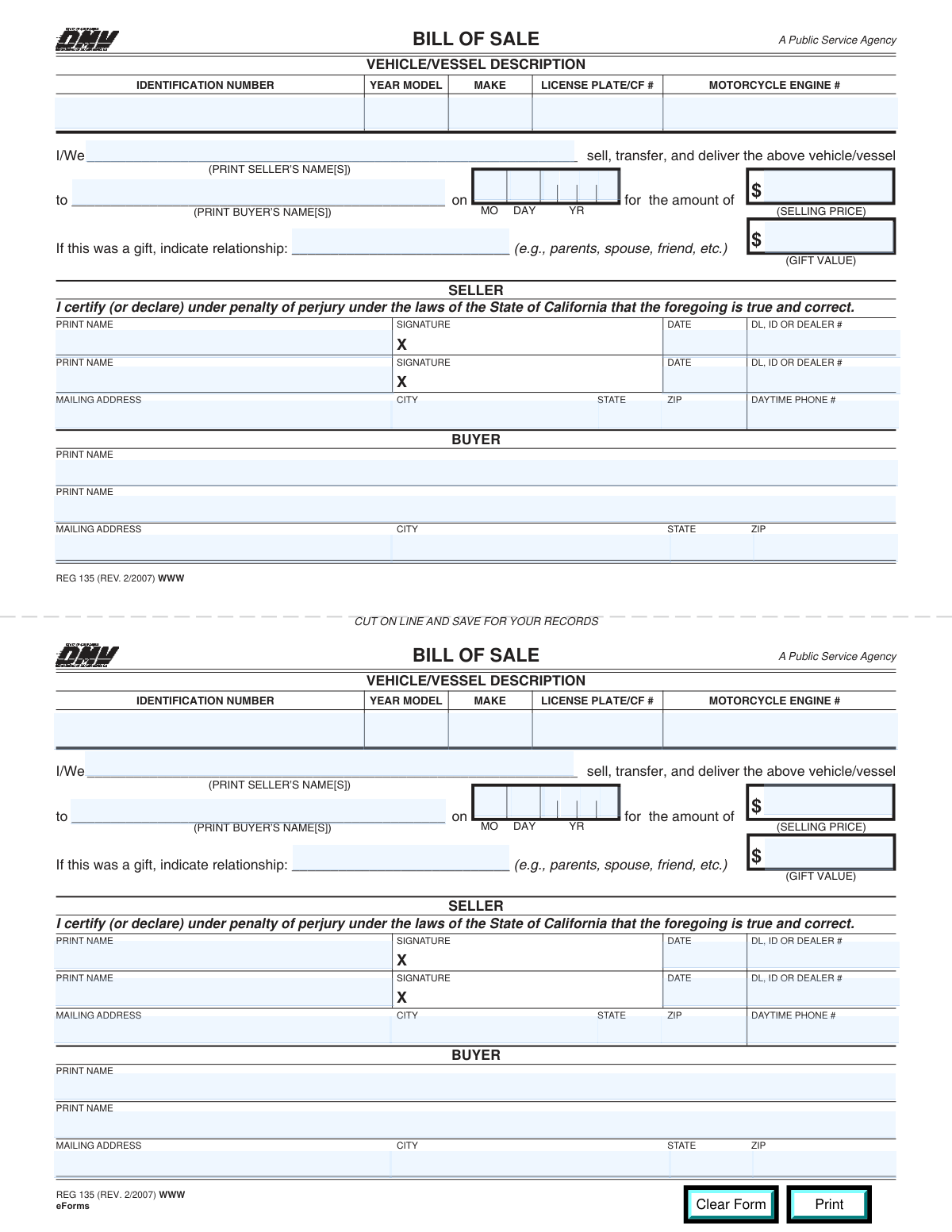
About vehicle bill of sale forms
Most people encounter these documents when buying or selling a vehicle in a private party transaction. Since requirements vary by location, using the correct state-specific document is crucial for a smooth transition at the DMV. For example, California residents typically use Form REG 135, while those in Oregon rely on Form 735-501 to satisfy state motor vehicle department requirements. These vehicle transfer forms ensure that the transition is documented accurately for tax purposes and official state records.
Completing these motor vehicle forms accurately is important to avoid delays at the DMV, but the process doesn't have to be time-consuming. Tools like Instafill.ai use AI to fill these forms in under 30 seconds, handling your data accurately and securely to simplify the paperwork involved in your vehicle sale.
Every form on this page can be completed without typing. Instafill is form filling software that reads a PDF and fills it for you — including flat and scanned documents that carry no fillable fields at all.
Forms in This Category
The forms in this category have a median Form Complexity Index of 47/100 (Moderate), measured across 3 forms by field count, input difficulty, length, conditional logic and structure. See how it is calculated.
| Form Name | Pages | FCI | |
|---|---|---|---|
| 1. | California Department of Motor Vehicles (DMV) Form REG 135, Bill of Sale | 1 | Moderate 47 |
| 2. | Form 735-501, Vehicle Bill of Sale | 1 | Simple 27 |
| 3. | Form HSMV 82050, Notice of Sale and/or Bill of Sale for a Motor Vehicle, Mobile Home, Off-Highway Vehicle or Vessel | 1 | Moderate 52 |
- Enterprise-grade security & data encryption
- 99%+ accuracy powered by AI
- 1,000+ forms from all industries
- Complete forms in under 60 seconds
How to Choose the Right Form
Choosing the correct vehicle bill of sale is essential for a smooth transfer of ownership and ensuring you meet state-specific DMV requirements. While these documents share a similar purpose—providing proof of purchase and detailing the transaction—they are not interchangeable across state lines. Selecting the wrong form can result in rejected title applications or delays in vehicle registration.
Transactions in California
If you are buying or selling a car, truck, or boat in California, you should use the California Department of Motor Vehicles (DMV) Form REG 135, Bill of Sale. This form is specifically designed for the California DMV and covers both motor vehicles and vessels.
- When to use it: Use this for standard sales, transfers between family members, or when gifting a vehicle.
- Key Details Required: You will need the Vehicle Identification Number (VIN) or Hull Identification Number (HIN), license plate or CF number, and the exact sale price or gift value.
- Legal Note: This form includes a certification under penalty of perjury, making it a vital legal document for both parties’ records and tax-related purposes.
Transactions in Oregon
For motor vehicle transfers occurring within Oregon, you must use Form 735-501, Vehicle Bill of Sale. Provided by the Oregon Driver and Motor Vehicle Services (DMV), this document is a requirement for the administrative side of the sale.
- For the Buyer: This form is a critical piece of the application package when applying for a new Oregon title.
- For the Seller: It serves as the official record to notify the DMV that you have sold the vehicle, protecting you from future liabilities associated with the car.
- Key Details Required: Ensure you have the year, make, and VIN clearly listed to avoid processing delays at the DMV office.
Summary of Choice
The choice is primarily determined by the state where the vehicle will be registered:
- California residents should select Form REG 135.
- Oregon residents should select Form 735-501.
Using Instafill.ai, you can quickly complete these vehicle transfer forms by letting our AI handle the data entry, ensuring that critical identifiers like VINs are transcribed accurately from your purchase records.
Form Comparison
| Form | State Jurisdiction | Primary Purpose | Key Details Included |
|---|---|---|---|
| California Department of Motor Vehicles (DMV) Form REG 135, Bill of Sale | California | Records transfer of ownership for vehicles or vessels for registration and taxes. | VIN/Hull ID, sale price or gift value, and seller certification. |
| Form 735-501, Vehicle Bill of Sale | Oregon | Legal record of sale used for title applications and DMV notification. | Vehicle description, buyer/seller details, and transaction date. |
Tips for vehicle bill of sale forms
Ensure the Vehicle Identification Number (VIN) and odometer reading exactly match the physical vehicle and the title. Even a single digit error can cause the DMV to reject your registration or title transfer application. Always verify these numbers twice before finalizing the document.
Both the buyer and the seller should retain a signed copy of the bill of sale for their personal records. This document serves as vital proof of the transaction date and price for tax purposes and liability protection. It is especially important for the seller to prove they are no longer responsible for the vehicle.
Be aware that different states, like California and Oregon, have unique forms and disclosure requirements. California's REG 135 and Oregon's 735-501 have different layouts, so ensure you are using the correct form for the state where the vehicle is being registered. Using the wrong state form may lead to processing delays.
AI-powered tools like Instafill.ai can complete these forms in under 30 seconds with high accuracy, and the data stays secure during the process. This is a practical time-saver for anyone dealing with multiple motor vehicle forms, as it reduces the risk of manual entry errors on critical fields.
Make sure both parties sign and date the bill of sale at the time of the transaction. In many jurisdictions, the DMV will not accept a bill of sale that is missing a signature or has an altered date. Clear, legible signatures help prevent future disputes regarding the legality of the transfer.
Submit the completed bill of sale to your local DMV office as soon as possible after the transaction. Sellers often need to file a separate notice of release of liability alongside the bill of sale to officially end their responsibility for the vehicle. Prompt filing ensures that any future tickets or tolls are correctly attributed to the new owner.
Frequently Asked Questions
A vehicle bill of sale acts as a legal receipt that documents the transfer of ownership from a seller to a buyer. It records essential details like the purchase price, the date of sale, and vehicle identifiers such as the VIN. This document is often required by state motor vehicle departments to update registration and title records.
Typically, the seller provides the bill of sale to the buyer at the time of the transaction. Both parties should sign the document and keep a copy for their personal records to prove the change in ownership and release of liability. Having a signed copy protects the seller from future tickets or legal issues involving the vehicle after it has been sold.
You should use the form provided by the state where the vehicle is being registered or where the transaction is taking place. For example, if you are selling a car in California, you would use Form REG 135, while an Oregon transaction would require Form 735-501. Using the correct state-sanctioned form ensures that the local DMV will accept the documentation for title processing.
Yes, most states require a bill of sale even if the vehicle is a gift or transferred between family members. In these cases, the sale price is usually listed as $0 or marked as a 'gift' on the form. This helps the DMV determine if any use tax is owed and establishes a clear timeline for the transfer of ownership.
While many states like California and Oregon do not strictly require a bill of sale to be notarized, it is sometimes recommended for added legal security. You should check the specific instructions on the form or your local DMV website to see if notarization is mandatory for your specific transaction type. In most standard private sales, the signatures of both parties are sufficient.
Most states require the seller to notify the DMV within a few days of the sale—often between 5 to 10 days. Submitting a notice of transfer or release of liability, alongside the bill of sale information, protects the seller from being held responsible for the vehicle's future operation. The buyer generally submits their copy when applying for a new title.
Yes, you can use AI tools like Instafill.ai to fill out vehicle bill of sale forms quickly and accurately. These tools can extract data from your source documents, such as your ID or existing title, and place it directly into the required fields. This minimizes the risk of manual entry errors and ensures the form is completed professionally.
Using AI-powered services, you can complete these forms in under 30 seconds. Instead of typing every detail manually, the AI handles the data mapping and entry for you. This allows you to generate a ready-to-print or ready-to-sign PDF almost instantly during the sale process.
You will typically need the Vehicle Identification Number (VIN), the make, model, year, and current license plate number. For vessels or trailers, you might need a Hull Identification Number (HIN) or specific equipment details. Having these details ready before you start filling out the form will make the process much smoother.
The buyer usually submits the original bill of sale to their local DMV office when they apply for a new title and registration. The seller should keep a copy as proof of the sale and may need to submit a separate notice of transfer form to the DMV. Some states allow these submissions to be handled through online portals, while others require an in-person visit or mail-in application.
Glossary
- Form Complexity Index
- Instafill’s 0–100 measure of how much effort a form takes to complete, calculated deterministically from the form’s own structure rather than estimated. It combines the number of fillable fields (the largest factor), how difficult those fields are to complete based on their type, the number of pages that contain fields, the amount of conditional “fill-only-if” logic, and how many sections the form is divided into, then adds modifiers for tables and repeating lists, bundled instruction pages, and dense page layouts. A higher score means the form is harder to fill out by hand. The forms in this category have a median Form Complexity Index of 47/100 (Moderate). See exactly how it is calculated.
- VIN (Vehicle Identification Number)
- A unique 17-character code that serves as a vehicle's fingerprint, identifying its specific manufacturer, model, and year.
- Title
- A formal legal document issued by a state agency that acts as official proof of ownership for a motor vehicle or vessel.
- Odometer Disclosure
- A required statement where the seller certifies the vehicle's current mileage to the buyer to prevent fraud during the transfer.
- Lienholder
- A lender or financial institution that holds a legal interest in the vehicle until the loan used to purchase it is paid in full.
- Transferor and Transferee
- Legal designations used on DMV forms to identify the seller (transferor) and the buyer (transferee) in a transaction.
- HIN (Hull Identification Number)
- A unique serial number assigned to a boat or vessel, required on bills of sale for watercraft transfers.
- As-Is
- A sale condition meaning the buyer accepts the vehicle in its current state, and the seller provides no warranty or guarantee after the purchase.
- Gift Value
- The estimated monetary worth of a vehicle when it is transferred between parties without a sale price, often for tax exemption purposes between relatives.