Fill out vendor disclosure forms
with AI.
Vendor disclosure forms are official documents that organizations and individuals must complete when seeking approval to provide services through government programs or public agencies. These forms exist to ensure transparency and accountability — they require applicants to disclose ownership structures, financial relationships, potential conflicts of interest, and whether any involved parties have been excluded from federal or state programs. Accurate and complete disclosure is critical, as errors or omissions can result in denial of an application or termination of an existing vendor relationship.
By continuing, you acknowledge Instafill's Privacy Policy and agree to get occasional product update and promotional emails.
About vendor disclosure forms
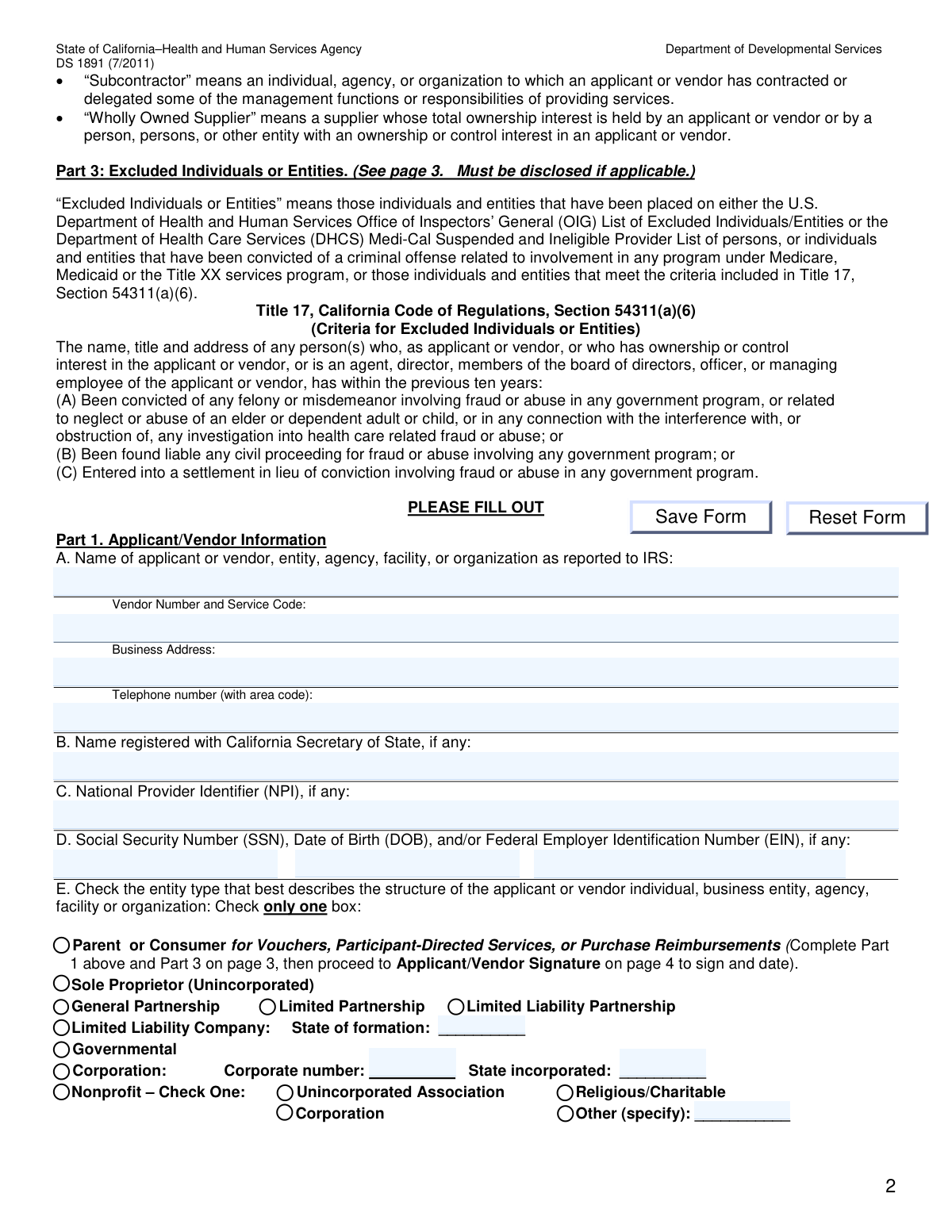
These forms are most commonly needed by service providers, businesses, and contractors applying to work with government agencies or regional program offices. A prime example in this category is the DS 1891, Applicant/Vendor Disclosure Statement, used by California's Department of Developmental Services. Anyone seeking vendorization with a regional center — or responding to a regional center's request — must complete this form, disclosing everything from ownership and managing employee information to subcontractor arrangements and significant business transactions. Because signers certify the information under penalty of perjury and must report any changes within 30 days, accuracy is essential.
For applicants navigating these requirements, tools like Instafill.ai use AI to fill out vendor disclosure forms in under 30 seconds, helping ensure the information is entered accurately and handled securely — a practical time-saver when compliance deadlines are involved.
Every form on this page can be completed without typing. Instafill is form filling software that reads a PDF and fills it for you — including flat and scanned documents that carry no fillable fields at all.
Forms in This Category
The forms in this category have a median Form Complexity Index of 58/100 (Moderate), measured across 1 forms by field count, input difficulty, length, conditional logic and structure. See how it is calculated.
| Form Name | Pages | FCI | |
|---|---|---|---|
| 1. | DS 1891, Applicant/Vendor Disclosure Statement (State of California Department of Developmental Services) | 4 | Moderate 58 |
- Enterprise-grade security & data encryption
- 99%+ accuracy powered by AI
- 1,000+ forms from all industries
- Complete forms in under 60 seconds
How to Choose the Right Form
Navigating California DDS Vendor Disclosures
If you are a service provider or applicant working within the California Department of Developmental Services (DDS) ecosystem, the disclosure process is a critical step in establishing and maintaining your "vendorization" status. Currently, this category focuses on the primary regulatory requirement for this specific industry.
When to Use the DS 1891
The DS 1891, Applicant/Vendor Disclosure Statement is specifically designed for individuals or business entities seeking to provide services through a regional center. You will need to complete this form in the following scenarios:
- New Applications: When you are first applying to become a vendor with a California regional center.
- Requested Updates: When a regional center requests a current disclosure statement as part of periodic monitoring or a routine audit.
- Reporting Changes: If there are significant changes to your ownership structure, business transactions, or managing employees, you are legally required to report these changes within 30 days using this form.
Key Requirements for the DS 1891
The DS 1891 is a comprehensive compliance document. Before you begin filling it out on Instafill.ai, ensure you have the following details ready to ensure a smooth process:
- Ownership and Control: Specific information regarding any person or entity with a 5% or more ownership or control interest.
- Managing Employees: Personal and professional details for individuals who exercise operational or managerial control over the entity.
- Subcontractor Data: Information regarding significant business transactions and relationships with subcontractors.
- Exclusion Status: You must verify and disclose whether any involved parties have been excluded from participating in federal or state healthcare programs (such as Medicare or Medi-Cal).
Why Accuracy is Essential
Because the Applicant/Vendor Disclosure Statement is signed under penalty of perjury, accuracy is paramount. Incomplete or incorrect filings can result in the denial of your application or the immediate termination of your vendorization status. Using our AI-powered filler helps ensure that all required fields are addressed, helping you maintain compliance with State of California regulations.
Form Comparison
| Form | Purpose | Who Files It | Key Disclosures |
|---|---|---|---|
| DS 1891, Applicant/Vendor Disclosure Statement (State of California Department of Developmental Services) | Ensures compliance with ownership, relationship, and exclusion rules for regional center vendorization. | Applicants or existing vendors seeking to provide services via California regional centers. | Includes ownership interests, managing employees, related-party transactions, and federal or state exclusion status. |
Tips for vendor disclosure forms
Since vendor disclosure forms are often signed under penalty of perjury, double-check every entry for accuracy. Inaccurate or incomplete disclosures can lead to the immediate denial of your application or the termination of your existing vendorization status.
Ensure you list every individual with ownership or control interests, including managing employees who direct daily operations. Omitting key personnel is a common oversight that can significantly delay the approval of your disclosure statement.
Be transparent about any relationships with other vendors or entities that provide services to the regional center. Providing clear disclosure of these connections helps prevent conflicts of interest and ensures compliance with state and federal regulations.
Maintain detailed records of any subcontractors or business transactions that meet the reporting threshold. Providing specific details about these entities upfront prevents the need for follow-up inquiries from the Department of Developmental Services.
AI-powered tools like Instafill.ai can complete these complex vendor forms in under 30 seconds with high accuracy. Your sensitive business data stays secure during the process, making it a major time-saver for busy applicants dealing with multiple disclosure requirements.
Vendor disclosure is an ongoing obligation rather than a one-time task. You must submit an updated form within 30 days of any change in ownership, control, or significant business relationships to remain in good standing.
Before starting the form, collect the Social Security numbers or Taxpayer Identification Numbers for all owners and managing employees. Having this data ready prevents interruptions and ensures the form is completed accurately in a single session.
Frequently Asked Questions
Vendor disclosure forms are used by government agencies and regional centers to ensure transparency and compliance among service providers. These forms require applicants to disclose ownership interests, business relationships, and any past legal or regulatory exclusions to prevent conflicts of interest and ensure program integrity.
These forms are generally required for any individual or business entity seeking to become an authorized vendor for state programs, such as those managed by the California Department of Developmental Services. Existing vendors may also need to submit updated disclosures periodically or upon request from their regional center.
A disclosure statement should be submitted during the initial application process for vendorization. Additionally, you are typically required to file a new form if there are significant changes in your business structure, ownership, or management within a specific timeframe, often 30 days.
Yes, AI tools like Instafill.ai can fill out these forms in under 30 seconds by accurately extracting and placing data from your source documents. This method helps ensure that complex sections regarding ownership and business transactions are completed quickly and precisely.
Most vendor disclosure forms collect information regarding ownership and control interests, the identity of managing employees, and relationships with subcontractors. You may also be asked to disclose whether any involved individuals or entities have been excluded from participating in federal or state-funded programs.
Agencies require information on managing employees because these individuals have the authority to direct the day-to-day operations of the vendor. Identifying these individuals allows the state to perform necessary background checks and ensure that no one in a leadership position is barred from receiving public funds.
While manually entering business and ownership data can be time-consuming, using an AI-powered platform like Instafill.ai can reduce the process to less than 30 seconds. The AI handles the data extraction and placement, allowing you to review and submit the form with minimal manual effort.
Providing incomplete or inaccurate information can lead to the denial of your vendor application or the termination of your current vendorization. Because these forms are often signed under penalty of perjury, it is essential to provide truthful and comprehensive data to avoid legal or administrative consequences.
Once the form is completed and signed, it is typically submitted directly to the regional center or the specific state department overseeing your vendorization. Some agencies allow for digital submission through an online portal, while others may require a physical copy or an emailed PDF.
Yes, many vendor disclosure forms require you to list subcontractors with whom you have significant business transactions. This helps the governing agency monitor the entire service chain and ensure that all parties involved meet the required compliance and ethical standards.
A significant business transaction generally refers to any payment or series of payments to a subcontractor or supplier that exceeds a certain monetary threshold set by the state. These disclosures help identify potential financial risks or dependencies within the vendor's business operations.
Yes, disclosure requirements apply to all types of legal entities, including sole proprietorships, partnerships, and corporations. The goal is to identify the individuals who ultimately exercise control or ownership over the entity providing services to the state.
Glossary
- Form Complexity Index
- Instafill’s 0–100 measure of how much effort a form takes to complete, calculated deterministically from the form’s own structure rather than estimated. It combines the number of fillable fields (the largest factor), how difficult those fields are to complete based on their type, the number of pages that contain fields, the amount of conditional “fill-only-if” logic, and how many sections the form is divided into, then adds modifiers for tables and repeating lists, bundled instruction pages, and dense page layouts. A higher score means the form is harder to fill out by hand. The forms in this category have a median Form Complexity Index of 58/100 (Moderate). See exactly how it is calculated.
- Vendorization
- The formal process used by California Regional Centers to identify and select service providers who meet specific legal and regulatory requirements to provide services to individuals with developmental disabilities.
- Regional Center
- A private, non-profit corporation that contracts with the State of California to coordinate and provide community-based services and support for people with developmental disabilities.
- Managing Employee
- An individual, such as a general manager, business manager, or administrator, who exercises operational or managerial control over the day-to-day activities of the applicant or vendor.
- Ownership or Control Interest
- A legal status where an individual or entity owns 5% or more of the business or has the power to direct the management and policies of the organization.
- Excluded Individual or Entity
- A person or business that has been legally barred from participating in federal or state healthcare programs, such as Medicare or Medi-Cal, often due to fraud or professional misconduct.
- Related-Party Relationship
- A connection where one party has the ability to significantly influence the management or operating policies of another, often through family ties or shared financial interests.
- Significant Business Transaction
- Any business agreement or series of agreements that exceed a specific financial threshold, typically $25,000, during a single fiscal year.
- DDS (Department of Developmental Services)
- The California state agency responsible for overseeing the network of regional centers that provide services to residents with developmental disabilities.