Fill out workforce forms
with AI.
Workforce forms encompass the essential documentation required to manage employment compliance, tax incentives, and wage reporting. These documents are vital for ensuring that businesses adhere to federal and state regulations, such as those established by the Department of Labor (DOL) and the Employment and Training Administration (ETA). By maintaining accurate records through these employment forms, organizations can protect themselves legally while also accessing specific financial benefits like federal tax credits.
By continuing, you acknowledge Instafill's Privacy Policy and agree to get occasional product update and promotional emails.
About workforce forms
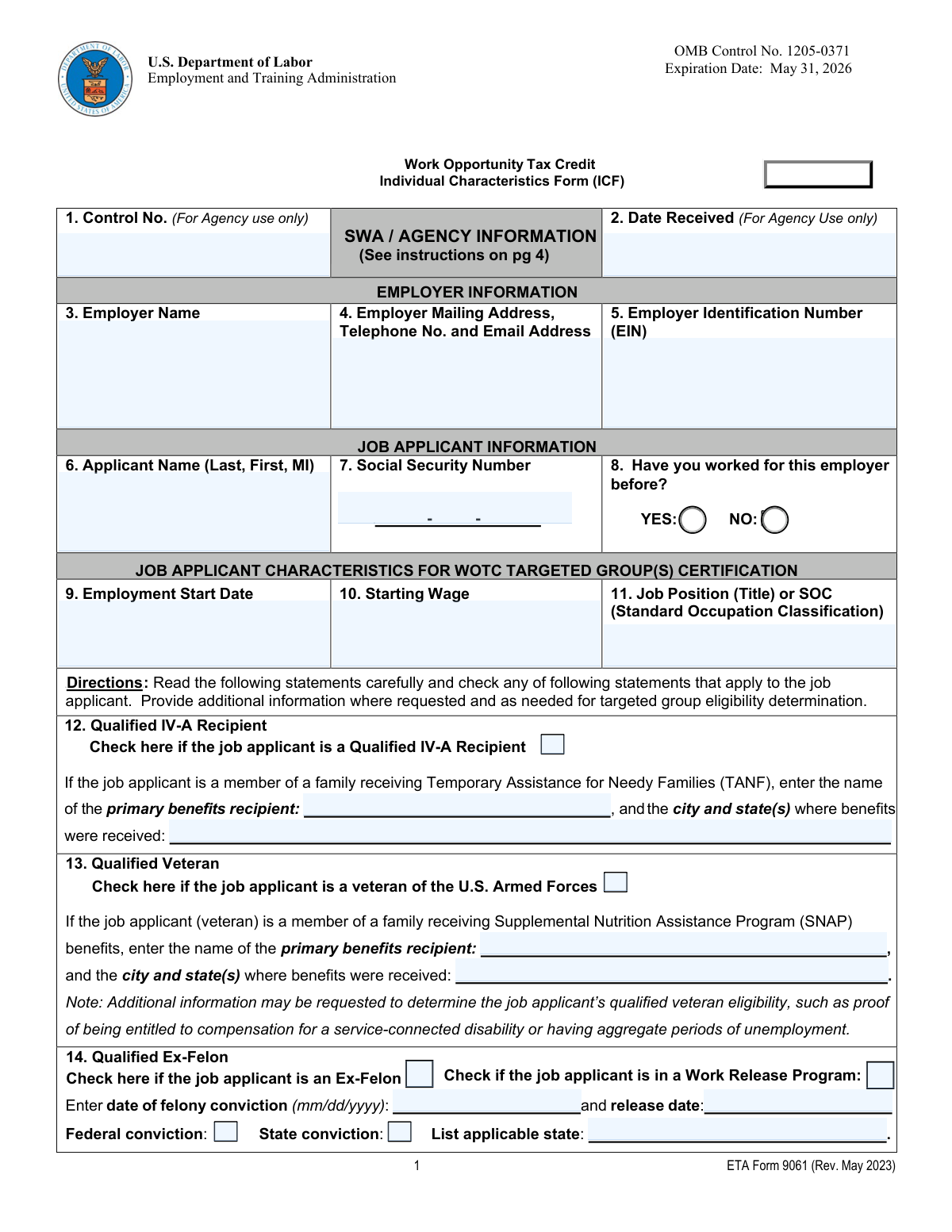
These forms are typically used by human resources professionals, payroll administrators, and business owners during various stages of the employment lifecycle. For example, tax credit forms like ETA Form 9061 are crucial during the hiring process to certify eligibility for the Work Opportunity Tax Credit (WOTC), while payroll certifications are required for contractors working on public projects to verify wage law compliance. Navigating these requirements ensures transparency and fairness in the labor market, though the administrative burden can be significant for growing teams.
Managing the high volume of paperwork involved in workforce administration can be time-consuming and prone to manual error. Tools like Instafill.ai use AI to fill these forms in under 30 seconds, handling sensitive data accurately and securely to streamline the compliance process. This allows teams to focus more on people and operations rather than manual data entry.
Every form on this page can be completed without typing. Instafill is form filling software that reads a PDF and fills it for you — including flat and scanned documents that carry no fillable fields at all.
Forms in This Category
The forms in this category have a median Form Complexity Index of 79/100 (Complex), measured across 2 forms by field count, input difficulty, length, conditional logic and structure. See how it is calculated.
- Enterprise-grade security & data encryption
- 99%+ accuracy powered by AI
- 1,000+ forms from all industries
- Complete forms in under 60 seconds
How to Choose the Right Form
Choosing the Right Workforce Form
Navigating workforce and employment documentation often depends on whether you are seeking federal tax incentives or complying with state-specific labor laws. In this category, the forms serve very different stages of the employment and contracting lifecycle.
Federal Tax Credits and Hiring
If your goal is to reduce your federal tax liability by hiring individuals from specific demographic groups, you will need to utilize Department of Labor (DOL) forms related to the Work Opportunity Tax Credit (WOTC).
- ETA Form 9061 (Individual Characteristics Form): Choose this form if you are an employer or hiring manager pre-screening job applicants. It is used to identify if a new hire belongs to a "targeted group"—such as veterans, SNAP recipients, or residents of empowerment zones—which makes your business eligible for federal tax credits. This is typically filled out during the onboarding process.
New Jersey Public Works Compliance
If you are a contractor performing work on government-funded construction projects within the state of New Jersey, your requirements shift toward wage and hour compliance rather than hiring incentives.
- NJ Form MW-562 (Payroll Certification for Public Works Projects): Select this form if you need to submit weekly or final payroll certifications to the New Jersey Department of Labor & Workforce Development. This document is mandatory for proving that you are paying workers the legal prevailing wage, including proper overtime and fringe benefits, as required by the New Jersey Prevailing Wage Act. It is a critical compliance record for both contractors and subcontractors.
Quick Selection Summary
To ensure you are using the correct document, identify your primary objective:
- Hiring a new employee and want a tax credit? Use ETA Form 9061 to establish eligibility for the WOTC program.
- Reporting payroll for a NJ government contract? Use NJ Form MW-562 to certify that your workers are being paid according to prevailing wage laws.
Both forms require high levels of accuracy to avoid penalties or missed financial benefits. Using an AI-powered tool like Instafill.ai helps ensure that your payroll calculations and applicant data are captured correctly every time.
Form Comparison
| Form | Purpose | Jurisdiction | Filing Frequency | Primary Data Collected |
|---|---|---|---|---|
| ETA Form 9061, Work Opportunity Tax Credit Individual Characteristics Form (ICF) | Determines eligibility for federal tax credits through hiring specific targeted groups. | Federal (U.S. Department of Labor) | Completed during the recruitment and hiring phase for new employees. | Veteran status, public assistance history, and demographic eligibility criteria. |
| NJ Department of Labor & Workforce Development Form MW-562, Payroll Certification for Public Works Projects (Contractor and Subcontractor’s Weekly and Final Certification) | Certifies wage compliance for contractors working on New Jersey public projects. | State (New Jersey Department of Labor) | Submitted weekly and upon completion of specific public works contracts. | Employee work hours, wage rates, deductions, and fringe benefit contributions. |
Tips for workforce forms
When filling out certified payroll forms like the MW-562, double-check that every worker is listed under the correct trade classification. Mismatched classifications can lead to compliance issues or penalties regarding prevailing wage requirements.
For forms like the ETA 9061, timing is critical to successfully claim the Work Opportunity Tax Credit. Ensure the form is completed and submitted within the required window post-hire to avoid losing out on significant tax savings.
Keep copies of all certifications, veteran status proofs, or public assistance records alongside your completed workforce forms. Having these documents organized makes it much easier to respond to audits or verification requests from the Department of Labor.
Errors in gross wages, fringe benefits, or net pay on payroll certifications can trigger unnecessary investigations. Always verify that the daily hours and overtime rates align with the final totals before signing the certification.
AI-powered tools like Instafill.ai can complete these workforce forms in under 30 seconds with high accuracy, which is a real time-saver when dealing with multiple employee records. Your data stays secure during the process, ensuring compliance while reducing manual entry errors.
Ensure that the person signing the workforce or payroll form has the legal authority to represent the company. Unauthorized signatures can invalidate the document, requiring a full re-submission and potentially delaying project payments or tax credits.
Frequently Asked Questions
Workforce forms are administrative documents used by employers and government agencies to track labor data, ensure compliance with wage laws, and manage tax incentive programs. They help document that workers are being paid fairly on public projects or help businesses qualify for federal hiring credits.
In most cases, the employer or the contractor is responsible for filling out and filing these documents. For recruitment-related forms, the job applicant may provide the initial information, but the business must finalize the submission to the relevant state or federal agency.
You need ETA Form 9061 if you are an employer seeking to claim the Work Opportunity Tax Credit (WOTC) for a new hire. This form helps determine if the individual belongs to a specific targeted group, such as veterans or recipients of public assistance, which makes the business eligible for the tax credit.
This form is required for contractors and subcontractors working on public works projects in New Jersey. It serves as a certified payroll record to prove that employees are receiving the prevailing wage and proper benefits as mandated by state law.
Yes, you can use AI tools like Instafill.ai to complete workforce forms quickly and accurately. The AI can extract data from your existing documents and automatically place it into the correct fields on the PDF, ensuring high precision for compliance-heavy paperwork.
Using AI-powered services, most workforce forms can be completed in under 30 seconds. This is significantly faster than manual entry and helps businesses manage high volumes of hiring or payroll documentation without dedicated administrative staff.
Submission requirements depend on the specific form; federal tax credit forms are typically sent to your State Workforce Agency (SWA), while certified payroll forms are usually submitted to the public entity overseeing the construction project or the state Department of Labor.
Filing inaccurate workforce forms can result in the denial of tax credits, financial penalties, or legal action for wage violations. For public works projects, incorrect payroll certifications can also lead to a contractor being debarred from future government contracts.
Most of these documents require a formal certification or signature from an authorized representative of the company. This signature confirms that the data provided, such as employee hours or eligibility characteristics, is true and accurate to the best of the signer's knowledge.
Yes, it is highly recommended to keep copies of all workforce forms for your records, usually for a period of three to seven years. These records are vital for internal audits, Department of Labor inquiries, or IRS verification of tax credit claims.
Glossary
- Form Complexity Index
- Instafill’s 0–100 measure of how much effort a form takes to complete, calculated deterministically from the form’s own structure rather than estimated. It combines the number of fillable fields (the largest factor), how difficult those fields are to complete based on their type, the number of pages that contain fields, the amount of conditional “fill-only-if” logic, and how many sections the form is divided into, then adds modifiers for tables and repeating lists, bundled instruction pages, and dense page layouts. A higher score means the form is harder to fill out by hand. The forms in this category have a median Form Complexity Index of 79/100 (Complex). See exactly how it is calculated.
- WOTC (Work Opportunity Tax Credit)
- A federal tax credit available to employers for hiring individuals from specific groups who have consistently faced significant barriers to employment.
- Prevailing Wage
- The hourly rate, including benefits and overtime, that the government determines must be paid to workers on public works projects in a specific geographic area.
- Certified Payroll
- A weekly report submitted by contractors on public projects to verify that all employees were paid the correct prevailing wages and fringe benefits.
- Targeted Group
- Specific categories of job seekers, such as qualified veterans, SNAP recipients, or residents of empowerment zones, who qualify an employer for tax credits.
- Public Works
- Construction, infrastructure, or repair projects funded by the government for the benefit of the community, such as schools, roads, or bridges.
- Work Classification
- The specific job title or trade assigned to a worker (e.g., laborer, carpenter, or electrician) which determines their required pay rate under wage laws.
- Fringe Benefits
- Compensation provided to employees in addition to their regular hourly wages, such as health insurance, life insurance, or retirement plan contributions.
- ETA (Employment and Training Administration)
- An agency within the U.S. Department of Labor that manages federal job training, worker placement, and unemployment insurance programs.