Fill out workplace injury forms
with AI.
Workplace injury forms are essential documents used to report accidents, illnesses, or fatalities that occur during the course of employment. These forms serve as the official record for insurance carriers and state regulatory bodies, effectively initiating the workers' compensation claims process. Accurate documentation is vital; it ensures that injured employees receive necessary medical benefits and wage replacement while protecting employers by maintaining compliance with legal reporting requirements. Whether documenting a sudden physical accident or a long-term occupational disease, these forms provide the factual foundation for every subsequent claim.
By continuing, you acknowledge Instafill's Privacy Policy and agree to get occasional product update and promotional emails.
About workplace injury forms
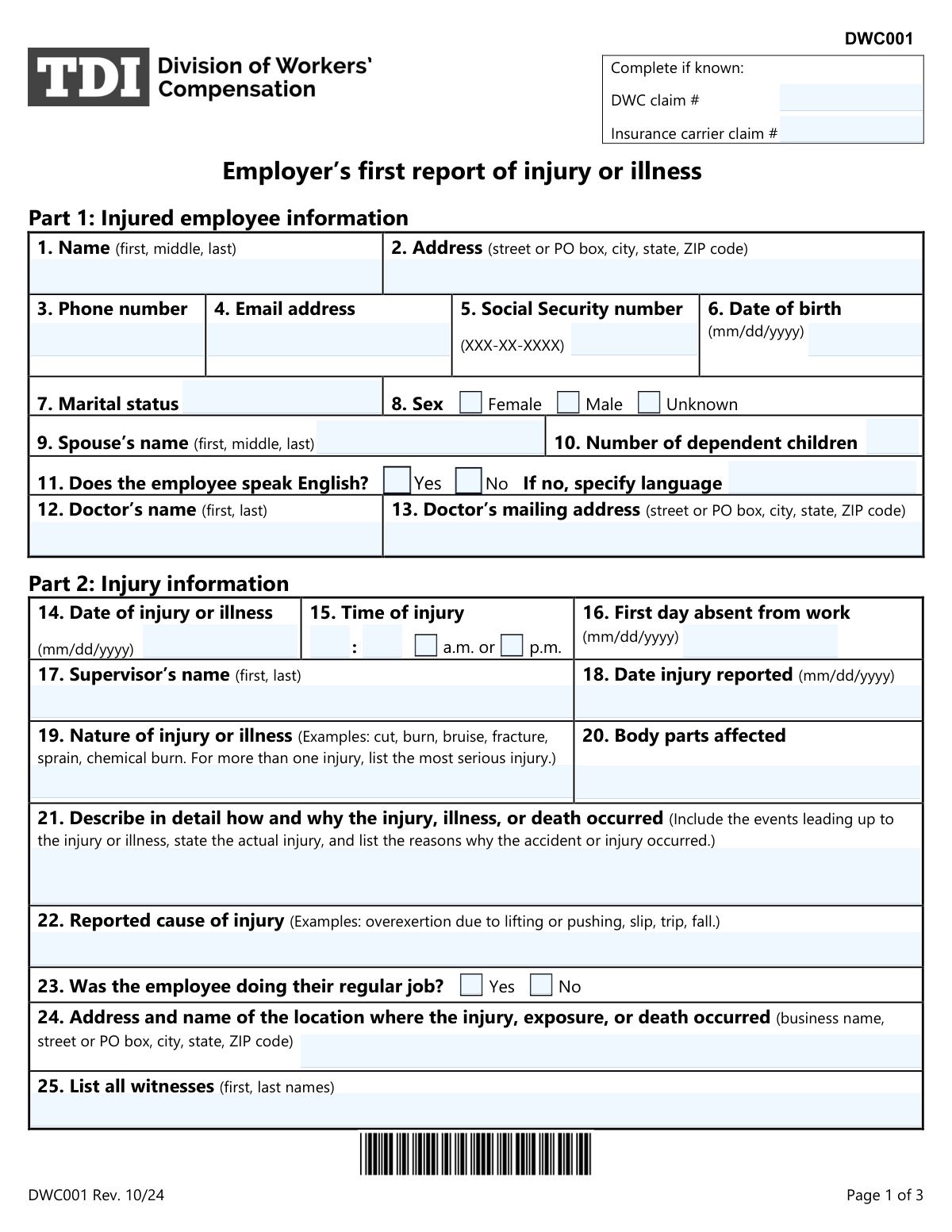
Typically, these forms are completed by business owners, HR administrators, and risk management officers. In many jurisdictions, such as Texas or Alberta, specific documents like the Employer’s First Report of Injury must be submitted within a strict timeframe—often just a few days following the incident or the notification of an illness. Timely filing is essential not only for legal compliance but also for the swift recovery of the worker. These documents are necessary whenever an employee requires medical attention beyond basic first aid or misses time from work due to a job-related health issue.
Managing the paperwork for workers' compensation can be a stressful task during an already difficult situation. Tools like Instafill.ai use AI to fill these workplace injury forms in under 30 seconds, ensuring that data is handled accurately and securely so you can focus on workplace safety and employee recovery. By automating the data entry process, these tools help prevent the common filing errors that often lead to administrative delays.
Every form on this page can be completed without typing. Instafill is form filling software that reads a PDF and fills it for you — including flat and scanned documents that carry no fillable fields at all.
Forms in This Category
The forms in this category have a median Form Complexity Index of 59/100 (Moderate), measured across 2 forms by field count, input difficulty, length, conditional logic and structure. See how it is calculated.
| Form Name | Pages | FCI | |
|---|---|---|---|
| 1. | DWC Form-001, Employer’s first report of injury or illness | 2 | Moderate 59 |
| 2. | DWC001S, Employer’s first report of injury or illness | 2 | Moderate 58 |
- Enterprise-grade security & data encryption
- 99%+ accuracy powered by AI
- 1,000+ forms from all industries
- Complete forms in under 60 seconds
How to Choose the Right Form
Choosing the Right Texas Workers' Compensation Form
When an employee suffers a workplace injury or contracts an occupational disease, filing the correct paperwork is critical for legal compliance and ensuring the claims process begins promptly. In Texas, the specific form you need depends primarily on which entity handles your workers' compensation coverage.
For Private Employers and Standard Insurance
If your company carries workers' compensation through a private insurance carrier, you should use DWC Form-001, Employer’s first report of injury or illness. This is the standard document used to notify your insurance provider of a work-related incident.
- Deadline: You must file this within eight days of the employee’s first day of absence, or within eight days of being notified of an occupational disease or a workplace fatality.
- Purpose: It initiates the formal claims process and provides the carrier with essential details regarding the nature of the injury and the circumstances of the incident.
For State Agencies and SORM-Covered Entities
If your organization reports to the State Office of Risk Management (SORM), you must use DWC001S, Employer’s first report of injury or illness. While it serves a similar purpose to the standard version, it is specifically designated for state-level risk management.
- Use Case: This form is typically used by Texas state agencies, universities, and other governmental entities covered under the SORM program.
- Action: Ensure you are submitting this directly to SORM rather than a private insurance carrier to avoid processing delays.
Key Considerations for Workplace Injury Forms
Regardless of which version you select, accuracy is vital as these workplace injury forms serve as the official legal record of the event. While the forms listed here focus on Texas jurisdictions, always ensure you are using the correct regional documents for your location, such as specific wcb alberta forms if the injury occurred in Canada. Using AI-powered tools like Instafill.ai can help you quickly complete these workers compensation forms, ensuring all mandatory fields are addressed before submission.
Form Comparison
| Form | Recipient | Target Employer | Filing Deadline |
|---|---|---|---|
| DWC Form-001, Employer’s first report of injury or illness | The employer's workers' compensation insurance carrier. | General private-sector employers operating in Texas. | Within eight days of injury notice or employee absence. |
| DWC001S, Employer’s first report of injury or illness | The State Office of Risk Management (SORM). | Texas state agencies and their employees. | Immediately as the first step in initiating a state-level claim. |
Tips for workplace injury forms
Most jurisdictions require the initial injury report to be filed within a very narrow window, often just a few days after the incident. Filing forms like the DWC Form-001 promptly prevents administrative penalties and ensures the injured employee receives timely medical care and benefits.
When describing the injury, focus on factual details such as the exact time, location, and specific body parts affected. Avoid speculative language and stick to what was observed or reported to ensure the insurance carrier can process the claim without requesting additional clarification.
Be sure to correctly identify if the claim is for a sudden accident or an occupational disease developed over time, such as repetitive strain. These categories often have different reporting triggers and documentation requirements, so clarity at the start of the form is essential.
Managing multiple workplace injury forms can be time-consuming during a high-stress situation. AI-powered tools like Instafill.ai can complete these forms in under 30 seconds with high accuracy, and your data stays secure throughout the process, allowing you to focus on employee safety rather than paperwork.
Always save a copy of the completed form for your company’s internal safety and HR records before submission. This documentation is vital for tracking workplace safety trends and serves as a critical reference if the claim is audited or contested in the future.
Ensure you are sending the form to the correct entity, such as a private insurance carrier or the State Office of Risk Management (SORM). Sending a DWC001S to the wrong office can result in a lost claim and legal non-compliance for the employer.
Frequently Asked Questions
Workplace injury forms are official documents used to report work-related accidents, illnesses, or fatalities to insurance carriers and state regulatory bodies. They serve as the initial step in the workers' compensation claims process, ensuring that medical expenses and lost wages are documented for potential reimbursement.
In most jurisdictions, the employer is responsible for filing the first report of injury. While the employee must report the incident to their supervisor, the official paperwork must be submitted by the company to their insurance provider or the relevant state risk management office.
Reports should generally be filed as soon as possible after an incident occurs to ensure timely processing of claims. For many employers, the first report of injury must be submitted within a specific window, often eight days after the employee’s first day of absence or when the employer first becomes aware of an occupational disease.
The DWC Form-001 is used by private employers to report injuries to their workers' compensation insurance carrier. In contrast, the DWC001S is a specific version intended for state agencies to report incidents to the State Office of Risk Management (SORM).
You will typically need the employee's personal details, social security number, and employment history, along with specific details about the incident. This includes the date, time, location, and a thorough description of how the injury or illness occurred.
Yes, you can fill out workplace injury forms using AI-driven platforms. Tools like Instafill.ai allow users to upload source documents or raw data, which the AI then uses to accurately extract and place data into the PDF fields in under 30 seconds.
Manual entry for workplace injury forms can take 15 to 20 minutes due to the amount of detail required. However, using AI tools like Instafill.ai can complete the process in under 30 seconds by automatically populating the form from your existing records.
Failure to file required injury reports in a timely manner can result in administrative penalties or fines from state regulatory agencies. Delays may also complicate the employee's ability to receive workers' compensation benefits, potentially leading to legal disputes or increased liability.
Yes, these forms are designed to cover both sudden physical injuries and occupational diseases that develop over time due to work conditions. When reporting an occupational disease, the filing timeline usually begins from the date the employer first becomes aware of the diagnosis.
Once completed, these forms are usually submitted to the employer's workers' compensation insurance carrier or a specific state agency, such as the State Office of Risk Management. It is standard practice to keep a copy for company records and provide a signed copy to the injured employee.
Glossary
- Form Complexity Index
- Instafill’s 0–100 measure of how much effort a form takes to complete, calculated deterministically from the form’s own structure rather than estimated. It combines the number of fillable fields (the largest factor), how difficult those fields are to complete based on their type, the number of pages that contain fields, the amount of conditional “fill-only-if” logic, and how many sections the form is divided into, then adds modifiers for tables and repeating lists, bundled instruction pages, and dense page layouts. A higher score means the form is harder to fill out by hand. The forms in this category have a median Form Complexity Index of 59/100 (Moderate). See exactly how it is calculated.
- Workers' Compensation
- A form of insurance providing wage replacement and medical benefits to employees injured in the course of employment in exchange for the employee's agreement not to sue the employer.
- Division of Workers' Compensation (DWC)
- The state-level agency responsible for overseeing the administration of workers' compensation claims and ensuring compliance with labor laws.
- Occupational Disease
- A chronic ailment or health condition that arises specifically from the nature of an employee's work or the environment in which they are employed.
- State Office of Risk Management (SORM)
- A government entity that manages workers' compensation claims and insurance services specifically for state agencies and their employees.
- Workers' Compensation Board (WCB)
- An independent organization, common in regions like Alberta, that administers no-fault workplace insurance and handles claims for injured workers.
- Insurance Carrier
- The company or fund that provides workers' compensation insurance coverage to an employer and is responsible for paying medical and indemnity benefits.
- First Report of Injury (FROI)
- The initial document filed by an employer to officially notify the insurance carrier and state authorities that a workplace injury or illness has occurred.
- Compensable Injury
- A physical injury or illness that is determined to have occurred within the scope of employment, making it eligible for workers' compensation benefits.