
Yes! You can use AI to fill out Form 1300t, Application for Australian Citizenship
Don't type 643 fields by hand. Tell our AI about yourself, or upload a document you already have, and it fills every field in seconds. You check it, then download, print or sign.
The AI does the filling. You just check it.
No typing into boxes, nothing to install.
What this form asks for
The AI fills all of it, from your answers or your documents.
The AI checks your answers before you download
14 checks built for this form, so a wrong date or a missing answer is caught before anyone else sees it.
Ensures that the applicant meets all the necessary eligibility criteria for Australian citizenship as outlined in Form 1300t. This includes verifying the applicant's age, ensuring they have the status of a permanent resident, and checking the residence requirement. Additionally, it confirms the applicant's intention to reside in or maintain a close and continuing association with Australia and assesses their character against the good character requirements.
Confirms that the applicant has reviewed the possibility of applying for Australian citizenship online through the Department of Home Affairs. It ensures that the applicant is aware of the online application process and proceeds with the paper form only if they are ineligible or unable to apply online. This check helps streamline the application process and directs applicants to the most efficient application method.
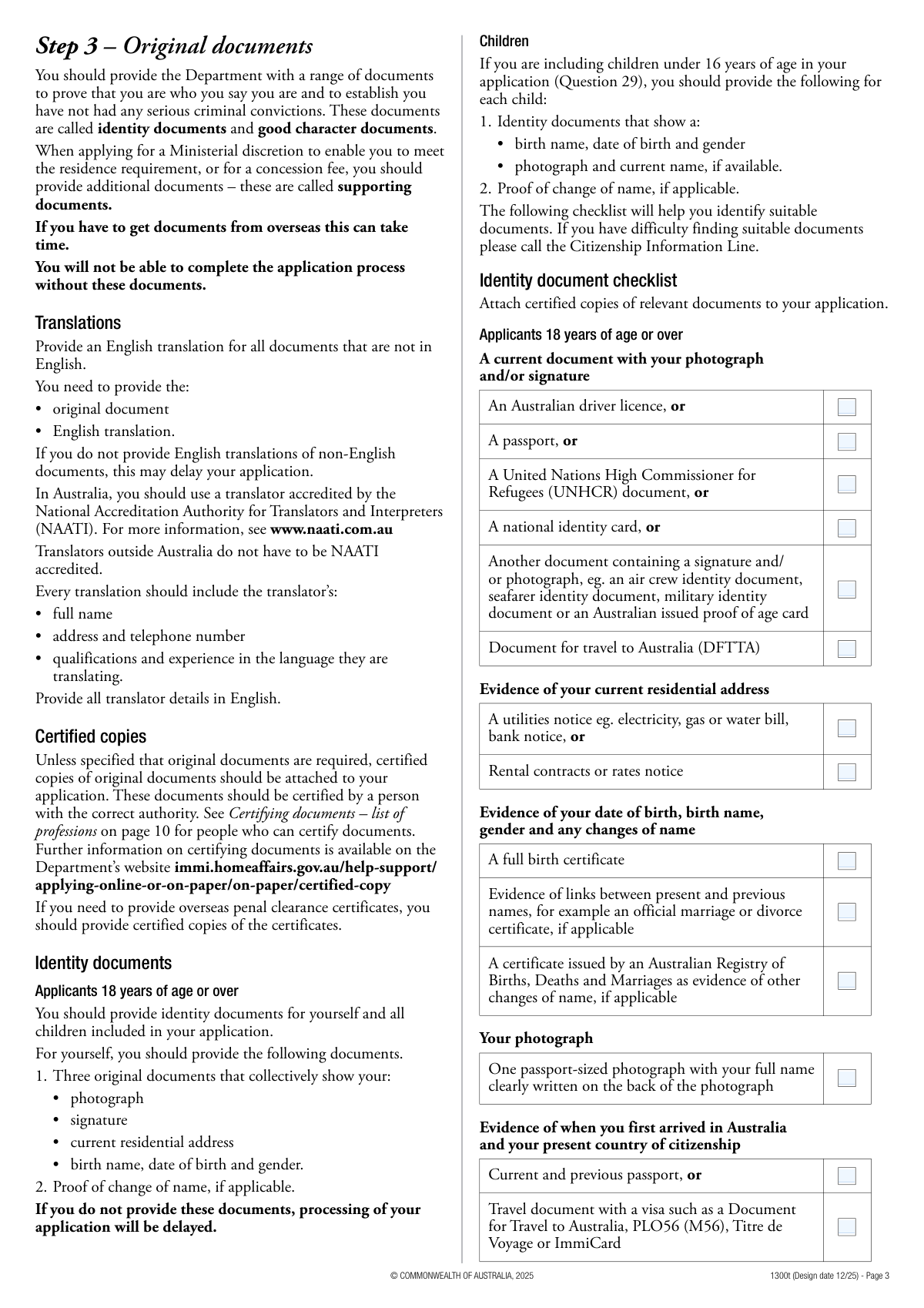
Verifies that all necessary original documents are collected and that certified copies are attached in accordance with the instructions provided in Form 1300t. This includes checking the validity and proper certification of identity documents, proof of residency, and any other supporting documents required by the form. It ensures that the documentation is complete and ready for submission to avoid delays in the application process.
Checks for the accuracy and truthfulness of all information provided in the Form 1300t application. This encompasses a thorough review of personal details, children's information, parents' details, associated family members, identity documents, travel history, character and any criminal offenses. It also includes verifying consent for communication as per the declaration section of the form. This validation is crucial to prevent fraud and ensure the integrity of the application.
Confirms that the applicant has selected their preferred citizenship pledge for the ceremony as part of the Form 1300t application process. This check ensures that the applicant's choice is clearly indicated on the form, which is necessary for the planning and execution of the citizenship ceremony. It also allows the applicant to review the pledge options and make an informed decision about their commitment to Australia.
The system ensures that if the applicant has any proposed overseas travel, the details are thoroughly provided within the form. It checks for completeness of information such as dates, destinations, and purpose of travel. If the section is applicable, the system prompts the applicant to fill in all the required fields. It also verifies that no relevant details are omitted, ensuring the application can be processed without delays due to missing travel information.
And 8 more checks
- Ensures the application fee is paid through ImmiAccount and a copy of the payment receipt is attached, unless a fee concession or exemption applies
- Checks that the declaration is read and signed by the applicant, acknowledging their understanding and acceptance of the responsibilities and values associated with Australian citizenship
- Confirms the application is lodged by post to the Department with certified copies of documents and the payment receipt, ensuring no original documents are sent
- Verifies the applicant is prepared for the citizenship test if required
- Ensures the applicant has a photo ID ready for the citizenship test appointment.
- Confirms the applicant is aware of the need to await notification of the Department's decision.
- Verifies the applicant's understanding that attendance at a citizenship ceremony and making the pledge is necessary to complete the citizenship process.
- Checks that the applicant has kept a copy of their application and all attachments for their records.
Let AI fill out your 1300t
No typing. Every field filled in seconds, checked, ready to sign.
How to Fill Out 1300t Online for Free in 2026
What the AI walks you through.
- Visit instafill.ai site and select 1300t
- Enter personal details and citizenship information
- Provide identity documents and character assessment
- Complete residence requirement section
- Include details of children if applicable
- Electronically sign and date the form
- Check for accuracy and submit form
Common Mistakes in Completing 1300t
The ones the AI is built to catch.
Not meeting eligibility criteria before applying
Applying with paper form when online is preferred
Failing to certify copies of documents correctly
Providing inaccurate or untruthful information
Omitting required details for children or parents
Incomplete travel history or criminal offenses section
Not choosing a citizenship pledge for the ceremony
Forgetting to include proposed overseas travel details
Not attaching payment receipt to the application
Signing the declaration without understanding it
Sending original documents instead of certified copies
Not preparing for the citizenship test
Missing the citizenship test appointment
Failing to attend the citizenship ceremony
Not keeping a copy of the application and attachments
Frequently Asked Questions About 1300t
Is it really free for 7 days?
Can I fill other forms too?
How do I cancel?
How does the AI fill out 1300t?
What happens to my information?
How complex is 1300t to fill out?
What is Form 1300t used for?
Who is eligible to apply for Australian citizenship using Form 1300t?
What are the general eligibility criteria for Australian citizenship?
Can children be included in a parent's Form 1300t application?
What is the residence requirement for Australian citizenship?
Are there any special residence requirements for Australian citizenship?
What documents are required when applying for Australian citizenship with Form 1300t?
How can I certify copies of documents for my citizenship application?
What is the process for applying for Australian citizenship?
Do I need to be in Australia when my citizenship application is decided?
What happens if I provide false or misleading information in my citizenship application?
What are the steps involved in the Australian citizenship application process?
How do I prepare for the Australian citizenship test?
What should I bring to my citizenship test appointment?
What happens if my Australian citizenship application is refused?
How long does it usually take to attend a citizenship ceremony after approval?
What are the photograph requirements for the citizenship application?
Can New Zealand citizens apply for Australian citizenship using Form 1300t?
What are the ministerial discretions that may assist with meeting the residence requirement?
How do I lodge my Form 1300t application for Australian citizenship?
Get your 1300t filled out by AI
$0 today. Cancel before Oct 31 and you pay nothing.
Let AI fill out your 1300t
Your trial starts once a card is added. You pay nothing before Oct 31.
Our AI already knows this form, all 643 fields of it. Skip the typing: tell it about yourself, or upload what you have, and it fills the whole form in seconds.
- AI fills every field on all 28 pages, tables and checkboxes included
- No typing into boxes: answer a few questions, or upload a document you already have, an old copy of this form, a photo of a document
- The AI checks the answers; you review and change anything before you download
- Download the finished PDF, print it, or sign it online
- Encrypted, and never used to train AI
Cancel before Oct 31 and you pay nothing.
A card is needed to start the trial. Cancel in two clicks from your account.
Terms · Privacy