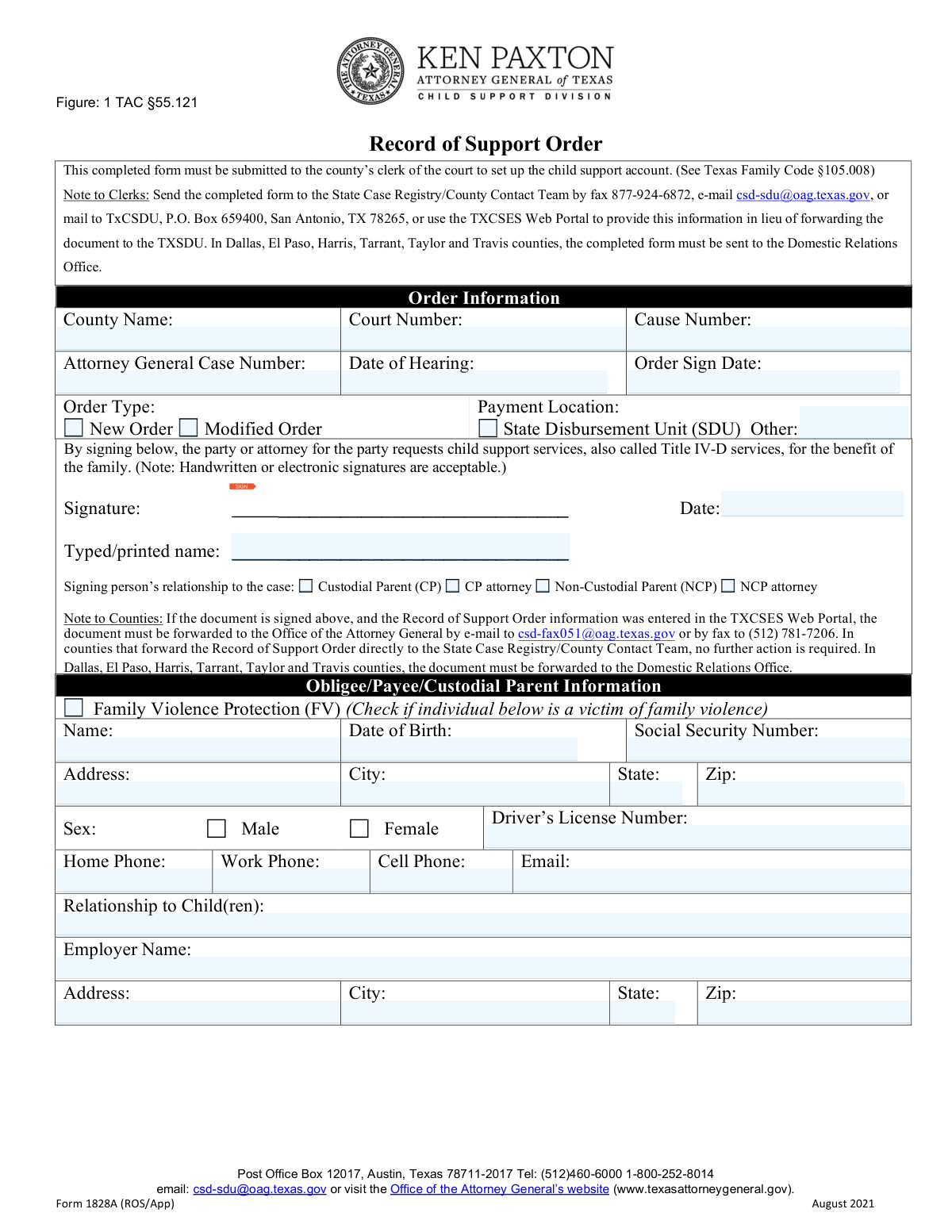
Yes! You can use AI to fill out Form 1828A, Record of Support Order with Application
Form 1828A, the Record of Support Order with Application, is a crucial document in Texas used to officially record a court-ordered child support arrangement and set up the necessary payment account. Mandated by the Texas Family Code, this form is submitted to the county's clerk of the court to ensure proper administration and enforcement of child support payments. Today, this form can be filled out quickly and accurately using AI-powered services like Instafill.ai, which can also convert non-fillable PDF versions into interactive fillable forms.
Our AI automatically handles information lookup, data retrieval, formatting, and form filling.
It takes less than a minute to fill out Form 1828A using our AI form filling.
Securely upload your data. Information is encrypted in transit and deleted immediately after the form is filled out.
Form specifications
| Form name: | Form 1828A, Record of Support Order with Application |
| Number of fields: | 94 |
| Number of pages: | 1 |
| Language: | English |
Instafill Demo: How to fill out PDF forms in seconds with AI
How to Fill Out Form 1828A Online for Free in 2026
Are you looking to fill out a FORM 1828A form online quickly and accurately? Instafill.ai offers the #1 AI-powered PDF filling software of 2026, allowing you to complete your FORM 1828A form in just 37 seconds or less.
Follow these steps to fill out your FORM 1828A form online using Instafill.ai:
- 1 Navigate to Instafill.ai and upload or select the Texas Record of Support Order with Application (Form 1828A).
- 2 Enter the court order details, including the county, court number, cause number, and order dates, letting the AI guide you to the correct fields.
- 3 Input the personal and contact information for the Obligee (Custodial Parent) and the Obligor (Non-Custodial Parent), including names, addresses, and social security numbers.
- 4 List the details for each dependent child covered by the support order, such as their name, date of birth, and social security number.
- 5 Indicate if you are requesting Title IV-D services and provide your signature, which can be done electronically through the platform.
- 6 Review the entire form for accuracy, as the AI will highlight any missing or potentially incorrect information, before downloading the completed document for submission to the appropriate county clerk or office.
Our AI-powered system ensures each field is filled out correctly, reducing errors and saving you time.
Why Choose Instafill.ai for Your Fillable Form 1828A Form?
Speed
Complete your Form 1828A in as little as 37 seconds.
Up-to-Date
Always use the latest 2026 Form 1828A form version.
Cost-effective
No need to hire expensive lawyers.
Accuracy
Our AI performs 10 compliance checks to ensure your form is error-free.
Security
Your personal information is protected with bank-level encryption.
Frequently Asked Questions About Form Form 1828A
This form is used to officially record the details of a new or modified child support court order. It must be submitted to the county's clerk of the court to establish the official child support account for payment processing.
This form should be completed by one of the parties in the child support case (the Custodial or Non-Custodial Parent) or their attorney. The completed form records the details of the court's order for official processing.
You must submit the completed form to the clerk of the court in the county where your child support order was issued. The clerk will then forward it to the appropriate state agency or domestic relations office.
Title IV-D services are child support services provided by the Texas Office of the Attorney General, which can include locating a parent, establishing paternity, and enforcing support orders. You can request these services by signing the designated section on the first page of the form.
This checkbox should be marked if the person or child listed is a victim of family violence. This alerts the Office of the Attorney General to take measures to protect the individual's personal information, such as their address, for safety reasons.
Select 'New Order' if this is the first time a child support order has been established for this case. Select 'Modified Order' if you are changing or updating an existing child support order.
The Obligee/Payee is the person who receives the child support payments, typically the Custodial Parent (CP). The Obligor/Payor is the person required to make the child support payments, typically the Non-Custodial Parent (NCP).
The form provides space for four dependents. If you have more than four children covered by the support order, you must attach an additional page listing the same required information for each additional child.
Yes, you should provide the Social Security Number for the parents and all children listed on the form. This information is crucial for accurate identification and for the enforcement of the child support order.
Yes, the form explicitly states that both handwritten and electronic signatures are acceptable. Be sure to also date the form and print your name clearly.
Yes, services like Instafill.ai use AI to accurately auto-fill form fields with your information, which can save you time and help prevent errors. This is especially useful for forms that require repetitive personal data.
You can easily fill out this form online by using a service like Instafill.ai. Simply upload the PDF to their platform, and you can type your information directly into the fields before printing it for submission.
If you have a non-fillable or 'flat' PDF, you can use a tool like Instafill.ai to convert it into an interactive, fillable form. This allows you to easily type your answers instead of having to print and fill it out by hand.
Compliance Form 1828A
Validation Checks by Instafill.ai
1
Valid Social Security Number Format
This check ensures that the Social Security Number (SSN) for the Custodial Parent, Non-Custodial Parent, and all dependents is entered in the standard XXX-XX-XXXX format. Maintaining a consistent and valid format is crucial for data integrity and successful integration with state and federal databases for identity verification. A failure would prevent proper record matching and halt the processing of the application.
2
Order Date Logical Consistency
This validation verifies that the 'Order Sign Date' is on or after the 'Date of Hearing'. This check is important for maintaining the chronological accuracy of legal events recorded on the form. An illogical sequence of dates suggests a data entry error and would cause the record to be rejected until the discrepancy is corrected.
3
Required Order Identification Fields
Ensures that the 'County Name', 'Court Number', and 'Cause Number' fields are all completed. These three fields collectively serve as the unique identifier for the court case to which the support order belongs. If any of this information is missing, it would be impossible to file the record correctly with the clerk of the court, rendering the submission invalid.
4
Parent and Child Date of Birth Logic
This check verifies that the 'Date of Birth' for both the Custodial Parent and Non-Custodial Parent precedes the 'Date of Birth' for all listed dependents. It is a fundamental logical validation to ensure the parent-child relationship is chronologically possible. An error here would call into question the validity of the entire record and require correction before processing.
5
Completeness of Dependent Information
Confirms that for every dependent entered, the 'Name', 'Date of Birth', 'Social Security Number', and 'Sex' fields are all filled out. Complete information for each child is a legal requirement for establishing the support order and ensuring benefits are administered correctly. An incomplete dependent record will result in the form being returned for correction.
6
At Least One Dependent is Listed
This validation ensures that information for at least one dependent child has been provided on the form. A child support order cannot be established without a child beneficiary. If no dependents are listed, the form is fundamentally incomplete for its purpose and cannot be processed.
7
Valid Contact Phone Number Format
This check validates that all phone numbers provided (Home, Work, Cell, Attorney) adhere to a standard 10-digit format, such as (XXX) XXX-XXXX or XXXXXXXXXX. This ensures the contact information is machine-readable and usable for official communication regarding the case. An invalid format could prevent the Office of the Attorney General from making necessary contact with the parties.
8
Exclusive Selection for Order Type
Verifies that exactly one option, either 'New Order' or 'Modified Order', is selected for the 'Order Type'. Selecting neither or both creates ambiguity about the legal action being recorded. This check ensures the form clearly communicates the status of the child support case for correct processing.
9
Required Core Party Information
Ensures that the full 'Name', 'Address', and 'Date of Birth' are provided for both the Obligee/Custodial Parent and the Obligor/Non-Custodial Parent. This core personally identifying information is essential for legal identification and the enforcement of the support order. Missing this information would render the form invalid and un-processable.
10
Valid Email Address Format
This check verifies that any email address provided follows the standard '[email protected]' format. Correctly formatted email addresses are crucial for enabling modern electronic communication and official notifications regarding the case. An invalid email format would lead to communication failures and potential delays in case management.
11
Application Signature Completeness
If a party or attorney signs the form to request Title IV-D services, this validation ensures the 'Signature', 'Date', 'Typed/printed name', and 'Signing person’s relationship to the case' fields are all completed. These fields are required to formally process the application for child support services. An incomplete application section would prevent the initiation of those services.
12
Unique Social Security Numbers for Parents
This validation confirms that the Social Security Number entered for the Custodial Parent is different from the Social Security Number entered for the Non-Custodial Parent. This is a critical data integrity check to ensure two distinct individuals are being identified for the order. Identical SSNs would indicate a severe data entry error that must be corrected.
13
Valid ZIP Code Format
This check ensures that all ZIP code fields (for parents and employers) contain a valid 5-digit or 9-digit (ZIP+4) numeric format. Accurate ZIP codes are essential for the mailability of legal notices and other correspondence. An invalid format could lead to returned mail and significant delays in the case.
14
Case Identifier Consistency Check
Verifies that the 'County Name', 'Court Number', and 'Cause Number' entered in the 'Order Information' section at the top of the form match the same fields repeated on the second page. This ensures data consistency across the entire document, which may be handled in separate pages during processing. Mismatched identifiers could lead to information being filed with the wrong case.
Common Mistakes in Completing Form 1828A
Users often mistype the 'Cause Number', 'Court Number', or 'Attorney General Case Number'. These numbers link the form to the specific legal case, and even a single incorrect digit can cause the document to be rejected or misfiled. This leads to significant delays in setting up the child support account and processing payments. To avoid this, carefully cross-reference these numbers with the official court order document before entering them.
The signature block is not just a formality; it serves as a formal application for Title IV-D child support services. People frequently forget to sign, date, or check the box indicating their relationship to the case (e.g., Custodial Parent, attorney). An unsigned or incomplete application is invalid and will not be processed, meaning the request for state enforcement and collection services will be ignored until the form is corrected and resubmitted.
The legal terms 'Obligee/Custodial Parent' (the one who receives support) and 'Obligor/Non-Custodial Parent' (the one who pays support) can be confusing. A common mistake is entering information for the wrong party in a section. This critical error can cause the entire system to be set up incorrectly, potentially sending payment demands to the custodial parent. Always remember the Obligee receives payments and the Obligor pays them, and double-check that the information in each section corresponds to the correct individual.
This small checkbox next to a person's name is a crucial safety feature that is easily missed. If a party or child is a victim of family violence, checking this box flags their personal information (like their address) for enhanced confidentiality. Forgetting to check this box can result in a victim's location being inadvertently disclosed to the other party, creating a serious safety risk. It is vital to review each party and dependent section carefully and check this box if applicable.
An accurate SSN is essential for identifying parties and dependents for enforcement actions like tax refund intercepts and wage withholding. People may leave this field blank due to privacy concerns or accidentally transpose digits. An incorrect or missing SSN is a primary reason for processing delays and can severely hinder the state's ability to enforce the support order, ultimately affecting the child's financial support.
The form provides space for only four children. The instruction 'If there are more children, attach an additional page' is often missed. Failing to list all children covered by the support order means the case will be set up incorrectly. This can lead to inaccurate support calculations and distribution, depriving some children of the support they are legally owed. Always account for all dependents, creating and attaching a supplementary page with all required information if necessary.
The Non-Custodial Parent's employer information is critical for executing an 'Income Withholding for Support Order'. Filers often provide an old employer, or just a company name without a full, correct address for their payroll department. This renders the information useless for wage garnishment, which is the most effective method of ensuring consistent payments. To avoid this, provide the most current and complete employer name and address known.
This form is often provided as a non-fillable PDF, forcing users to print it and fill it out by hand. Illegible handwriting, especially for critical numbers (SSN, Case Number) and names, can lead to data entry errors by the clerk. This can result in returned mail, misdirected payments, and failed identity verification. To prevent this, it is best to use a tool like Instafill.ai that can convert the document into a fillable PDF, ensuring all entries are typed and perfectly legible.
The checkboxes for 'New Order' vs. 'Modified Order' and 'State Disbursement Unit' vs. 'Other' are small but vital. Filers often overlook them while focusing on the larger information fields. This omission leaves clerks guessing whether they are creating a new case or updating an old one, and where payments should be routed. This ambiguity halts the process until the filer is contacted for clarification, causing unnecessary delays.
Users may enter dates in an incorrect format or provide dates that are chronologically impossible, such as an 'Order Sign Date' that occurs before the 'Date of Hearing'. These errors can cause automated system rejections or flag the form for a manual review, delaying processing. It is important to verify all dates against the official court documents and ensure they make logical sense. AI-powered form-filling tools like Instafill.ai can help by validating date formats and flagging potential inconsistencies.
Saved over 80 hours a year
“I was never sure if my IRS forms like W-9 were filled correctly. Now, I can complete the forms accurately without any external help.”
Kevin Martin Green
Your data stays secure with advanced protection from Instafill and our subprocessors

Robust compliance program
Transparent business model
You’re not the product. You always know where your data is and what it is processed for.
ISO 27001, HIPAA, and GDPR
Our subprocesses adhere to multiple compliance standards, including but not limited to ISO 27001, HIPAA, and GDPR.
Security & privacy by design
We consider security and privacy from the initial design phase of any new service or functionality. It’s not an afterthought, it’s built-in, including support for two-factor authentication (2FA) to further protect your account.
Fill out Form 1828A with Instafill.ai
Worried about filling PDFs wrong? Instafill securely fills form-1828a-record-of-support-order-with-application forms, ensuring each field is accurate.