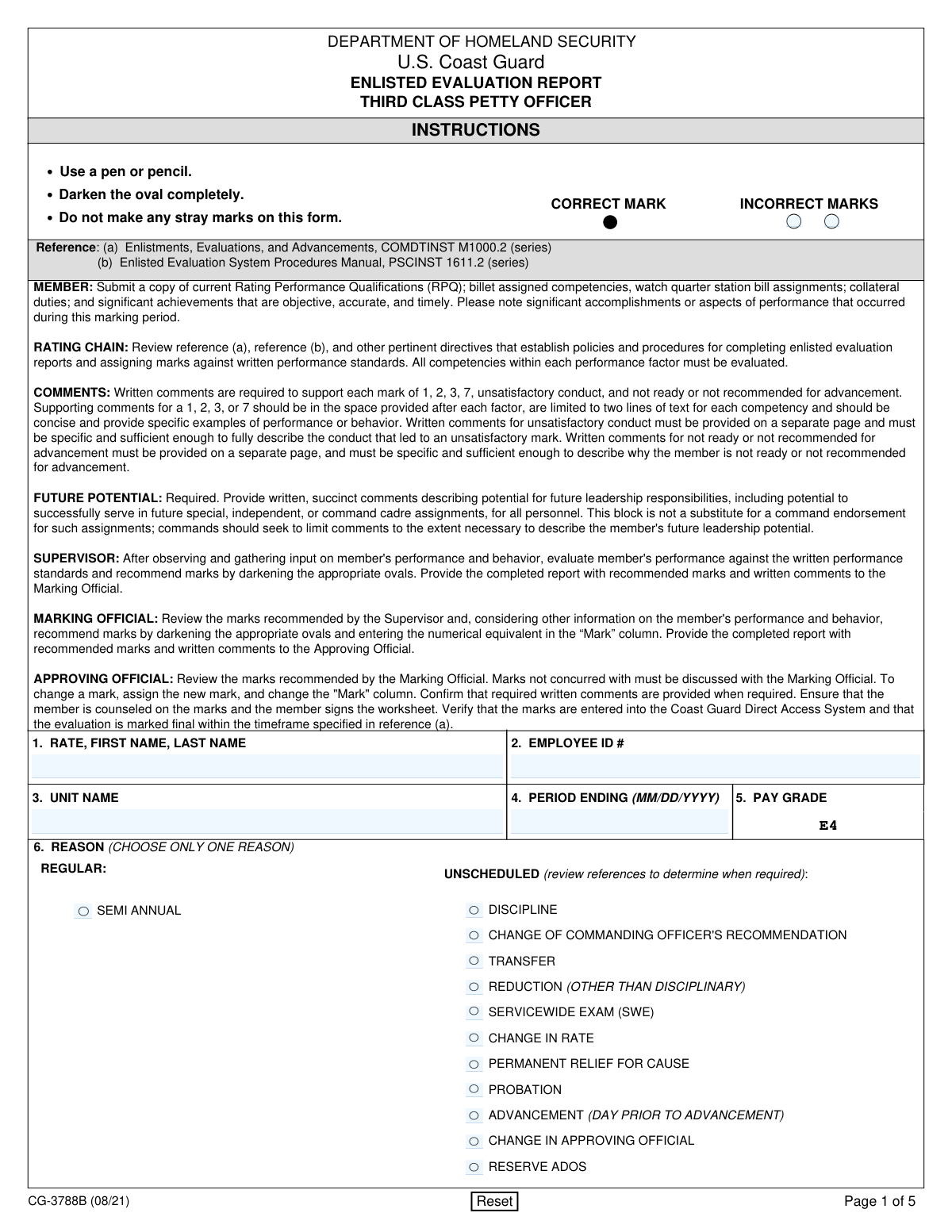
Yes! You can use AI to fill out Form CG-3788B, Enlisted Evaluation Report, Third Class Petty Officer
The CG-3788B, Enlisted Evaluation Report, is a formal assessment tool used within the U.S. Coast Guard to document the performance, military bearing, leadership, and professional qualities of a Third Class Petty Officer. This evaluation is critical for career development, influencing decisions on advancement, special assignments, and overall service record. Today, this form can be filled out quickly and accurately using AI-powered services like Instafill.ai, which can also convert non-fillable PDF versions into interactive fillable forms.
Our AI automatically handles information lookup, data retrieval, formatting, and form filling.
It takes less than a minute to fill out CG-3788B using our AI form filling.
Securely upload your data. Information is encrypted in transit and deleted immediately after the form is filled out.
Form specifications
| Form name: | Form CG-3788B, Enlisted Evaluation Report, Third Class Petty Officer |
| Number of fields: | 169 |
| Number of pages: | 5 |
| Language: | English |
Instafill Demo: How to fill out PDF forms in seconds with AI
How to Fill Out CG-3788B Online for Free in 2026
Are you looking to fill out a CG-3788B form online quickly and accurately? Instafill.ai offers the #1 AI-powered PDF filling software of 2026, allowing you to complete your CG-3788B form in just 37 seconds or less.
Follow these steps to fill out your CG-3788B form online using Instafill.ai:
- 1 Navigate to Instafill.ai and upload or select the CG-3788B form.
- 2 Enter the member's identification information, including name, employee ID, unit, and the evaluation period end date.
- 3 Select the appropriate reason for the evaluation, such as 'Semi-Annual' or an unscheduled reason like 'Transfer' or 'Advancement'.
- 4 The rating chain (Supervisor, Marking Official) will use the interactive fields to assign numerical marks (1-7) for each performance factor, such as Military Bearing, Quality of Work, and Leadership.
- 5 Input required written comments in the designated text boxes to justify any marks of 1, 2, 3, 7, or an 'Unsatisfactory' conduct rating.
- 6 Provide an assessment of the member's future potential and make a recommendation for advancement (Ready, Not Ready, Not Recommended).
- 7 The Supervisor, Marking Official, Approving Official, and the member will digitally sign and date the form to certify and acknowledge the evaluation.
Our AI-powered system ensures each field is filled out correctly, reducing errors and saving you time.
Why Choose Instafill.ai for Your Fillable CG-3788B Form?
Speed
Complete your CG-3788B in as little as 37 seconds.
Up-to-Date
Always use the latest 2026 CG-3788B form version.
Cost-effective
No need to hire expensive lawyers.
Accuracy
Our AI performs 10 compliance checks to ensure your form is error-free.
Security
Your personal information is protected with bank-level encryption.
Frequently Asked Questions About Form CG-3788B
This form is the U.S. Coast Guard's Enlisted Evaluation Report for a Third Class Petty Officer (E4). It is used to formally document performance, provide feedback, and assist in decisions regarding advancement, selection, and assignments.
The evaluation is completed by your rating chain, which includes your Supervisor, a Marking Official, and an Approving Official. As the member, you are responsible for providing initial input and documentation of your accomplishments.
You should submit copies of your current Rating Performance Qualifications (RPQ), billet assigned competencies, watch quarter station bill assignments, collateral duties, and a summary of significant achievements during the marking period.
Written comments are mandatory for any performance factor marked as 1, 2, 3, or 7. Comments are also required for an 'Unsatisfactory' conduct mark or an advancement recommendation of 'Not Ready' or 'Not Recommended'.
'Not Ready' means you are performing your duties well but are not yet prepared for the next pay grade. 'Not Recommended' means you should not be advanced due to poor performance or conduct issues, regardless of other qualifications.
Any mark of 1, 2, or 3 must be justified with specific written comments from your rater. You will be counseled on these marks and have 15 calendar days to submit an appeal after signing.
This mark indicates a failure to meet minimum standards due to events like NJP, civil conviction, or other actions that discredit the Coast Guard. It requires detailed comments on a separate page and will negatively impact your career.
You must review the completed report, receive counseling on the marks, and sign to acknowledge your review. Your signature confirms you understand the marks and your right to appeal within 15 days.
After all signatures are complete, the Approving Official is responsible for ensuring the marks are entered into the Coast Guard Direct Access System and that the evaluation is marked as final within the required timeframe.
An unscheduled evaluation may be required for various reasons, including transfer, discipline, a change in rate, participation in the Servicewide Exam (SWE), or a change in the Approving Official.
Yes, services like Instafill.ai use AI to accurately auto-fill form fields like your name, employee ID, and unit information, which helps save time and reduce errors.
You can upload the form to a platform like Instafill.ai. This allows you and your rating chain to digitally fill out the required fields and add comments before printing for wet signatures.
If you have a non-fillable or 'flat' PDF, you can use a service like Instafill.ai to convert it into an interactive, fillable form, making it easy for everyone in the rating chain to complete on a computer.
Yes, written comments in the 'Future Potential' block are required for all personnel. These comments should succinctly describe your potential for future leadership responsibilities and special assignments.
Compliance CG-3788B
Validation Checks by Instafill.ai
1
Exclusive Reason for Evaluation
Ensures that exactly one reason for the evaluation is selected from the list in section 6. The form specifies 'CHOOSE ONLY ONE REASON', so the system must prevent the user from selecting zero or multiple reasons. This is critical for correctly categorizing and processing the evaluation for personnel records and career management.
2
Period Ending Date Format and Logic
Validates that the 'PERIOD ENDING' date in section 4 is a valid date in MM/DD/YYYY format. It also checks that the date is not in the future and is logically sound for an evaluation period. This ensures data integrity and prevents reports from being submitted for invalid or future timeframes.
3
Employee ID and Name Validation
Verifies that the 'EMPLOYEE ID #' and 'RATE, FIRST NAME, LAST NAME' combination exists and matches an active record in the Coast Guard Direct Access System. This is a fundamental check to ensure the evaluation is being filed for the correct service member. A mismatch would lead to incorrect personnel file entries and significant administrative problems.
4
Mandatory Comments for Specific Marks
Checks if a comment has been provided for any performance factor that receives a mark of 1, 2, 3, or 7. The form instructions explicitly require written comments to support these marks. Failure to provide justification for unusually low, standard, or high marks would make the evaluation incomplete and difficult to defend or understand.
5
Mark and Rating Selection Consistency
For each performance factor, this validation ensures the numeric value entered in the 'Mark' column corresponds to the selected radio button rating. For example, if the radio button for a '5' is selected, the 'Mark' field must also contain a '5'. This prevents data entry errors and ensures the intended rating is accurately recorded.
6
Completeness of All Performance Marks
Verifies that every performance factor on pages 2, 3, and 4 has a numeric mark entered. The instructions state that 'All competencies within each performance factor must be evaluated'. Submitting a form with missing marks would result in an incomplete evaluation of the member's performance.
7
Mandatory Future Potential Comments
Ensures the 'FUTURE POTENTIAL' comment block on page 5 is not empty. The form explicitly states that these comments are 'Required'. This information is vital for succession planning and identifying candidates for future leadership roles, so its absence would render the report incomplete.
8
Conditional Requirement for Unsatisfactory Conduct Comments
If the 'CONDUCT' block is marked 'UNSATISFACTORY', this validation confirms that the 'Required comments for unsatisfactory conduct...' checkbox is checked by the Approving Official. This serves as a system check to enforce the rule that such a serious finding must be accompanied by detailed, specific documentation on a separate page.
9
Conditional Requirement for Advancement Comments
If 'Not Ready' or 'Not Recommended' is selected for 'ADVANCEMENT POTENTIAL' by any official, this validation ensures the Approving Official checks the 'Required comments... attached on separate page' box. This is crucial as a negative advancement recommendation has significant career implications and must be thoroughly justified in writing.
10
Logical Signature Date Sequence
Validates that the signature dates are in a logical chronological order: Supervisor date ≤ Marking Official date ≤ Approving Official date ≤ Member date. It also ensures all signature dates are on or after the 'PERIOD ENDING' date. This maintains the integrity of the review process, showing it was completed in the proper sequence.
11
Completeness of Rater Advancement Recommendations
Verifies that the Supervisor, Marking Official, and Approving Official have each selected one option ('Ready', 'Not Ready', or 'Not Recommended') for the member's Advancement Potential. Each level of the rating chain must provide this input. A missing recommendation from any official makes the evaluation incomplete.
12
Approving Official Concurrence Selection
Ensures the Approving Official has made a selection for 'Concur' or 'Do Not Concur, changes made'. This is a mandatory decision point for the final reviewer in the chain. Failure to make this selection leaves the status of the Marking Official's ratings ambiguous.
13
Completeness of All Signature Blocks
Checks that all required signature and date fields for the Supervisor, Marking Official, Approving Official, and Member are filled before final submission. An unsigned evaluation is not official and cannot be entered into the member's record. This check prevents the submission of incomplete or unacknowledged reports.
14
Comment Field Character Limit Enforcement
Validates that text entered into the various comment fields does not exceed the specified character limits (e.g., 220 for factor comments, 550 for Future Potential). This is important for ensuring comments are concise as instructed and for maintaining the integrity of the data fields in the backend system. The system should prevent the user from entering excess characters.
Common Mistakes in Completing CG-3788B
The form explicitly requires written comments for any mark of 1, 2, 3, or 7, as well as for 'unsatisfactory conduct' and 'not ready/not recommended' for advancement. Raters often overlook this, especially for a mark of 3, assuming it's average and needs no explanation. Failure to provide these comments can lead to the form being rejected by the approving official or personnel support command, delaying the evaluation's finalization and entry into the member's official record. To avoid this, carefully review each mark and ensure a specific, concise comment is provided whenever required by the instructions.
The instructions on page 5 mandate that comments for 'Unsatisfactory Conduct' or an advancement recommendation of 'Not Ready' or 'Not Recommended' must be provided on a separate page. A common error is to either forget this attachment entirely or attempt to write these detailed justifications in the limited space on the form itself. This procedural failure can invalidate the negative recommendation or conduct mark, as the full justification is not properly documented, potentially leading to an appeal or requiring the entire evaluation to be redone. Always prepare and attach a separate, clearly referenced page for these specific circumstances.
The 'Future Potential' comment block on page 5 is mandatory for all personnel, yet it is frequently left blank or filled with generic, unhelpful phrases. Raters may overlook it as it appears near the end of the form after the main rating sections. Leaving this section blank misses a critical opportunity to provide context on the member's leadership trajectory and suitability for special assignments, which can negatively impact their consideration for future roles. To prevent this, treat this section as a required field and provide succinct, meaningful comments describing the member's potential for future leadership responsibilities.
The instructions on page 1 clearly state to darken the oval completely and not use checkmarks or 'X's. However, many individuals default to using checks or making other stray marks out of habit. This can cause issues with automated scanning systems or lead to ambiguity in the intended rating, forcing the form to be returned for correction. To avoid this, use a pen or pencil to fill in the entire oval for the intended mark, ensuring a clean and unambiguous entry. AI-powered form fillers like Instafill.ai can ensure digital versions are marked correctly and consistently.
The 'REASON' section on page 1 explicitly states 'CHOOSE ONLY ONE REASON'. A frequent mistake is selecting multiple options, such as 'SEMI ANNUAL' and 'TRANSFER', if they occur close together. This creates an administrative conflict as the evaluation can only be processed under a single event code. This error will cause the form to be rejected by the processing center, requiring clarification and resubmission. Always determine the single, primary reason for the evaluation based on official guidance and mark only that box.
The form has a workflow where the Supervisor recommends marks and the Marking Official confirms or changes them. A mistake occurs when the Marking Official changes a mark (e.g., from a 5 to a 4) without documenting the change or discussing it with the Supervisor as required. This leads to a discrepancy between the ovals marked by each rater and the final numerical mark entered, indicating a breakdown in the evaluation process. This can be grounds for an appeal by the member. Approving Officials must ensure any changes are justified and the form is internally consistent before signing.
When comments are provided, they are often too vague (e.g., 'Good work' for a 5 or 'Needs improvement' for a 3) and lack the required 'specific examples of performance or behavior.' This fails to properly document the member's performance, making the evaluation less useful for future boards and providing no actionable feedback for the member. To avoid this, raters should cite specific tasks, projects, or observable behaviors that directly support the numerical mark given, adhering to the character limits. This provides a clear and defensible record of performance.
Errors in the top section of page 1, such as misspelling the member's name, entering the wrong Employee ID, or using an incorrect format for the 'Period Ending' date (not MM/DD/YYYY), are very common. These simple data entry mistakes can cause significant processing delays or result in the evaluation being filed incorrectly in the Direct Access system. To prevent this, double-check all identification data against official sources. Using a tool like Instafill.ai can help by auto-populating and validating this information to ensure accuracy and correct formatting.
The form specifies character limits for comment blocks (e.g., 220 for competencies, 550 for future potential). Raters may write detailed comments that exceed these limits, especially when handwriting or typing in a separate document first. When the data is entered into the official digital system, any text beyond the character limit will be truncated, potentially cutting off critical information or context. To avoid this, be mindful of the limits and write concisely, focusing on the most impactful examples. If the form is a non-fillable PDF, a tool like Instafill.ai can convert it to a fillable version with character counters to prevent this issue.
An evaluation is not complete until it is signed and dated by all parties in the correct sequence: Supervisor, Marking Official, Approving Official, and finally the Member. A common mistake is for one person in the chain to forget to sign or date their section, which halts the entire process. This delays the finalization of the report and its entry into the member's record, which can affect eligibility for advancement or special programs. A thorough final review by the Approving Official should be conducted to ensure all signature and date fields are complete before counseling the member.
Saved over 80 hours a year
“I was never sure if my IRS forms like W-9 were filled correctly. Now, I can complete the forms accurately without any external help.”
Kevin Martin Green
Your data stays secure with advanced protection from Instafill and our subprocessors

Robust compliance program
Transparent business model
You’re not the product. You always know where your data is and what it is processed for.
ISO 27001, HIPAA, and GDPR
Our subprocesses adhere to multiple compliance standards, including but not limited to ISO 27001, HIPAA, and GDPR.
Security & privacy by design
We consider security and privacy from the initial design phase of any new service or functionality. It’s not an afterthought, it’s built-in, including support for two-factor authentication (2FA) to further protect your account.
Fill out CG-3788B with Instafill.ai
Worried about filling PDFs wrong? Instafill securely fills form-cg-3788b-enlisted-evaluation-report-third-class-petty-officer forms, ensuring each field is accurate.