Yes! You can use AI to fill out Form DE-135, Proof of Holographic Instrument

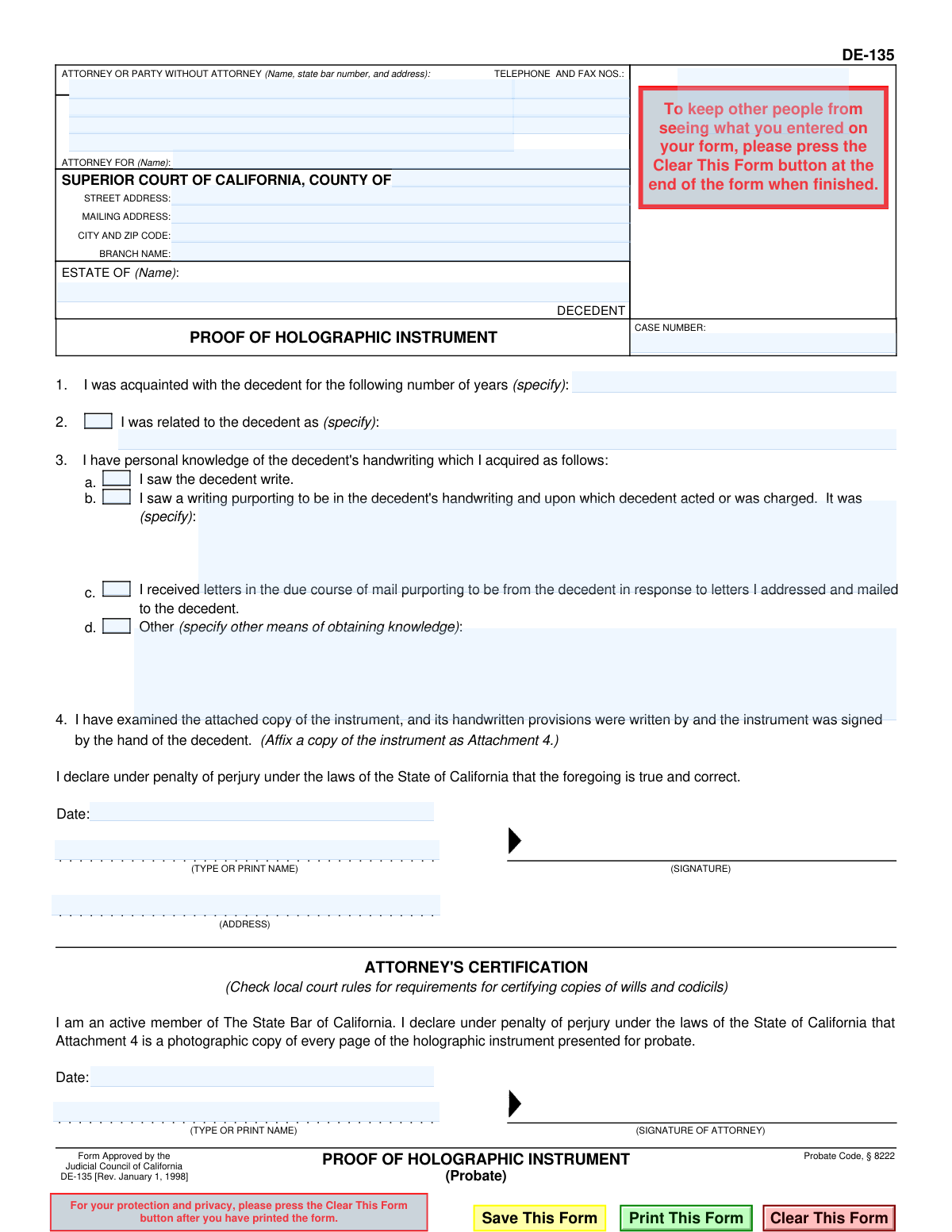
Form DE-135, the Proof of Holographic Instrument, is a legal document used in California probate proceedings to validate a handwritten will. A person familiar with the deceased's handwriting signs this declaration under penalty of perjury to confirm that the will was genuinely written and signed by the decedent. This testimony is essential for the court to accept the holographic will as legally valid. Today, this form can be filled out quickly and accurately using AI-powered services like Instafill.ai, which can also convert non-fillable PDF versions into interactive fillable forms.
Our AI automatically handles information lookup, data retrieval, formatting, and form filling.
It takes less than a minute to fill out DE-135 using our AI form filling.
Securely upload your data. Information is encrypted in transit and deleted immediately after the form is filled out.

Form specifications

Form name: Form DE-135, Proof of Holographic Instrument
Number of fields: 35
Number of pages: 1
Language: English
main-image

Instafill Demo: How to fill out PDF forms in seconds with AI

How to Fill Out DE-135 Online for Free in 2026

Are you looking to fill out a DE-135 form online quickly and accurately? Instafill.ai offers the #1 AI-powered PDF filling software of 2026, allowing you to complete your DE-135 form in just 37 seconds or less.
Follow these steps to fill out your DE-135 form online using Instafill.ai:
  1. 1 Navigate to Instafill.ai and upload or select the Form DE-135, Proof of Holographic Instrument.
  2. 2 Provide the court and case information, including the California county, court address, estate name, and case number.
  3. 3 Enter your information as the declarant, including your name, address, and your relationship and length of acquaintance with the decedent.
  4. 4 Specify how you acquired knowledge of the decedent's handwriting by selecting the appropriate option and providing details as required.
  5. 5 Confirm that you have examined the attached copy of the holographic instrument and that it was written and signed by the decedent. Ensure a copy is attached as Attachment 4.
  6. 6 Review all the information populated by the AI for accuracy. Once verified, date and sign the declaration.
  7. 7 If you are an attorney, complete the Attorney's Certification section before downloading the completed form for filing with the court.

Our AI-powered system ensures each field is filled out correctly, reducing errors and saving you time.

Why Choose Instafill.ai for Your Fillable DE-135 Form?

Speed

Complete your DE-135 in as little as 37 seconds.

Up-to-Date

Always use the latest 2026 DE-135 form version.

Cost-effective

No need to hire expensive lawyers.

Accuracy

Our AI performs 10 compliance checks to ensure your form is error-free.

Security

Your personal information is protected with bank-level encryption.

Frequently Asked Questions About Form DE-135

This form is used in California probate court to prove that a handwritten will or legal document (a "holographic instrument") was genuinely written and signed by the deceased person.

A holographic instrument is a will or an amendment to a will (codicil) that is written entirely in the handwriting of the person making it (the testator or decedent).

This form should be completed by a person who has personal knowledge of the decedent's handwriting and can confirm the document was written by them. This person does not need to be a beneficiary of the will.

You must attach a complete and clear copy of the holographic instrument (the handwritten will) to this form as 'Attachment 4'. An attorney may also need to certify that it is a true copy.

You must check the box that best describes how you know their handwriting, such as seeing them write, receiving letters from them, or seeing other documents they wrote. Be prepared to provide specific details where the form asks for them.

While you sign the main declaration, an active member of the State Bar of California typically completes the Attorney's Certification. This certifies that the attached document is a true photographic copy of the original presented for probate.

The completed form should be filed with the Superior Court of California in the county where the probate case for the decedent's estate is located.

Yes, being a relative does not disqualify you. Section 2 of the form specifically asks you to state your relationship to the decedent.

This is a serious legal statement confirming that all the information you have provided is true and correct. Knowingly providing false information can lead to significant legal consequences.

The court reviews this form as evidence to help validate the handwritten will. It is a critical step in the process of having the will officially accepted by the court for probate.

Yes, services like Instafill.ai use AI to accurately auto-fill form fields like your name, address, and case information, which saves time. However, you must personally attest to your knowledge of the decedent's handwriting.

You can use a service like Instafill.ai to upload the form and fill it out on your computer. Their platform allows you to type directly into the fields, save your progress, and ensure it's complete before printing.

If you have a non-fillable 'flat' PDF, you can upload it to a service like Instafill.ai. Their technology can convert it into an interactive, fillable form that you can easily complete online.

Compliance DE-135
Validation Checks by Instafill.ai

1
Case Number Presence and Format
This check ensures the 'CASE NUMBER' field is not empty and, if possible, conforms to the standard format for California court cases. The case number is the primary identifier for court filings, and its absence or incorrectness would lead to the document being rejected or misfiled. If the validation fails, the user should be prompted to enter a valid case number before submission.
2
Decedent Name Is Required
Validates that the 'ESTATE OF (Name)' field has been completed. This field identifies the decedent whose holographic instrument is being proven, which is the central purpose of the form. A submission without the decedent's name is fundamentally incomplete and cannot be processed by the court.
3
Basis of Knowledge Selection
Ensures that at least one of the checkboxes under question 3 ('a', 'b', 'c', or 'd') is selected. The declarant must specify how they have personal knowledge of the decedent's handwriting for their testimony to be valid. Failure to select an option invalidates the declaration, so the form should not be submittable until a choice is made.
4
Conditional Requirement for Knowledge Details
This is a logical check that verifies if checkboxes 3b, 3c, or 3d are selected, the corresponding 'specify' text field must contain text. These fields provide the necessary details to support the selected basis of knowledge. If a checkbox is ticked but the explanation is missing, the submission should be flagged for incompleteness.
5
Attachment 4 Presence Verification
Confirms that a document designated as 'Attachment 4' has been uploaded or included with the form submission. The form explicitly states to 'Affix a copy of the instrument as Attachment 4,' making this the most critical piece of evidence. A submission without this attachment is useless and must be rejected.
6
Declarant Signature Date Validity
Checks that the 'Date' field in the main declaration section is filled with a valid date that is not in the future. The date establishes when the declaration was made under penalty of perjury. An invalid or future date would compromise the legal standing of the document, requiring the user to correct it.
7
Declarant Information Completeness
Verifies that the declarant's printed name and address are provided below their signature line. This information is required to identify the person making the declaration and is essential for legal accountability and contact purposes. The form should be considered incomplete if these fields are empty.
8
Attorney/Party Header Information
Ensures the header block for 'ATTORNEY OR PARTY WITHOUT ATTORNEY' contains a name and a full address. This information identifies the filer of the document, whether they are an attorney or a self-represented party. Without this, the court cannot identify who submitted the form, so submission should be blocked until it's complete.
9
California State Bar Number Format
If the filer identifies as an attorney, this check validates that the 'state bar number' is present and consists of a sequence of numbers (typically up to 6 digits for California). This is crucial for verifying the attorney's credentials and active status with the State Bar. An invalid or missing number would require correction.
10
Court County Specification
Validates that the 'COUNTY OF' field is filled in. This specifies which county's Superior Court has jurisdiction over the estate case. Leaving this blank would result in the form being sent to the wrong court or being rejected outright for lack of jurisdiction information.
11
Acquaintance Duration Is a Positive Number
This check ensures that the value entered for 'number of years' in question 1 is a positive integer. This field helps establish the length and nature of the declarant's relationship with the decedent. The system should reject non-numeric or negative values to maintain data integrity.
12
Attorney Certification Completeness
If the 'SIGNATURE OF ATTORNEY' field in the certification section is filled, this validation ensures the corresponding 'TYPE OR PRINT NAME' and 'Date' fields are also completed. A partial certification is invalid. This check maintains the integrity of the attorney's separate declaration about the attached copy.

Common Mistakes in Completing DE-135

Forgetting to Attach the Holographic Instrument

Item 4 explicitly requires the filer to 'Affix a copy of the instrument as Attachment 4.' This is the most critical and common mistake. People either forget to include the attachment or assume the court already has a copy. Without the copy of the will or codicil, the entire 'Proof of Holographic Instrument' form is meaningless and will be rejected by the court, causing significant delays in the probate process. Always double-check that a clear, complete, and legible copy of the instrument is attached before submission.

Providing Insufficient Basis of Handwriting Knowledge

Section 3 requires the declarant to explain how they have personal knowledge of the decedent's handwriting. A common error is providing vague, conclusory, or circular statements like 'I just know it' or 'I saw them write.' The court needs specific facts to establish credibility. This mistake can lead the court to disregard the proof. To avoid this, provide concrete examples, such as 'I received weekly, handwritten letters from the decedent from 2015 to 2020' or 'I witnessed the decedent handwrite and sign their 5-page lease agreement on June 1, 2018.'

Missing or Incorrect Case Number

The 'CASE NUMBER' field is essential for the court clerk to link the document to the correct probate proceeding. Filers, especially those without an attorney, often leave this blank because they don't know it or can't find it. Submitting a form without the correct case number guarantees it will be rejected or misfiled, halting progress on the case. To prevent this, always copy the exact case number from the initial probate petition or other official court documents.

Invalid or Missing Signatures and Dates

This form has two separate signature blocks: one for the declarant and one for the attorney's certification. A frequent mistake is forgetting to sign or date one or both sections, or signing in the wrong place. An unsigned or undated declaration is legally invalid and will be rejected by the court. Carefully review the completed form to ensure the declarant has signed, printed their name, and dated their declaration, and that the attorney has done the same in their certification section.

Incorrect Court Branch Information

Many counties have multiple court branches, with specific locations designated for probate matters. A common error is to list the main county courthouse address instead of the specific branch name and address. This can cause the document to be mailed to the wrong location, leading to significant filing delays or the document being lost. Before filling out the form, verify the exact street address, mailing address, and branch name for the court handling the specific probate case from the court's official website.

Improper Attorney Certification

The 'ATTORNEY'S CERTIFICATION' section has specific legal requirements. It must be signed by an active member of The State Bar of California who is certifying the attached copy. Mistakes include having a paralegal, the declarant, or an inactive/out-of-state attorney sign this section. This invalidates the certification and can cause the court to question the authenticity of the attached will. Only a qualified, active California attorney should complete this section after personally comparing the copy to the original instrument.

Illegible Handwriting on a Printed Form

This form is often provided as a non-fillable PDF, leading people to print it and complete it by hand. Illegible handwriting can make names, addresses, dates, and other crucial details unreadable to the court clerk. This can result in the form being rejected or, worse, incorrect information being entered into the official court record. To avoid this, use a service like Instafill.ai, which can convert flat PDFs into fillable forms, allowing you to type your answers for maximum clarity before printing for signature.

Incomplete Attorney or Party Information

The box at the top-left of the form requires the filer's full name, address, phone number, and, if an attorney, their state bar number. People often rush and leave parts of this section blank. If the court has a question or needs to send a notice, incomplete information makes it impossible for them to contact the filer, leading to delays or missed deadlines. Using an AI-powered tool like Instafill.ai can help prevent this by saving your contact information and automatically populating it correctly every time.

Confusing the 'ATTORNEY FOR (Name)' Field

This field often causes confusion. Filers sometimes put their own name, the decedent's name, or the attorney's name here. This field is meant for the name of the party the attorney is representing in the probate case, such as the petitioner or administrator of the estate. An error here can cause confusion in the court records about who is being represented. The correct name should be taken from the main probate petition.

Vague Relationship and Acquaintance Details

In items 1 and 2, the form asks for the number of years the declarant knew the decedent and their relationship. People often provide vague answers like 'many years' or 'friend.' These answers lack the specificity needed to establish the declarant's credibility and close relationship with the decedent. The court may find the proof less persuasive as a result. Be precise: state the exact number of years and specify the relationship clearly, for example, 'First cousin' or 'Business partner and close friend.'
Saved over 80 hours a year

“I was never sure if my IRS forms like W-9 were filled correctly. Now, I can complete the forms accurately without any external help.”

Kevin Martin Green

Your data stays secure with advanced protection from Instafill and our subprocessors

Robust compliance program

Transparent business model

You’re not the product. You always know where your data is and what it is processed for.

ISO 27001, HIPAA, and GDPR

Our subprocesses adhere to multiple compliance standards, including but not limited to ISO 27001, HIPAA, and GDPR.

Security & privacy by design

We consider security and privacy from the initial design phase of any new service or functionality. It’s not an afterthought, it’s built-in, including support for two-factor authentication (2FA) to further protect your account.

Fill out DE-135 with Instafill.ai

Worried about filling PDFs wrong? Instafill securely fills form-de-135-proof-of-holographic-instrument forms, ensuring each field is accurate.