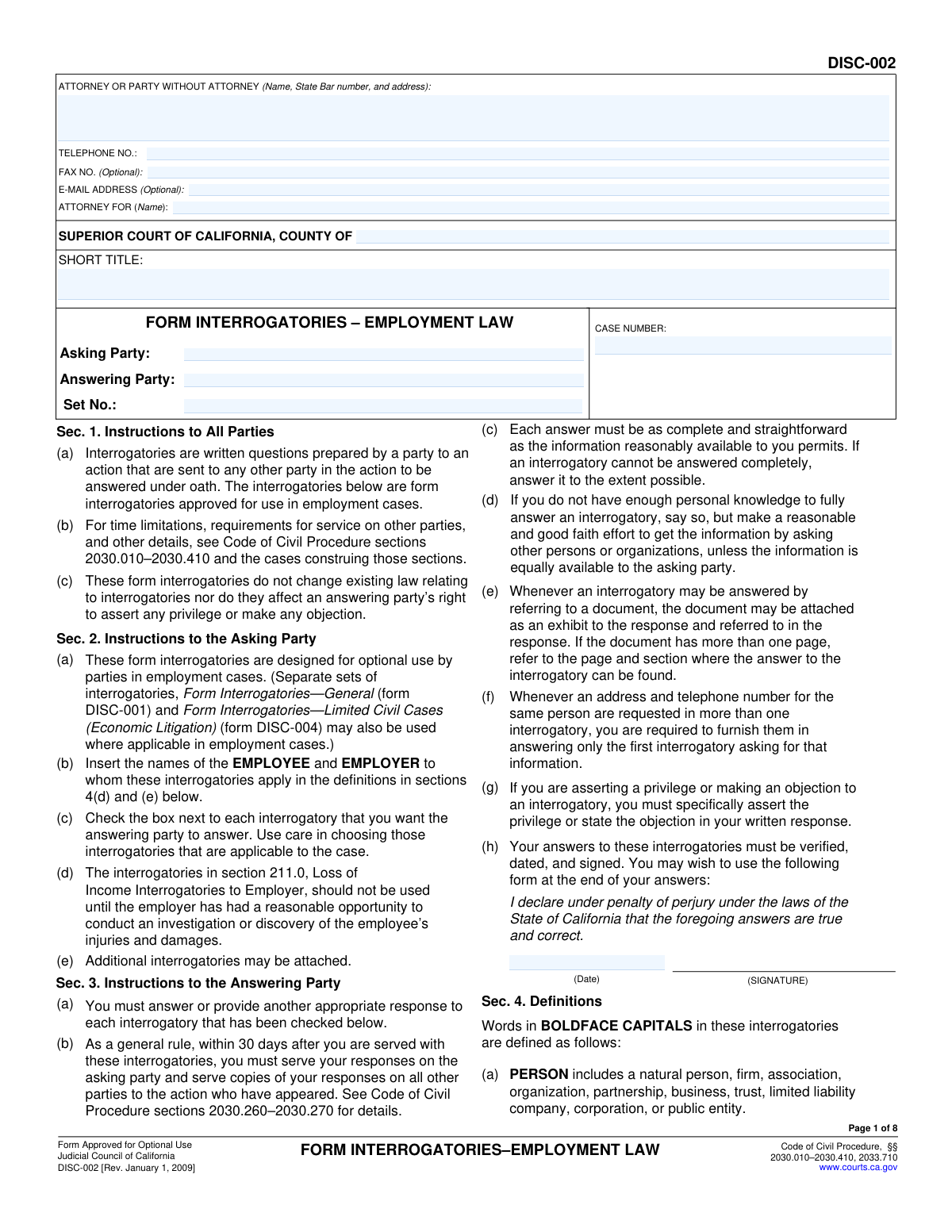
Yes! You can use AI to fill out Form DISC-002, Form Interrogatories–Employment Law

Form DISC-002, Form Interrogatories–Employment Law, is a standardized questionnaire approved by the Judicial Council of California for use in the discovery phase of employment-related lawsuits. It allows one party to ask the opposing party a series of written questions about topics like contract formation, adverse employment actions, discrimination, and harassment to gather evidence for the case. Today, this form can be filled out quickly and accurately using AI-powered services like Instafill.ai, which can also convert non-fillable PDF versions into interactive fillable forms.
DISC-002 has a moderate Form Complexity Index of 56/100 — 77 fillable fields across 8 pages. Instafill’s AI completes it accurately in under a minute.

Form specifications

Form name: Form DISC-002, Form Interrogatories–Employment Law
Number of fields: 77
Number of pages: 8
FCI: Moderate (56/100)
Language: English
Our AI automatically handles information lookup, data retrieval, formatting, and form filling.
It takes less than a minute to fill out DISC-002 using our AI form filling.
Securely upload your data. Information is encrypted in transit and deleted immediately after the form is filled out.
Preview of Form DISC-002, Form Interrogatories–Employment Law

Instafill Demo: How to fill out PDF forms in seconds with AI

How to Fill Out DISC-002 Online for Free in 2026

Are you looking to fill out a DISC-002 form online quickly and accurately? Instafill.ai offers the #1 AI-powered PDF filling software of 2026, allowing you to complete your DISC-002 form in just 37 seconds or less.
Follow these steps to fill out your DISC-002 form online using Instafill.ai:
  1. 1 Navigate to Instafill.ai and upload or select Form DISC-002, Form Interrogatories–Employment Law.
  2. 2 Enter the court, county, case number, and the names of the asking and answering parties in the header section.
  3. 3 As the asking party, check the boxes next to each interrogatory you want the answering party to respond to.
  4. 4 As the answering party, provide complete and straightforward answers to each checked question, using the AI assistant to ensure all parts of the question are addressed.
  5. 5 Use the platform to attach any documents referenced in your answers as exhibits.
  6. 6 Carefully review all the information provided, including your answers and the verification statement, for accuracy and completeness.
  7. 7 Electronically sign and date the verification section, then download the completed form to serve on the asking party and file with the court as required.

Our AI-powered system ensures each field is filled out correctly, reducing errors and saving you time.

Why Choose Instafill.ai for Your Fillable DISC-002 Form?

Speed

Complete your DISC-002 in as little as 37 seconds.

Up-to-Date

Always use the latest 2026 DISC-002 form version.

Cost-effective

No need to hire expensive lawyers.

Accuracy

Our AI performs 10 compliance checks to ensure your form is error-free.

Security

Your personal information is protected with bank-level encryption.

Frequently Asked Questions About DISC-002

DISC-002 has a Form Complexity Index of 56 out of 100, placing it in the moderate complexity tier. This score is calculated deterministically from the form’s own structure using Instafill’s published Form Complexity Index methodology, so it can be reproduced and independently verified — it is not a subjective estimate.

For DISC-002 specifically, the score reflects 77 fillable fields across 8 pages, grouped into 51 sections, and 25 conditional fields that only apply depending on earlier answers. The number of fields is the largest factor in the base score (weighted 36%), followed by how difficult those fields are to complete based on their type, where free-text and signature fields count for more than simple checkboxes (26%). The number of pages that actually contain fields (15%), the amount of conditional “fill-only-if” logic (16%), and how many sections the form is divided into (7%) account for the rest of the base. On top of that base, the index adds points for tables and repeating lists, bundled instruction pages, and dense page layouts — capturing difficulty the base alone can miss.

In practical terms, a moderate score means the form takes real effort: there are enough fields, pages and rules that errors are easy to make by hand. Instafill removes that effort entirely: our AI reads your information, maps each value to the correct field — including the conditional ones — and completes DISC-002 accurately in under a minute, with every field available for you to review before you download. See exactly how the Form Complexity Index is calculated.

This form provides a standard set of written questions, called interrogatories, for parties in a California employment lawsuit to gather information from each other. It is part of the discovery process and helps parties prepare for trial.

The 'Asking Party' is the party in the lawsuit who sends the questions to be answered. The 'Answering Party' is the party who receives the questions and must provide responses under oath.

Generally, you must serve your responses on the asking party within 30 days after you are served with the interrogatories. Your answers must be signed and verified under penalty of perjury.

No, you only need to answer the questions that the Asking Party has marked with a check in the box next to the interrogatory number. Each answer must be as complete and straightforward as possible.

If you don't have personal knowledge, you must make a reasonable and good-faith effort to obtain the information from others, unless it's equally available to the asking party. If you still can't answer completely, answer to the extent possible and explain why.

The form defines 'DOCUMENT' broadly to include writings, emails, photos, and electronically stored information. When asked to identify a document, you should provide enough information for the other party to request it, such as its title, date, and who has it.

Yes, you have the right to object to a question or assert a legal privilege (like attorney-client privilege). You must state the specific objection or privilege in your written response instead of providing an answer.

You do not file your answers with the court. You must serve your completed and signed responses directly on the Asking Party and copies to all other parties who have appeared in the action.

You need to provide your attorney's information (or your own if you don't have one), the court county, the short case title, the case number, and the names of the Asking and Answering parties.

Yes, services like Instafill.ai use AI to auto-fill form fields accurately with your case and contact details, which saves time and reduces errors. However, you must provide the substantive answers to the questions based on your own knowledge.

Simply upload the Form DISC-002 PDF to the Instafill.ai platform. The service will make the document interactive, allowing you to easily type in your information and answers, then save or print the completed form.

You can use a service like Instafill.ai, which can convert flat, non-fillable PDFs into interactive forms. This allows you to easily type your answers directly into the document on your computer.

As defined in the form, this includes actions like termination, suspension, demotion, loss of pay, or failure to hire or promote that negatively affects the employee's rights or interests as alleged in the lawsuit's pleadings.

You must sign and date a declaration under penalty of perjury, stating that your answers are true and correct. The form provides the exact wording to use for this mandatory verification.

Compliance DISC-002
Validation Checks by Instafill.ai

1
Validates Case Number Format
This check ensures that the 'Case Number' field conforms to the standard format used by the Superior Court of California. A valid case number is crucial for correctly identifying and filing the document within the court system. If the format is incorrect, the document could be rejected by the court clerk, causing delays in the legal proceedings.
2
Ensures Attorney State Bar Number is Provided
This validation verifies that if an attorney's name is entered in the 'Attorney or Party Without Attorney' field, the corresponding 'State Bar number' field is also filled. The State Bar number is a unique identifier required for attorneys practicing in California, and its absence can lead to questions about the filer's authority to practice. This ensures the attorney is properly identified as required by court rules.
3
Verifies Completeness of Party Information
This check confirms that the 'Asking Party' and 'Answering Party' fields are not empty. These fields are fundamental to the document's purpose, as they identify the sender and intended recipient of the interrogatories. Failure to populate these fields would render the document legally ambiguous and unenforceable.
4
Validates Set Number is a Positive Integer
This check ensures that the 'Set No.' field contains a positive integer (e.g., 1, 2, 3). Legal discovery procedures often involve multiple sets of questions, and this number is used to track them sequentially. An invalid or missing set number can cause confusion and complicate case management and discovery disputes.
5
Validates Telephone Number Format
This check verifies that all telephone number fields across the form adhere to a standard 10-digit format (e.g., XXX-XXX-XXXX or (XXX) XXX-XXXX). This is important for ensuring that parties and individuals mentioned in the responses can be contacted reliably. An incorrectly formatted number could prevent opposing counsel or the court from making necessary contact.
6
Ensures EMPLOYEE and EMPLOYER Names are Defined
This validation confirms that the 'Employee Name' and 'Employer Name' fields in Section 4 have been filled out by the Asking Party. These definitions are critical as the terms 'EMPLOYEE' and 'EMPLOYER' are used throughout the interrogatories. Without these names, the questions are ambiguous and the responses would lack clear context.
7
Confirms At Least One Interrogatory is Selected
This check ensures that the Asking Party has checked the box next to at least one interrogatory. The purpose of the form is to ask questions, and if no questions are selected, the form serves no purpose. Submitting a blank set of interrogatories wastes time and resources for all parties involved.
8
Enforces Conditional Response Logic for Lost Income (210.1)
This validation checks that if the Answering Party responds 'no' to interrogatory 210.1 (attributing loss of income), then the subsequent interrogatories 210.2 through 210.6 are left blank. This enforces the form's explicit instructions and prevents the submission of contradictory or irrelevant information. A failure would indicate a misunderstanding of the question or an erroneous entry.
9
Enforces Conditional Response Logic for Injuries (212.1)
This validation verifies that if the answer to interrogatory 212.1 is 'no' (attributing injuries to the adverse action), then interrogatories 212.2 through 212.7 are not answered. This logic is required by the form's instructions to streamline the response process. Answering these subsequent questions after a 'no' response creates confusion and unnecessary data.
10
Validates Verification Date is Not in the Future
This check ensures the 'Verification Date' is a valid date that is on or before the submission date. The verification is a declaration made under penalty of perjury, so the date must accurately reflect when the answers were certified as true. A future date is logically impossible and would invalidate the legal declaration.
11
Validates Completeness of Address Fields
This check verifies that any field requiring an 'ADDRESS' contains a street, city, state, and zip code, as defined in Section 4(m). Complete and accurate addresses are essential for formal service of legal documents and for contacting individuals identified in the responses. Incomplete addresses can hinder investigations and communications.
12
Checks for Specification of Adverse Actions in 201.3
This validation ensures that if the checkbox for interrogatory 201.3 is selected, the accompanying text area for listing the 'ADVERSE EMPLOYMENT ACTIONS' is not empty. The question is incomplete without this specification from the Asking Party. This check ensures the Answering Party receives a clear and specific question to which they can properly respond.
13
Validates County Name
This check ensures the 'County' field in the court case header contains a valid California county name. The form is specific to the Superior Court of California, and a correct county is required for proper jurisdiction and filing. An invalid county name would lead to rejection of the filing.
14
Logical Check for 'At Will' Employment Contentions (200.1 & 200.2)
This validation ensures that the checkboxes for interrogatories 200.1 ('at will') and 200.2 ('not at will') are not both checked by the Asking Party. These two contentions are mutually exclusive. Checking both would create a logically contradictory question set, making it impossible for the Answering Party to respond coherently.

Common Mistakes in Completing DISC-002

Failure to Define 'EMPLOYEE' and 'EMPLOYER'

The Asking Party often overlooks Section 4, which requires them to insert the specific names for 'EMPLOYEE' and 'EMPLOYER'. If left blank, the definitions default to 'all such PERSONS,' making the interrogatories overly broad, ambiguous, and subject to objection, which delays the discovery process. To avoid this, always complete sections 4(d) and 4(e) with the full, correct legal names of the parties involved in the lawsuit to ensure the questions are precise and enforceable.

Submitting Unverified or Unsigned Responses

Section 3(h) explicitly requires that answers to interrogatories be verified with a dated signature under penalty of perjury. Forgetting to include this verification is a critical error that invalidates the entire set of responses, making them legally ineffective. This can lead to motions to compel and potential sanctions from the court. Always conclude your answer document with the exact verification language provided and ensure it is dated and signed by the answering party.

Providing Incomplete Details for Identified Persons

When an interrogatory asks for the 'name, ADDRESS, and telephone number' of a person (e.g., 200.1(b)), answering parties often provide only a name. This incomplete response is non-compliant and will likely trigger a meet-and-confer letter and a motion to compel further responses, wasting time and money. To prevent this, ensure every piece of requested information (name, full address including zip code, and phone number) is provided for each person identified.

Vague or Ambiguous Document Identification

Many questions require the answering party to 'identify all DOCUMENTS' (e.g., 201.1(d)). A common error is to provide a vague reference like 'emails' or 'personnel file,' which is insufficient and forces the asking party to seek clarification. A proper identification should include the document's title, date, author, recipient, and Bates number if available, making it uniquely identifiable. AI-powered tools like Instafill.ai can help manage and reference document productions consistently to avoid this issue.

Failing to Answer All Interrogatory Sub-parts

Interrogatories are frequently broken down into multiple sub-parts (a, b, c, etc.), and parties often only answer the introductory question while ignoring the specific follow-ups. Each sub-part is a distinct question that requires a separate and complete answer. Failing to address every part renders the entire response deficient and will result in legal challenges. To avoid this, structure your response document to clearly label and answer each sub-part individually.

Omitting or Incorrectly Entering Case Information

Parties often rush through the header section and enter an incorrect Case Number, misspell the 'Short Title,' or list the wrong county. These errors can lead to misfiling of documents with the court and confusion for the opposing party, delaying the case docket and creating unnecessary administrative work. To prevent this, double-check the Case Number and Short Title against other official court documents. Using a tool like Instafill.ai can help populate this information consistently across all legal forms.

Asking Party's Failure to Specify Actions in 201.3

Interrogatory 201.3 asks about 'other ADVERSE EMPLOYMENT ACTIONS' and explicitly instructs the asking party to list them in the provided space. A common mistake is to check the box for 201.3 but forget to write in the specific actions (e.g., 'demotion on May 1, 2023'). This makes the question vague and impossible for the answering party to respond to, leading to objections and wasted effort. The asking party must be specific to get a meaningful answer.

Claiming Lack of Knowledge Without a Reasonable Search

Answering parties may respond to a question with 'I don't know.' However, Section 3(d) requires a 'reasonable and good faith effort to get the information,' which includes asking others or searching records. A failure to conduct this search makes the response inadequate and can lead to a motion to compel, where a judge may order a more thorough search. Before claiming lack of knowledge, document the steps you took to find the information to demonstrate a good faith effort.

Improperly Referencing a Document Instead of Answering

Section 3(e) allows a party to answer by referencing a document, but parties often do this improperly by saying 'See attached document' without providing the specific page and section where the answer is located. This forces the asking party to hunt for the information, making the response non-compliant. When using this option, your answer must state 'The answer is in [Document Title], page X, section/paragraph Y' to be valid.

Reversing 'Asking Party' and 'Answering Party' Names

Parties, especially those without legal representation, frequently confuse the 'Asking Party' (the one sending the questions) with the 'Answering Party' (the one responding). This simple mistake can cause significant confusion, leading to incorrect processing and potential rejection by the opposing counsel or court. To avoid this, carefully read each field title; the 'Asking Party' is your side of the case, and the 'Answering Party' is the opposing party.

Struggling with a Non-Fillable PDF Format

This official form is often a 'flat' non-fillable PDF, causing users to print and handwrite information, which is unprofessional and can be illegible. The actual answers must be provided in a separate, typed document, not on the form itself. AI-powered form filling tools like Instafill.ai can convert the non-fillable PDF into an interactive version for easily selecting questions and can help structure the separate answer document for clarity and compliance.
Saved over 80 hours a year

“I was never sure if my IRS forms like W-9 were filled correctly. Now, I can complete the forms accurately without any external help.”

Kevin Martin Green

Your data stays secure with advanced protection from Instafill and our subprocessors

Robust compliance program

Transparent business model

You’re not the product. You always know where your data is and what it is processed for.

ISO 27001, HIPAA, and GDPR

Our subprocesses adhere to multiple compliance standards, including but not limited to ISO 27001, HIPAA, and GDPR.

Security & privacy by design

We consider security and privacy from the initial design phase of any new service or functionality. It’s not an afterthought, it’s built-in, including support for two-factor authentication (2FA) to further protect your account.

Fill out DISC-002 with Instafill.ai

Worried about filling PDFs wrong? Instafill securely fills form-disc-002-form-interrogatories-employment-law forms, ensuring each field is accurate.