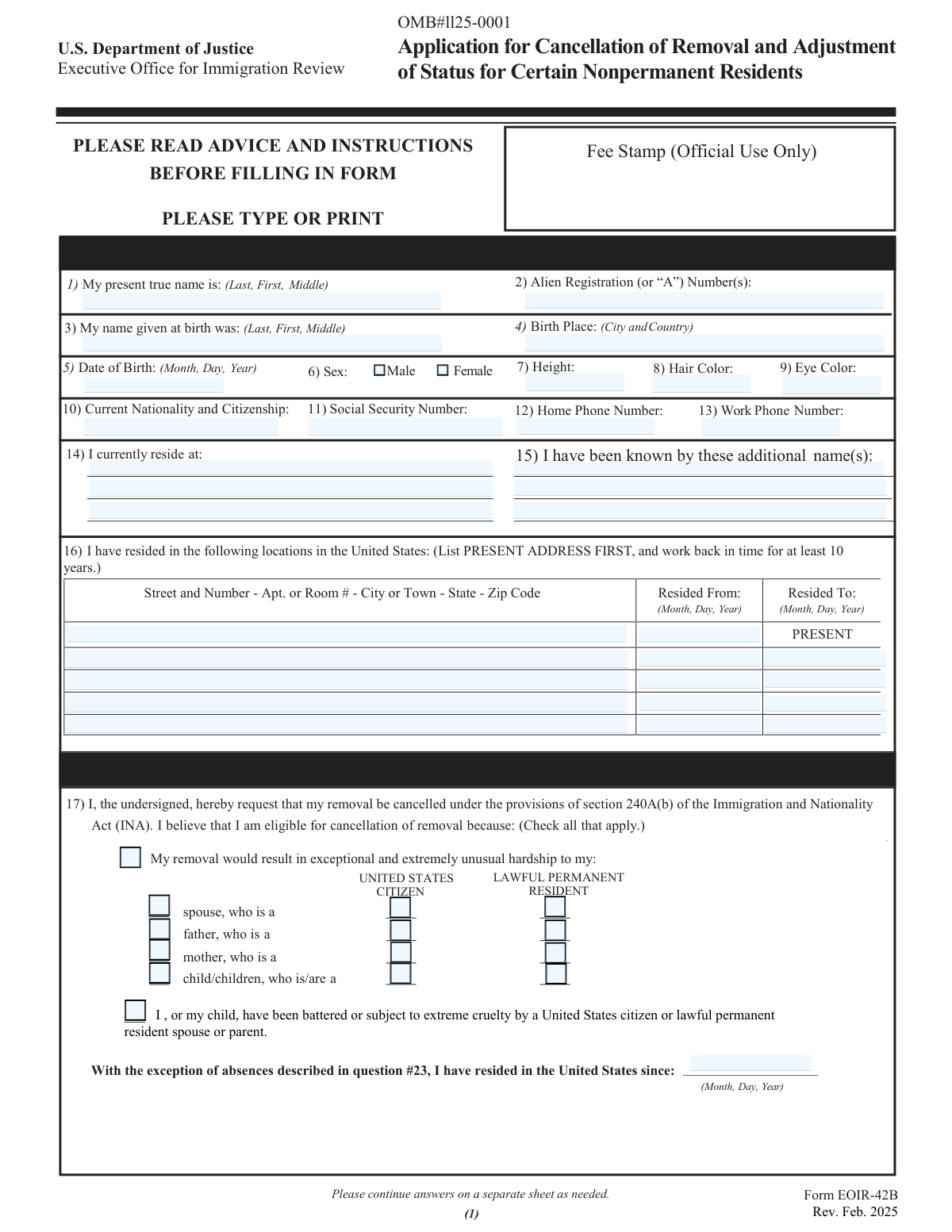
Yes! You can use AI to fill out Form EOIR-42B, Application for Cancellation of Removal and Adjustment of Status for Certain Nonpermanent Residents
Form EOIR-42B, Application for Cancellation of Removal, is a critical legal document submitted to an Immigration Judge by a nonpermanent resident facing deportation. It serves as an application for relief, allowing the individual to remain in the U.S. and obtain a green card if they can prove they meet strict criteria, including ten years of continuous presence and demonstrating that their removal would cause 'exceptional and extremely unusual hardship' to a qualifying U.S. citizen or lawful permanent resident relative. Today, this detailed form can be filled out quickly and accurately using AI-powered services like Instafill.ai, which can also convert non-fillable PDF versions into interactive fillable forms.
Our AI automatically handles information lookup, data retrieval, formatting, and form filling.
It takes less than a minute to fill out EOIR-42B using our AI form filling.
Securely upload your data. Information is encrypted in transit and deleted immediately after the form is filled out.
Form specifications
| Form name: | Form EOIR-42B, Application for Cancellation of Removal and Adjustment of Status for Certain Nonpermanent Residents |
| Number of fields: | 417 |
| Number of pages: | 13 |
| Language: | English |
Instafill Demo: How to fill out PDF forms in seconds with AI
How to Fill Out EOIR-42B Online for Free in 2026
Are you looking to fill out a EOIR-42B form online quickly and accurately? Instafill.ai offers the #1 AI-powered PDF filling software of 2026, allowing you to complete your EOIR-42B form in just 37 seconds or less.
Follow these steps to fill out your EOIR-42B form online using Instafill.ai:
- 1 Navigate to Instafill.ai and upload your Form EOIR-42B, or select it from the platform's library of official forms.
- 2 Provide your personal information, including your full name, A-Number, biographic data, and contact details, as prompted by the AI assistant.
- 3 Carefully enter your complete U.S. residence and employment history for the last ten years, along with details of your entry and any departures from the United States.
- 4 Detail the basis for your claim, focusing on the 'exceptional and extremely unusual hardship' your qualifying relatives (spouse, parent, or child) would face upon your removal.
- 5 Complete the sections on your marital history, children, and financial information, including all assets and liabilities for yourself, your spouse, and other relevant family members.
- 6 Answer the comprehensive series of statutory questions regarding your background, including military service, organizational memberships, and any prior legal or immigration issues.
- 7 Review the entire application for accuracy and completeness with the AI's assistance, then securely download the finalized Form EOIR-42B for submission to the Immigration Court.
Our AI-powered system ensures each field is filled out correctly, reducing errors and saving you time.
Why Choose Instafill.ai for Your Fillable EOIR-42B Form?
Speed
Complete your EOIR-42B in as little as 37 seconds.
Up-to-Date
Always use the latest 2026 EOIR-42B form version.
Cost-effective
No need to hire expensive lawyers.
Accuracy
Our AI performs 10 compliance checks to ensure your form is error-free.
Security
Your personal information is protected with bank-level encryption.
Frequently Asked Questions About Form EOIR-42B
This form is an application for relief from removal (deportation) from the United States. It is used by certain nonpermanent residents to request to stay in the U.S. based on factors like continuous residence and hardship to qualifying relatives.
Your A-Number is a unique 8 or 9-digit number assigned by U.S. immigration authorities, usually starting with an 'A'. You can find it on official documents like a Notice to Appear, an Employment Authorization Document, or a Permanent Resident Card.
The form asks for your Social Security Number if you have one. If you have not been issued one, you can leave this field blank or write 'None'.
This is a very high legal standard requiring you to prove that your qualifying U.S. citizen or permanent resident relative would suffer substantially more than the common results of family separation. You must provide detailed evidence about your relative's specific health, financial, or other unique circumstances.
In the 'Inspection and Admission Details' section, you should check the box for 'Was not inspected and admitted.' Then, select the most appropriate sub-option, such as 'Entered without inspection,' and provide a brief, truthful explanation.
Yes, the form requires you to disclose if you have ever been arrested, summoned, convicted, or fined for any offense, which includes traffic violations. You must provide details for each incident, regardless of how minor it may seem.
The form provides a limited number of spaces for your history. If you have more information to provide, you should attach a separate sheet of paper, clearly labeling it with your name, A-Number, and the section you are continuing.
If you are claiming that your removal would cause hardship to a U.S. citizen or permanent resident parent, their financial information is needed to evaluate the economic impact of your absence. You must provide details on their employment, income, and assets.
This section is your declaration that you have provided a copy of your completed application to the government's attorney (the DHS Assistant Chief Counsel). You must state the date and method you used to deliver the copy, which is a required step when filing with the Immigration Court.
Yes, services like Instafill.ai use AI to help you accurately auto-fill form fields, which can save time and help prevent errors. However, AI cannot provide legal advice, so you should consult an immigration attorney for questions about your eligibility and case strategy.
You can upload the form to the Instafill.ai platform. Its AI technology will identify all the fields, allowing you to answer questions in a simple format and have your information automatically and accurately placed onto the official form.
If you have a non-fillable or 'flat' PDF, you can use a service like Instafill.ai. It is designed to convert static PDFs into interactive, fillable forms that you can easily complete and save on your computer.
You should attach documents that support the claims made in your application, such as birth certificates for your children, your marriage certificate, and proof of your relatives' U.S. citizenship or permanent resident status. You should also include evidence of hardship, like medical records or financial documents.
Compliance EOIR-42B
Validation Checks by Instafill.ai
1
Date of Birth Chronology Check
Validates that the applicant's 'Date of Birth' is chronologically before all other significant dates on the form, such as 'Date of First Arrival', 'Date of marriage', and all employment or residence start dates. This is a fundamental logical check to ensure the applicant existed before the events they are reporting. A failure would indicate a critical data entry error and would make the entire timeline of the application nonsensical.
2
Alien Registration Number (A-Number) Format Validation
Verifies that the 'Alien Registration Number (A-Number)' is in the correct format, which is typically an 'A' followed by 8 or 9 digits (e.g., A123456789). The A-Number is a primary identifier in the USCIS system, and an incorrect format will prevent the case from being located or properly filed. This check is critical for linking the application to the correct immigration file.
3
Social Security Number Format Validation
Checks if the 'Social Security Number' field, if provided, follows the standard ###-##-#### format. This ensures the data is correctly structured for identification and verification with the Social Security Administration. An incorrectly formatted SSN can lead to processing delays or rejection of the application.
4
Residence History Date Sequence Validation
Validates that for each listed U.S. residence, the 'Resided From Date' is before the 'Resided To Date'. It also checks for overlaps or gaps between consecutive residence periods to ensure a continuous and logical history. This is crucial for establishing periods of continuous physical presence, which is often a legal requirement for eligibility.
5
Hardship Claim Consistency Check
Ensures that if the 'Exceptional and extremely unusual hardship' box is checked, at least one qualifying relative (Spouse, Father, Mother, Child/children) is also selected. A hardship claim must be based on a specific qualifying relative. If the main box is checked but no relative is specified, the claim is incomplete and cannot be adjudicated.
6
Hardship Relative Status Requirement
If a hardship claim is made for a relative (e.g., 'Spouse'), this check ensures that one of the status boxes ('is a United States citizen' or 'is a lawful permanent resident') is also checked for that relative. A hardship claim is typically based on a relative with a specific legal status in the U.S. Failing to specify this status makes the claim incomplete and invalid.
7
Marital Status Conditional Requirement
Verifies that if the 'I am married' box is checked, the subsequent sections for 'Current Spouse Full Name' and 'Date of marriage' are filled out. Conversely, it checks that these fields are empty if 'I am not married' is selected. This ensures completeness and prevents contradictory information, which is vital for assessing eligibility.
8
Prior Marriage Date Logic
If the applicant indicates they 'Have been previously married', this validates that the 'Marriage Begin Date' is before the 'Marriage End Date' for each prior marriage listed. It also ensures the marriage end date is before the start date of any subsequent marriage. This logic is critical for verifying a clear marital history and ensuring there are no legal impediments to a current marriage.
9
Child Count and Details Consistency
Verifies that the number entered in the 'Number of Children' field matches the number of individual child information sections that are filled out. This ensures the data is consistent and complete. A mismatch could indicate that information for a child is missing or that the total count is incorrect, impacting dependency and hardship claims.
10
Departure History Logic
If the applicant indicates they have departed the U.S. since their first arrival, this validates that for each trip, the 'Departure Date' is before the 'Return Date'. It also ensures that all trip dates fall between the 'Date of First Arrival' and the present date. This is essential for accurately calculating periods of physical presence and identifying any absences that might affect eligibility.
11
Mutually Exclusive Checkbox Validation
This check ensures that for pairs of mutually exclusive options, only one is selected. Examples include 'Male'/'Female', 'I am married'/'I am not married', 'Was inspected and admitted'/'Was not inspected and admitted', and 'Yes'/'No' pairs for statutory questions. Selecting both options in a pair creates a logical contradiction that makes the data unusable and requires correction.
12
Conditional Explanation Field Requirement
Validates that if a checkbox requiring an explanation is selected (e.g., 'Entered without documents', 'Other (Explain)' for entry, or 'I have' for arrest history), the corresponding explanation text field is not empty. This ensures that the adjudicating officer has the necessary context to understand the applicant's circumstances. Failure to provide a required explanation results in an incomplete application.
13
Asset Total Calculation Check
Automatically calculates the sum of individual asset values ('Cash, Stocks, and Bonds', 'Real Estate', 'Auto', 'Other Assets') and verifies that it matches the value entered in the 'Total Assets' field for the applicant, spouse, and parents. This acts as a data integrity check to prevent mathematical errors in the financial section. Incorrect totals can misrepresent the applicant's financial situation.
14
Conditional Asset Description Requirement
Ensures that if a value greater than zero is entered in an 'Other Assets Value' field (for self, spouse, or parents), the corresponding 'Other Assets Description' field is filled out. This provides necessary clarification on the nature of the assets being declared. An amount without a description is incomplete information and may require a request for evidence.
Common Mistakes in Completing EOIR-42B
Applicants often fail to provide a continuous history of their U.S. residences, leaving gaps between the 'Resided To' date of one address and the 'Resided From' date of the next. This happens due to forgotten short-term moves or misremembered dates, which can lead to a Request for Evidence (RFE) or accusations of misrepresentation. To avoid this, carefully review your history, use personal records to confirm dates, and ensure there are no unexplained gaps; the 'To' date for one residence should align with the 'From' date for the next.
Applicants frequently forget to list all names they have ever used, such as maiden names, nicknames used on official documents, aliases, or names from previous marriages. This omission can be seen as an attempt to hide information, leading to credibility issues, processing delays, and potential denial. It is crucial to list every single name ever used legally or for official purposes by reviewing old documents like passports, driver's licenses, and marriage certificates.
The questions about how an applicant entered the U.S. ('Was inspected and admitted,' 'Entered without inspection') are legally specific and often misunderstood. An applicant might mistakenly believe they were 'inspected' when they were not, or vice-versa, which has significant legal consequences for their eligibility. An incorrect answer can lead to an immediate finding of ineligibility or a charge of misrepresentation, so it is vital to understand the precise legal meaning of these terms and answer with absolute accuracy.
The form contains numerous 'Yes/No' questions about criminal history and immigration violations. When answering 'Yes,' applicants often provide a brief or incomplete explanation in the designated field, forcing the adjudicator to issue an RFE for more details. A proper explanation must include the date, location, specific charge or event, and the final outcome, supported by official documentation whenever possible, to avoid significant case delays.
Applicants sometimes use variations of their name or make a typo in their Alien Registration Number (A-Number) across different sections of the form. This creates confusion and can cause the application to be rejected at intake or linked to the wrong file, leading to severe processing delays. The 'Applicant Present True Name' and 'A-Number' must be entered identically and accurately on every page. AI-powered form-filling tools like Instafill.ai can prevent this by auto-populating these critical fields consistently after the first entry.
This form requires detailed financial disclosures, including the value of assets like cash, real estate, and vehicles. Applicants often make errors by providing gross instead of net values, guessing at amounts, or failing to properly separate personal assets from jointly-owned assets. These inaccuracies can undermine the applicant's credibility and affect eligibility, so it is essential to calculate these figures carefully and consult financial records.
Applicants may accidentally omit children, especially those who are adults, live in another country, or are from a previous relationship. The form requires a complete list of all children, regardless of age, location, or marital status, as well as other specified relatives. Failing to list a required relative can be considered misrepresentation and have severe consequences for the current application and any future immigration petitions.
When claiming 'exceptional and extremely unusual hardship' to a qualifying relative, applicants sometimes provide inconsistent information. For example, they might check the box for hardship to a U.S. citizen spouse but then fail to provide the spouse's naturalization details or list their immigration status incorrectly elsewhere. Such contradictions weaken the hardship claim and can lead an adjudicator to question its validity, so all information related to the qualifying relative must be consistent throughout the application.
Similar to residence history, the form requires a detailed account of employment. Applicants often leave unexplained gaps between jobs, which can raise questions about unreported work or periods of unemployment that can impact the assessment of good moral character. It is important to provide a continuous history, including periods of self-employment or unemployment, and ensure the 'Employed To' date of one job aligns with the 'Employed From' date of the next, or the gap is otherwise accounted for.
This lengthy form requires dozens of dates, from birthdates to employment history and travel records. Applicants often switch between MM/DD/YYYY and DD/MM/YYYY or use ambiguous formats, which can cause data entry errors and RFEs to clarify the timeline of events. Always use the standard U.S. format (MM/DD/YYYY) consistently for all date fields. AI-powered tools like Instafill.ai can automatically validate and format dates correctly, preventing these common errors.
Many fields on this form are conditional, meaning they should only be filled out if a specific answer was given previously (e.g., 'Fill only if 'I am married' is 'Yes''). Applicants often miss these instructions and either fill out sections they shouldn't, or fail to fill out required sections. This creates a confusing and potentially incomplete application, leading to delays. It is crucial to read the instructions for every single field carefully.
Saved over 80 hours a year
“I was never sure if my IRS forms like W-9 were filled correctly. Now, I can complete the forms accurately without any external help.”
Kevin Martin Green
Your data stays secure with advanced protection from Instafill and our subprocessors

Robust compliance program
Transparent business model
You’re not the product. You always know where your data is and what it is processed for.
ISO 27001, HIPAA, and GDPR
Our subprocesses adhere to multiple compliance standards, including but not limited to ISO 27001, HIPAA, and GDPR.
Security & privacy by design
We consider security and privacy from the initial design phase of any new service or functionality. It’s not an afterthought, it’s built-in, including support for two-factor authentication (2FA) to further protect your account.
Fill out EOIR-42B with Instafill.ai
Worried about filling PDFs wrong? Instafill securely fills form-eoir-42b-application-for-cancellation-of-removal-and-adjustment-of-status-for-certain-nonpermanent-residents forms, ensuring each field is accurate.