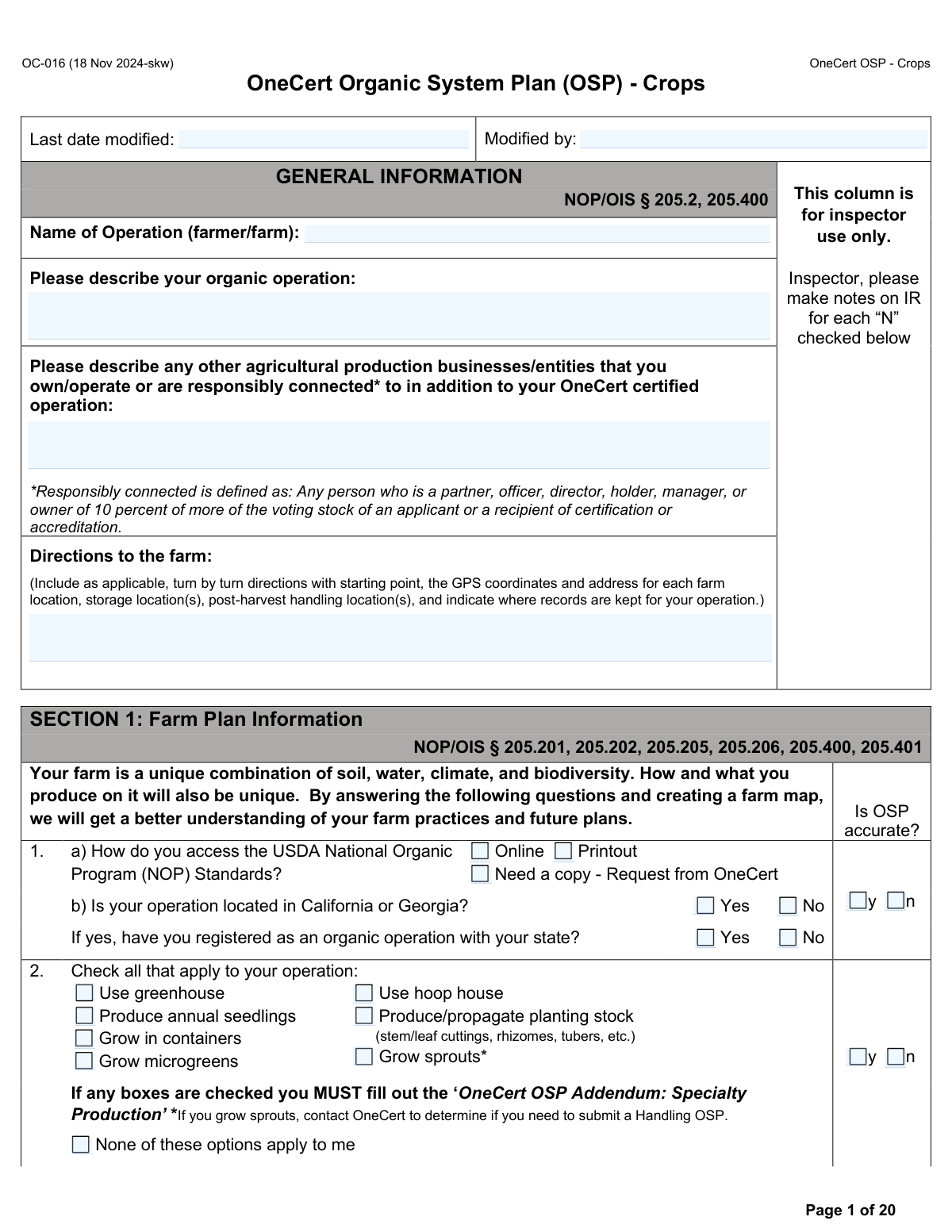
Yes! You can use AI to fill out Form OC-016, OneCert Organic System Plan (OSP) - Crops
Form OC-016, the OneCert Organic System Plan (OSP) for Crops, is a comprehensive document required for farmers seeking organic certification. It serves as a detailed blueprint of the entire farming operation, ensuring compliance with USDA National Organic Program (NOP) standards by documenting practices related to soil management, pest control, harvesting, and record-keeping. The plan is crucial for demonstrating that all aspects of crop production meet the stringent requirements for organic certification. Today, this form can be filled out quickly and accurately using AI-powered services like Instafill.ai, which can also convert non-fillable PDF versions into interactive fillable forms.
Our AI automatically handles information lookup, data retrieval, formatting, and form filling.
It takes less than a minute to fill out OC-016 using our AI form filling.
Securely upload your data. Information is encrypted in transit and deleted immediately after the form is filled out.
Form specifications
| Form name: | Form OC-016, OneCert Organic System Plan (OSP) - Crops |
| Number of fields: | 640 |
| Number of pages: | 20 |
| Language: | English |
Instafill Demo: How to fill out PDF forms in seconds with AI
How to Fill Out OC-016 Online for Free in 2026
Are you looking to fill out a OC-016 form online quickly and accurately? Instafill.ai offers the #1 AI-powered PDF filling software of 2026, allowing you to complete your OC-016 form in just 37 seconds or less.
Follow these steps to fill out your OC-016 form online using Instafill.ai:
- 1 Navigate to Instafill.ai and upload or select the OC-016, OneCert Organic System Plan for Crops.
- 2 Provide general information about your farm, including its name, location, and a description of your organic operation.
- 3 Detail your farm plan, covering soil management, water use, crop rotation schedules, and measures to prevent contamination as prompted by the AI.
- 4 Describe your fertility, pest, weed, and disease management strategies, listing all inputs used and ensuring they are approved for organic use.
- 5 Outline your harvest, post-harvest handling, storage, and transportation procedures, including equipment cleaning, packaging details, and labeling.
- 6 Explain your recordkeeping system, confirming you can trace products from seed to sale and maintain all necessary documentation for at least five years.
- 7 Review the AI-populated form for accuracy, make any necessary corrections, and then sign and submit the completed Organic System Plan to OneCert.
Our AI-powered system ensures each field is filled out correctly, reducing errors and saving you time.
Why Choose Instafill.ai for Your Fillable OC-016 Form?
Speed
Complete your OC-016 in as little as 37 seconds.
Up-to-Date
Always use the latest 2026 OC-016 form version.
Cost-effective
No need to hire expensive lawyers.
Accuracy
Our AI performs 10 compliance checks to ensure your form is error-free.
Security
Your personal information is protected with bank-level encryption.
Frequently Asked Questions About Form OC-016
This form is your detailed plan for managing an organic crop farm according to USDA National Organic Program (NOP) standards. All farmers seeking new or continued organic certification for their crops with OneCert must complete this OSP to document their practices.
You must submit several required appendices, including a Farm Map (Appendix A), an Inputs List (Appendix B), a Seed & Planting Stock List (Appendix C), an Equipment List (Appendix D), and an Annual Field Plan/History (Appendix E). Ensure you read the instructions on each appendix before completing it.
You need to describe the sequence of crops you plan to grow on a specific field over six years, including any cover crops or fallow periods. You must also explain how this rotation helps improve soil, manage pests, balance nutrients, and control erosion as required by the NOP.
A 'Split Operation' means you grow both organic and non-organic crops on your farm. 'Parallel Production' is when you grow the same type of crop both organically and non-organically, which requires very strict measures to prevent commingling and contamination.
All inputs, including fertilizers, soil amendments, and pest control products, must be approved by OneCert before you use them. You must list them on your 'Appendix B: Inputs List' and submit an 'Input Request Form' for any new products you wish to add.
Yes, the NOP has strict rules for raw manure application. It must be incorporated at least 120 days before harvesting crops that touch the soil (like potatoes) and 90 days before harvesting crops that don't (like corn).
You must maintain detailed records for at least five years to create an audit trail from seed to sale. This includes records of planting, cultivation, harvest, sales, input applications, equipment cleaning, and storage.
If you use custom harvesting services, you must list all custom equipment on your 'Appendix D: Equipment List'. You also need to maintain records showing how the equipment was cleaned to prevent contamination from non-organic crops or prohibited substances.
No, all labels, bags, or boxes that identify a product as 'organic' must be submitted to OneCert for approval before you use them. This ensures they comply with NOP labeling regulations.
Yes, if you use a greenhouse, grow microgreens, produce seedlings, or have other specialty production methods listed in Question 2, you must also complete the 'OneCert OSP Addendum: Specialty Production'. This addendum covers the specific requirements for those practices.
You must establish and describe adequate buffer zones to prevent contamination from prohibited substances like pesticides from the neighboring farm. This could be a tree line, a grass strip, or a designated buffer crop that is not sold as organic.
Yes, services like Instafill.ai use AI to accurately auto-fill form fields, which can save you significant time and reduce errors. This is especially helpful for repetitive information across the OSP and its many appendices.
Simply upload the OneCert OSP form to the Instafill.ai platform. The AI will identify the fields, allowing you to answer the questions in an easy-to-use interface and helping to populate information accurately and efficiently.
If you have a non-fillable or 'flat' PDF, you can use a service like Instafill.ai to convert it into an interactive, fillable form. This allows you to easily type your answers directly into the document online without needing to print it.
Compliance OC-016
Validation Checks by Instafill.ai
1
Ensures State Registration for CA/GA Operations
This check verifies that if an operation is located in California or Georgia (Question 1b is 'Yes'), a response is provided for whether the operation is registered with the state. This is a state-specific regulatory requirement for organic operations in those locations. Failure to answer this question will result in an incomplete application and a delay in processing until the information is provided.
2
Requires Specialty Production Addendum
This validation confirms that if any specialty production methods (e.g., 'Use greenhouse', 'Grow sprouts') are selected in Question 2, the 'OneCert OSP Addendum: Specialty Production' is also submitted. These production methods have specific standards and require additional information for certification. If the addendum is missing, the OSP is considered incomplete and cannot be fully evaluated.
3
Validates Fallow Period Details are Complete
This check ensures that if an applicant indicates their crop rotation includes a fallow period (Question 8b is 'Yes'), they must provide all subsequent details. This includes the plant species present, the duration of the fallow period, and the tillage frequency. This information is crucial for assessing soil health management practices, and missing details will require follow-up before the OSP can be approved.
4
Verifies Split Operation and Parallel Production Details
This validation checks that if an operator indicates they are a 'Split Operation' (Question 11a is 'Yes'), they must complete all parts of Question 12, describing the non-organic crops and commingling prevention measures. This is critical for ensuring organic integrity and preventing contamination. An incomplete response will trigger a non-compliance and halt the certification process until adequate prevention measures are documented.
5
Requires GMO Risk Mitigation for Saved Seed
This check ensures that if an operator saves seed (Question 14a is 'Yes') from a crop with a high risk of GMO contamination (e.g., corn, soy, canola in 14b), they must answer how they test for GMOs and prevent cross-pollination (14c and 14d). This is a critical control point for preventing prohibited GMOs in organic production. Failure to provide this information will result in a finding and may require the operator to source certified organic seed instead.
6
Validates Justification for Burning
This check confirms that if an operator uses burning as a management tool (Question 18 is 'Yes'), a description is provided. The validation also flags if the description includes 'disposal of crop residues,' which is prohibited under NOP § 205.203(e)(3). An invalid or missing justification will result in a non-compliance, as burning is only permitted for specific reasons like disease suppression.
7
Ensures Documentation for Synthetic Micronutrient Use
This validation verifies that if an operator plans to use synthetic micronutrients (Question 22 is 'Yes'), they have submitted documentation of a soil or tissue deficiency. The NOP requires a documented need for the use of such synthetic substances. Without this documentation, the input cannot be approved for use, and its application would be a violation of organic standards.
8
Verifies Post-Harvest Processing Information
This check ensures that if a crop is further processed after harvest (Question 32a is 'Yes'), all subsequent details (description, ownership, location) are provided. It also flags that a Post-Harvest Structural Map must be submitted. This information is vital to assess contamination risks and determine if a separate Handling OSP is required, and missing information will render the application incomplete.
9
Validates Food-Grade Packaging for Human Consumption Products
This validation checks the logical consistency between questions 34 and 35. If a product is for human consumption (35a is 'Yes') and packaging is used (34 is not 'I do not use packaging'), then the food-grade verification status (35b) must be answered with 'Yes' or 'No', not 'NA'. This ensures compliance with food safety and organic handling standards.
10
Requires Explanation for Re-used Packaging
This check ensures that if any packaging material is marked as 're-used' in the table for Question 36a, then the corresponding description of how contamination and commingling are prevented (Question 36b) must be filled out. Reusing packaging is a high-risk activity for contamination, and a clear, effective cleaning and handling procedure is mandatory. A missing description will result in a non-compliance.
11
Flags Requirement for Handling OSP
This validation flags submissions where the applicant indicates they buy, sell, or handle organic products from other certified operations (Question 40 is 'Yes'). This activity typically requires a separate Handling OSP. The flag alerts certification staff to review the operation's scope and ensure the correct application is on file, preventing uncertified handling activities.
12
Verifies Off-Site Storage Affidavit Submission
This check ensures that for any storage location listed in Question 44c that is off-site, the 'Off-Site Storage Affidavit submitted?' field is marked 'Yes'. This affidavit is a required document to verify that uncertified off-site locations are managed in compliance with organic standards. Failure to submit this affidavit for an off-site location is a critical compliance issue.
13
Validates Record Retention Period Compliance
This validation ensures that the number entered for the record retention period in Question 45 is greater than or equal to 5. The NOP requires all records to be maintained for a minimum of five years. An entry less than 5 indicates a misunderstanding of the regulations and will be flagged as a minor issue requiring correction and confirmation from the operator.
14
Ensures Supplier Verification Process is Described
This check verifies that the supplier verification process description in Question 54 is completed, unless the applicant has checked 'N/A' because they purchase no organic inputs. Verifying the certification status of suppliers is a key part of fraud prevention. An empty response where inputs are used will be flagged as a non-compliance until a sufficient verification procedure is described.
Common Mistakes in Completing OC-016
Applicants often provide a simple list of crops, failing to detail the required 6-year rotation plan and its justification. The NOP requires a detailed description of how the rotation maintains soil organic matter, manages pests, manages nutrients, and controls erosion. A vague plan will lead to certification delays and requests for more information. To avoid this, describe the specific sequence of crops, cover crops, and fallow periods for each field group, and explicitly state how this plan addresses each of the four required functions under §205.205.
The form frequently directs applicants to fill out separate appendices (e.g., Appendix B for Inputs, Appendix C for Seeds, Appendix D for Equipment) based on their answers. A common mistake is checking a box, such as 'Use greenhouse' or 'Use manure', but failing to complete the corresponding required addendum or list the item on the appendix. This results in an incomplete application and significant processing delays. Always double-check which appendices are required by your answers before submitting.
For 'split operations' that handle both organic and non-organic crops, simply stating that equipment will be cleaned is insufficient. The form requires a detailed description of how commingling is prevented at every stage: planting, harvest, storage, and transport. Failure to provide specific protocols, such as clean-out procedures, use of designated equipment, and lot number tracking, can lead to non-compliance and increases the risk of accidental contamination, which could render a crop unsellable as organic.
Every single input—including seeds, fertilizers, pest control products, soil amendments, and even packaging materials—must be listed and approved by OneCert prior to use. A frequent error is purchasing and using a new product without first submitting it for approval. This can lead to the accidental use of a prohibited substance, which could result in the decertification of land or crops for three years. To prevent this, maintain a complete list on the appropriate appendices and always submit an Input Request Form before purchasing any new material.
The NOP has strict rules differentiating raw manure from compliant compost. Applicants often fail to provide the necessary documentation (e.g., temperature and turning logs for compost) to prove their compost meets NOP standards. Without this proof, the material must be treated as raw manure, subject to the 90/120 day pre-harvest incorporation restrictions, which can severely impact cropping plans. To avoid this, either keep meticulous compost production records or be prepared to document raw manure application dates to prove compliance with the required intervals.
A simple sketch of the farm is not sufficient. The form requires a detailed map (Appendix A) that includes field boundaries and IDs, buffer zones with dimensions, all structures (storage, processing), and the use of all adjacent land (e.g., 'conventional corn field,' 'state highway'). Omitting these details prevents the certifier from properly assessing contamination risks and will delay the application. Use an aerial photograph or plat map as a base to ensure all required elements are clearly and accurately labeled.
Organic certification requires the ability to trace a product from the final sale all the way back to the seed. While applicants may check boxes in Question 50 indicating they keep records, they often have gaps in their system, such as missing harvest dates, equipment clean-out logs, or lot numbers on sales records. An incomplete audit trail will result in a non-compliance during inspection. It is crucial to have a robust system that links every step and to retain all records for at least five years.
Under the NOP's Strengthening Organic Enforcement (SOE) rule, it is critical to verify that all suppliers of organic seeds, seedlings, and other inputs are actively certified. A common mistake is to rely on an old certificate or fail to have a regular verification process. This creates a risk of purchasing from a fraudulent or decertified supplier, which would invalidate your product's organic status. To avoid this, implement a procedure to check supplier certification on the USDA Organic Integrity Database with every purchase or on a regular schedule and document these checks.
Applicants often get confused by the specific definitions of 'split operation' (handling any non-organic crops) and 'parallel production' (growing the same crop both organically and conventionally, e.g., organic and conventional corn). Incorrectly identifying the operation type leads to an inadequate plan for preventing commingling and cross-contamination, which is a major compliance risk. Carefully read the definitions in Question 11 to ensure you accurately describe your operation and implement the necessary, more stringent, safeguards required for parallel production.
The 'Directions to the farm' section requires more than just a single address; it asks for turn-by-turn directions, GPS coordinates, and addresses for *all* relevant locations, including each farm, storage site, post-harvest facility, and where records are kept. Applicants often provide incomplete information, which can delay or complicate the scheduling of the on-site inspection. To prevent issues, list every location with its full address and specific directions. AI-powered form-filling tools like Instafill.ai can help by storing and accurately pre-filling these complex, multi-part location details for all future forms.
Saved over 80 hours a year
“I was never sure if my IRS forms like W-9 were filled correctly. Now, I can complete the forms accurately without any external help.”
Kevin Martin Green
Your data stays secure with advanced protection from Instafill and our subprocessors

Robust compliance program
Transparent business model
You’re not the product. You always know where your data is and what it is processed for.
ISO 27001, HIPAA, and GDPR
Our subprocesses adhere to multiple compliance standards, including but not limited to ISO 27001, HIPAA, and GDPR.
Security & privacy by design
We consider security and privacy from the initial design phase of any new service or functionality. It’s not an afterthought, it’s built-in, including support for two-factor authentication (2FA) to further protect your account.
Fill out OC-016 with Instafill.ai
Worried about filling PDFs wrong? Instafill securely fills form-oc-016-onecert-organic-system-plan-osp-crops forms, ensuring each field is accurate.