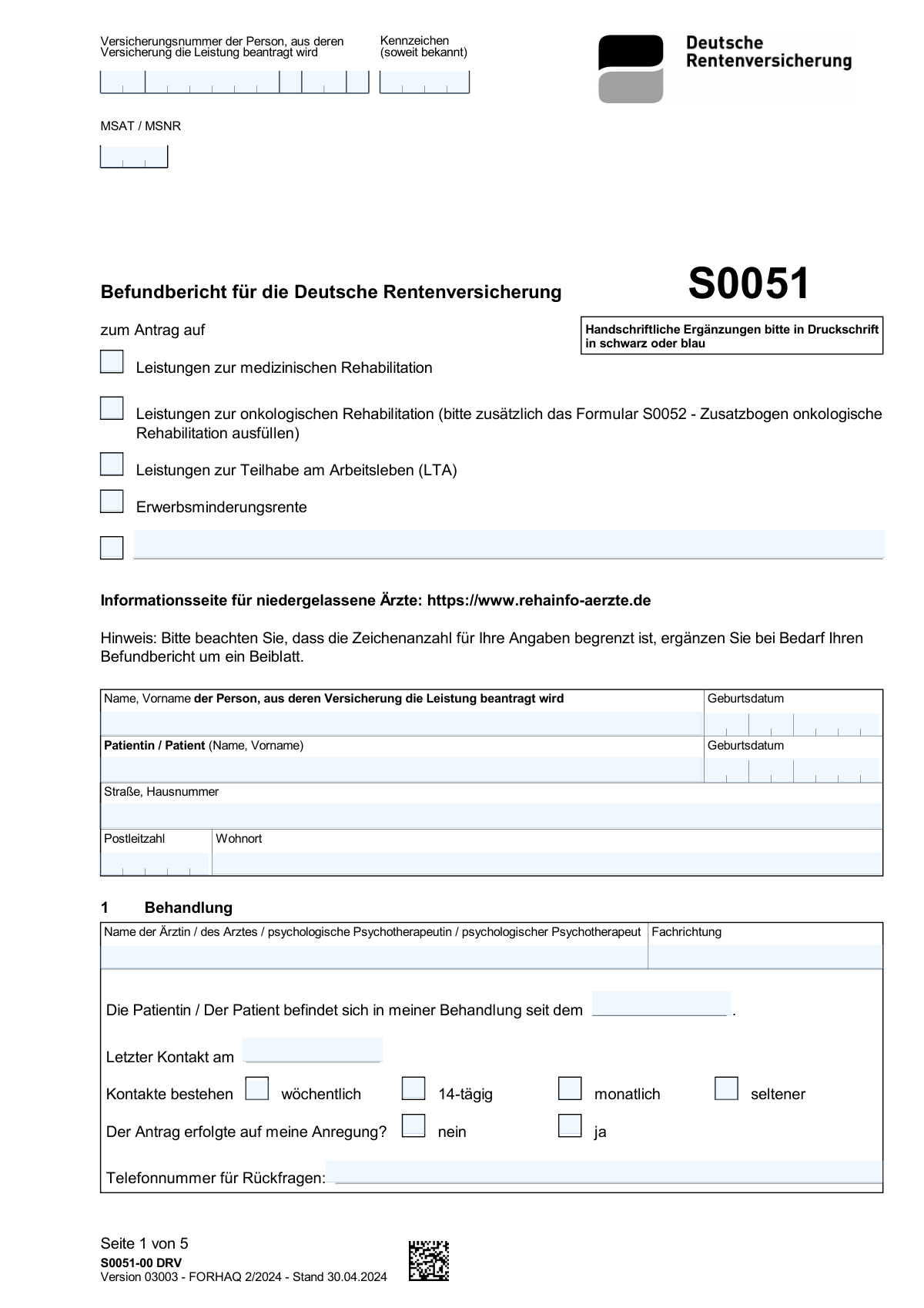
Yes! You can use AI to fill out Form S0051, Befundbericht für die Deutsche Rentenversicherung zum Antrag auf Leistungen zur medizinischen Rehabilitation / Erwerbsminderungsrente
Form S0051 is a detailed medical report ('Befundbericht') required by the German Pension Insurance (Deutsche Rentenversicherung) for applications concerning medical rehabilitation or reduced earning capacity pensions. A physician or psychotherapist completes this form to provide a comprehensive overview of the patient's health, including diagnoses, functional impairments, and treatment history, which is essential for the pension authority's decision-making process. Today, this form can be filled out quickly and accurately using AI-powered services like Instafill.ai, which can also convert non-fillable PDF versions into interactive fillable forms for easier completion.
Our AI automatically handles information lookup, data retrieval, formatting, and form filling.
It takes less than a minute to fill out S0051 using our AI form filling.
Securely upload your data. Information is encrypted in transit and deleted immediately after the form is filled out.
Form specifications
| Form name: | Form S0051, Befundbericht für die Deutsche Rentenversicherung zum Antrag auf Leistungen zur medizinischen Rehabilitation / Erwerbsminderungsrente |
| Number of fields: | 119 |
| Number of pages: | 5 |
| Language: | English |
Instafill Demo: How to fill out PDF forms in seconds with AI
How to Fill Out S0051 Online for Free in 2026
Are you looking to fill out a S0051 form online quickly and accurately? Instafill.ai offers the #1 AI-powered PDF filling software of 2026, allowing you to complete your S0051 form in just 37 seconds or less.
Follow these steps to fill out your S0051 form online using Instafill.ai:
- 1 Navigate to Instafill.ai and upload or select the S0051 form.
- 2 Use the AI assistant to automatically populate patient details like name, date of birth, and insurance number from your records.
- 3 Enter the application-relevant diagnoses and their corresponding ICD-10 codes, with the AI providing suggestions or validation.
- 4 Detail the patient's medical history, functional limitations, and current therapies in the designated text fields, using AI to help structure the information clearly.
- 5 Complete the sections on risk factors, work capacity, and rehabilitation prognosis by checking the appropriate boxes and providing necessary dates.
- 6 Review all entered information for accuracy, then digitally sign, date, and stamp the document before submitting it to the Deutsche Rentenversicherung.
Our AI-powered system ensures each field is filled out correctly, reducing errors and saving you time.
Why Choose Instafill.ai for Your Fillable S0051 Form?
Speed
Complete your S0051 in as little as 37 seconds.
Up-to-Date
Always use the latest 2026 S0051 form version.
Cost-effective
No need to hire expensive lawyers.
Accuracy
Our AI performs 10 compliance checks to ensure your form is error-free.
Security
Your personal information is protected with bank-level encryption.
Frequently Asked Questions About Form S0051
The S0051 form is a medical report (Befundbericht) for the German Pension Insurance (Deutsche Rentenversicherung). It is used to medically substantiate a patient's application for benefits like medical rehabilitation, a reduced earning capacity pension, or participation in working life programs.
The patient's treating physician or psychotherapist is responsible for completing and signing this form. It provides the official medical assessment required for the patient's application.
ICD-10 codes are a standardized system for classifying diagnoses. They are mandatory on this form to ensure the German Pension Insurance can process the medical information accurately and consistently.
You should attach copies of important, application-relevant medical documents. This includes reports from other specialists, hospital discharge summaries, and recent, significant lab or technical findings.
No. For applications concerning oncological rehabilitation, you must also complete the supplementary form S0052, the 'Zusatzbogen onkologische Rehabilitation'.
In Section 4, provide a brief narrative describing the specific activities at work or in daily life that the patient can no longer perform due to their illness. In Section 5, use the checkboxes to rate the level of impairment across different areas like mobility, self-care, and communication.
The form's text fields have a limited character count. If your detailed findings exceed the available space, you can attach a separate sheet (Beiblatt) with your supplementary report.
The 'Patient' is the person receiving medical treatment. The 'insured person' is the one whose insurance record the claim is based on, which can be the patient themselves or a family member (e.g., a spouse or parent).
In Section 11, you can check 'nein' for 'VerstÀndigung ist in deutscher Sprache möglich' and specify the language the patient communicates in. This informs the pension insurance about potential language barriers for rehabilitation.
This assessment helps the German Pension Insurance determine if the patient can travel to a rehabilitation facility, particularly using public transportation. It is a practical consideration for planning the rehabilitation measures.
Yes, services like Instafill.ai use AI to help you accurately auto-fill form fields from patient records. This can save you significant time and help prevent data entry errors.
You can upload the S0051 PDF to Instafill.ai, which makes the document interactive. You can then type your information directly into the fields online before printing the completed form for your signature and stamp.
If you have a non-fillable or 'flat' PDF, you can use a service like Instafill.ai. It can convert the document into an interactive, fillable form, allowing you to easily complete it on your computer.
Compliance S0051
Validation Checks by Instafill.ai
1
Validates German Insurance Number Format and Checksum
This check ensures the 'Versicherungsnummer' is a 12-digit number that conforms to the specific structure and checksum algorithm defined by the Deutsche Rentenversicherung. This is critical for uniquely and correctly identifying the insured person in the system. A failure would prevent the application from being linked to the correct insurance account, halting the process until corrected.
2
Ensures at Least One Application Purpose is Selected
Validates that at least one of the primary application purpose checkboxes (e.g., 'Leistungen zur medizinischen Rehabilitation', 'Erwerbsminderungsrente') has been selected. This is a fundamental completeness check to understand the reason for the report. If no purpose is selected, the application is ambiguous and cannot be routed to the correct department for processing.
3
Validates Chronological Order of Treatment Dates
This check verifies that the 'Letzter Kontakt am' (last contact date) is on or after the 'in meiner Behandlung seit dem' (treatment start date). Both dates must also be in the past. This ensures logical consistency in the treatment timeline provided by the physician. An illogical date sequence would cast doubt on the validity of the provided information.
4
Requires Conditional Oncology Form (S0052)
If the checkbox 'Leistungen zur onkologischen Rehabilitation' is selected, this validation flags that the supplementary form 'S0052 - Zusatzbogen onkologische Rehabilitation' must also be submitted. This is a cross-form dependency check crucial for ensuring all necessary oncological details are provided for a proper assessment. Failure to include the S0052 form will result in an incomplete application and processing delays.
5
Mandatory Primary Diagnosis and ICD-10 Code
Ensures that at least the first diagnosis ('1.') and its corresponding 'ICD-10' code are provided. These fields are the primary medical justification for the application. An application without a primary diagnosis lacks the core information needed for any medical assessment and would be immediately rejected for being incomplete.
6
Validates ICD-10 Code Structure
This check verifies that all entered 'ICD-10' codes follow the standard international format (e.g., a letter followed by two digits, with optional decimal extensions like F32.2). This ensures data integrity and allows for accurate automated processing, reporting, and statistical analysis. Invalid codes would require manual correction and could lead to misclassification of the medical condition.
7
Conditional Requirement for Work Incapacity Details
If the 'ja' option is selected for 'Die Patientin / der Patient ist derzeit durch mich arbeitsunfÀhig geschrieben', this validation makes the 'seit' (date) and 'wegen' (reason) fields mandatory. This ensures that a claim of work incapacity is properly substantiated with a start date and medical reason. Missing this information would leave a critical gap in the patient's current work status assessment.
8
Conditional Requirement for Non-German Language Specification
If the 'nein' option is selected for 'VerstÀndigung ist in deutscher Sprache möglich', this check makes the 'Wenn nein, in welcher Sprache?' field mandatory. This information is vital for the administration to arrange for a translator for future appointments or communications. Failure to specify the language could lead to significant communication barriers and delays in the rehabilitation process.
9
Plausibility Check for Body Measurements
Validates that the 'KörpergröĂe' (height) and 'Körpergewicht' (weight) fields contain positive, numeric values within a realistic range for a human being (e.g., height between 50-250 cm, weight between 5-300 kg). This prevents obvious data entry errors and ensures the data can be used for further calculations like BMI. Grossly incorrect values would render related health assessments invalid.
10
Logical Consistency between BMI and Risk Factors
This check calculates the Body Mass Index (BMI) from the provided height and weight. It then cross-references the result with the 'Risikofaktoren' section, suggesting a warning if the BMI indicates 'underweight' or 'overweight' but the corresponding checkboxes are not ticked. This helps ensure the physician's assessment is consistent and complete.
11
Exclusive Selection in Functional Limitation Grid
For each activity row in section 5 (e.g., 'MobilitÀt', 'Selbstversorgung'), this validation ensures that exactly one choice from the columns ('keine BeeintrÀchtigungen', 'EinschrÀnkungen', etc.) is selected. This prevents ambiguous or incomplete data entry in a critical assessment section. Submitting the form with multiple or no selections in a row would require clarification from the physician.
12
Validates Patient's Date of Birth
This check ensures the 'Geburtsdatum' is a valid date in the DD.MM.YYYY format, is in the past, and represents a plausible age (e.g., not more than 120 years ago). This is a fundamental data integrity check to confirm the patient's identity and eligibility. An invalid or future date would immediately halt processing.
13
Mandatory Physician's Final Assessment
Verifies that a selection has been made for all three final assessment questions in section 11: 'Belastbarkeit fĂŒr eine Rehabilitation besteht', 'ReisefĂ€higkeit...', and 'Besserung der LeistungsfĂ€higkeit ist möglich'. These answers represent the physician's final expert opinion and are critical for the insurance provider's decision. Missing any of these answers makes the report inconclusive.
Common Mistakes in Completing S0051
The German Pension Insurance Number is a long, unique identifier crucial for processing the application. Due to its length, transcription errors are common, or the field may be left blank if the number isn't readily available. An incorrect or missing number will halt the entire process, as the application cannot be assigned to the correct individual, leading to significant delays. AI-powered tools like Instafill.ai can help prevent this by validating the number's format and checksum, ensuring it's correct before submission.
Section 2 requires both a text diagnosis and its corresponding ICD-10 code. Physicians often write a detailed text diagnosis but may forget to add the specific code or enter a code that doesn't precisely match the written description. This discrepancy hinders automated processing by the pension insurance and can lead to requests for clarification, delaying the assessment of the medical necessity. Using a system that suggests ICD-10 codes based on the diagnosis text can mitigate this error.
In Section 4, the form asks for specific functional limitations in work and daily life. A common mistake is providing vague statements like 'patient has pain' instead of quantifiable descriptions like 'patient is unable to sit for more than 30 minutes or lift objects heavier than 5 kg'. Such ambiguity weakens the justification for rehabilitation or a disability pension, as it fails to paint a clear picture of the patient's impairments for the reviewing body.
The form explicitly requests that copies of reports from other specialists (Section 3) and important medical-technical findings (Section 8) be attached. It is a frequent oversight for the filling physician's office to forget to collate and include these essential documents with the submission. This omission invariably leads to a processing stop and a formal request for the missing information, significantly extending the application timeline.
This form is often distributed as a flat, non-fillable PDF, forcing physicians to print and complete it by hand. Despite the instruction to use block letters ('Druckschrift'), illegible handwriting can render critical information like diagnoses, contact numbers, or medication details unreadable. This can lead to data entry errors on the insurance agency's side or require them to send the form back. Tools like Instafill.ai can convert such non-fillable PDFs into interactive forms, eliminating handwriting issues entirely.
Section 5 contains a detailed grid for assessing impairments across various life domains, from 'Learning and applying knowledge' to 'Self-care'. Due to its complexity, it's easy to accidentally skip a row or fail to check a box for each category. Leaving parts of this grid blank creates ambiguity and forces the reviewer to make assumptions or request clarification, delaying the evaluation of the patient's overall condition.
The final section requires the physician's signature, date, official stamp, and professional title to be legally valid. Forgetting any of these elements, especially the signature or stamp, is a critical error that invalidates the entire medical report. This often happens in a rush and is a common reason for the form to be immediately returned, requiring a complete re-submission.
The form asks for multiple dates, including the start of treatment, the last contact, and the start of work incapacity. A common mistake is entering dates that are logically inconsistent (e.g., the work incapacity start date is before the treatment start date). These inconsistencies raise red flags for reviewers and necessitate follow-up questions to clarify the timeline of the patient's condition and treatment history. AI form-filling tools can be programmed to flag such logical inconsistencies.
The form distinguishes between the patient ('Patientin / Patient') and the person whose insurance is being used ('Person, aus deren Versicherung die Leistung beantragt wird'). In cases of family insurance, these may be different people. A frequent error is entering the patient's information in the insured person's fields or vice versa, causing significant administrative issues in matching the application to the correct insurance account.
In Section 11, if a physician certifies that the patient is currently unable to work ('arbeitsunfÀhig geschrieben'), they must specify the start date and the reason ('wegen'). A common mistake is checking 'ja' but leaving the 'wegen' field blank or writing something too generic. This omits the direct medical justification for the work incapacity, which is a key piece of information for the pension insurance's assessment.
Saved over 80 hours a year
âI was never sure if my IRS forms like W-9 were filled correctly. Now, I can complete the forms accurately without any external help.â
Kevin Martin Green
Your data stays secure with advanced protection from Instafill and our subprocessors

Robust compliance program
Transparent business model
Youâre not the product. You always know where your data is and what it is processed for.
ISO 27001, HIPAA, and GDPR
Our subprocesses adhere to multiple compliance standards, including but not limited to ISO 27001, HIPAA, and GDPR.
Security & privacy by design
We consider security and privacy from the initial design phase of any new service or functionality. Itâs not an afterthought, itâs built-in, including support for two-factor authentication (2FA) to further protect your account.
Fill out S0051 with Instafill.ai
Worried about filling PDFs wrong? Instafill securely fills form-s0051-befundbericht-fr-die-deutsche-rentenversicherung-zum-antrag-auf-leistungen-zur-medizinischen-rehabilitation forms, ensuring each field is accurate.