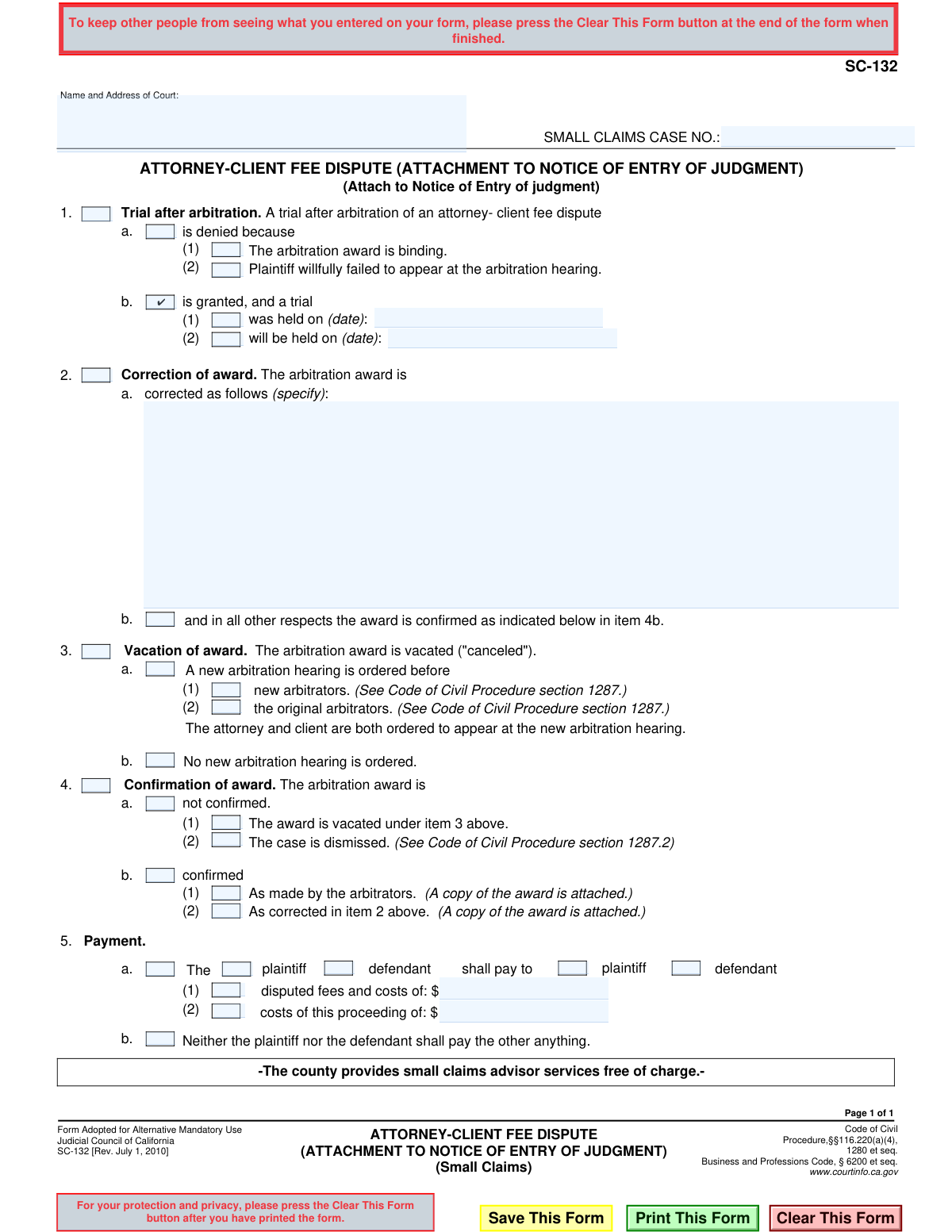
Yes! You can use AI to fill out Form SC-132, Attorney-Client Fee Dispute (Attachment to Notice of Entry of Judgment)
Form SC-132, Attorney-Client Fee Dispute, is a legal document used in California small claims court. It serves as an attachment to the Notice of Entry of Judgment to detail the outcome of a fee dispute that has gone through arbitration, specifying whether the arbitration award is confirmed, corrected, or vacated by the court. Today, this form can be filled out quickly and accurately using AI-powered services like Instafill.ai, which can also convert non-fillable PDF versions into interactive fillable forms.
SC-132 is part of the
California court forms, court claim forms and small claims forms categories on Instafill.
Our AI automatically handles information lookup, data retrieval, formatting, and form filling.
It takes less than a minute to fill out SC-132 using our AI form filling.
Securely upload your data. Information is encrypted in transit and deleted immediately after the form is filled out.
Form specifications
| Form name: | Form SC-132, Attorney-Client Fee Dispute (Attachment to Notice of Entry of Judgment) |
| Number of fields: | 41 |
| Number of pages: | 1 |
| Language: | English |
Instafill Demo: How to fill out PDF forms in seconds with AI
How to Fill Out SC-132 Online for Free in 2026
Are you looking to fill out a SC-132 form online quickly and accurately? Instafill.ai offers the #1 AI-powered PDF filling software of 2026, allowing you to complete your SC-132 form in just 37 seconds or less.
Follow these steps to fill out your SC-132 form online using Instafill.ai:
- 1 Navigate to Instafill.ai and upload or select Form SC-132.
- 2 Enter the court's name, address, and the small claims case number in the designated fields.
- 3 Indicate the court's decision regarding a trial after arbitration by checking the appropriate boxes, such as whether it was denied or granted.
- 4 Specify the court's action on the arbitration award: whether it is corrected, vacated, or confirmed, and provide any required details.
- 5 Document the payment order, specifying which party must pay, the amounts for disputed fees and costs, or if no payment is ordered.
- 6 Review all the information entered with the AI assistant to ensure accuracy and completeness.
- 7 Download the completed form to attach it to the Notice of Entry of Judgment for filing with the court.
Our AI-powered system ensures each field is filled out correctly, reducing errors and saving you time.
Why Choose Instafill.ai for Your Fillable SC-132 Form?
Speed
Complete your SC-132 in as little as 37 seconds.
Up-to-Date
Always use the latest 2026 SC-132 form version.
Cost-effective
No need to hire expensive lawyers.
Accuracy
Our AI performs 10 compliance checks to ensure your form is error-free.
Security
Your personal information is protected with bank-level encryption.
Frequently Asked Questions About Form SC-132
The SC-132 form is an official court attachment to a Notice of Entry of Judgment. It documents the court's final decision in a small claims case that followed an arbitration over a fee dispute between an attorney and a client.
This form is completed by court personnel, such as the judge or court clerk, to record the judgment. It is not a form that the plaintiff or defendant fills out themselves.
No, this form is not used to initiate a dispute. It is used by the court to finalize a case after an arbitration hearing has already occurred.
This means the court has rejected a request for a new trial after the arbitration. This can happen if the arbitration award was legally binding or if the plaintiff intentionally failed to appear at the arbitration hearing.
A 'correction' (Item 2) means the court made specific changes to the arbitration award but otherwise upheld it. A 'vacation' (Item 3) means the court has completely canceled the original arbitration award.
If an award is vacated, the court can either order a new arbitration hearing with new or the original arbitrators, or it may decide not to order a new hearing at all.
When the court 'confirms' the award, it is making the arbitrator's decision a legally binding court judgment. This can be the original award or an award that the court has corrected.
The 'Payment' section specifies the final financial outcome. It states who must pay whom, the total amount of disputed fees and costs, or if neither party owes the other anything.
You will receive this form attached to the 'Notice of Entry of Judgment' (Form SC-130), which is mailed to you by the court after a decision has been made in your case.
As stated on the form, every county provides free small claims advisor services. You can contact your local court to find out how to access this service.
While you don't fill out this specific judgment form, AI services like Instafill.ai can help you accurately complete other related court forms by auto-filling fields, which saves time and reduces errors.
You can use a service like Instafill.ai to handle this issue. It can convert flat, non-fillable PDFs into interactive forms that you can easily complete on your computer.
Simply upload your PDF form to the Instafill.ai platform. The AI will automatically detect the form fields, allowing you to type in your information, and then you can download or print the completed document.
Compliance SC-132
Validation Checks by Instafill.ai
1
Case Number Required
Validates that the 'SMALL CLAIMS CASE NO.' field is not empty. The case number is the primary unique identifier for the legal proceeding and is essential for associating this attachment with the correct case file in the court's records. A submission without a case number cannot be processed or filed correctly.
2
Court Information Required
Ensures the 'Name and Address of Court' field is populated. This information is critical for identifying the specific court and jurisdiction handling the case. Without it, the document is legally ambiguous and cannot be routed or filed in the proper venue.
3
Exclusive Trial Outcome Selection
Verifies that for item 1, 'Trial after arbitration', either 'denied' (1a) or 'granted' (1b) is selected, but not both. These are mutually exclusive outcomes of the trial request, and selecting both would create a logical contradiction in the court's order, making it invalid.
4
Conditional Trial Date Requirement
If the 'trial... is granted, and a trial was held on' checkbox (1b) is selected, this rule ensures the corresponding date field is not empty and contains a valid date. The date of the trial is a critical fact for the official case record, and its absence would make the judgment entry defective.
5
Conditional Correction Details Requirement
If the 'Correction of award' checkbox (2a) is selected, this validation confirms that the text field specifying the correction details is not empty. It is crucial to detail the exact changes made to the award for clarity and enforceability. An order to correct without specifying the correction is legally insufficient.
6
Exclusive New Hearing Order
Ensures that within item 3, 'Vacation of award', either 'A new arbitration hearing is ordered' (3a) or 'No new arbitration hearing is ordered' (3b) is selected, but not both. These are mutually exclusive directives that follow the vacation of an award, and the court's decision must be unambiguous.
7
Exclusive Award Confirmation Status
Validates that for item 4, 'Confirmation of award', the award is marked as either 'not confirmed' (4a) or 'confirmed' (4b), but not both. The final status of the arbitration award must be clear and singular. A form with both options checked would be void for uncertainty.
8
Logical Consistency for Corrected Confirmation
This rule checks that if 'confirmed... As corrected in item 2 above' (4b(2)) is selected, the form must also have the 'Correction of award' (2a) option selected. It is logically impossible to confirm a corrected award if the award was never designated as being corrected in the first place.
9
Logical Consistency for Vacated Award
Ensures that if the award is marked as 'vacated' (item 3), it is also marked as 'not confirmed' (4a). Vacating an award is the legal opposite of confirming it, so the form must reflect this consistent logical relationship to constitute a valid order.
10
Exclusive Payment Decision
Verifies that for item 5, 'Payment', either an order for payment is made (5a) or it is explicitly stated that 'Neither the plaintiff nor the defendant shall pay the other anything' (5b), but not both. These two outcomes are mutually exclusive and define the final financial resolution of the dispute.
11
Valid Currency Format for Payment Amounts
If payment is ordered (item 5a), this validates that the 'disputed fees' and 'costs of this proceeding' fields contain valid numerical or currency values. This prevents data entry errors and ensures the judgment amount is clear, calculable, and enforceable. Non-numeric entries would cause processing and collection issues.
12
Conditional Payment Details Requirement
If 'Payment' (5a) is ordered, this check ensures that a payer/payee relationship is defined and at least one amount field is greater than zero. An order to pay must specify who is paying whom and for how much to be a complete and enforceable judgment.
13
At Least One Judgment Outcome Required
Verifies that at least one of the primary outcome checkboxes on the form has been selected. A form submitted with only case information but no decision indicated (e.g., trial denied/granted, award confirmed/vacated, payment ordered) is incomplete. This check ensures the document reflects an actual judgment or order from the court.
Common Mistakes in Completing SC-132
The Small Claims Case Number is the primary identifier for the legal action. People often mistype this number or leave it blank, causing the document to be rejected or misfiled. This error can significantly delay the entry of judgment. To prevent this, carefully copy the number from previous court documents. AI-powered tools like Instafill.ai can help by validating number formats and auto-populating information from previous forms.
When confirming the arbitration award (Section 4b), the form explicitly states that a copy of the award must be attached. This is one of the most common and critical procedural errors. Forgetting to include this attachment will render the confirmation invalid, forcing the court to reject the filing until the award is provided.
The form's title clearly indicates it is an 'Attachment to Notice of Entry of Judgment'. A frequent mistake is to file this form by itself, without the main 'Notice of Entry of Judgment' form it is meant to supplement. This results in an automatic rejection by the court clerk, as the attachment has no parent document to which it can be attached.
In Section 5, users must specify exactly who pays whom and the precise monetary amounts for fees and costs. Common errors include leaving the dollar amounts blank, writing illegible figures, or incorrectly checking the plaintiff/defendant boxes. This ambiguity makes the payment order unenforceable and may require a corrected form to be submitted.
The form contains mutually exclusive options, such as vacating the award (Section 3) and confirming it (Section 4). Users sometimes check boxes in conflicting sections, creating a logical impossibility for the court. This forces a rejection of the form, as the court cannot determine the filer's true intent.
Filers sometimes enter the wrong court name or address, especially if they are dealing with multiple cases or are unfamiliar with the specific courthouse handling their dispute. Submitting the form to the wrong judicial branch leads to processing delays or the document being lost. AI form-fillers like Instafill.ai can prevent this by auto-populating correct court information from a verified database.
This form is often provided as a flat, non-fillable PDF, leading users to print and complete it by hand. Poor handwriting for names, dates, or monetary amounts can lead to critical data entry errors by court staff, potentially resulting in an incorrect judgment. To avoid this, use a tool like Instafill.ai that can convert non-fillable PDFs into fillable versions, ensuring all entries are typed and perfectly legible.
The form contains important date fields, such as the date of a trial after arbitration in Section 1b. Omitting these dates makes the legal record incomplete and can be grounds for rejection by the court clerk. It is crucial to provide the exact date for any event referenced to ensure the judgment is based on an accurate timeline. AI tools can help by flagging empty required fields before submission.
When choosing to correct an award in Section 2a, the form requires a specific description in the 'corrected as follows' field. A common mistake is to provide a vague or incomplete explanation, making it impossible for the court to understand and enforce the change. The description must be clear, precise, and legally sufficient to modify the original award, or the correction will be denied.
Saved over 80 hours a year
“I was never sure if my IRS forms like W-9 were filled correctly. Now, I can complete the forms accurately without any external help.”
Kevin Martin Green
Your data stays secure with advanced protection from Instafill and our subprocessors

Robust compliance program
Transparent business model
You’re not the product. You always know where your data is and what it is processed for.
ISO 27001, HIPAA, and GDPR
Our subprocesses adhere to multiple compliance standards, including but not limited to ISO 27001, HIPAA, and GDPR.
Security & privacy by design
We consider security and privacy from the initial design phase of any new service or functionality. It’s not an afterthought, it’s built-in, including support for two-factor authentication (2FA) to further protect your account.
Fill out SC-132 with Instafill.ai
Worried about filling PDFs wrong? Instafill securely fills form-sc-132-attorney-client-fee-dispute-attachment-to-notice-of-entry-of-judgment forms, ensuring each field is accurate.