
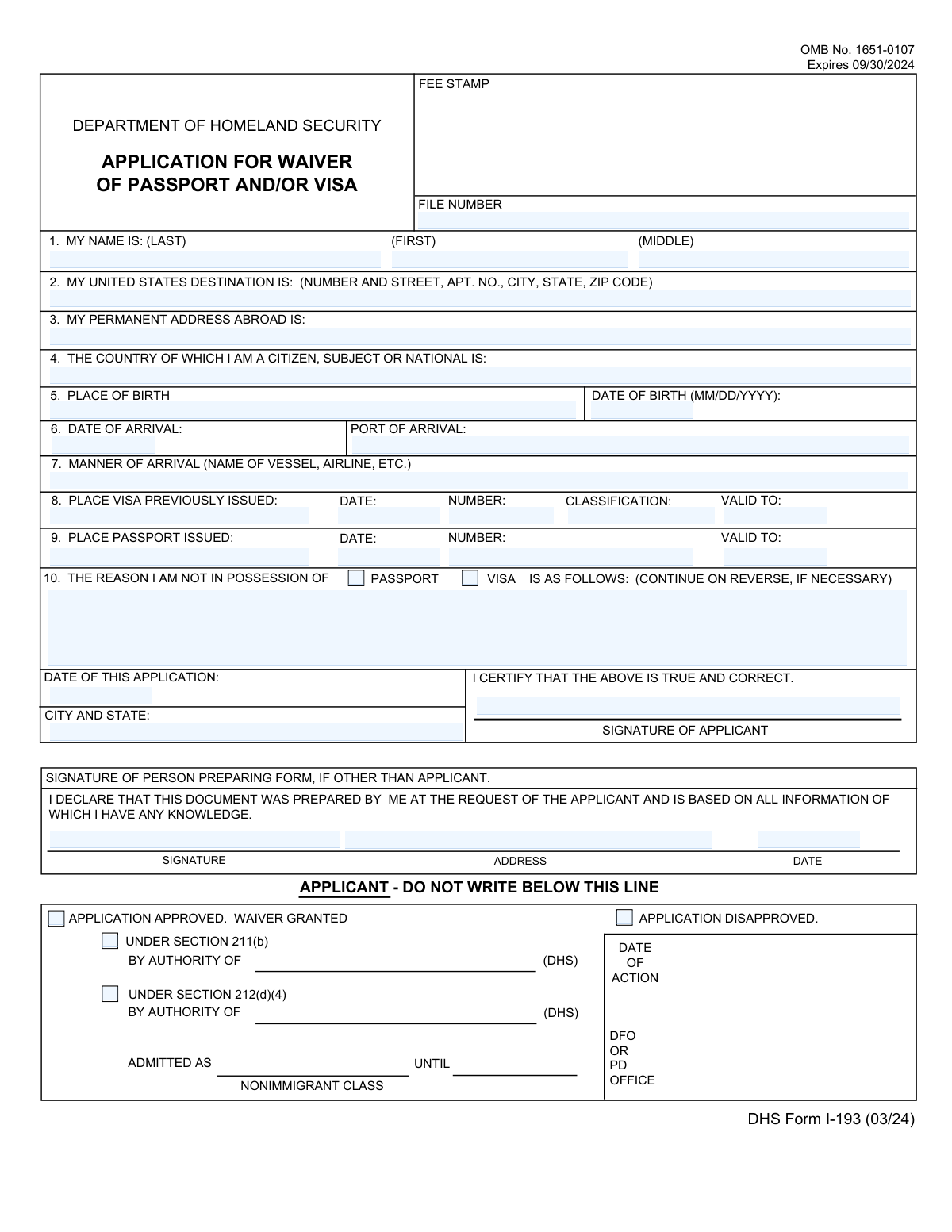
Yes! You can use AI to fill out Form I-193, Application for Waiver
Don't type 34 fields by hand. Tell our AI about yourself, or upload a document you already have, and it fills every field in seconds. You check it, then download, print or sign.
The AI does the filling. You just check it.
No typing into boxes, nothing to install.
What this form asks for
The AI fills all of it, from your answers or your documents.
The AI checks your answers before you download
15 checks built for this form, so a wrong date or a missing answer is caught before anyone else sees it.
The system ensures that the applicant's full name is entered correctly by checking the order of the name fields. It verifies that the last name is entered first, followed by the first name, and then the middle name if provided. The system also confirms that no part of the name is missing and prompts the user to complete any missing fields to ensure the name matches the official documents.
The system confirms that the U.S. destination address provided by the applicant is complete. It checks for the presence of the street number, street name, apartment number if applicable, city, state, and zip code. The system validates that each component of the address is present and formatted correctly to ensure the address can be used for official correspondence and is recognized by postal services.
The system verifies that the applicant's permanent address abroad is fully listed. It checks for completeness and accuracy of the address details, including street name, house or apartment number, city, region or province, and country. The system ensures that no part of the address is omitted, which is crucial for establishing the applicant's residence outside of the U.S.
The system checks that the applicant has stated their country of citizenship, subject, or nationality. It ensures that this field is not left blank and that the information provided is consistent with other official documents. The system may also cross-reference this information with a database of countries to confirm that the country stated is recognized and correctly spelled.
The system validates the date of birth entered by the applicant to ensure it is in the correct format of MM/DD/YYYY. It also checks the plausibility of the date, confirming that it is not a future date and that it corresponds to a real date in the past. The system may also calculate the applicant's age to ensure it is within reasonable limits for the application being processed.
The AI ensures that the date of arrival into the United States is not only provided but also accurately recorded in the appropriate format. It checks for the completeness and correctness of the port of arrival information, confirming that it matches recognized ports of entry. The AI cross-references this data with available databases to ensure accuracy and validity. Any discrepancies or missing information prompts the AI to flag the entry for review or correction.
And 9 more checks
- Verifies the manner of arrival is described in detail, including vessel name or airline.
- Checks details of previous visa issuance, including number, classification, and validity, are complete.
- Ensures the passport issuance details are specified, including number and validity.
- Validates the explanation for the lack of possession of a passport and/or visa is provided.
- Confirms the application is signed and dated
- Verifies that if someone else prepares the form, their signature, address, and date are included
- Checks that the payment of $695.00 is included and is in the correct form
- Ensures the applicant's name is included on the face of the check if it's drawn from another person's account
- Confirms no writing is present below the designated applicant line
Let AI fill out your DHS Form I-193
No typing. Every field filled in seconds, checked, ready to sign.
How to Fill Out DHS Form I-193 Online for Free in 2026
What the AI walks you through.
- Visit instafill.ai site and select Form I-193.
- Enter your name and address details.
- Provide your citizenship and place of birth.
- Fill in your travel details and reason for waiver.
- Sign and date the form electronically.
- Check for accuracy and submit the form.
Common Mistakes in Completing DHS Form I-193
The ones the AI is built to catch.
Incomplete or inaccurate name information
Incorrect or incomplete U.S. destination address
Forgetting to list permanent address abroad
Misstating country of citizenship, subject, or nationality
Incorrect date of birth format
Incorrect or incomplete date and port of arrival in the U.S.
Providing incorrect or incomplete manner of arrival
Incorrect or incomplete information about previously issued visa (number, classification, validity)
Incorrect or incomplete information about previously issued passport (number and validity)
Leaving the reason for not having a passport and/or visa blank
Signing the application before filling it out
Failing to pay the required fee or using an incorrect payment method
Writing below the designated applicant line
Not signing and dating the application
Having someone else sign and declare preparation without their address and date
Frequently Asked Questions About DHS Form I-193
Is it really free for 7 days?
Can I fill other forms too?
How do I cancel?
How does the AI fill out DHS Form I-193?
What happens to my information?
How complex is DHS Form I-193 to fill out?
What is the purpose of the Application for Waiver of Passport and/or Visa Fee Stamp form?
What information is required in section 1 of the form?
What is the purpose of section 2 of the form?
What information is required in section 3 of the form?
What information is required in section 4 of the form?
What is the process for submitting the Application for Waiver of Passport and/or Visa Fee Stamp form?
What documentation is required to support the application for a waiver?
How long does it take to process a waiver application?
Can the waiver be denied?
What is the purpose of section 5 in the Application for Waiver of Passport form?
What is the fee for filing the Application for Waiver of Passport form?
How should the fee for the Application for Waiver of Passport form be paid?
How long does it take to complete the Application for Waiver of Passport form?
What is the OMB control number for the Application for Waiver of Passport form collection?
What should I do if I have comments regarding the burden estimate for the Application for Waiver of Passport?
What happens if a check in payment of a fee for the Application for Waiver of Passport is not honored by the financial institution?
How should I file the Application for Waiver of Passport outside the United States?
What is the purpose of the Paperwork Reduction Act Statement in the Application for Waiver of Passport?
Get your DHS Form I-193 filled out by AI
$0 today. Cancel before Oct 31 and you pay nothing.
Let AI fill out your DHS Form I-193
Your trial starts once a card is added. You pay nothing before Oct 31.
Our AI already knows this form, all 34 fields of it. Skip the typing: tell it about yourself, or upload what you have, and it fills the whole form in seconds.
- AI fills every field on the form, checkboxes included
- No typing into boxes: answer a few questions, or upload a document you already have, an old copy of this form, a photo of a document
- The AI checks the answers; you review and change anything before you download
- Download the finished PDF, print it, or sign it online
- Encrypted, and never used to train AI
Cancel before Oct 31 and you pay nothing.
A card is needed to start the trial. Cancel in two clicks from your account.
Terms · Privacy