Yes! You can use AI to fill out Local Form 2084-4, Chapter 13 Plan
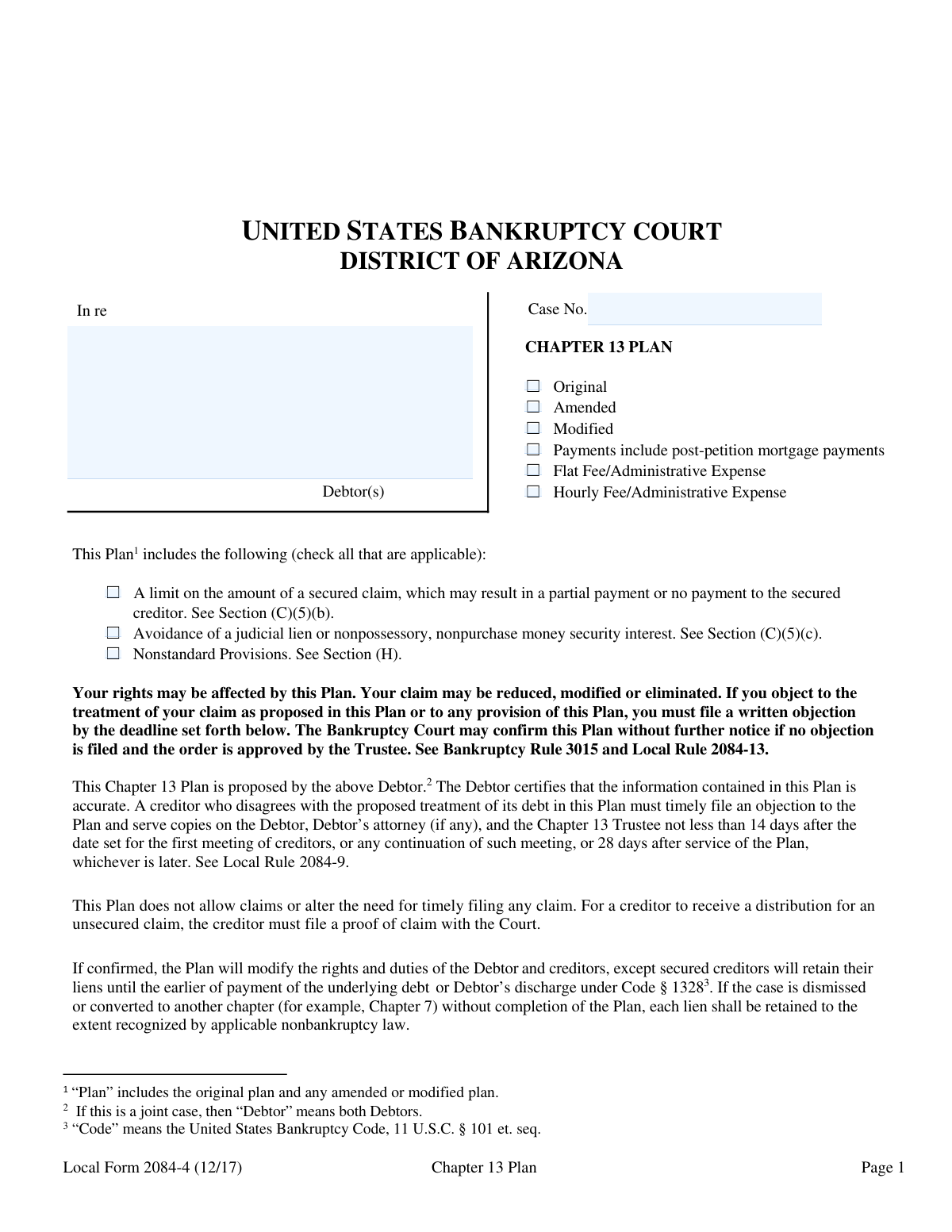
Local Form 2084-4, the Chapter 13 Plan for the District of Arizona, is a critical legal document submitted by a debtor in a Chapter 13 bankruptcy case. It details the debtor's proposed plan to repay creditors over a three to five-year period, outlining how much will be paid to different classes of creditors. The plan's confirmation by the court is essential for the bankruptcy case to proceed, making accuracy paramount. Today, this form can be filled out quickly and accurately using AI-powered services like Instafill.ai, which can also convert non-fillable PDF versions into interactive fillable forms.
Our AI automatically handles information lookup, data retrieval, formatting, and form filling.
It takes less than a minute to fill out Local Form 2084-4 using our AI form filling.
Securely upload your data. Information is encrypted in transit and deleted immediately after the form is filled out.
Form specifications
| Form name: | Local Form 2084-4, Chapter 13 Plan |
| Number of fields: | 160 |
| Number of pages: | 10 |
| Language: | English |
Instafill Demo: How to fill out PDF forms in seconds with AI
How to Fill Out Local Form 2084-4 Online for Free in 2026
Are you looking to fill out a LOCAL FORM 2084-4 form online quickly and accurately? Instafill.ai offers the #1 AI-powered PDF filling software of 2026, allowing you to complete your LOCAL FORM 2084-4 form in just 37 seconds or less.
Follow these steps to fill out your LOCAL FORM 2084-4 form online using Instafill.ai:
- 1 Navigate to Instafill.ai and upload or select Local Form 2084-4, the Chapter 13 Plan.
- 2 Provide your case information, including the case number and debtor name(s), and select the appropriate plan status (Original, Amended, or Modified).
- 3 Detail your proposed plan payments in Section A, including the start date, payment amounts, and duration, as prompted by the AI assistant.
- 4 Systematically complete Section C, detailing the treatment of administrative expenses, leases, and all secured, priority, and unsecured claims.
- 5 Specify any property to be surrendered in Section D and address any nonstandard provisions in Section H.
- 6 Review the automatically generated Plan Summary (Section I) and the Section 1325 analysis (Section J) for accuracy, making any necessary corrections before finalizing.
- 7 Certify and e-sign the completed form, then download the final document ready for filing with the U.S. Bankruptcy Court for the District of Arizona.
Our AI-powered system ensures each field is filled out correctly, reducing errors and saving you time.
Why Choose Instafill.ai for Your Fillable Local Form 2084-4 Form?
Speed
Complete your Local Form 2084-4 in as little as 37 seconds.
Up-to-Date
Always use the latest 2026 Local Form 2084-4 form version.
Cost-effective
No need to hire expensive lawyers.
Accuracy
Our AI performs 10 compliance checks to ensure your form is error-free.
Security
Your personal information is protected with bank-level encryption.
Frequently Asked Questions About Form Local Form 2084-4
This form, Local Form 2084-4, is a legal document you submit to the bankruptcy court outlining your proposed plan to repay creditors over a set period. It details payment amounts, how different debts will be treated, and the plan's duration.
Any individual or couple (Debtor) filing for Chapter 13 bankruptcy in the U.S. Bankruptcy Court for the District of Arizona must complete and file this plan.
An 'Original' plan is the very first version you file. An 'Amended' plan is a revision made before the court confirms it, while a 'Modified' plan is a change proposed after the court has already approved your plan.
In Section A, you must enter the start date for your payments, the monthly amount(s) you will pay to the Trustee, and the total number of months your plan will last. You can set up different payment amounts for different periods if your income is expected to change.
Surrendering property means you are giving it back to the secured creditor, such as returning a car to the lender. Upon plan confirmation, the creditor can take possession of the surrendered property.
Section (C)(2) requires you to disclose your attorney's fee arrangement, whether it's a flat fee or hourly. These fees are considered an administrative expense and are paid by the Trustee from your plan payments.
A Nonstandard Provision is any unique term that deviates from the standard options on the form. You must place these provisions exclusively in Section H and provide a justification, as any nonstandard terms written elsewhere in the plan are void.
A creditor who disagrees with the proposed treatment of their debt must file a formal written objection with the court. The court may then schedule a hearing to resolve the issue before deciding whether to confirm your plan.
You should list debts secured by personal property, like car loans, in Section (C)(5). You will need to provide details about the creditor, the property, the amount you propose to pay on the secured claim, and the interest rate.
Assuming a lease means you will keep the leased item (like a car or apartment) and continue payments, curing any arrears through the plan. Rejecting a lease means you are terminating the agreement and returning the property to the lessor.
This calculation in Section J is required to show that your unsecured creditors will receive at least as much under your Chapter 13 plan as they would if you filed for a Chapter 7 liquidation. Your plan must pass this test to be confirmed by the court.
Yes, services like Instafill.ai use AI to accurately auto-fill form fields, which can save you time and help reduce errors on a complex legal document like this one.
You can use a service like Instafill.ai to fill out the form online. Simply upload the PDF, and the platform will make it interactive, allowing you to type your information directly into the correct fields.
If you have a non-fillable or 'flat' PDF, you can use a tool like Instafill.ai to help. It can convert the static document into an interactive, fillable form that you can complete and save on your computer.
Compliance Local Form 2084-4
Validation Checks by Instafill.ai
1
Exclusive Plan Status Selection
Validates that only one checkbox is selected among 'Original', 'Amended', or 'Modified' at the top of the form. This is critical for establishing the procedural posture of the plan filing. Selecting multiple statuses creates ambiguity and would cause the filing to be rejected for clarification.
2
Conditional Requirement for Amended/Modified Plan Details
If 'Amended' or 'Modified' is checked, this validation ensures that the 'Reason(s) for Amended or Modified Plan' and 'Summary of How Plan Varies' fields are not empty. This information is legally required to inform the court and creditors of the proposed changes. A failure to provide this justification will result in the plan being deemed incomplete and unconfirmable.
3
Sequential and Non-Overlapping Payment Tiers
Verifies that the month ranges for the payment tiers in Section (A) are sequential and do not overlap (e.g., month 1-12, then 13-36). The start month of the first tier must be '1'. This logic is fundamental to creating a coherent and executable payment schedule for the Trustee to follow, and any error would make the plan mathematically unsound.
4
Plan Duration Consistency with Payment Tiers
Ensures the 'Proposed Plan duration' in months (Section A) is equal to the end month of the final payment tier listed. A mismatch would create a logical contradiction where the stated duration does not align with the scheduled payments. This discrepancy would cause the plan to be rejected as it is impossible to execute.
5
Commitment Period vs. Plan Duration
Validates that the 'Proposed Plan duration' is greater than or equal to the 'Applicable commitment period' as required by Bankruptcy Code § 1325(b)(4). A plan that is shorter than the legally mandated commitment period is statutorily non-compliant. This is a critical check for legal sufficiency, and failure would lead to an automatic objection from the Trustee and denial of confirmation.
6
Enforces 'None' Checkbox Exclusivity
For any section with a 'None' checkbox (e.g., C(1)(a), C(3), C(4)), this validation confirms that if 'None' is checked, all other data entry fields within that specific subsection are empty. This prevents the submission of contradictory information. Including data in a section marked as not applicable would require clarification and an amended filing.
7
Singular Attorney Fee Arrangement Selection
In Section (C)(2)(a), this check validates that either the 'Flat fee' or the 'File a fee application' option is selected, but not both. It also ensures that if an option is selected, the corresponding dollar amount fields are filled. This prevents ambiguity regarding attorney compensation and ensures the plan's administrative expenses are clearly defined for the Trustee.
8
Flat Fee Pre-Filing Payment Logic
In Section (C)(2)(a), if a 'flat fee' is specified, this check ensures that the amount 'paid before the filing of the case' is less than or equal to the total 'flat fee'. It is logically impossible to have paid more than the total fee agreed upon. This validation prevents simple data entry errors and ensures the financial details of the administrative expenses are accurate.
9
Lien Avoidance Completeness Check
If Section (C)(5)(c) is used to avoid a lien, this validation ensures that all required fields in both columns ('Information regarding judicial lien' and 'Information regarding calculation') are completed. Avoiding a lien has significant legal consequences, and incomplete information prevents the court and creditors from evaluating the request. The plan cannot be confirmed without this detailed information being provided.
10
Nonstandard Provisions Justification Requirement
If the 'Nonstandard Provisions' checkbox in Section (H) is checked, this validation ensures the corresponding text area explaining the provisions is not empty. Bankruptcy rules require any deviation from the standard plan to be explicitly stated and justified. An empty explanation for checked nonstandard provisions makes the plan incomplete and subject to objection or rejection.
11
Plan Summary Calculation Accuracy
This is a crucial cross-check that validates the figures in the 'Plan Summary' (Section I) by summing the corresponding values from the detailed sections (C, D, etc.). For example, the total for 'Administrative Expenses' (I(2)) must equal the sum of fees from Section (C)(2). This ensures the summary accurately reflects the plan's details, preventing mathematical errors that would render the plan unconfirmable.
12
Validates 'Best Interest of Creditors' Test Compliance
This check ensures that the 'Estimated Payment to Unsecured, Nonpriority Creditors Under Plan' (Section J(3)) is greater than or equal to the 'Estimated amount payable to unsecured, nonpriority claims if Debtor filed Chapter 7' (Section J(1)(e)). This is a fundamental requirement of Chapter 13 confirmation, ensuring creditors are not worse off than in a liquidation. A failing test means the plan is legally deficient and will be rejected.
13
Case Number Format Validation
Ensures the 'Case No.' field is not empty and follows the expected format for the District of Arizona (e.g., X:YY-bk-NNNNN). An incorrect or missing case number is a fatal flaw, as the document cannot be correctly docketed or associated with the proper debtor. This would lead to immediate rejection by the court clerk.
14
Plan Start Date Validity
This validation checks that the 'Plan payments start on' date in Section (A) is a complete, valid calendar date and is not a date in the past. Plan payments must begin on a future date after the plan is filed. An invalid or past date would make the payment schedule impossible to execute and would require correction before confirmation.
Common Mistakes in Completing Local Form 2084-4
A frequent and critical error is proposing plan payments in Section (A) that are mathematically insufficient to cover all debts and administrative expenses detailed in Section (C) and summarized in Section (I). This happens from simple addition errors or underestimating the total cost of trustee fees, attorney fees, and priority claims. An infeasible plan will face an objection from the Chapter 13 Trustee and will not be confirmed by the court, causing significant delays. To avoid this, carefully sum all proposed disbursements and ensure the total payments from Section (A) are equal to or greater than this amount.
Debtors often add custom terms directly into various sections instead of consolidating them in Section (H) as required. The form explicitly states, 'Any Nonstandard Provision placed elsewhere in this Plan is void,' meaning these crucial, negotiated terms will be legally unenforceable. This mistake can lead to the loss of important rights regarding specific debts. To prevent this, all deviations from the standard form must be placed in Section (H) with a clear reference to the plan paragraph being modified.
Filers often check a summary box on page 1, such as 'Amended Plan' or 'Avoidance of a judicial lien,' but then fail to provide the required narrative explanation or detailed calculations in the corresponding sections. This creates ambiguity and forces the Trustee or creditors to object to the plan for lack of clarity. To avoid this, meticulously review the form to ensure every checked box has its corresponding detailed information filled out completely in the relevant section.
In sections for secured debt like (C)(4) and (C)(5), filers may use generic descriptions like 'my car' or 'credit card' without providing the creditor's full name, a complete property address, or a vehicle's VIN. This lack of specificity makes it impossible for the Trustee and creditors to identify the exact debt and collateral being treated, leading to objections and disputes. Always provide the most detailed and specific identifying information available for each creditor and asset.
When proposing to pay secured claims through the plan in Section (C)(5), filers frequently leave the 'Proposed Interest Rate' field blank, assuming a default rate applies. This makes the plan incomplete and subject to objection, as creditors are entitled to the present value of their claim, which includes interest. To avoid this, always calculate and enter a specific proposed interest rate for all secured claims being paid through the plan, even if the proposed rate is 0%.
Many sections, such as (C)(3) for leases or (D) for surrendered property, include a 'None' checkbox. Filers often leave an entire section blank if it doesn't apply, creating ambiguity as to whether the omission was intentional or an oversight. This can prompt the Trustee to require a clarifying amendment, delaying the case. To ensure clarity, always check the 'None' box for any section or subsection that is not applicable.
In Section (C)(5)(c), a filer may state their intent to avoid a judicial lien but fail to provide the required mathematical justification showing how the lien impairs their exemption. The form requires showing the property value, the amount of senior liens, the applicable exemption amount, and the final calculation. Without this complete data, the lien avoidance is ineffective and will be denied by the court. To properly avoid a lien, you must provide the entire calculation as requested.
In Section (C)(2)(a), filers must accurately disclose the total attorney fee, the amount paid before filing, and the fee structure (flat vs. hourly). Common mistakes include entering the wrong pre-petition amount or failing to check the correct box for the fee type. These inaccuracies can lead to scrutiny from the court and Trustee, delaying both attorney payment and plan confirmation. Always verify these figures against the signed fee agreement before filling out this section.
In Section (A), filers must state both the 'proposed Plan duration' and the 'applicable commitment period,' which is a legally defined term based on income. A common mistake is proposing a plan duration that is shorter than the required commitment period (e.g., a 48-month plan when a 60-month period is required). This is not allowed under the Bankruptcy Code and will result in an automatic objection. Ensure the proposed plan duration is always equal to or greater than the applicable commitment period.
Filers often make errors in Section (C)(4)(a) when attempting to 'strip off' a wholly unsecured junior mortgage or in (C)(5)(b) when 'cramming down' a vehicle loan. They may misstate the value of the collateral or the amount of senior liens, leading to an incorrect classification. These errors will be challenged by creditors, leading to litigation and denial of the proposed treatment. It is crucial to use a valid, recent valuation method and show accurate calculations to justify the claim's classification. AI-powered tools like Instafill.ai can help prevent many of these data entry and calculation errors by validating information as it's entered and ensuring all required fields are completed correctly.
Saved over 80 hours a year
“I was never sure if my IRS forms like W-9 were filled correctly. Now, I can complete the forms accurately without any external help.”
Kevin Martin Green
Your data stays secure with advanced protection from Instafill and our subprocessors

Robust compliance program
Transparent business model
You’re not the product. You always know where your data is and what it is processed for.
ISO 27001, HIPAA, and GDPR
Our subprocesses adhere to multiple compliance standards, including but not limited to ISO 27001, HIPAA, and GDPR.
Security & privacy by design
We consider security and privacy from the initial design phase of any new service or functionality. It’s not an afterthought, it’s built-in, including support for two-factor authentication (2FA) to further protect your account.
Fill out Local Form 2084-4 with Instafill.ai
Worried about filling PDFs wrong? Instafill securely fills local-form-2084-4-chapter-13-plan forms, ensuring each field is accurate.