Yes! You can use AI to fill out Schedule C (Form 1040), Profit or Loss From Business

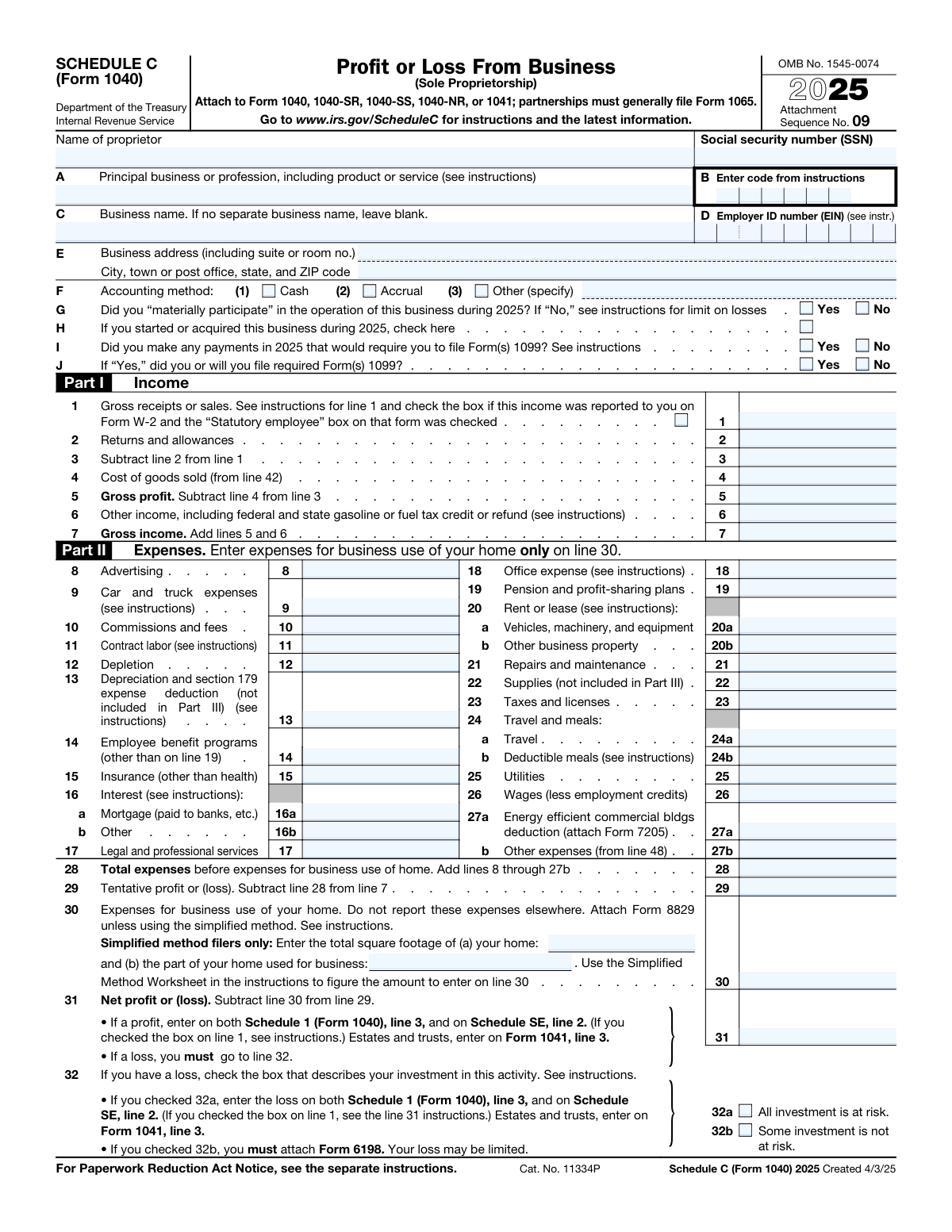
Schedule C (Form 1040) is an Internal Revenue Service (IRS) tax form used by sole proprietors to report the income and expenses of their business. It is a critical part of a business owner's tax return, as the calculated net profit or loss is used to determine self-employment tax and is reported on their personal Form 1040. Today, this form can be filled out quickly and accurately using AI-powered services like Instafill.ai, which can also convert non-fillable PDF versions into interactive fillable forms.
Schedule C (Form 1040) has a complex Form Complexity Index of 68/100 — 106 fillable fields across 2 pages. Instafill’s AI completes it accurately in under a minute.

Form specifications

Form name: Schedule C (Form 1040), Profit or Loss From Business
Number of fields: 106
Number of pages: 2
FCI: Complex (68/100)
Language: English
Our AI automatically handles information lookup, data retrieval, formatting, and form filling.
It takes less than a minute to fill out Schedule C (Form 1040) using our AI form filling.
Securely upload your data. Information is encrypted in transit and deleted immediately after the form is filled out.
Preview of Schedule C (Form 1040), Profit or Loss From Business

Instafill Demo: How to fill out PDF forms in seconds with AI

How to Fill Out Schedule C (Form 1040) Online for Free in 2026

Are you looking to fill out a SCHEDULE C (FORM 1040) form online quickly and accurately? Instafill.ai offers the #1 AI-powered PDF filling software of 2026, allowing you to complete your SCHEDULE C (FORM 1040) form in just 37 seconds or less.
Follow these steps to fill out your SCHEDULE C (FORM 1040) form online using Instafill.ai:
  1. 1 Navigate to Instafill.ai and upload or select the Schedule C (Form 1040).
  2. 2 Provide your personal and business identification details, such as name, SSN, business name, and address, letting the AI pre-fill information from your profile.
  3. 3 Enter your business income in Part I, including gross receipts, sales, and other income sources.
  4. 4 Detail all your business expenses in Part II, such as advertising, supplies, and travel, allowing the AI to help categorize and calculate totals.
  5. 5 Complete the additional sections as needed, such as Part III for Cost of Goods Sold and Part IV for vehicle information.
  6. 6 Review the automatically calculated net profit or loss. The AI ensures all calculations are accurate and flow correctly through the form.
  7. 7 Securely download, print, or e-file the completed Schedule C to attach to your Form 1040 tax return.

Our AI-powered system ensures each field is filled out correctly, reducing errors and saving you time.

Why Choose Instafill.ai for Your Fillable Schedule C (Form 1040) Form?

Speed

Complete your Schedule C (Form 1040) in as little as 37 seconds.

Up-to-Date

Always use the latest 2026 Schedule C (Form 1040) form version.

Cost-effective

No need to hire expensive lawyers.

Accuracy

Our AI performs 10 compliance checks to ensure your form is error-free.

Security

Your personal information is protected with bank-level encryption.

Frequently Asked Questions About Schedule C (Form 1040)

Schedule C (Form 1040) has a Form Complexity Index of 68 out of 100, placing it in the complex complexity tier. This score is calculated deterministically from the form’s own structure using Instafill’s published Form Complexity Index methodology, so it can be reproduced and independently verified — it is not a subjective estimate.

For Schedule C (Form 1040) specifically, the score reflects 106 fillable fields across 2 pages, grouped into 35 sections, and 19 conditional fields that only apply depending on earlier answers, 1 table or repeating lists. The number of fields is the largest factor in the base score (weighted 36%), followed by how difficult those fields are to complete based on their type, where free-text and signature fields count for more than simple checkboxes (26%). The number of pages that actually contain fields (15%), the amount of conditional “fill-only-if” logic (16%), and how many sections the form is divided into (7%) account for the rest of the base. On top of that base, the index adds points for tables and repeating lists, bundled instruction pages, and dense page layouts — capturing difficulty the base alone can miss.

In practical terms, a complex score means the form is demanding, with many fields, multiple pages and branching rules that are easy to get wrong. Instafill removes that effort entirely: our AI reads your information, maps each value to the correct field — including the conditional ones — and completes Schedule C (Form 1040) accurately in under a minute, with every field available for you to review before you download. See exactly how the Form Complexity Index is calculated.

Schedule C is an IRS form used to report income or loss from a business you operated as a sole proprietor. You must file it if you are self-employed, an independent contractor, a freelancer, or a single-member LLC that has not elected to be treated as a corporation.

You can use your SSN if you are the sole owner and have no employees. You generally need an EIN if you hire employees, have a Keogh plan, or are required to file employment, excise, or alcohol, tobacco, and firearms tax returns.

Gross receipts or sales (Line 1) is the total income your business received before any deductions. Gross income (Line 7) is your gross profit (receipts minus cost of goods sold) plus any other business income.

Material participation means you were involved in the business's operations on a regular, continuous, and substantial basis during the year. This is important because your ability to deduct a business loss may be limited if you did not materially participate.

You must complete Part III if your business involves producing or selling merchandise. This section is for businesses that maintain inventory to calculate the direct costs of the goods they sold during the year.

You report car and truck expenses on Line 9 and provide details in Part IV if required. You can use either the standard mileage rate or your actual expenses, but you must keep detailed records of your business mileage and costs.

If your expenses exceed your income, you have a net loss which you report on Line 31. You must then complete Line 32 to indicate whether your investment is 'at risk,' which may affect how much of the loss you can deduct.

You must check 'Yes' on Line I if you paid an individual who is not your employee, such as an independent contractor, $600 or more for services during the year. If you answer 'Yes,' you are also required to file the necessary Form(s) 1099 with the IRS and provide copies to the recipients.

You will need detailed records of all your business income, including bank statements and Forms 1099-NEC or 1099-K you received. You also need receipts and records for all your deductible expenses, such as advertising, supplies, and vehicle costs.

You report expenses for business use of your home on Line 30. You can use either the simplified method, which is a standard deduction based on square footage, or the regular method, which requires tracking actual expenses and filing Form 8829.

Schedule C is not filed by itself; it is a schedule that must be attached to your main tax return, such as Form 1040, 1040-SR, or 1040-NR. The net profit or loss from Schedule C is then carried over to your main tax form.

Yes, services like Instafill.ai use AI to help you fill out your forms accurately and quickly. These tools can auto-fill fields based on your data, reducing manual entry and helping to prevent common errors.

To fill out your Schedule C online, you can upload the PDF to a platform like Instafill.ai. The service will make the form interactive, allowing you to easily type your information into the correct fields, save your progress, and download the completed document.

If you have a non-fillable or 'flat' PDF, you can use a tool like Instafill.ai to convert it into an interactive, fillable form. Simply upload the file, and the service's AI will identify the fields and make them editable for you.

Compliance Schedule C (Form 1040)
Validation Checks by Instafill.ai

1
Validates Social Security Number (SSN) Format
This check ensures the 'Social security number (SSN)' field is entered in the correct nine-digit format (XXX-XX-XXXX or XXXXXXXXX). The SSN is a critical identifier for the IRS to link the business activity to the correct individual taxpayer. An invalid format will cause the form to be rejected by the IRS processing systems, preventing the return from being filed.
2
Validates Employer Identification Number (EIN) Format
This check verifies that if an 'Employer ID number (EIN)' is provided, it follows the standard nine-digit format (XX-XXXXXXX). While optional for many sole proprietors, if an EIN is used for business banking or hiring employees, it must be correct. An incorrectly formatted EIN can lead to processing delays and mismatches with other tax filings, such as payroll tax forms.
3
Conditional Logic for Form 1099 Questions
This validation ensures that question J ('did you or will you file required Form(s) 1099?') is answered only if the answer to question I ('Did you make any payments... that would require you to file Form(s) 1099?') is 'Yes'. This maintains the logical flow of the form and prevents contradictory information. Answering question J when it's not applicable can create confusion and may trigger unnecessary IRS scrutiny.
4
Verifies Gross Income Calculation (Line 7)
This check confirms that the value on Line 7 ('Gross income') is the correct sum of Line 5 ('Gross profit') and Line 6 ('Other income'). This is a fundamental calculation for determining the business's total income before expenses. An error here will lead to incorrect calculations for tentative profit, net profit, and ultimately, the taxpayer's total taxable income.
5
Verifies Total Expenses Calculation (Line 28)
This validation ensures that the amount on Line 28 ('Total expenses before expenses for business use of home') correctly equals the sum of all individual expense lines from 8 through 27b. Accurate expense totaling is crucial for calculating the correct net profit or loss. A miscalculation can result in overpayment or underpayment of taxes, potentially leading to penalties and interest.
6
Verifies Net Profit or Loss Calculation (Line 31)
This check confirms that the value on Line 31 ('Net profit or (loss)') is the result of subtracting Line 30 ('Expenses for business use of your home') from Line 29 ('Tentative profit or (loss)'). This final profit/loss figure is a key amount that transfers to other parts of the tax return (Schedule 1 and Schedule SE). An incorrect value will directly impact the taxpayer's adjusted gross income (AGI) and self-employment tax liability.
7
Conditional Requirement for At-Risk Determination (Line 32)
This check ensures that the at-risk boxes on Line 32 are only checked if Line 31 shows a net loss (a negative number). The at-risk rules limit the amount of loss a taxpayer can deduct, and they only apply when a loss has occurred. Incorrectly checking a box on Line 32 when there is a profit is illogical and will cause processing errors or rejection.
8
Cross-references Cost of Goods Sold (Line 4 and Line 42)
This validation verifies that the amount entered for 'Cost of goods sold' in Part I (Line 4) is identical to the amount calculated in Part III (Line 42). This ensures consistency across the form, as Part III provides the detailed breakdown for the COGS figure. A mismatch indicates a calculation or data entry error and will likely result in an IRS inquiry or automatic adjustment.
9
Verifies Cost of Goods Sold Calculation (Line 42)
This check confirms that the value on Line 42 ('Cost of goods sold') is correctly calculated by subtracting Line 41 ('Inventory at end of year') from Line 40 (the sum of beginning inventory and costs). This calculation is fundamental to determining gross profit for businesses with inventory. An error in this calculation will skew gross profit, net income, and the overall tax liability.
10
Conditional Requirement for Vehicle Information (Part IV)
This validation ensures that Part IV ('Information on Your Vehicle') is completed only if an expense is claimed on Line 9 ('Car and truck expenses'). The details in Part IV are required by the IRS to substantiate the vehicle expense deduction. Failing to complete Part IV when claiming a vehicle expense can lead to the disallowance of the deduction during an audit.
11
Cross-references Other Expenses (Line 27b and Line 48)
This check verifies that the amount for 'Other expenses' on Line 27b is identical to the total calculated in Part V on Line 48. Part V provides the necessary itemization for the 'Other expenses' category. A discrepancy between these two lines suggests either a calculation error or missing information, which can cause processing delays or questions from the IRS.
12
Ensures Returns and Allowances Do Not Exceed Gross Receipts
This validation checks that the value on Line 2 ('Returns and allowances') is less than or equal to the value on Line 1 ('Gross receipts or sales'). It is logically impossible for returns to exceed total sales. An entry that violates this rule is a clear data entry error and would result in a negative net receipt, which is incorrect and would cause the form to be rejected.
13
Validates Business Use of Home Square Footage
This check ensures that if the simplified method for business use of home is used, the 'Business-use home square footage' is not greater than the 'Total home square footage'. The area used for business cannot be larger than the entire home. This logical error would lead to an incorrect deduction calculation and would likely be flagged for review or rejected.
14
Ensures Accounting Method Selection is Mutually Exclusive
This validation confirms that only one accounting method checkbox (Cash, Accrual, or Other) is selected in section F. Furthermore, if 'Other' is checked, the corresponding specification field must be filled in. A taxpayer must use a single, consistent accounting method, and failing to specify an 'Other' method makes the filing incomplete and subject to rejection.

Common Mistakes in Completing Schedule C (Form 1040)

Using an Incorrect or Vague Business Activity Code

Filers often guess or choose a generic code for their principal business activity on Line B. The IRS uses this code to compare a business's income and expenses against industry averages, and an incorrect code can make a return an outlier, increasing the likelihood of an audit. To avoid this, carefully review the official IRS instructions to find the six-digit code that most accurately describes your primary business. AI-powered form-filling tools can also help suggest appropriate codes based on your business description, reducing the chance of error.

Incorrectly Answering Form 1099 Filing Questions

Many business owners mistakenly check "No" on Line I, forgetting they are required to file Form 1099-NEC for any independent contractor paid $600 or more during the year. This is a significant compliance error that the IRS can easily cross-reference, leading to penalties for failure to file. Always review your payments to contractors and ensure you answer Lines I and J accurately. Using accounting software or AI-powered tools like Instafill.ai can help track contractor payments and flag potential 1099 filing requirements, preventing this oversight.

Misclassifying Employees as Contract Labor

A common error is to report payments to employees on Line 11 (Contract Labor) instead of Line 26 (Wages) to avoid payroll taxes. This misclassification has severe consequences, including liability for back employment taxes, interest, and substantial penalties. It's crucial to understand the difference between an employee and an independent contractor based on IRS guidelines regarding behavioral and financial control.

Double-Dipping on Vehicle Expense Deductions

Filers often get confused between the standard mileage rate and the actual expense method for vehicle deductions on Line 9. A frequent mistake is claiming the standard mileage rate while also deducting actual costs like gas, insurance, or repairs, which is not permitted. You must choose one method and keep meticulous records, especially a contemporaneous mileage log. AI-powered tools like Instafill.ai can help by calculating deductions based on your chosen method and validating mileage entries to prevent common calculation errors.

Reporting Net Income on the Gross Receipts Line

On Line 1, filers must report their total gross receipts or sales before any expenses or cost of goods sold are subtracted. Some proprietors mistakenly enter their net income (profit), which significantly understates their business's total activity and is incorrect. This can lead to processing delays and IRS inquiries. Always report the full amount of income received from all business operations on this line.

Deducting Personal Expenses as Business Costs

A major red flag for the IRS is the deduction of personal, living, or family expenses that are not directly related to the business. For example, claiming 100% of a utility or cell phone bill that is also used for personal purposes is improper without prorating the expense. Commingling funds and failing to keep separate records makes this mistake more likely and can lead to disallowed deductions and accuracy-related penalties.

Errors in the Business Use of Home Deduction

The home office deduction on Line 30 is complex and prone to errors, such as miscalculating the square footage of the exclusive business area or claiming expenses for a space that is also used for personal activities. If not using the simplified method, you must complete and attach Form 8829, and failure to do so will result in the deduction being denied. If the form is a non-fillable PDF, tools like Instafill.ai can convert it into an interactive version with built-in calculators for deductions like the simplified home office method, reducing mathematical errors.

Mismatching Beginning and Prior Year's Ending Inventory

A critical but common error is when the 'Inventory at beginning of year' on Line 35 does not exactly match the 'Inventory at end of year' from the previous year's Schedule C. This discrepancy immediately signals poor record-keeping or potential income manipulation to the IRS, almost guaranteeing further review. AI-powered form-filling tools like Instafill.ai can help prevent this by carrying over data from prior-year returns or flagging inconsistencies between the beginning inventory value and previously entered data.

Misinterpreting 'Material Participation'

The question on Line G, 'Did you “materially participate”...', is a legal test with specific criteria, not just a simple question about being involved. Incorrectly checking 'Yes' when your involvement doesn't meet one of the seven IRS tests can lead to improperly deducting business losses against other income. This can result in the loss being disallowed and a higher tax bill upon review. If you are unsure, consult the IRS instructions to see if your hours and type of involvement qualify.

Including Owner's Pay in Cost of Labor

Sole proprietors often mistakenly include their own 'salary' or draws in the 'Cost of labor' on Line 37. However, a sole proprietor's compensation is the net profit of the business, not a deductible wage or labor cost. Including owner's pay on this line artificially inflates the Cost of Goods Sold, understates gross profit, and is explicitly disallowed by the IRS, which can lead to adjustments and penalties.
Saved over 80 hours a year

“I was never sure if my IRS forms like W-9 were filled correctly. Now, I can complete the forms accurately without any external help.”

Kevin Martin Green

Your data stays secure with advanced protection from Instafill and our subprocessors

Robust compliance program

Transparent business model

You’re not the product. You always know where your data is and what it is processed for.

ISO 27001, HIPAA, and GDPR

Our subprocesses adhere to multiple compliance standards, including but not limited to ISO 27001, HIPAA, and GDPR.

Security & privacy by design

We consider security and privacy from the initial design phase of any new service or functionality. It’s not an afterthought, it’s built-in, including support for two-factor authentication (2FA) to further protect your account.

Fill out Schedule C (Form 1040) with Instafill.ai

Worried about filling PDFs wrong? Instafill securely fills schedule-c-form-1040-profit-or-loss-from-business forms, ensuring each field is accurate.