Yes! You can use AI to fill out Spanish Grant of Representation Form
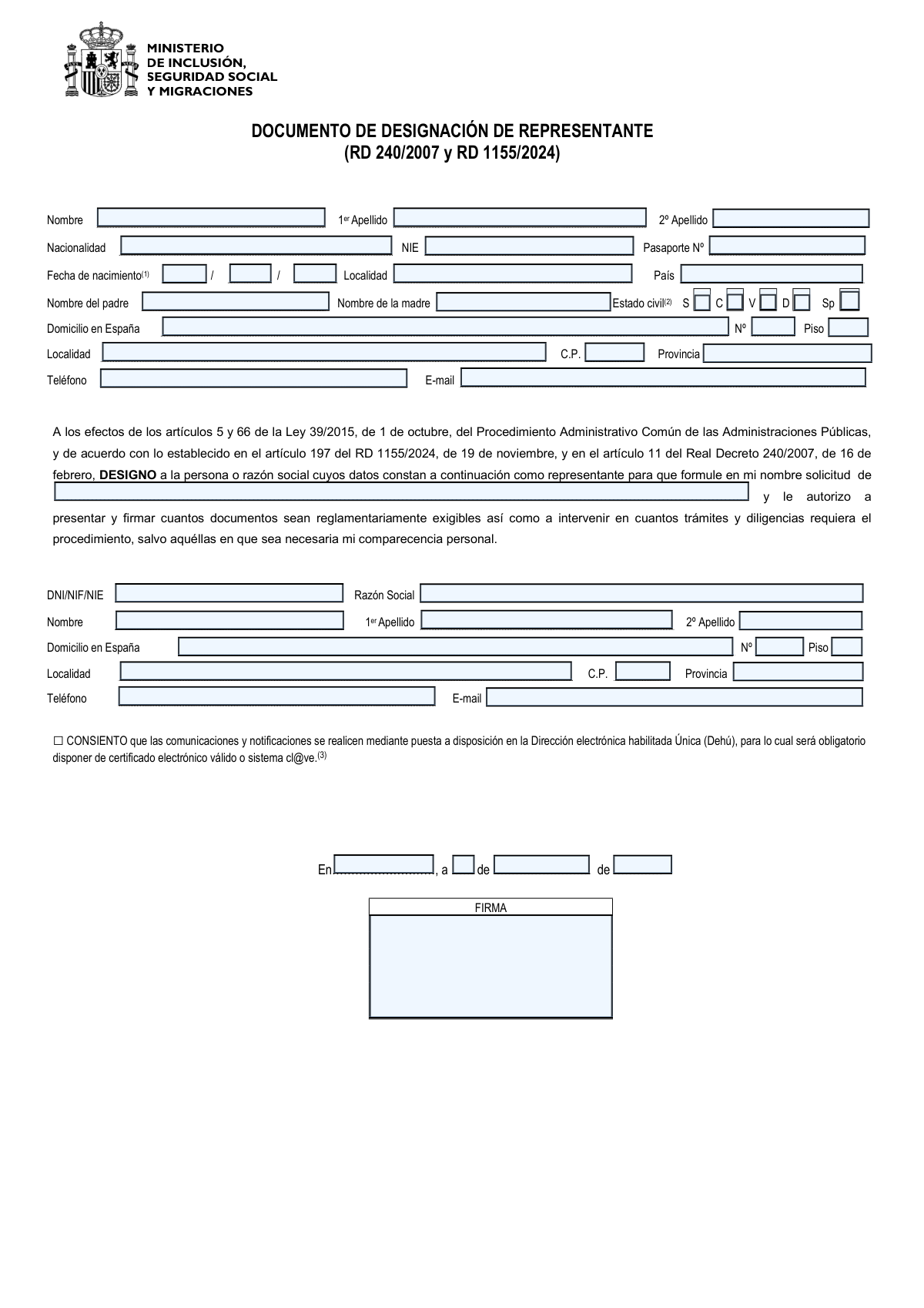
The Spanish Grant of Representation form is a legal document used to authorize another individual or company to act on your behalf in Spain. This is essential for handling administrative, tax, or legal affairs, particularly if you are not a resident or are unable to manage these tasks yourself, ensuring your representative is officially recognized by Spanish authorities. Today, this form can be filled out quickly and accurately using AI-powered services like Instafill.ai, which can also convert non-fillable PDF versions into interactive fillable forms.
Our AI automatically handles information lookup, data retrieval, formatting, and form filling.
It takes less than a minute to fill out Spanish Grant of Representation using our AI form filling.
Securely upload your data. Information is encrypted in transit and deleted immediately after the form is filled out.
Form specifications
| Form name: | Spanish Grant of Representation Form |
| Number of fields: | 45 |
| Number of pages: | 2 |
| Filled form examples: | Form Spanish Grant of Representation Examples |
| Language: | English |
Instafill Demo: How to fill out PDF forms in seconds with AI
How to Fill Out Spanish Grant of Representation Online for Free in 2026
Are you looking to fill out a SPANISH GRANT OF REPRESENTATION form online quickly and accurately? Instafill.ai offers the #1 AI-powered PDF filling software of 2026, allowing you to complete your SPANISH GRANT OF REPRESENTATION form in just 37 seconds or less.
Follow these steps to fill out your SPANISH GRANT OF REPRESENTATION form online using Instafill.ai:
- 1 Navigate to Instafill.ai and upload or select the Spanish Grant of Representation form.
- 2 Provide your personal information as the 'Grantor,' including your full name, address, marital status, and identification number (NIE or Passport).
- 3 Enter the complete details for your 'Designated Representative,' including their name, Spanish address, and identification number (DNI/NIF/NIE).
- 4 Clearly state the name of the representative in the authorization section to define who is being appointed.
- 5 Review all the information auto-filled by the AI to ensure accuracy, paying close attention to names, ID numbers, and addresses.
- 6 Complete the form by entering the place and date of signing, then electronically sign the document to finalize the grant of representation.
Our AI-powered system ensures each field is filled out correctly, reducing errors and saving you time.
Why Choose Instafill.ai for Your Fillable Spanish Grant of Representation Form?
Speed
Complete your Spanish Grant of Representation in as little as 37 seconds.
Up-to-Date
Always use the latest 2026 Spanish Grant of Representation form version.
Cost-effective
No need to hire expensive lawyers.
Accuracy
Our AI performs 10 compliance checks to ensure your form is error-free.
Security
Your personal information is protected with bank-level encryption.
Frequently Asked Questions About Form Spanish Grant of Representation
This form is used to officially designate a person or company as your legal representative in Spain. The person completing the 'Grantor' section is giving authority to the person or entity listed in the 'Designated representative' section.
The 'Grantor' is you, the person granting power and filling out your personal details. The 'Designated Representative' is the individual or company you are authorizing to act on your behalf.
This is standard for Spanish documents, as individuals traditionally have two surnames (paternal and maternal). If you only have one surname, enter it in the 'First surname' field and leave the 'Second surname' field blank.
A NIE is an identification number for foreigners in Spain, while a DNI is for Spanish citizens. You must provide your NIE as the grantor if you have one, and you must provide the DNI/NIF/NIE for your designated representative as it is essential for their identification.
Yes, you can appoint either an individual or a company. For an individual, fill in their name and surnames; for a company, enter the legal name in the 'Razón social' field.
You should have your passport and/or Spanish NIE card for your own details. You will also need the full name, address, and DNI/NIF/NIE number of your chosen representative.
These are Spanish abbreviations for marital status: S for Soltero (Single), C for Casado (Married), V for Viudo (Widowed), D for Divorciado (Divorced), and Sp for Separado (Separated).
The form explicitly asks for an address in Spain ('Domicilio en España'). If you do not have one, you should seek clarification from the authority requesting the form, as this is often a mandatory field.
Submission instructions are not included on the form itself. Generally, you would sign the document and provide it to the relevant Spanish authority or to your representative to present when acting on your behalf.
Yes, services like Instafill.ai use AI to help you accurately auto-fill form fields. This can save you time and help prevent common errors when entering your personal information.
To use Instafill.ai, you would upload the form to their platform. The AI technology will identify the fields, allowing you to enter your information once and have it automatically and correctly placed throughout the document.
You can use a service like Instafill.ai, which can convert flat, non-fillable PDFs into interactive forms. This allows you to easily type your information into the correct fields online before printing the completed document.
Yes, providing parents' names is a standard identification requirement on many official Spanish forms. You should enter their full names as they appear on official records.
You should sign in the 'Firma' section after entering the city, day, month, and year of signing in the designated fields. Ensure your signature matches the one on your official ID.
Compliance Spanish Grant of Representation
Validation Checks by Instafill.ai
1
Validates Spanish Identification Number Format (NIE/DNI/NIF)
This check verifies that the Grantor's NIE and the Representative's DNI/NIF/NIE numbers adhere to the official Spanish format, including the correct sequence of letters and numbers and a valid check digit. This is critical for legal identification and prevents processing errors with government agencies. Failure means the ID is invalid and the submission cannot be linked to the correct individual or entity.
2
Ensures Single Marital Status Selection
This validation confirms that only one marital status checkbox (Single, Married, Widowed, Divorced, or Separated) is selected for the grantor. Selecting multiple statuses is a logical impossibility and would invalidate the legal declaration of status on the form. If more than one box is checked, the form should prompt the user to select only one.
3
Verifies Grantor is of Legal Age
This check calculates the grantor's age based on the provided birth date and the current date, ensuring the grantor is over 18 years old. This is the standard age of majority required to legally designate a representative. If the grantor is underage, the form submission is invalid as they lack the legal capacity to enter into such an agreement.
4
Validates Signing Date is Logically Possible
This check ensures the 'Date of signing' is not in the future and is not a date before the grantor's date of birth. A future date is impossible, and a date before birth is a clear data entry error. This validation maintains the chronological integrity and legal plausibility of the document.
5
Validates Spanish Postal Code (C.P.) Format
This check verifies that the `Postal code (C.P.)` fields for both the grantor and the representative contain exactly five numeric digits. Spanish postal codes follow this strict format, and this validation is essential for ensuring mail delivery and correct geographic data processing. An incorrect format would lead to address lookup failures and returned mail.
6
Ensures E-mail Address Format is Valid
This validation checks that the e-mail address fields for both the grantor and representative follow the standard `local-part@domain` format. It looks for the presence of an '@' symbol and a domain name with a period. This is crucial for ensuring that communication, notifications, and digital copies of documents can be successfully delivered.
7
Ensures Grantor Provides at Least One Primary ID
This validation checks that either the `NIE (Foreigner ID)` field or the `Passport number` field is filled out for the grantor. Since these are primary forms of legal identification, at least one is required to uniquely and officially identify the person designating authority. A submission without either would lack the necessary proof of identity.
8
Validates Representative is Identified as Person or Company
This check ensures that the representative is clearly identified as either a natural person or a legal entity. It verifies that either the personal name fields (`Nombre`, `1er apellido`) are filled OR the company name field (`Razón social`) is filled, along with the required ID number. This is critical for correctly addressing the power of attorney and avoiding legal confusion about who the representative is.
9
Ensures Grantor's Given Name and First Surname are Provided
This validation confirms that the `Given name(s)` and `First surname` fields for the grantor are not empty. These fields are the absolute minimum requirement for identifying an individual on a legal document in Spain and many other jurisdictions. Failure to provide this information would render the document legally incomplete and unusable.
10
Verifies Completeness of Spanish Address Fields
This check ensures that for any Spanish address provided (for the grantor or representative), the core components are all present: `Domicilio` (street address), `Localidad` (town/city), `Provincia` (province), and `C.P.` (postal code). A complete address is necessary for legal notifications, correspondence, and establishing residency or contact location. An incomplete address can invalidate legal notices sent to that location.
11
Cross-Validates Postal Code with Province
This is a logical consistency check that verifies the first two digits of the Spanish `Postal code (C.P.)` correspond to the selected `Province`. Each Spanish province has a unique two-digit prefix for its postal codes (e.g., 28 for Madrid, 08 for Barcelona). This check helps catch data entry errors and ensures the provided address components are geographically consistent.
12
Validates Birth Date is a Real Calendar Date
This check ensures the combination of the grantor's `Birth date — day`, `month`, and `year` fields forms a valid calendar date. It prevents impossible dates like April 31st or February 29th in a non-leap year. This fundamental check prevents data corruption and subsequent errors in age calculation or record-keeping.
13
Ensures Representative's Personal Name is Complete
This validation rule is triggered if the representative is identified as a natural person (i.e., `Razón social` is empty). It then checks that the `Nombre` (given name) and `1er apellido` (first surname) fields are both filled in. This is essential to uniquely identify the individual being granted power of attorney.
14
Ensures Grantor's Nationality is Specified
This validation checks that the `Nationality` field for the grantor is not empty. Nationality is a key piece of identifying information on legal and international documents, often determining which laws or treaties may apply. Omitting this information can create ambiguity and cause processing delays or rejection by authorities.
Common Mistakes in Completing Spanish Grant of Representation
Users often enter their name using a common nickname, an anglicized version, or omit middle names. This form requires the name to be entered exactly as it appears on official identity documents like a passport or NIE. Any discrepancy can lead to the legal document being rejected by notaries, government agencies, or banks, rendering it invalid. To avoid this, meticulously copy your full legal name from your ID, ensuring every part, including multiple given names or surnames, is included.
The Spanish NIE (Foreigner ID Number) has a specific format, typically starting and/or ending with a letter (e.g., X12345678Z). A common mistake is to omit these letters or make a typo in the long string of digits. An incorrect NIE will fail validation in official systems, causing an immediate rejection of the form and significant processing delays. Always double-check the number and include all characters. AI-powered tools like Instafill.ai can help by validating the format of the NIE as you enter it.
The form asks for a 'First surname' (paternal) and a 'Second surname' (maternal), which is standard in Spain but confusing for those from other cultures. People may incorrectly enter a middle name in the surname field or leave the second surname blank when it is part of their official name. This creates an incorrect legal identity and can invalidate the document. It is crucial to enter your family names exactly as they are recorded on your official documentation, respecting the two-surname structure if applicable.
Spanish addresses are broken into specific components: street name ('Domicilio'), number ('Nº'), floor/door ('Piso'), postal code ('C.P.'), city ('Localidad'), and province ('Provincia'). A frequent error is to enter the entire address into the main 'Domicilio' field. This can lead to failed mail delivery and residency verification issues. To prevent this, carefully parse the address into the corresponding fields. If the form is a non-fillable PDF, a tool like Instafill.ai can convert it into a fillable version with clearly demarcated fields.
This form contains two nearly identical sections for the 'Grantor' (the person giving power) and the 'Designated Representative'. It is very easy to lose focus and accidentally enter your own information in the representative's section, or vice-versa. This critical error makes the document legally nonsensical and will require it to be redone from scratch. To avoid this, carefully read each section header and complete all fields for the Grantor before moving on to the Representative's section.
The representative section has separate fields for an individual ('Nombre', 'apellidos') and a legal entity ('Razón social'). A common mistake is to fill in the wrong set of fields, for instance, putting a company's name in the 'Nombre' field. This creates legal ambiguity about who the power is actually granted to, making the document unusable. Before filling, confirm if the representative is a person or a company and only complete the relevant fields.
Users may enter the date they filled out the form rather than the actual date of signing, or use a numerical format for the month (e.g., '03') when the name is required ('March' or 'marzo'). This can create legal questions about the document's timeline and validity. The place and date should be filled in at the moment of signing. Pay close attention to format requirements to prevent rejection by a notary or official body.
The fields 'Domicilio en España' and 'Address in Spain' explicitly require a Spanish address. Applicants living abroad sometimes enter their foreign address, not realizing it's a specific legal requirement for the process. This will likely lead to the form being rejected, as a Spanish address may be necessary for jurisdiction, tax, or notification purposes. If you lack a Spanish address, you must seek clarification on how to proceed before submitting the form.
It's easy to overlook checkboxes, but fields like marital status ('Soltero', 'Casado', etc.) are often mandatory for legal and administrative reasons. Failing to select an option renders the form incomplete and will cause it to be returned for correction, delaying the entire process. A final review of the document, specifically scanning for any empty checkboxes or required fields, is essential before submission. AI form-fillers like Instafill.ai can help by highlighting required fields that have been missed.
Despite some English translations, key fields like 'Razón social' (company name) or 'Localidad' (town/city) are in Spanish. Non-Spanish speakers may guess the meaning incorrectly, leading to errors. For example, one might not understand that 'Razón social' is exclusively for a legal entity, not a person. This can cause data to be entered in the wrong place, leading to rejection. Using a reliable translation or an intelligent form-filler that understands bilingual field labels is crucial for accuracy.
Saved over 80 hours a year
“I was never sure if my IRS forms like W-9 were filled correctly. Now, I can complete the forms accurately without any external help.”
Kevin Martin Green
Your data stays secure with advanced protection from Instafill and our subprocessors

Robust compliance program
Transparent business model
You’re not the product. You always know where your data is and what it is processed for.
ISO 27001, HIPAA, and GDPR
Our subprocesses adhere to multiple compliance standards, including but not limited to ISO 27001, HIPAA, and GDPR.
Security & privacy by design
We consider security and privacy from the initial design phase of any new service or functionality. It’s not an afterthought, it’s built-in, including support for two-factor authentication (2FA) to further protect your account.
Fill out Spanish Grant of Representation with Instafill.ai
Worried about filling PDFs wrong? Instafill securely fills spanish-grant-of-representation-form forms, ensuring each field is accurate.



