Yes! You can use AI to fill out State Bar of Wisconsin Form 3-2003, Quit Claim Deed
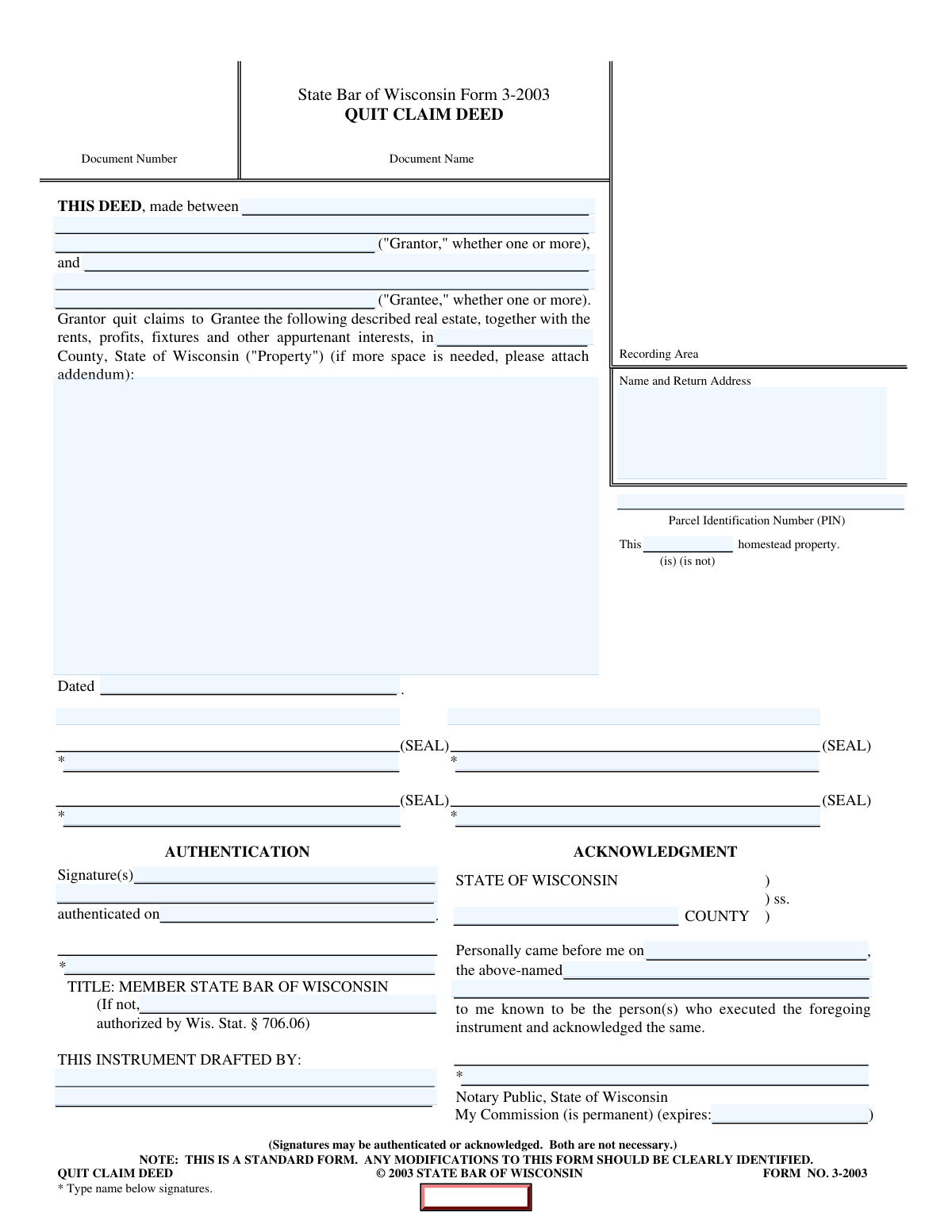
Form 3-2003 is a standard Quit Claim Deed provided by the State Bar of Wisconsin for transferring a person's interest in a property to another party. This type of deed makes no promises or warranties about the quality of the title, simply transferring whatever ownership rights the grantor has. It is a critical document for certain real estate transactions, such as transferring property between family members. Today, this form can be filled out quickly and accurately using AI-powered services like Instafill.ai, which can also convert non-fillable PDF versions into interactive fillable forms.
Form 3-2003 is part of the
NJ state forms, PA state forms, state ID forms and VA claim forms categories on Instafill.
Our AI automatically handles information lookup, data retrieval, formatting, and form filling.
It takes less than a minute to fill out Form 3-2003 using our AI form filling.
Securely upload your data. Information is encrypted in transit and deleted immediately after the form is filled out.
Form specifications
| Form name: | State Bar of Wisconsin Form 3-2003, Quit Claim Deed |
| Number of fields: | 35 |
| Number of pages: | 1 |
| Filled form examples: | Form Form 3-2003 Examples |
| Language: | English |
More forms in NJ state forms
Instafill Demo: How to fill out PDF forms in seconds with AI
How to Fill Out Form 3-2003 Online for Free in 2026
Are you looking to fill out a FORM 3-2003 form online quickly and accurately? Instafill.ai offers the #1 AI-powered PDF filling software of 2026, allowing you to complete your FORM 3-2003 form in just 37 seconds or less.
Follow these steps to fill out your FORM 3-2003 form online using Instafill.ai:
- 1 Navigate to Instafill.ai and upload or select the Wisconsin Quit Claim Deed (Form 3-2003).
- 2 Provide the full legal names of the Grantor(s) and Grantee(s) as prompted by the AI assistant.
- 3 Enter the property details, including the Parcel Identification Number (PIN), county, and the complete legal description.
- 4 Indicate whether the property is or is not homestead property.
- 5 Review all the information auto-filled by the AI across the form for accuracy, including the return address and drafter information.
- 6 Download the completed deed. The Grantor(s) must then sign the document in the presence of a notary or have their signatures authenticated.
- 7 File the original, executed deed with the Register of Deeds in the county where the property is located.
Our AI-powered system ensures each field is filled out correctly, reducing errors and saving you time.
Why Choose Instafill.ai for Your Fillable Form 3-2003 Form?
Speed
Complete your Form 3-2003 in as little as 37 seconds.
Up-to-Date
Always use the latest 2026 Form 3-2003 form version.
Cost-effective
No need to hire expensive lawyers.
Accuracy
Our AI performs 10 compliance checks to ensure your form is error-free.
Security
Your personal information is protected with bank-level encryption.
Frequently Asked Questions About Form Form 3-2003
This form is used to transfer a person's (the Grantor's) interest in a piece of real estate to another person (the Grantee). It transfers only the interest the Grantor currently has, without providing any warranties or guarantees about the property's title.
The Grantor, who is the current owner giving up their interest in the property, is responsible for completing and signing this form. The Grantee is the party who receives the property interest.
The legal description is a formal description of the property's boundaries and can be found on a previous deed, a property survey, or in the county's land records. It is more detailed than a simple street address.
The PIN is a unique number assigned to the property for tax purposes. You can typically find it on your property tax bill or by contacting the local county assessor's office.
This indicates whether the property is the Grantor's primary residence. This status has legal implications in Wisconsin, especially regarding spousal rights and protection from certain creditors.
No, the form indicates that you only need to complete one of these sections. Either have the signatures authenticated or have the document acknowledged by a notary public; both are not required.
After the form is completed, signed, and notarized or authenticated, it must be filed with the Register of Deeds in the county where the property is located. Make sure the 'Name and Return Address' section is filled out so the recorded deed can be sent back to you.
The drafter is the person who prepared the deed, which could be an attorney, a title company representative, or yourself if you filled it out. Wisconsin law requires the drafter's name to be listed on the document.
Yes, services like Instafill.ai use AI to accurately auto-fill form fields, which can save time and reduce errors. However, for legal advice concerning the property transfer, it is best to consult with an attorney.
You can upload the Quit Claim Deed PDF to the Instafill.ai platform. The service will automatically identify the fields, allowing you to type in your information and then download the completed document.
Services like Instafill.ai can convert flat, non-fillable PDFs into interactive, fillable forms. This allows you to easily type your information directly into the correct fields on your computer.
The form provides space for multiple parties, but if you need more, you should attach an addendum. Clearly state on the main form that an addendum is attached for additional Grantors or Grantees.
Typing or printing your name below the signature line ensures your name is legible for the official record. This is a standard requirement for legal documents to prevent ambiguity.
Compliance Form 3-2003
Validation Checks by Instafill.ai
1
Grantor Name Completeness
This check ensures that at least one Grantor name is provided in the 'Grantor Names' section. A quit claim deed is a legal transfer of property from a grantor, so the document is invalid without identifying who is giving up their interest. If this field is empty, the submission should be rejected as fundamentally incomplete.
2
Grantee Name Completeness
This validation verifies that at least one Grantee name is entered in the 'Grantee Names' section. The property must be transferred to a specific individual or entity. An absence of a grantee means there is no recipient for the property interest, making the deed legally meaningless and unrecordable.
3
Parcel Identification Number (PIN) Presence
This check confirms that the Parcel Identification Number (PIN) field is not empty. The PIN is a unique identifier used by the county for tax and recording purposes, and it is critical for correctly identifying the property. A missing PIN will lead to the rejection of the document by the recording office.
4
Legal Description Presence
This validation ensures the 'Legal Description' field contains text. The legal description is the official description of the property's boundaries and is the primary means of identifying the real estate being conveyed. A deed without a legal description is void because it fails to define the subject of the transfer.
5
Execution Date Validity and Logic
This check verifies that the 'Execution Date' is a valid calendar date and is not set in the future. The execution date establishes the point in time the deed was signed by the Grantor. It serves as a reference for other dates on the form, such as the acknowledgment date, which cannot precede it.
6
Homestead Declaration Requirement
This validation ensures that one of the two options, 'is' or 'is not', is selected for the 'Homestead Property Declaration'. This declaration has significant legal implications in Wisconsin regarding creditor claims and spousal rights. Failure to make this declaration leaves the property's status ambiguous and can cause the form to be rejected.
7
Drafter Name Requirement
This check confirms that the 'Drafter Name' field is filled out. Wisconsin Statute § 59.43(3) requires that any instrument for conveyance, such as a deed, must identify the name of the person who drafted it. A missing drafter name is a common reason for a Register of Deeds to refuse to record a document.
8
Authentication or Acknowledgment Section Completeness
This validation checks that either the 'Authentication' section or the 'Acknowledgment' section has been completed. For a deed to be recordable, the grantor's signature must be formally verified through one of these two processes. If both sections are left blank, the deed is not properly executed and will be invalid for recording purposes.
9
Acknowledgment Date Consistency
This check ensures the 'Acknowledgment Date' is on or after the 'Execution Date'. A notary acknowledges that the grantor appeared before them and signed the document; this cannot logically happen before the document itself is dated as executed. An inconsistent date would call the validity of the acknowledgment into question.
10
Notary Commission Expiration Date Validity
This validation verifies that the 'Notary Commission Expiration Date' is a valid future date. A notary's actions are only valid during their period of commission. An expired or missing commission date invalidates the notarial act, making the acknowledgment defective and the deed unrecordable.
11
Grantor Name and Signature Consistency
This check ensures that for every Grantor name listed at the top of the form, there is a corresponding signature and typed name in the signature block. This confirms that all parties who are listed as giving up their interest have actually executed the document. A mismatch can create a cloud on the title and indicates an incomplete transfer.
12
Return Address Completeness
This validation verifies that the 'Name and Return Address' field is not empty and contains plausible address information. This address is required by the recording office to mail the original document back after it has been recorded. A missing or incorrect return address will delay the return of the document and could result in it being lost.
13
Property County Validation
This check ensures the 'Property County' field contains the name of a valid county in Wisconsin. The deed must be recorded in the county where the property is located. Specifying an incorrect or non-existent county will cause the filing to be rejected and sent to the wrong jurisdiction.
Common Mistakes in Completing Form 3-2003
This is one of the most critical errors. It often occurs when filers copy the property description from a tax bill, which is usually abbreviated, instead of from the prior deed. An incorrect or incomplete legal description can render the deed invalid, fail to transfer the intended property, or create a 'cloud on title' that requires expensive legal action to fix. To avoid this, you must copy the full legal description verbatim from the most recent deed for the property, attaching an addendum if necessary.
Filers often use nicknames, omit middle initials, or fail to list their full legal name exactly as it appeared on the deed when they acquired the property. This creates a discrepancy in the chain of title, potentially causing issues with future sales or financing. The Grantor's name must match the prior deed, and all names must be spelled correctly and consistently throughout the document. Using a tool like Instafill.ai can help ensure consistency by auto-populating names across different fields once entered.
The form states that either authentication or acknowledgment is required, but not both. People often get confused and either fill out both sections incorrectly, leave both blank, or choose the wrong one for their situation. This is a primary reason for a deed to be rejected by the Register of Deeds. You must have the Grantor's signature either authenticated by a qualified person (like a Wisconsin attorney) or acknowledged before a Notary Public, and only that one section should be completed.
Wisconsin law requires that the name of the person who drafted the instrument be listed on the deed for it to be recordable. Many people who fill out the form themselves believe they can leave the 'THIS INSTRUMENT DRAFTED BY' section blank. Failure to include the drafter's name will result in the Register of Deeds refusing to record the document. Even if you prepare it yourself, you must list your own name and address as the drafter.
The form requires the filer to indicate if the property 'is' or 'is not' homestead property by striking out the inapplicable word. People often forget to do this or don't understand the legal definition of a homestead in Wisconsin. This declaration is legally significant for matters concerning spousal rights and creditor exemptions, and omitting it can cause recording delays or future legal questions about the property's status.
If acknowledgment is chosen, the notary section must be perfect. Common mistakes include the notary forgetting to sign, affix their seal, or list their commission expiration date. A document with an incomplete or incorrect notarization is not considered properly executed and will be rejected for recording. Always double-check the notary's work before leaving their presence to ensure all required elements are present and correct.
The form explicitly requires that names be typed or printed below the signature lines for all grantors. This is a common oversight, especially on physical paper forms that may not be fillable. This requirement ensures the signatory's name is legible and correctly identified, which is essential for public records. AI-powered tools like Instafill.ai can convert non-fillable PDFs into fillable forms and automatically populate typed names to prevent this error.
The PIN is a unique number used for property tax purposes, and while the legal description is the controlling element for a transfer, an incorrect PIN can cause significant confusion. It can lead to misfiling by the county, incorrect tax bills, and difficulties when searching property records. The PIN should be carefully copied from a current tax bill or the county's property information website. Smart form-filling tools can validate the format of the PIN to catch typos.
This seems simple, but it's a frequent mistake. Filers may provide an old address, a typo, or an incomplete address. After the deed is recorded by the county, the original document is mailed back to the address provided in this box. An error here means the recorded deed could be lost in the mail, delaying receipt of the official document and causing significant inconvenience.
The form has multiple date fields: the Execution Date and the Acknowledgment Date. The date of execution cannot be after the date of acknowledgment, as the signature must exist before it can be notarized. Filers sometimes post-date the document or get the dates mixed up, which creates a logical impossibility on the face of the deed and can lead to its rejection by the recording office.
Saved over 80 hours a year
“I was never sure if my IRS forms like W-9 were filled correctly. Now, I can complete the forms accurately without any external help.”
Kevin Martin Green
Your data stays secure with advanced protection from Instafill and our subprocessors

Robust compliance program
Transparent business model
You’re not the product. You always know where your data is and what it is processed for.
ISO 27001, HIPAA, and GDPR
Our subprocesses adhere to multiple compliance standards, including but not limited to ISO 27001, HIPAA, and GDPR.
Security & privacy by design
We consider security and privacy from the initial design phase of any new service or functionality. It’s not an afterthought, it’s built-in, including support for two-factor authentication (2FA) to further protect your account.
Fill out Form 3-2003 with Instafill.ai
Worried about filling PDFs wrong? Instafill securely fills state-bar-of-wisconsin-form-3-2003-quit-claim-deed forms, ensuring each field is accurate.



