Fill out account update forms
with AI.
Account update forms are vital administrative tools used to notify financial institutions and service providers of changes to your personal or professional records. Whether you are updating a mailing address, changing a legal name, or modifying tax identification details, these documents ensure your accounts remain compliant and secure. Maintaining accurate information is essential for receiving critical communications, ensuring correct tax reporting, and preventing unauthorized access to your assets.
By continuing, you acknowledge Instafill's Privacy Policy and agree to get occasional product update and promotional emails.
About account update forms
These forms are frequently used by individual investors, account holders, and trustees who need to adjust their account structures or personal information. For instance, you might need to update your details for a Merrill Lynch account after a life event, or modify the features of a Schwab brokerage account to add checkwriting capabilities. Trustees also use these forms to provide updated information regarding unregulated trusts to firms like Vanguard. These updates are often triggered by changes in marital status, the addition of account holders, or regulatory requirements like FATCA/CRS reporting.
Navigating these multi-page documents can be time-consuming, but modern tools have simplified the process significantly. Tools like Instafill.ai use AI to fill these account update forms in under 30 seconds, handling the data accurately and securely to save you time. This automated approach ensures that even non-fillable PDF versions are processed efficiently, allowing you to complete necessary paperwork without the hassle of manual data entry.
Every form on this page can be completed without typing. Instafill is form filling software that reads a PDF and fills it for you — including flat and scanned documents that carry no fillable fields at all.
Forms in This Category
The forms in this category have a median Form Complexity Index of 61/100 (Moderate), measured across 3 forms by field count, input difficulty, length, conditional logic and structure. See how it is calculated.
| Form Name | Pages | FCI | |
|---|---|---|---|
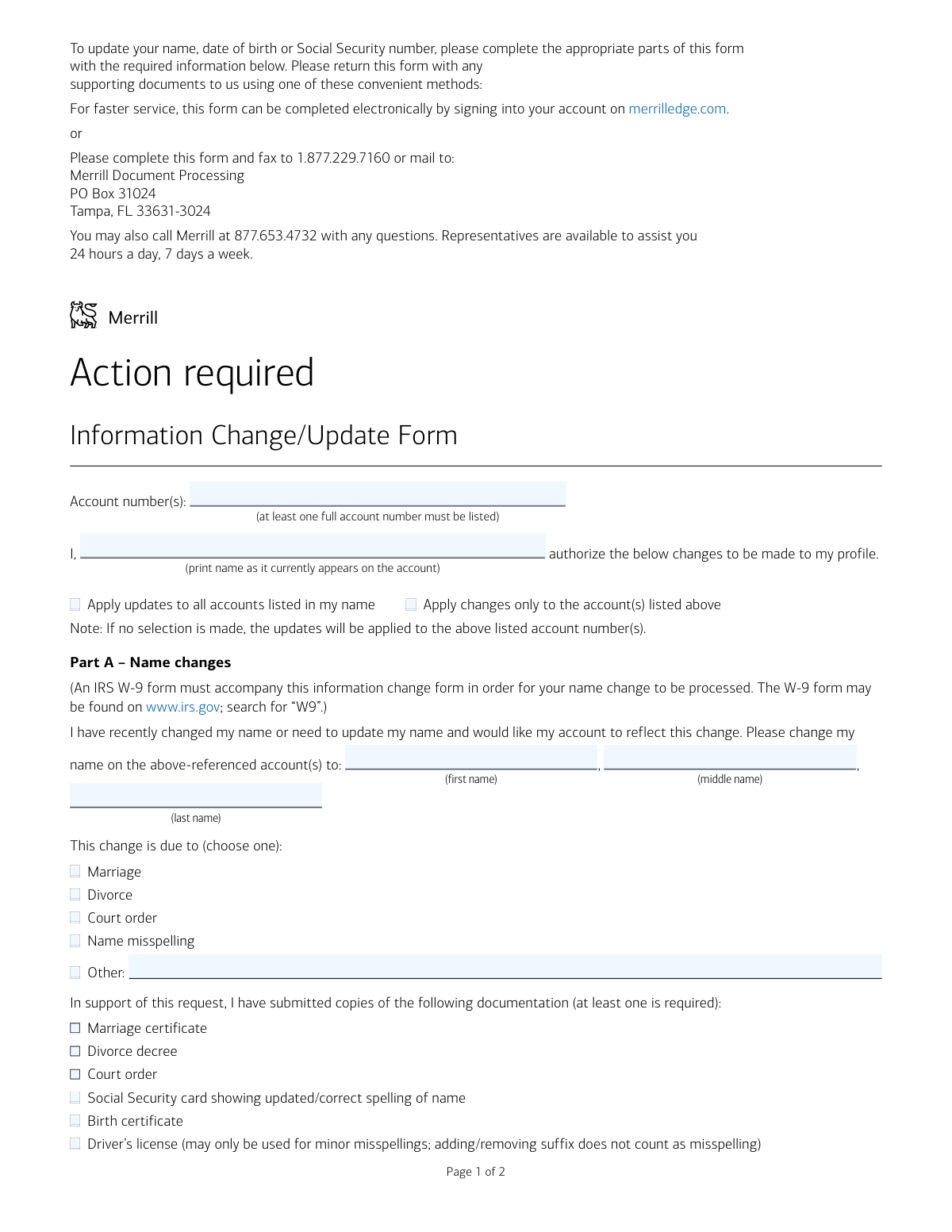
| 1. | Merrill Lynch Information Change/Update Form | 1 | Basic 31 |
| 2. | Update Your Schwab or Schwab One® Account | 1 | Moderate 61 |
| 3. | Vanguard Personal Investor – Unregulated Trust details – Account information update | 1 | Complex 64 |
- Enterprise-grade security & data encryption
- 99%+ accuracy powered by AI
- 1,000+ forms from all industries
- Complete forms in under 60 seconds
How to Choose the Right Form
Updating your financial records is critical for security, tax reporting, and account access. To select the correct form, first identify your financial institution and then determine the specific nature of the update you need to perform.
Updating Personal Identity Information
If you are a Merrill Lynch client and need to update your core identity details, use the Merrill Lynch Information Change/Update Form. This form is specifically designed for fundamental changes that affect your legal profile, such as:
- Changing your legal name or marital status.
- Correcting your date of birth or Social Security number.
- Ensuring your account matches your current legal identification for accurate year-end tax reporting.
Modifying Account Features and Holders
For Charles Schwab clients who want to change the functionality of their existing brokerage account rather than just personal details, the Update Your Schwab or Schwab One® Account form is the correct choice. Select this form if you intend to:
- Add a new account holder to an existing individual account.
- Convert a standard brokerage account into a Schwab One account to access more features.
- Add banking-related features like checkwriting or a Visa® debit card.
- Close a linked Schwab Bank checking account while keeping the brokerage side active.
Managing Trust and Regulatory Details
Trust accounts have unique reporting requirements that standard personal accounts do not. If you are a trustee managing a Vanguard account, you should use the Vanguard Personal Investor – Unregulated Trust details – Account information update form. This is the appropriate document for:
- Updating the organizational structure of an unregulated trust.
- Providing updated details on beneficiaries or "controlling persons."
- Ensuring your trust remains compliant with international tax regulations, including FATCA and CRS reporting standards.
By using Instafill.ai, you can quickly complete these PDFs by converting them into interactive forms, ensuring that your sensitive financial updates are handled accurately and efficiently.
Tips for account update forms
Cross-reference your current account statement or online profile to ensure account numbers and existing names are entered exactly as they appear on record. Even a minor typo in an account number can cause the financial institution to reject your update request.
Major changes such as a legal name change, updated Social Security number, or marital status update typically require proof. Have digital scans of your marriage certificate, court orders, or government-issued IDs ready to upload or attach alongside your form.
AI-powered tools like Instafill.ai can complete these complex account update forms in under 30 seconds with high accuracy. Your sensitive financial data stays secure during the process, providing a fast and reliable alternative to manual data entry for multiple accounts.
When updating unregulated trust details or entity-held accounts, the name of the trust must be identical to the one listed on the trust deed. Discrepancies in trust naming can lead to significant issues with tax reporting and compliance with FATCA or CRS regulations.
Updating your personal or trust information is the ideal time to review your designated beneficiaries. Ensure that their contact information and legal names are current to avoid complications with asset transfers in the future.
Many brokerage and trust update forms require signatures from all account holders or all acting trustees. Review the form instructions to see if a spouse or co-trustee needs to sign before you submit the document to avoid it being marked as incomplete.
Frequently Asked Questions
Account update forms are used to notify financial institutions of changes to your personal, legal, or financial status. Keeping this information current ensures that your account remains secure, tax reporting is accurate, and that you continue to receive important communications and statements without interruption.
You should file an update form whenever there is a significant change in your circumstances, such as a legal name change, a change in marital status, or a correction to your Social Security number. Additionally, trust accounts must be updated whenever there are changes to the trustees, beneficiaries, or the overall structure of the trust.
Depending on the type of change, you may need to provide legal evidence such as a marriage certificate, divorce decree, or a court-ordered name change document. For trust accounts, institutions like Vanguard may require updated trust deeds or certificates of trust to verify the authority of the individuals managing the account.
Yes, certain account update forms, such as those provided by Charles Schwab, allow you to modify your account features. This can include adding checkwriting and debit card access, converting a standard brokerage account into a more comprehensive account type, or adding additional account holders.
You must use the specific form provided by the institution where your account is held. For example, a Merrill Lynch client would use their specific Information Change form for personal data updates, while a Vanguard trustee would use the Unregulated Trust details form for trust-specific modifications.
Generally, all primary account holders and any authorized signers must sign the form to validate the requested changes. In the case of trust accounts, the current trustees or controlling persons identified in the trust agreement are responsible for signing and submitting the update.
Submission methods vary by institution but typically include secure online document uploads, faxing to a dedicated department, or mailing the physical document to a processing center. Always check the specific instructions provided on the form to ensure it reaches the correct department for processing.
Yes, AI tools like Instafill.ai can fill out account update forms in under 30 seconds by accurately extracting and placing data from your source documents. This technology ensures that your information is mapped correctly to the required fields, reducing the risk of errors that could delay your account updates.
When using AI-powered services, the process of filling out these forms is nearly instantaneous, often taking less than 30 seconds. The AI automatically identifies the necessary fields and populates them with your data, allowing you to review and submit the form much faster than manual entry.
Financial institutions are required to collect and report specific information under regulations like FATCA and CRS to prevent tax evasion. Updating trust details ensures that the broker has current information on beneficiaries and controlling persons, keeping the account in compliance with both domestic and international tax laws.
No, account update forms are not universal and are specific to the individual financial institution. You must complete separate forms for Merrill Lynch, Charles Schwab, or Vanguard, as each firm requires different disclosures and follows unique internal verification procedures.
Glossary
- Form Complexity Index
- Instafill’s 0–100 measure of how much effort a form takes to complete, calculated deterministically from the form’s own structure rather than estimated. It combines the number of fillable fields (the largest factor), how difficult those fields are to complete based on their type, the number of pages that contain fields, the amount of conditional “fill-only-if” logic, and how many sections the form is divided into, then adds modifiers for tables and repeating lists, bundled instruction pages, and dense page layouts. A higher score means the form is harder to fill out by hand. The forms in this category have a median Form Complexity Index of 61/100 (Moderate). See exactly how it is calculated.
- Beneficiary
- A person or entity designated to receive the assets or benefits from an account or trust, typically upon the death of the primary account holder.
- Trustee
- The individual or organization legally responsible for managing the assets within a trust and ensuring the trust's instructions are followed for the benefit of others.
- Brokerage Account
- A financial account held at a licensed firm that allows an individual to deposit money and trade various securities like stocks, bonds, and mutual funds.
- Checkwriting
- A feature that can be added to an investment account, allowing you to pay for expenses by writing checks directly from your account's cash balance.
- FATCA (Foreign Account Tax Compliance Act)
- A federal law requiring financial institutions to report information about accounts held by U.S. persons to the IRS for tax compliance purposes.
- CRS (Common Reporting Standard)
- An international system for the automatic exchange of financial account information between countries to help prevent global tax evasion.
- Unregulated Trust
- A trust that does not fall under the direct supervision of a government regulatory agency, often requiring additional documentation to verify its structure and owners.
- Controlling Person
- An individual who has significant influence or legal authority over a trust or entity, such as the person who established it or the one managing it.