Fill out address verification forms
with AI.
Address verification forms are essential documents used by financial institutions, government bodies, and service providers to confirm an individual's primary place of residence. These forms serve as a critical layer of security and compliance, ensuring that applicants are providing accurate geographic data before accessing services like banking, insurance, or local government benefits. In many cases, a standard utility bill or lease agreement may not be sufficient, requiring a formal attestation from a third party or a specific letter of authorization to validate where an individual lives.
By continuing, you acknowledge Instafill's Privacy Policy and agree to get occasional product update and promotional emails.
About address verification forms
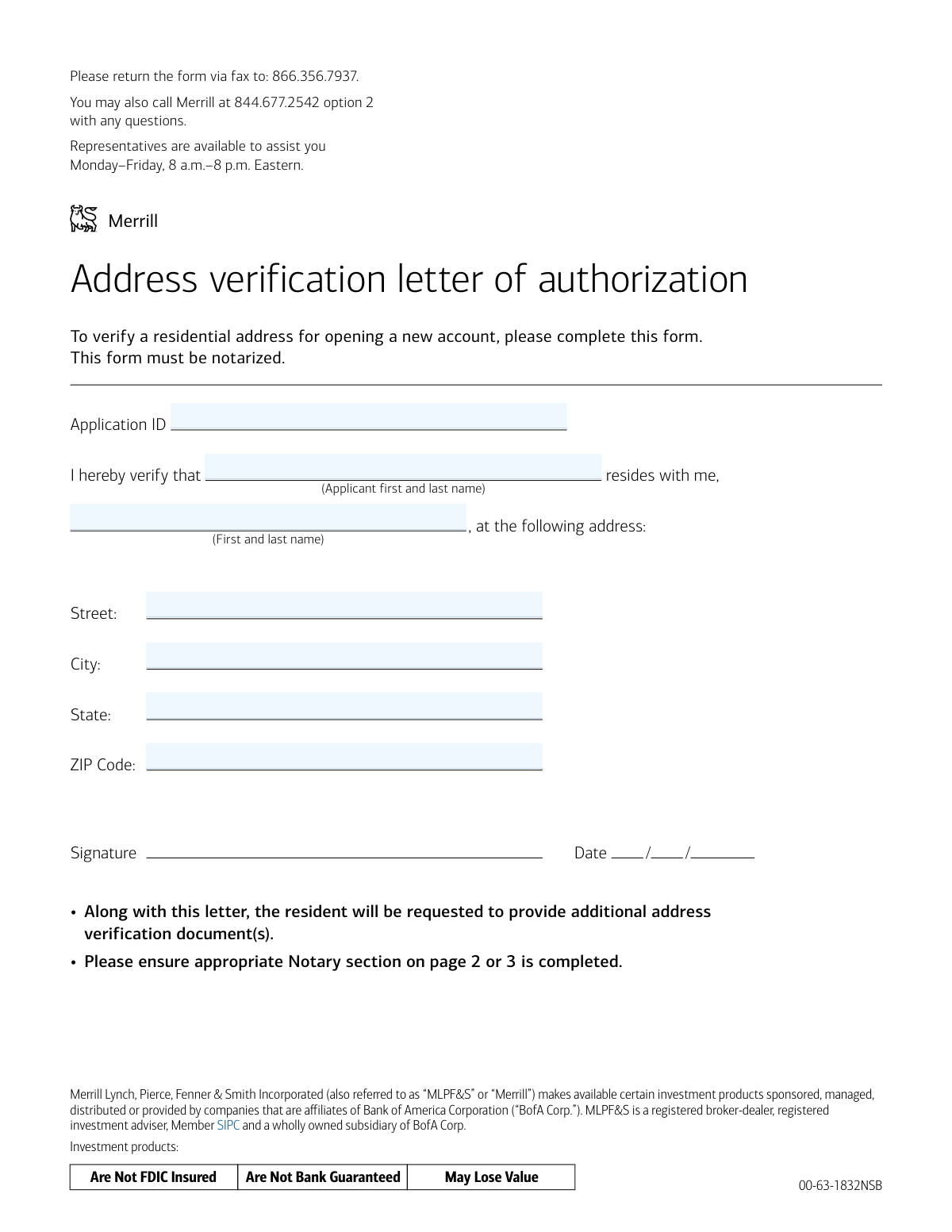
These forms are typically needed by individuals who are opening new accounts, applying for credit, or updating their legal records. For instance, if you are opening a brokerage account and live with a family member or friend, you may need an Address Verification Letter of Authorization to have that person vouch for your residency. Because these documents often require notarization or legal signatures, it is important that the information is presented clearly and accurately to prevent administrative delays. Tools like Instafill.ai use AI to fill these forms in under 30 seconds, handling your data accurately and securely to streamline the entire process.
Every form on this page can be completed without typing. Instafill is form filling software that reads a PDF and fills it for you — including flat and scanned documents that carry no fillable fields at all.
Forms in This Category
The forms in this category have a median Form Complexity Index of 35/100 (Basic), measured across 2 forms by field count, input difficulty, length, conditional logic and structure. See how it is calculated.
| Form Name | Pages | FCI | |
|---|---|---|---|
| 1. | Address Verification Letter of Authorization | 1 | Basic 34 |
| 2. | Declaration of Address Verification (Wage Garnishment—Enforcement of Judgment) | 1 | Basic 35 |
- Enterprise-grade security & data encryption
- 99%+ accuracy powered by AI
- 1,000+ forms from all industries
- Complete forms in under 60 seconds
How to Choose the Right Form
Understanding Address Verification Forms
Address verification forms are essential documents used by financial institutions and service providers to confirm a person's physical residency. These are typically required during the "Know Your Customer" (KYC) process to prevent fraud and ensure compliance with federal regulations. While many people use utility bills or lease agreements for this purpose, those who live with others or do not have bills in their own name require a specialized third-party attestation.
When to Use the Address Verification Letter of Authorization
Currently, the primary document in this category is the Address Verification Letter of Authorization. You should choose this form if you meet the following criteria:
- Financial Account Setup: You are specifically opening a new account with Merrill Lynch or a related financial entity.
- Lack of Primary Documentation: You do not have a standard proof of residency (like a deed, lease, or utility bill) in your own name.
- Shared Residency: You reside with a third party (such as a parent, spouse, or roommate) who is willing to legally attest to your living situation.
Key Requirements for a Valid Submission
To ensure your Address Verification Letter of Authorization is accepted, keep these specific requirements in mind:
- Third-Party Attestation: The person you live with must provide their details and sign the document to confirm you reside at the specified address.
- Notarization: This form is a legal affidavit. It must be signed in the presence of a Notary Public to be considered valid by financial institutions.
- Accuracy: Because this is used for financial compliance, any discrepancies in the address or names can lead to your account application being delayed or rejected.
Using Instafill.ai simplifies this process by allowing you to convert the PDF into an interactive format, ensuring all fields are typed clearly before you take the document to a notary, reducing the risk of manual errors.
Form Comparison
| Form | Purpose | Required Signatories | Notarization Required | Common Usage |
|---|---|---|---|---|
| Address Verification Letter of Authorization | Verify a residential address when opening a new account. | The applicant and the third party they reside with. | Yes, this document must be notarized to be valid. | Used specifically for Merrill Lynch account applications. |
Tips for address verification forms
Double-check that the address provided exactly matches your supporting documentation, such as utility bills or government IDs. Even minor discrepancies in street suffixes or apartment numbers can lead to processing delays or the rejection of your verification request.
Many address verification forms require a co-habitant or landlord to attest to your residence. Ensure this individual is available to sign the document and has their own valid identification ready, as their information is often required to validate your claim.
Check the form instructions to see if a notary public's seal is mandatory for the document to be valid. If notarization is required, do not sign the form until you are in the presence of the notary, as they must witness the signature firsthand.
AI-powered tools like Instafill.ai can complete these forms in under 30 seconds with high accuracy, ensuring all fields are mapped correctly. Your data stays secure during the process, making it a practical time-saver for anyone dealing with complex residency paperwork.
Always keep a digital scan of the completed form alongside the specific utility bills or bank statements used for verification. Having these organized in one place makes it easier to resolve future disputes or provide secondary proof if the institution requests it.
Before final submission, perform a final sweep to ensure every signature line and date field is filled. Missing a single signature from either the applicant or the third-party verifier is the most common reason these forms are flagged as incomplete.
Frequently Asked Questions
These forms are used to confirm a person's physical residence when standard documentation, such as a utility bill or lease agreement, is not available in their name. They are commonly used by financial institutions and government agencies to comply with residency requirements and identity theft prevention regulations.
This form generally requires the signature of a third party, such as a homeowner or primary leaseholder, with whom the applicant resides. By signing, the third party legally attests that the applicant lives at the specified address, providing a secondary layer of verification for the requesting organization.
Many financial institutions, including firms like Merrill Lynch, require these forms to be notarized to ensure the validity of the third-party signature. Notarization confirms that the person signing the authorization has been properly identified by a public official, making the document legally binding.
Yes, AI tools like Instafill.ai can fill out these forms in under 30 seconds by accurately extracting data from your source documents and placing it into the appropriate fields. This technology ensures that names, addresses, and dates are entered precisely, reducing the risk of administrative errors.
In addition to the form, you may be asked to provide a copy of the third party's own proof of residency, such as a recent mortgage statement or utility bill. The applicant may also need to provide a government-issued photo ID to confirm their identity to the notary or the receiving institution.
Using traditional manual methods, it may take several minutes to ensure all details are correct, but with AI-powered services, the process is significantly faster. Platforms like Instafill.ai can identify the required fields and populate them automatically from your uploaded files in less than a minute.
Financial institutions are bound by 'Know Your Customer' (KYC) laws, which require them to maintain accurate records of where their clients live. If an individual is a student, a young adult living at home, or in a similar living arrangement without bills in their name, this letter serves as the necessary legal proof of address.
Once the form is filled out and notarized, it should be submitted directly to the department or institution that requested it. Most modern organizations allow you to upload a scanned copy through their secure online portal, though some may still require the original physical document to be mailed.
Incorrect information can lead to the rejection of your application or the freezing of your account until the data is corrected. Using an AI tool helps prevent these issues by accurately mapping data from official documents directly onto the form, ensuring consistency across all your paperwork.
While some DMVs may accept a notarized letter of residency, they often have their own specific state-issued forms for this purpose. It is best to check the specific requirements of the organization requesting the proof to ensure you are using the version they prefer.
Glossary
- Form Complexity Index
- Instafill’s 0–100 measure of how much effort a form takes to complete, calculated deterministically from the form’s own structure rather than estimated. It combines the number of fillable fields (the largest factor), how difficult those fields are to complete based on their type, the number of pages that contain fields, the amount of conditional “fill-only-if” logic, and how many sections the form is divided into, then adds modifiers for tables and repeating lists, bundled instruction pages, and dense page layouts. A higher score means the form is harder to fill out by hand. The forms in this category have a median Form Complexity Index of 35/100 (Basic). See exactly how it is calculated.
- Proof of Residency
- Official documentation provided to confirm an individual's physical living location, often required for legal or financial registrations.
- Notarization
- A formal process where a licensed public official verifies a signer's identity and ensures the document is signed voluntarily to prevent fraud.
- KYC (Know Your Customer)
- Regulatory standards used by financial institutions to verify the identity of their clients to prevent money laundering and identity theft.
- Attestation
- A formal statement or signature by a third party that confirms the information provided in a document is true and accurate.
- Letter of Authorization (LOA)
- A legal document that grants permission for one party to act on behalf of another or confirms specific facts to a service provider.
- Affiant
- The individual who provides a sworn statement or signs a legal document under oath, such as the person verifying another's address.
- Residential Address
- A physical street location where an individual actually lives, which financial institutions usually require instead of a P.O. Box.