Yes! You can use AI to fill out Declaration of Address Verification (Wage Garnishment—Enforcement of Judgment)
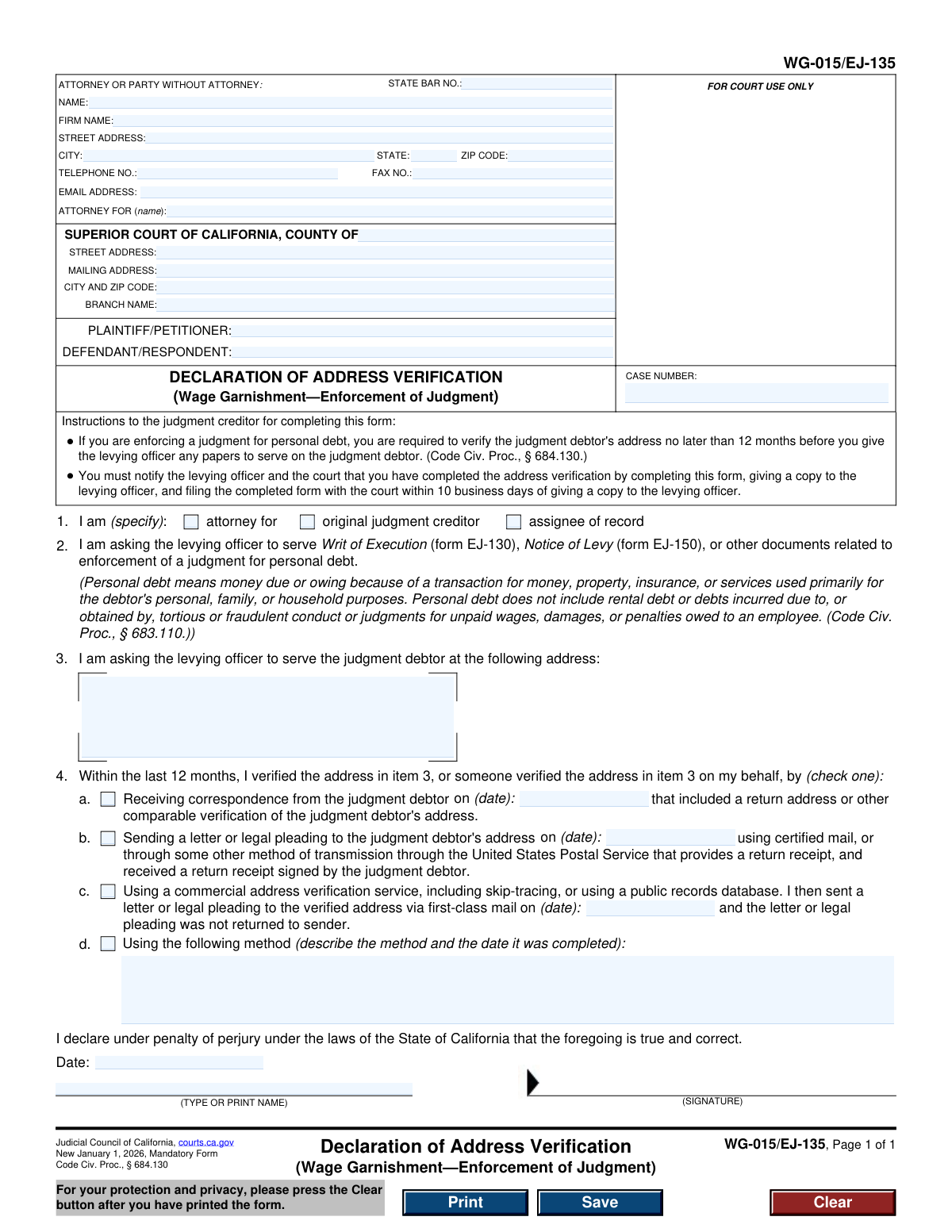
The Declaration of Address Verification (WG-015/EJ-135) is a mandatory California court form required when enforcing a judgment for personal debt. A judgment creditor must complete this form to certify, under penalty of perjury, that they have verified the judgment debtor's address within the preceding 12 months before a levying officer can serve wage garnishment documents. This process ensures proper legal notification to the debtor. Today, this form can be filled out quickly and accurately using AI-powered services like Instafill.ai, which can also convert non-fillable PDF versions into interactive fillable forms.
WG-015/EJ-135 is part of the
address verification forms, California court forms and judgment enforcement forms categories on Instafill.
Our AI automatically handles information lookup, data retrieval, formatting, and form filling.
It takes less than a minute to fill out WG-015/EJ-135 using our AI form filling.
Securely upload your data. Information is encrypted in transit and deleted immediately after the form is filled out.
Form specifications
| Form name: | Declaration of Address Verification (Wage Garnishment—Enforcement of Judgment) |
| Number of fields: | 36 |
| Number of pages: | 1 |
| Language: | English |
Instafill Demo: How to fill out PDF forms in seconds with AI
How to Fill Out WG-015/EJ-135 Online for Free in 2026
Are you looking to fill out a WG-015/EJ-135 form online quickly and accurately? Instafill.ai offers the #1 AI-powered PDF filling software of 2026, allowing you to complete your WG-015/EJ-135 form in just 37 seconds or less.
Follow these steps to fill out your WG-015/EJ-135 form online using Instafill.ai:
- 1 Navigate to Instafill.ai and upload or select the WG-015/EJ-135 form.
- 2 Provide your information as the attorney or party without an attorney, including name, firm, address, and state bar number.
- 3 Enter the specific court information, case number, and the names of the plaintiff/petitioner and defendant/respondent.
- 4 Indicate your status (e.g., attorney, original judgment creditor) and provide the judgment debtor's address that was verified.
- 5 Check the box corresponding to the method used for address verification (e.g., received correspondence, used a commercial service) and enter the date of verification.
- 6 Review all the information populated by the AI for accuracy, then type your name and date the form to declare its truthfulness under penalty of perjury.
- 7 Download the completed form to file with the court and provide a copy to the levying officer as required.
Our AI-powered system ensures each field is filled out correctly, reducing errors and saving you time.
Why Choose Instafill.ai for Your Fillable WG-015/EJ-135 Form?
Speed
Complete your WG-015/EJ-135 in as little as 37 seconds.
Up-to-Date
Always use the latest 2026 WG-015/EJ-135 form version.
Cost-effective
No need to hire expensive lawyers.
Accuracy
Our AI performs 10 compliance checks to ensure your form is error-free.
Security
Your personal information is protected with bank-level encryption.
Frequently Asked Questions About Form WG-015/EJ-135
This form is used by a judgment creditor to declare that they have recently verified the address of a judgment debtor. It is a mandatory step before asking a levying officer to serve wage garnishment papers for a personal debt.
The judgment creditor (the person or entity owed money) or their attorney must complete this form. It is required when attempting to enforce a judgment for a 'personal debt' through wage garnishment.
Personal debt is money owed from a transaction for personal, family, or household purposes, like a personal loan or credit card debt. It does not include rental debt, debts from fraud, or judgments for unpaid wages.
You must file this form with the court within 10 business days after giving a copy to the levying officer. The address verification itself must have occurred within the 12 months prior to giving the levying officer the service papers.
You can verify the address by receiving recent mail from the debtor, getting a signed return receipt from certified mail you sent, or using a commercial verification service and then sending a letter that is not returned. You must select the method you used on the form.
You will need the court case number, party names, the debtor's verified address, and the date and method of your address verification. You must also provide your own contact information as the filer.
You must give a copy of the completed form to the levying officer (e.g., the Sheriff's Department) and file the original signed form with the Superior Court where your case is being heard.
No, this declaration is specifically required for enforcing judgments on 'personal debt.' The form does not apply to judgments for unpaid wages, rental debt, or debts from fraudulent conduct.
Failure to file this declaration can cause the levying officer to refuse to serve your wage garnishment documents or lead to the court rejecting your enforcement action. It is a mandatory part of the process for personal debts.
Yes, services like Instafill.ai use AI to accurately auto-fill repetitive information like your name, address, and case details, which can save time and reduce errors. You are still responsible for the accuracy of all information entered.
Simply upload the WG-015/EJ-135 PDF to the Instafill.ai platform. The AI will make the document interactive, allowing you to type your information directly into the fields before printing or saving the completed form.
You can use a service like Instafill.ai, which converts flat, non-fillable PDFs into interactive forms. Just upload your document, and the platform will make the fields fillable online for your convenience.
The address verification must have been completed no more than 12 months before you give the enforcement papers, such as a Writ of Execution, to the levying officer for service.
Compliance WG-015/EJ-135
Validation Checks by Instafill.ai
1
Exclusive Declarer Role Selection
Validates that exactly one of the checkboxes in item 1 ('attorney for', 'original judgment creditor', 'assignee of record') is selected. This is crucial for establishing the legal standing of the person making the declaration. Failure to select one, or selecting multiple, makes the declaration ambiguous and legally insufficient.
2
Judgment Debtor Address Presence
Ensures that the address of the judgment debtor in item 3 is filled out. The entire purpose of this form is to declare the verification of this specific address for service. If this field is empty, the form is meaningless and cannot fulfill its legal function.
3
Exclusive Verification Method Selection
This check confirms that exactly one method of address verification (options a, b, c, or d) is selected in item 4. The law requires the creditor to specify how they verified the address. Submitting the form without this selection, or with multiple selections, fails to meet the statutory requirement and will be rejected.
4
Conditional Date for Selected Verification Method
Verifies that if verification method 'a', 'b', or 'c' is checked in item 4, the corresponding date field is filled with a valid date. The date provides evidence of when the verification occurred. Without a date, the claim of verification is unsubstantiated and the declaration is incomplete.
5
Required Description for 'Other' Verification Method
This validation ensures that if the 'Other method' checkbox 'd' is selected in item 4, the corresponding text box describing the method is not empty. The court needs to understand and evaluate the alternative method used for verification. An empty description makes this choice invalid.
6
Verification Date Within 12 Months
Checks that the date entered in item 4 is no more than 12 months prior to the date of signing or submission. The form explicitly states this legal requirement from Code of Civil Procedure § 684.130. A date older than 12 months makes the address verification stale and legally invalid for current enforcement actions.
7
Logical Signature Date
This validation confirms that the signature date is on or after the address verification date entered in item 4. A person cannot legally declare under penalty of perjury that an event has occurred before it has actually happened. This check prevents a logical and legal contradiction on the face of the document.
8
Case Number Presence
Checks that the Case Number field is not empty. This number is the primary identifier for the legal case and is essential for the clerk to file the document correctly. A missing case number will result in the document being rejected or misfiled.
9
Plaintiff and Defendant Names Presence
Ensures that the 'PLAINTIFF/PETITIONER' and 'DEFENDANT/RESPONDENT' fields are both filled in. These names are fundamental to identifying the specific legal case to which this declaration applies. Without them, the document cannot be correctly associated with the case file.
10
Signature Date and Printed Name Presence
Validates that the 'Date' and 'TYPE OR PRINT NAME' fields in the signature block are completed. A declaration made under penalty of perjury is legally invalid without a date and a clear identification of the declarant. Failure to provide this information nullifies the document's legal weight.
11
Attorney Information Consistency
If the 'attorney for' checkbox is selected in item 1, this check ensures the 'ATTORNEY FOR', 'NAME', and 'STATE BAR NO.' fields are filled. This confirms the identity and authority of the attorney filing the form on behalf of a client. Missing information would call the attorney's representation into question and could lead to rejection.
12
Court County Specification
This check ensures that the 'COUNTY OF' field is filled out to specify the Superior Court's county. This is a critical piece of information for routing the document to the correct court and jurisdiction. A missing county name would make it impossible to file the document correctly.
13
Valid Email Address Format
This check validates that the value entered in the 'EMAIL ADDRESS' field conforms to a standard email format (e.g., [email protected]). While not legally critical for the declaration itself, it is vital for court and party communications. An invalid email address can lead to missed notices and procedural delays.
14
Valid ZIP Code Format
Verifies that all ZIP code fields contain a valid 5-digit or 9-digit (ZIP+4) format. Correct ZIP codes are essential for mail delivery and correctly identifying geographic locations for both the court and the attorney. Incorrect formats can lead to returned mail and communication failures.
Common Mistakes in Completing WG-015/EJ-135
Users often miscopy the case number, misspell plaintiff or defendant names, or enter the wrong court branch information in the header. This typically happens due to simple transcription errors from other legal documents. An incorrect caption can lead to the declaration being rejected by the court clerk or misfiled, delaying the entire wage garnishment process. To prevent this, meticulously double-check all information against the official court record; AI-powered tools like Instafill.ai can also ensure accuracy by auto-populating caption information from previous filings.
The form requires the filer to check a box in Item 1 to specify their capacity as 'attorney for,' 'original judgment creditor,' or 'assignee of record.' Forgetting to select a role is a common oversight that leaves the declarant's authority ambiguous. This omission can cause the court to reject the form, as it is unclear who is making the declaration under penalty of perjury. Always review the form to ensure one, and only one, box is checked to clearly establish your standing.
A critical error is entering an old address for the judgment debtor in Item 3 without performing the required recent verification. The entire purpose of this form is to attest to a *current* address verified within the last 12 months. Using an old address invalidates the declaration, leads to failed service attempts by the levying officer, and wastes significant time and money. The address in Item 3 must be the exact one verified using one of the methods described in Item 4.
In Item 4, options 'a,' 'b,' and 'c' each require a corresponding date to show when the verification occurred. Filers frequently check the box for the method used but forget to fill in the date. Since the law requires verification within the last 12 months, a missing date makes it impossible for the court to confirm compliance, which will almost certainly lead to the form's rejection and halt the enforcement action.
When selecting option 4d ('Using the following method'), filers must provide a detailed description of how the address was verified. A common mistake is to write a vague or conclusory statement like 'confirmed with debtor.' This is insufficient and can cause the declaration to be rejected. The description must be specific enough for the court to understand that a valid verification took place, including the method used and the date it was completed.
The form and underlying law (Code Civ. Proc., § 684.130) explicitly require that the address verification took place no more than 12 months before giving papers to the levying officer. Filers sometimes mistakenly enter a date from an earlier stage of the case that falls outside this 12-month window. This makes the declaration invalid on its face and will result in its rejection, forcing the creditor to re-verify the address and start the process over.
A declaration made 'under penalty of perjury' has no legal effect without a signature and the date it was signed. In the rush to file, people often print their name but forget to sign, or they leave the date field blank. An unsigned or undated form will be immediately rejected by the court clerk, bringing the enforcement process to a halt. Always perform a final check for a valid signature and the current date before filing.
The instructions clearly state that this declaration must be filed with the court within 10 business days of giving a copy to the levying officer. Many filers overlook this procedural deadline, assuming the form only needs to be provided to the officer. Missing this filing deadline can jeopardize the validity of the service and may require the creditor to restart the process, causing significant delays and additional costs.
This form is specifically for enforcing judgments on 'personal debt,' which excludes certain types like rental debt or judgments for unpaid wages owed to an employee. A creditor might mistakenly use this form for a non-qualifying debt, which is an improper use of the procedure. This error could lead to a legal challenge from the debtor and the potential dismissal of the wage garnishment action. It is crucial to read the definition in Item 2 carefully before proceeding.
While a filer may have used several ways to confirm an address, the form's layout implies selecting the single method being declared. Checking multiple boxes in Item 4 (e.g., both 4a and 4c) can create ambiguity and may lead to the form being returned by the clerk for clarification. To avoid this, you should choose the single strongest and most recent method of verification you are relying on and check only that corresponding box.
The form's header contains separate, distinct blocks for the filer's address and the court's address. A common data entry error is to accidentally input the filer's firm information into the court address fields. This looks unprofessional and can cause confusion or misdirection of court correspondence. Since this form is a non-fillable PDF, using a tool like Instafill.ai to convert it into an intelligent, fillable version can help prevent this by clearly labeling fields and reducing manual entry errors.
Saved over 80 hours a year
“I was never sure if my IRS forms like W-9 were filled correctly. Now, I can complete the forms accurately without any external help.”
Kevin Martin Green
Your data stays secure with advanced protection from Instafill and our subprocessors

Robust compliance program
Transparent business model
You’re not the product. You always know where your data is and what it is processed for.
ISO 27001, HIPAA, and GDPR
Our subprocesses adhere to multiple compliance standards, including but not limited to ISO 27001, HIPAA, and GDPR.
Security & privacy by design
We consider security and privacy from the initial design phase of any new service or functionality. It’s not an afterthought, it’s built-in, including support for two-factor authentication (2FA) to further protect your account.
Fill out WG-015/EJ-135 with Instafill.ai
Worried about filling PDFs wrong? Instafill securely fills declaration-of-address-verification-wage-garnishmentenforcement-of-judgment forms, ensuring each field is accurate.