Fill out AOPC forms
with AI.
The Administrative Office of Pennsylvania Courts (AOPC) provides a standardized set of forms designed to streamline legal proceedings across the Commonwealth’s judicial system. These Pennsylvania court forms are essential for maintaining procedural consistency, ensuring that every filing meets the specific requirements of the Magisterial District Courts. By using these official documents, individuals can clearly communicate their legal claims or financial circumstances to the court, which is a critical step in any civil matter.
By continuing, you acknowledge Instafill's Privacy Policy and agree to get occasional product update and promotional emails.
About AOPC forms
Typically, these forms are used by plaintiffs seeking to initiate a lawsuit or by defendants responding to one. For instance, someone looking to recover damages in a dispute would utilize a civil complaint form, while those experiencing financial hardship might file an In Forma Pauperis Affidavit to request a waiver of court fees. Because these documents require precise personal and financial disclosures, they are used by anyone from self-represented litigants to legal professionals to ensure their cases are processed without administrative delays. Tools like Instafill.ai use AI to fill these AOPC forms in under 30 seconds, handling the data accurately and securely to simplify the preparation process.
Every form on this page can be completed without typing. Instafill is form filling software that reads a PDF and fills it for you — including flat and scanned documents that carry no fillable fields at all.
Forms in This Category
The forms in this category have a median Form Complexity Index of 76/100 (Complex), measured across 3 forms by field count, input difficulty, length, conditional logic and structure. See how it is calculated.
| Form Name | Pages | FCI | |
|---|---|---|---|
| 1. | AOPC 308A, Civil Complaint | 1 | Moderate 51 |
| 2. | In Forma Pauperis Affidavit Petition (AOPC 622A) — Pennsylvania Magisterial District Court | 7 | Complex 76 |
| 3. | In Forma Pauperis Affidavit/Petition (AOPC 622A) – Pennsylvania Magisterial District Court | 7 | Complex 78 |
- Enterprise-grade security & data encryption
- 99%+ accuracy powered by AI
- 1,000+ forms from all industries
- Complete forms in under 60 seconds
How to Choose the Right Form
Navigating the Pennsylvania Magisterial District Court system requires specific documentation depending on whether you are initiating a lawsuit or seeking relief from court costs. These AOPC (Administrative Office of Pennsylvania Courts) forms are the standard tools for civil litigation in the Commonwealth.
Starting a Legal Action
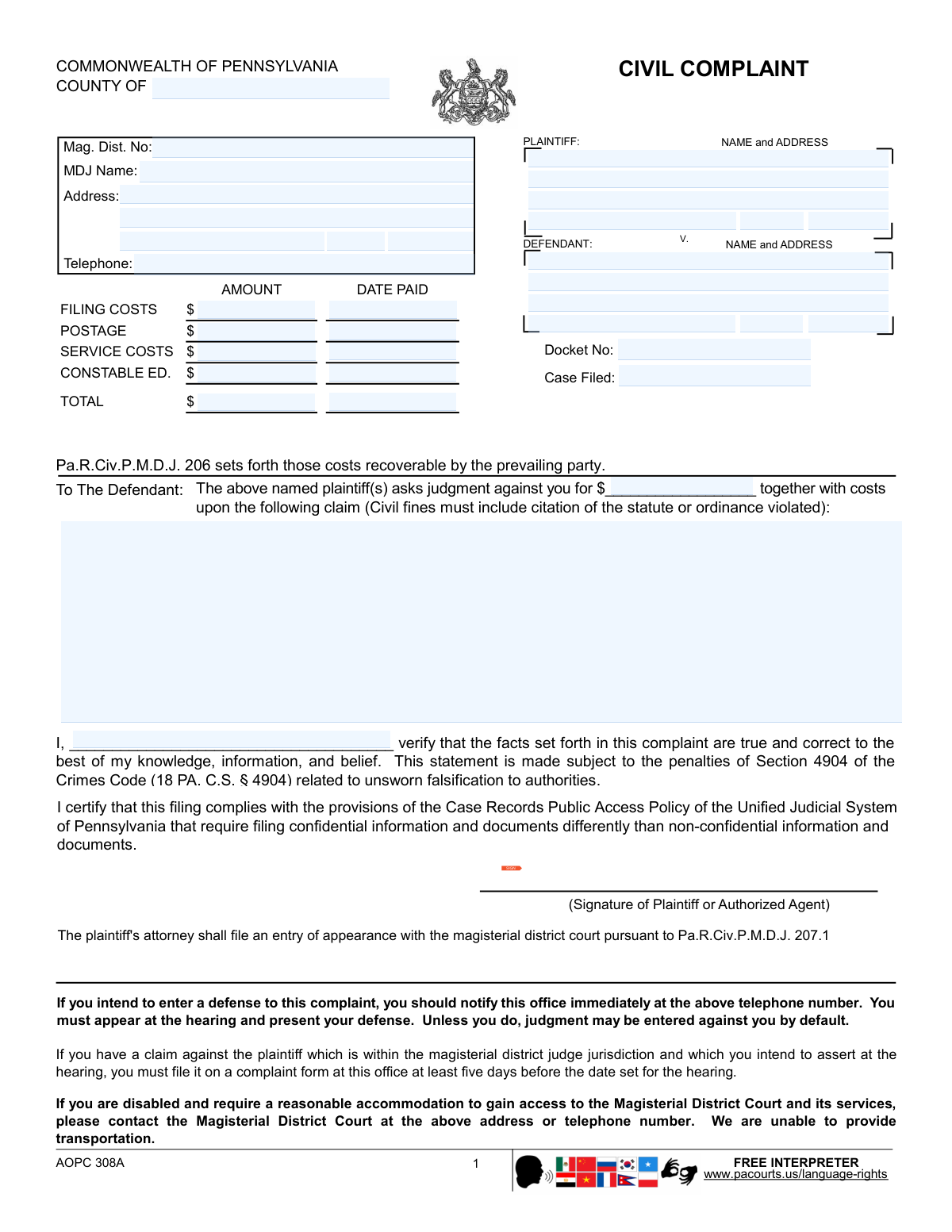
If you are the plaintiff and wish to begin a lawsuit against an individual or business, you need the AOPC 308A, Civil Complaint. This is the foundational document for Magisterial District Court cases. You should choose this form if you need to:
- Outline a claim for damages or money owed.
- Identify the defendant and provide the court with the facts of your dispute.
- Specify the exact amount of money you are seeking to recover.
Requesting a Fee Waiver
Court proceedings involve filing fees that can be a barrier for some individuals. If you are unable to pay these costs due to financial hardship, you should use the In Forma Pauperis Affidavit Petition (AOPC 622A). This form acts as a formal request to the judge to waive filing fees. You will need this form if:
- Your household income is below certain thresholds.
- You lack the assets or property to cover the cost of starting or continuing a case.
- You can provide detailed disclosures about your employment, debts, and dependents.
Which Form Do You Need Right Now?
- To Sue Someone: Start with the AOPC 308A, Civil Complaint. This is the primary form for most civil court interactions at this level.
- To Save on Filing Costs: If you are the one filing the complaint but cannot afford the fee, you must fill out both the AOPC 308A and the In Forma Pauperis Affidavit Petition (AOPC 622A) simultaneously.
- To Respond to a Financial Inquiry: If the court has asked for proof of your financial status to determine your eligibility for legal aid or fee waivers, use the AOPC 622A.
Form Comparison
| Form | Primary Purpose | Who Files It | Key Information Required |
|---|---|---|---|
| AOPC 308A, Civil Complaint | To initiate a legal action against a defendant in Magisterial District Court. | A plaintiff seeking monetary damages or a specific legal remedy. | Details of the claim and the specific amount of damages being sought. |
| In Forma Pauperis Affidavit Petition (AOPC 622A) | To request a waiver of court filing fees due to financial hardship. | Low-income plaintiffs or petitioners who cannot afford standard court costs. | Comprehensive disclosure of employment, income, assets, debts, and household dependents. |
| In Forma Pauperis Affidavit/Petition (AOPC 622A) – Pennsylvania Magisterial District Court | A sworn application to proceed in court without paying required filing fees. | Individuals seeking court access who meet specific financial eligibility criteria. | A detailed financial statement verified under penalty of law regarding income and property. |
Tips for AOPC forms
Ensure all party names and contact details are exactly correct on your Civil Complaint. Errors in the defendant's address can lead to the complaint being dismissed or delayed because the court cannot properly serve the legal papers.
On Form 308A, do not just list a total dollar amount; briefly explain the basis for the debt or damage. Providing a concise, chronological summary of the dispute helps the Magisterial District Judge understand your case during the initial review.
When filing Form 622A, have your income, debt, and asset information ready before you start filling out the document. Since this is a sworn affidavit, accuracy is vital to ensure your fee waiver is approved and to avoid penalties for false statements.
AI-powered tools like Instafill.ai can complete these complex Pennsylvania court forms in under 30 seconds with high accuracy. Your data stays secure during the process, providing a massive time-saving benefit for those who need to file multiple court documents efficiently.
Before filing your Civil Complaint, confirm which specific district has jurisdiction over your case, typically based on where the defendant resides or where the incident occurred. Filing in the wrong district can result in your case being transferred or dismissed, wasting valuable time.
Always keep a dated copy of every form you submit to the court, including the IFP petition and the complaint itself. Having an organized digital or physical file helps you track deadlines and provides a reference for your hearing date.
Frequently Asked Questions
AOPC forms are standardized legal documents provided by the Administrative Office of Pennsylvania Courts for use in the state's judicial system. These forms ensure that filings in Magisterial District Courts are uniform and contain all the information required by Pennsylvania law to process a case.
To initiate a legal action for money damages in a Pennsylvania Magisterial District Court, you should use the AOPC 308A Civil Complaint form. This document allows you to identify the parties involved and state the specific reasons and factual basis for your claim.
If you are experiencing financial hardship, you can file the AOPC 622A In Forma Pauperis Affidavit Petition. This form requests the court to waive the standard filing fees based on a detailed assessment of your income, assets, and overall financial situation.
Yes, AI-powered tools like Instafill.ai can be used to fill out AOPC forms quickly and accurately. These tools can extract data from your source documents and place it directly into the correct fields of the PDF, reducing the risk of manual entry errors.
While manual entry can be time-consuming, using AI technology significantly speeds up the process. Platforms like Instafill.ai can often complete these forms in under 30 seconds by accurately extracting and placing data from your source documents into the form fields.
The AOPC 622A form requires disclosures regarding your employment status, monthly income, household contributions, and any property or assets you own. You must also list your debts and dependents so the judge can accurately assess your eligibility for a fee waiver.
These forms are generally filed at the Magisterial District Court that has jurisdiction over the area where the incident occurred or where the defendant resides. It is important to confirm the correct district office before submitting your paperwork to ensure it is processed by the right court.
You are not required to have an attorney and can file these forms 'pro se,' meaning you are representing yourself. However, because these are legal documents with binding consequences, many people choose to consult with a legal professional for complex cases.
Once the complaint is filed and the fee is paid or waived, the court will typically serve the defendant with a copy of the complaint. A hearing date will eventually be scheduled where both parties can present evidence and testimony before a Magisterial District Judge.
Yes, forms like the In Forma Pauperis petition are sworn affidavits signed under penalty of perjury. Providing false information about your finances or the facts of a case can lead to legal penalties under Pennsylvania law, including charges related to unsworn falsification to authorities.
Magisterial District Courts in Pennsylvania generally handle civil claims where the amount in dispute is below a specific dollar threshold, often referred to as 'small claims.' If your claim exceeds this limit, you may need to file in the Court of Common Pleas using different forms.
Glossary
- Form Complexity Index
- Instafill’s 0–100 measure of how much effort a form takes to complete, calculated deterministically from the form’s own structure rather than estimated. It combines the number of fillable fields (the largest factor), how difficult those fields are to complete based on their type, the number of pages that contain fields, the amount of conditional “fill-only-if” logic, and how many sections the form is divided into, then adds modifiers for tables and repeating lists, bundled instruction pages, and dense page layouts. A higher score means the form is harder to fill out by hand. The forms in this category have a median Form Complexity Index of 76/100 (Complex). See exactly how it is calculated.
- AOPC
- The Administrative Office of Pennsylvania Courts, the agency that provides administrative support and standardized legal forms for the state's judicial system.
- Magisterial District Court
- The first level of the Pennsylvania court system, which handles small civil claims, landlord-tenant disputes, and minor criminal matters.
- In Forma Pauperis
- A Latin term meaning 'in the character of a pauper,' referring to a request to have court filing fees waived due to the petitioner's financial hardship.
- Plaintiff
- The individual or business entity that initiates a lawsuit by filing a civil complaint against another party.
- Defendant
- The person or entity being sued in a civil case who must respond to the allegations in the complaint.
- Affidavit
- A written statement of facts confirmed by the oath or affirmation of the person making it, used as evidence in court proceedings.
- Petitioner
- The party who submits a formal written request, such as a petition for a fee waiver, to the court for a specific judicial action.
- Unsworn Falsification to Authorities
- A criminal offense under Pennsylvania law (18 Pa. C.S. § 4904) involving the submission of false written statements on official government forms.