Fill out Arkansas Medicaid forms
with AI.
Arkansas Medicaid forms cover a wide range of administrative and clinical documentation required to access, authorize, and coordinate services for Medicaid-enrolled members across the state. These forms are essential for ensuring that healthcare services — particularly specialized treatments like behavioral health therapies — are properly reviewed, approved, and documented before care is delivered. Prior authorization forms, in particular, play a critical role in confirming medical necessity and aligning care with Medicaid coverage guidelines.
By continuing, you acknowledge Instafill's Privacy Policy and agree to get occasional product update and promotional emails.
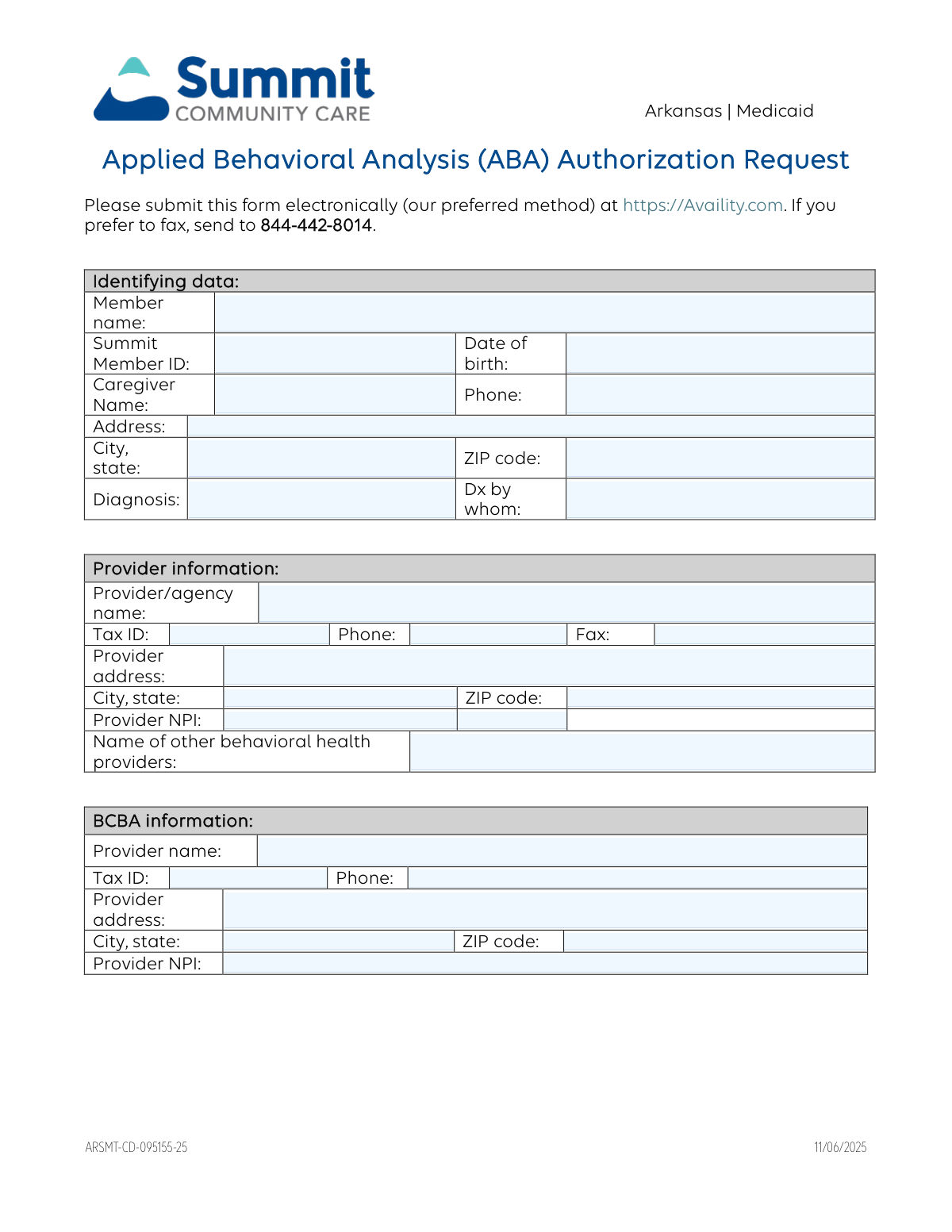
About Arkansas Medicaid forms
The providers and families who typically need these forms include behavioral health clinicians, Board Certified Behavior Analysts (BCBAs), and care coordinators seeking approval for services such as Applied Behavioral Analysis (ABA) therapy for individuals with autism spectrum disorder. These requests require detailed clinical information — including diagnoses, treatment goals, functional assessments, and specific service codes — making accuracy and completeness especially important. Errors or omissions can delay authorization and, ultimately, delay care for vulnerable patients.
Given the level of detail these forms require, tools like Instafill.ai use AI to fill them out in under 30 seconds, reducing the administrative burden on providers while helping ensure the information entered is accurate and complete.
Every form on this page can be completed without typing. Instafill is form filling software that reads a PDF and fills it for you — including flat and scanned documents that carry no fillable fields at all.
Forms in This Category
The forms in this category have a median Form Complexity Index of 59/100 (Moderate), measured across 2 forms by field count, input difficulty, length, conditional logic and structure. See how it is calculated.
| Form Name | Pages | FCI | |
|---|---|---|---|
| 1. | Arkansas Medicaid Applied Behavioral Analysis (ABA) Authorization Request | 6 | Moderate 59 |
| 2. | Arkansas Medicaid Provider Application Packet (DMS-652) | 1 | – |
- Enterprise-grade security & data encryption
- 99%+ accuracy powered by AI
- 1,000+ forms from all industries
- Complete forms in under 60 seconds
How to Choose the Right Form
With one specialized form currently available in this category, finding what you need is straightforward — but understanding *when* and *why* to use it is key.
For ABA Therapy Prior Authorization
The Arkansas Medicaid Applied Behavioral Analysis (ABA) Authorization Request is the form you need if:
- You are a BCBA or behavioral health provider seeking prior authorization for ABA therapy services
- Your patient is enrolled in Arkansas Medicaid and covered through Summit Community Care
- You are requesting services under codes 97151, 97153, 97155, or 97156 (assessment, therapy, supervision, or caregiver training)
- You need to document DSM-V diagnoses, treatment goals, behavior reduction plans, or functional assessment results to justify medical necessity
Who Fills Out This Form?
- BCBAs and supervising providers complete the clinical sections (diagnoses, treatment plans, service hours)
- Billing or administrative staff may handle provider NPI numbers, member IDs, and authorization codes
- Primary Care Physicians (PCPs) may need to provide supporting information referenced in the form
Before You Start
Have the following ready to complete the form accurately:
- Member's Medicaid ID and demographic details
- DSM-V diagnosis codes and current medication list
- Functional assessment results and behavior reduction plan
- Specific service codes and the number of hours/units being requested
Tips for Faster Completion
This form can be dense and clinically detailed. Using an AI-powered tool like Instafill.ai can help you fill it out quickly and accurately — especially useful if you received a non-fillable PDF version, which Instafill can convert into an interactive form.
If you are unsure whether this form applies to your situation, contact Summit Community Care directly to confirm authorization requirements before submitting.
Form Comparison
| Form | Purpose | Who Files It | When to Use |
|---|---|---|---|
| Arkansas Medicaid Applied Behavioral Analysis (ABA) Authorization Request | Request prior authorization for ABA therapy services | Behavioral health providers and BCBAs | Before rendering ABA services to Medicaid members |
Tips for Arkansas Medicaid forms
Before filling out the ABA Authorization Request, collect the member's Medicaid ID, date of birth, and current DSM-V diagnosis codes. Having this information ready upfront prevents delays and reduces the chance of submitting an incomplete form that gets rejected.
The form requires accurate NPI numbers, provider names, and BCBA certification details. Even a small error in these fields can cause authorization denials, so verify all credentialing information against your official records before submission.
Vague or generic treatment goal descriptions are a common reason ABA prior authorizations get denied. Clearly tie each goal to functional outcomes and reference your functional assessment results to demonstrate medical necessity.
The form covers multiple CPT codes (97151, 97153, 97155, 97156) — only request authorization for the specific services your treatment plan requires. Over-requesting or under-requesting hours can complicate approvals and disrupt service delivery.
AI-powered tools like Instafill.ai can fill out the Arkansas Medicaid ABA Authorization Request in under 30 seconds with high accuracy, making it a real time-saver when managing multiple client authorizations. Your data stays secure throughout the process, so you can focus on patient care rather than paperwork.
Always save a completed copy of each authorization request before submitting it to Summit Community Care. This protects you if questions arise about the requested units, dates, or clinical justification during the review process.
The number of hours and units you request should be directly supported by your functional assessment findings and behavior reduction plan. Mismatches between requested hours and documented clinical need are a frequent cause of authorization delays.
The form requires the member's Primary Care Provider (PCP) details, which can change when members switch plans or update their Medicaid information. Confirm PCP details with the member or through the Medicaid portal before submitting to avoid processing issues.
Frequently Asked Questions
The Arkansas Medicaid Applied Behavioral Analysis (ABA) Authorization Request form is used by behavioral health providers and Board Certified Behavior Analysts (BCBAs) to request prior authorization for ABA therapy services. It ensures that services are medically necessary and clinically justified before they are rendered to Medicaid-enrolled members.
Behavioral health providers and BCBAs who plan to deliver ABA therapy services to Arkansas Medicaid members are required to submit this authorization request. The form must be completed before services begin to ensure proper coordination and coverage through Summit Community Care.
The completed ABA Authorization Request is submitted to Summit Community Care, the managed care organization responsible for coordinating behavioral health services for Arkansas Medicaid members. Providers should follow Summit Community Care's submission guidelines to ensure timely processing.
The form requires member identifying information, provider and BCBA details, primary care physician (PCP) information, DSM-V diagnoses, current medications, treatment goals, behavior reduction plans, and functional assessment results. Specific service authorization codes such as 97151, 97153, 97155, and 97156 must also be included along with requested hours and units.
Yes, the ABA Authorization Request requires providers to document the member's DSM-V diagnosis as part of demonstrating medical necessity for ABA therapy services. This clinical information helps reviewers determine whether the requested services are appropriate and justified.
Generally, prior authorization must be obtained before ABA services are rendered to ensure Medicaid coverage. Providing services without an approved authorization may result in denied claims, so it is important to submit the request and receive approval in advance.
The ABA Authorization Request covers service codes 97151 (behavior identification assessment), 97153 (adaptive behavior treatment), 97155 (adaptive behavior treatment with protocol modification), and 97156 (family adaptive behavior treatment guidance). Providers must specify the number of hours and units requested for each applicable code.
Providers typically need to submit renewal authorization requests periodically to continue ABA therapy services for Medicaid members. The frequency of reauthorization depends on Summit Community Care's policies and the member's treatment plan, so providers should check current guidelines for specific timeframes.
Yes, AI-powered tools like Instafill.ai can fill out the Arkansas Medicaid ABA Authorization Request accurately in under 30 seconds by extracting and placing data from source documents. Instafill.ai can also convert non-fillable PDF versions of the form into interactive, fillable formats, making the process faster and reducing the risk of errors.
Manually completing the ABA Authorization Request can take significant time due to the volume of clinical and administrative information required. Using AI tools like Instafill.ai, the form can be populated accurately in under 30 seconds, streamlining the prior authorization process for busy behavioral health providers.
After submission, Summit Community Care reviews the request to determine whether the proposed ABA services meet medical necessity criteria. Providers will receive an authorization decision, and approved requests will specify the authorized service codes, hours, and duration of coverage.
Yes, the form requires providers to include functional assessment results as part of the clinical justification for ABA services. These assessments help demonstrate the member's behavioral needs and support the development of individualized treatment goals and behavior reduction plans.
Glossary
- Form Complexity Index
- Instafill’s 0–100 measure of how much effort a form takes to complete, calculated deterministically from the form’s own structure rather than estimated. It combines the number of fillable fields (the largest factor), how difficult those fields are to complete based on their type, the number of pages that contain fields, the amount of conditional “fill-only-if” logic, and how many sections the form is divided into, then adds modifiers for tables and repeating lists, bundled instruction pages, and dense page layouts. A higher score means the form is harder to fill out by hand. The forms in this category have a median Form Complexity Index of 59/100 (Moderate). See exactly how it is calculated.
- Prior Authorization (PA)
- Approval required from Arkansas Medicaid or a managed care organization before certain services can be rendered and reimbursed. Without prior authorization, providers may not be paid for the services they deliver.
- Applied Behavioral Analysis (ABA)
- A therapy based on the science of learning and behavior, commonly used to treat autism spectrum disorder (ASD) by reinforcing positive behaviors and reducing harmful ones. ABA services require prior authorization under Arkansas Medicaid.
- BCBA (Board Certified Behavior Analyst)
- A credentialed professional who designs, oversees, and supervises ABA therapy programs. Arkansas Medicaid requires BCBA information on ABA authorization requests to verify clinical oversight of the treatment plan.
- Summit Community Care
- A managed care organization (MCO) that administers Arkansas Medicaid behavioral health benefits for enrolled members. Providers submit ABA authorization requests directly to Summit Community Care for review and approval.
- DSM-V Diagnosis
- A psychiatric diagnosis classified according to the fifth edition of the Diagnostic and Statistical Manual of Mental Disorders. Medicaid authorization requests for ABA therapy require a DSM-V diagnosis code (such as autism spectrum disorder) to establish medical necessity.
- Functional Behavior Assessment (FBA)
- A clinical evaluation process used to identify the causes and triggers of a patient's challenging behaviors. Results from an FBA are typically required on ABA authorization forms to justify the proposed treatment plan.
- Service Authorization Codes (CPT Codes)
- Standardized numeric codes (e.g., 97151, 97153, 97155, 97156) used to identify specific ABA therapy services being requested. Each code corresponds to a particular type of service, such as assessments or direct treatment sessions.
- Medical Necessity
- A clinical standard that Medicaid uses to determine whether a requested service is appropriate, reasonable, and required to treat a member's condition. Authorization requests must demonstrate medical necessity to be approved.
- PCP (Primary Care Provider)
- The physician or healthcare provider responsible for coordinating a Medicaid member's overall medical care. ABA authorization forms often require PCP information to ensure treatment is properly coordinated across providers.
- Behavior Reduction Plan
- A documented clinical strategy outlining specific interventions designed to decrease harmful or disruptive behaviors in a patient receiving ABA therapy. This plan is submitted as part of the authorization request to demonstrate clinical justification for the services.