Fill out bank authorization forms
with AI.
Bank authorization forms serve as the legal bridge between your financial accounts, allowing for the secure and automated movement of funds. These documents are essential for establishing trust and providing clear instructions to financial institutions or employers regarding how and when money should be transferred. By formalizing permissions for transactions like ACH agreements or bank wires, these forms help prevent unauthorized access while ensuring that recurring or one-time payments are executed without administrative delays.
By continuing, you acknowledge Instafill's Privacy Policy and agree to get occasional product update and promotional emails.
About bank authorization forms
Typically, these forms are required during major life transitions or routine administrative setups. For instance, new employees use direct deposit authorization forms to link their payroll to a personal bank account, while investors often need wire authorization documents to move capital between brokerage accounts and external banks. Because these forms require precise details like routing numbers and account identifiers, accuracy is paramount to avoid failed transfers or frozen assets.
Completing these technical documents manually can be time-consuming and prone to errors. Tools like Instafill.ai use AI to fill these forms in under 30 seconds, handling your data accurately and securely to ensure every field is correctly addressed. This approach simplifies the paperwork process, allowing you to finalize banking instructions quickly so you can focus on managing your finances.
Every form on this page can be completed without typing. Instafill is form filling software that reads a PDF and fills it for you — including flat and scanned documents that carry no fillable fields at all.
Forms in This Category
The forms in this category have a median Form Complexity Index of 38/100 (Basic), measured across 5 forms by field count, input difficulty, length, conditional logic and structure. See how it is calculated.
| Form Name | Pages | FCI | |
|---|---|---|---|
| 1. | ACH Authorization Agreement | 1 | Basic 38 |
| 2. | Authorization to transfer funds from a bank retirement account | 1 | Simple 24 |
| 3. | Employee Direct Deposit Banking Authorization Form (RUN Powered by ADP®) | 1 | Basic 33 |
| 4. | Fidelity Bank Wire Authorization | 3 | Basic 39 |
| 5. | Fidelity Bank Wire Authorization | 3 | Basic 39 |
- Enterprise-grade security & data encryption
- 99%+ accuracy powered by AI
- 1,000+ forms from all industries
- Complete forms in under 60 seconds
How to Choose the Right Form
Bank authorization forms are essential tools for automating the movement of money between financial institutions, whether you are setting up your paycheck or managing investment capital. To find the right document, identify the specific financial institution involved and the method of transfer you require.
Payroll and Direct Deposit
If you are an employee looking to receive your wages electronically, you need a payroll-specific authorization.
- Employee Direct Deposit Banking Authorization Form (RUN Powered by ADP®): Use this form if your company utilizes ADP for payroll. It allows your employer to send credit entries directly to your checking or savings account, eliminating the need for physical checks.
Investment and Brokerage Transfers
When moving funds between a brokerage account and a personal bank account, the choice of form depends on the institution and the speed of the transfer:
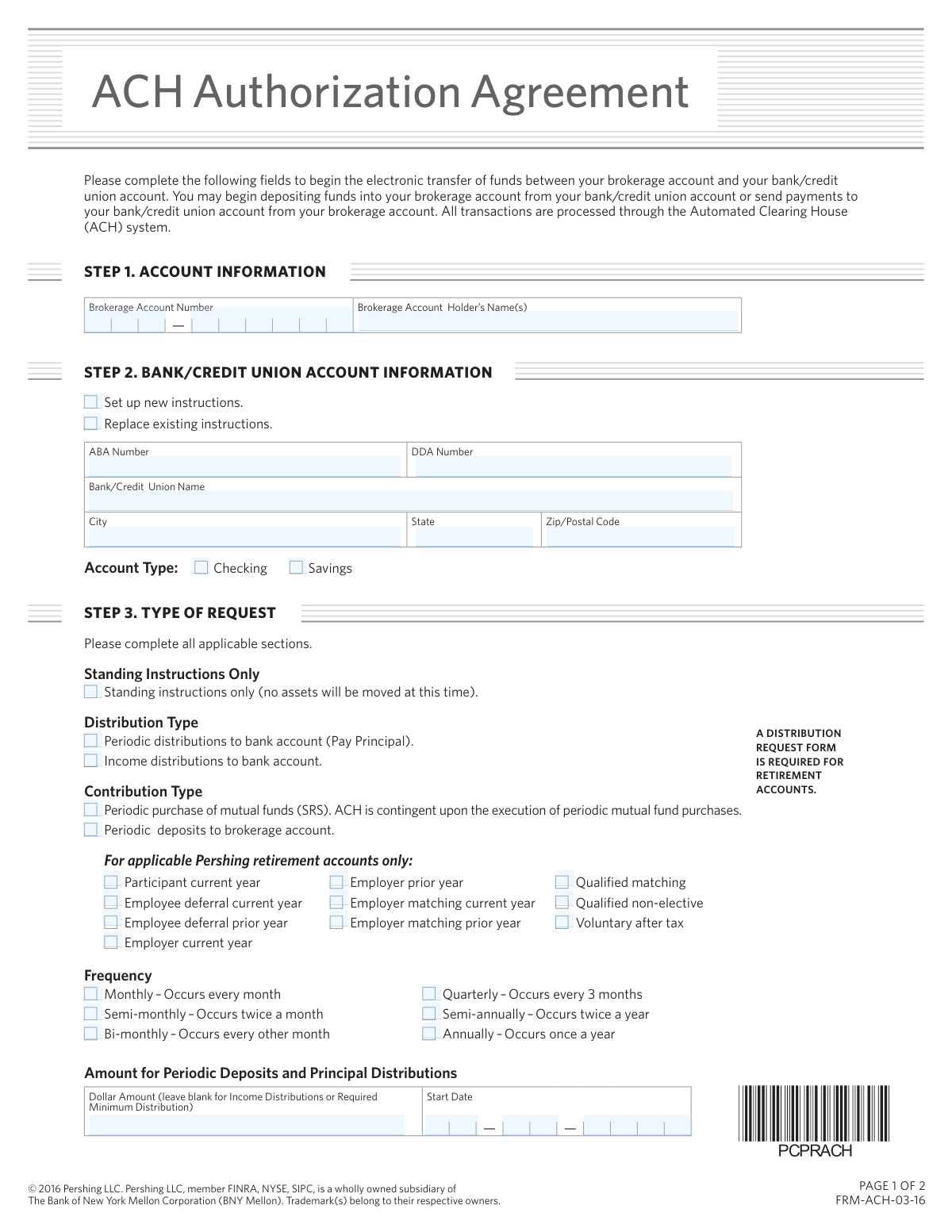
- ACH Authorization Agreement: Choose this form for Pershing LLC brokerage accounts. It is designed for setting up standing instructions for bidirectional (two-way) fund transfers via the Automated Clearing House (ACH) network.
- Fidelity Bank Wire Authorization: If you hold a Fidelity account, use this form to authorize high-value or urgent transfers. Note that there are several versions of the Fidelity Bank Wire Authorization Form, which are used to establish standing instructions for wires to your own account or a third party. Be aware that these often require a Medallion signature guarantee for security.
Retirement Account Consolidation
Transferring retirement assets requires specific documentation to ensure the move is handled correctly for tax purposes.
- Authorization to transfer funds from a bank retirement account: Use this specific document if you are moving retirement assets from a Bank of America IRA to a Merrill IRA. This form is critical for consolidating accounts under the Merrill platform and specifies how assets should be liquidated or moved.
Choosing Between ACH and Wire
When selecting a form, remember that ACH transfers (like the Pershing agreement) are typically used for recurring, non-urgent transfers, while Wire transfers (like the Fidelity forms) are intended for same-day, high-priority movements that may involve transaction fees.
Form Comparison
| Form | Primary Purpose | Transaction Type | Key Requirement |
|---|---|---|---|
| ACH Authorization Agreement | Link brokerage and bank accounts for seamless fund transfers | Automated ACH credit and debit transactions | Bank account details for standing instructions |
| Authorization to transfer funds from a bank retirement account | Consolidate retirement assets from Bank of America to Merrill | Direct IRA asset transfer or liquidation | Account details for both financial institutions |
| Employee Direct Deposit Banking Authorization Form (RUN Powered by ADP®) | Authorize employer to pay wages directly into bank accounts | Payroll direct deposit for employee wages | Completed payroll setup via RUN Powered by ADP |
| Fidelity Bank Wire Authorization | Establish pre-approved instructions for urgent external wire transfers | High-value external bank wire transfers | Verified destination bank account information |
| Fidelity Bank Wire Authorization | Authorize recurring wires to personal or third-party accounts | External bank wire transfers | Medallion signature guarantee for enhanced security |
| Fidelity Bank Wire Authorization Form | Set up standing wire instructions for eligible Fidelity accounts | Bank wire (potential IRA distribution) | Medallion signature and awareness of IRS reporting |
Tips for bank authorization forms
Mistyping a single digit in your routing or account number can lead to failed transfers or funds being sent to the wrong destination. Always double-check these numbers against your bank statement or a digital banking portal before finalizing any authorization form.
Managing multiple bank authorization forms can be tedious, but AI-powered tools like Instafill.ai can complete these documents in under 30 seconds with high accuracy. Your sensitive financial data stays secure throughout the process, allowing you to generate professional, error-free forms instantly.
Many institutions require a voided check or a bank verification letter to confirm the account details provided on the form. Having a digital scan of these documents ready will prevent delays in processing your ACH or direct deposit setup.
High-value transfers or retirement account movements often require a Medallion signature guarantee rather than a standard notary or electronic signature. Review the form instructions early to see if you need to visit a physical bank branch for this specific type of verification.
When submitting new banking information for payroll, check with your employer regarding their cutoff dates for the upcoming pay period. Submitting the form too late in the cycle may result in your next paycheck being issued via the old method or as a physical check.
Ensure you are using the correct form for your needs, as ACH transfers are typically for recurring payments like payroll, while wire transfers are for urgent, high-value transactions. Using the wrong authorization form can lead to unexpected fees or longer processing times from your financial institution.
Frequently Asked Questions
Bank authorization forms provide legal permission for a third party, such as an employer or a financial institution, to move funds into or out of your bank account. These forms are essential for establishing recurring transactions like payroll direct deposits, monthly bill payments, or automated transfers between investment and checking accounts. Without a signed authorization, banks cannot legally process these electronic transfers on your behalf.
The choice depends on the speed and cost requirements of your transaction. ACH authorizations are typically used for routine, non-urgent transfers like payroll or standard bank-to-bank links and usually take one to three business days to clear. Wire transfer forms are used for high-value or urgent transfers that need to be completed within the same business day, though they often involve higher service fees from the sending bank.
Yes, AI-powered tools like Instafill.ai allow you to complete these forms with high precision and minimal effort. These tools can accurately extract your banking data from source documents and place it directly into the correct fields on the PDF form. This significantly reduces the risk of manual entry errors, which is critical when handling sensitive information like routing and account numbers.
Most bank authorization forms require your full name, the name of your financial institution, your account number, and your bank's 9-digit routing number. Depending on the form, you may also need to specify the account type, such as checking or savings, and provide your employer's details or brokerage account number. Having a voided check or an account statement handy can help you verify these details quickly.
Using AI tools like Instafill.ai, you can complete most bank authorization forms in under 30 seconds. The AI automates the data entry process by identifying required fields and populating them with information from your existing documents. This makes the process much faster than manual typing and helps ensure that all required sections are addressed before you submit the form.
No, a Medallion Signature Guarantee is only required for specific high-security transactions, such as transferring large sums from brokerage accounts or moving retirement assets. This is a special certification that confirms the authenticity of your signature and your legal authority to move the funds. Standard employee direct deposit forms and simple ACH links generally do not require this level of verification.
Retirement account transfers, such as moving funds from a Bank of America IRA to a Merrill IRA, require specific forms to ensure the transaction complies with IRS regulations. These forms specify how the assets should be liquidated and transferred to avoid accidental tax penalties or early withdrawal fees. They also provide the necessary documentation to maintain the tax-advantaged status of the funds during the move.
Submission instructions vary depending on the purpose of the form. Employee direct deposit forms should be submitted to your company's HR or payroll department, while brokerage or wire forms are typically sent to the financial institution managing the transfer. Many modern institutions allow you to upload these documents through a secure online portal, though some high-value transfers may still require the original document to be mailed.
Providing incorrect banking details can lead to failed transactions, delays in receiving your pay, or funds being sent to the wrong account. If an error occurs, you will typically need to submit a new, corrected authorization form to your bank or employer. Using automated tools to fill the form can help prevent these typos by pulling the data directly from verified digital sources.
Most bank authorizations remain in effect until you provide written notice to cancel them or until the account is closed. However, some authorizations for specific one-time transfers expire once the transaction is completed. It is a good practice to review your active authorizations periodically, especially when changing banks or updating your financial accounts.
Glossary
- Form Complexity Index
- Instafill’s 0–100 measure of how much effort a form takes to complete, calculated deterministically from the form’s own structure rather than estimated. It combines the number of fillable fields (the largest factor), how difficult those fields are to complete based on their type, the number of pages that contain fields, the amount of conditional “fill-only-if” logic, and how many sections the form is divided into, then adds modifiers for tables and repeating lists, bundled instruction pages, and dense page layouts. A higher score means the form is harder to fill out by hand. The forms in this category have a median Form Complexity Index of 38/100 (Basic). See exactly how it is calculated.
- Routing Number (ABA)
- A nine-digit code that identifies your specific bank or financial institution during electronic transactions to ensure funds reach the correct destination.
- ACH (Automated Clearing House)
- A primary electronic network used in the United States for financial transactions, typically used for direct deposits, bill payments, and standard bank-to-bank transfers.
- Wire Transfer
- An immediate, real-time method of electronic fund transfer used for high-value or urgent transactions, often involving higher fees than standard ACH transfers.
- Medallion Signature Guarantee
- A special certification stamp used for the transfer of securities that confirms the signer's identity and legal authority, offering more security than a standard notary.
- Standing Instructions
- A permanent authorization given to a financial institution to execute recurring or future transactions automatically based on pre-set conditions without new paperwork.
- Credit and Debit Entries
- In authorization forms, a 'credit' refers to money being deposited into your account, while a 'debit' refers to money being withdrawn or pulled from your account.
- Direct Deposit
- The electronic transfer of a payment, such as a salary or tax refund, directly from the payer's bank account into the recipient's account.
- Liquidation
- The process of selling assets like stocks or mutual funds to convert them into cash before they are moved or distributed to another account.