Fill out city permit forms
with AI.
City permit forms are the essential bridge between a project plan and its legal execution. Whether you are embarking on a new construction project, a home renovation, or a specialized trade installation, these documents ensure that your work meets local safety, zoning, and environmental standards. Beyond simple administrative requirements, these permits protect the community by verifying that designers, contractors, and property owners adhere to specific provincial or municipal codes. Proper documentation is the first step in securing inspection authorization and avoiding costly legal or structural complications down the line.
By continuing, you acknowledge Instafill's Privacy Policy and agree to get occasional product update and promotional emails.
About city permit forms
Homeowners, professional contractors, and licensed designers typically encounter these forms during the planning and submission phases of residential or commercial projects. For example, you might need to submit designer information schedules to establish accountability for structural plans or complete comprehensive applications for plan reviews in cities like Manchester or Raleigh. These forms are necessary for a wide range of activities, including accessory structures, utility service requests, and internal renovations, making them a recurring necessity for anyone involved in urban development or home improvement.
Navigating municipal paperwork can be a tedious process, but tools like Instafill.ai use AI to fill these forms in under 30 seconds while ensuring your data is handled accurately and securely. This technology simplifies the application process, allowing you to move from paperwork to project execution more efficiently.
Every form on this page can be completed without typing. Instafill is form filling software that reads a PDF and fills it for you — including flat and scanned documents that carry no fillable fields at all.
Forms in This Category
The forms in this category have a median Form Complexity Index of 70/100 (Complex), measured across 4 forms by field count, input difficulty, length, conditional logic and structure. See how it is calculated.
| Form Name | Pages | FCI | |
|---|---|---|---|
| 1. | Application Schedule 1: Designer Information (City of Toronto Building Permit Application) | 2 | Basic 43 |
| 2. | City of Fremont Class II, III, IV, and V Special Event Permit Application Form | 17 | Very Complex 89 |
| 3. | City of Manchester Application for Plan Review and Building Permit | 2 | Complex 70 |
| 4. | City of Raleigh Residential Permit Application (Revision 08-20-2025) | 2 | Complex 70 |
- Enterprise-grade security & data encryption
- 99%+ accuracy powered by AI
- 1,000+ forms from all industries
- Complete forms in under 60 seconds
How to Choose the Right Form
Selecting the right city permit form depends primarily on your project's location and the specific role you play in the construction process. Because building codes and zoning laws vary by municipality, using the correct form for your specific city is essential for a successful submission and to avoid delays in the review process.
Residential and General Construction
If you are the property owner or a general contractor starting a new project, you will likely need a primary application form to initiate the permit process:
- City of Raleigh Residential Permit Application (Revision 08-20-2025): This form is specifically for residential projects within Raleigh, North Carolina. It covers a wide range of activities, from new home construction and accessory structures to single-trade work and water/sewer service. It is the correct choice if your project involves site impacts like disturbed area calculations or specific utility meter requests.
- City of Manchester Application for Plan Review and Building Permit: This is the standard application for construction work within Manchester. Whether you are handling a small renovation, a large-scale addition, or a complete demolition, this form initiates the formal review process with the local Planning & Community Development department.
Professional and Design Documentation
In many jurisdictions, the general application must be accompanied by technical schedules that verify the qualifications and accountability of the professionals involved in the project design:
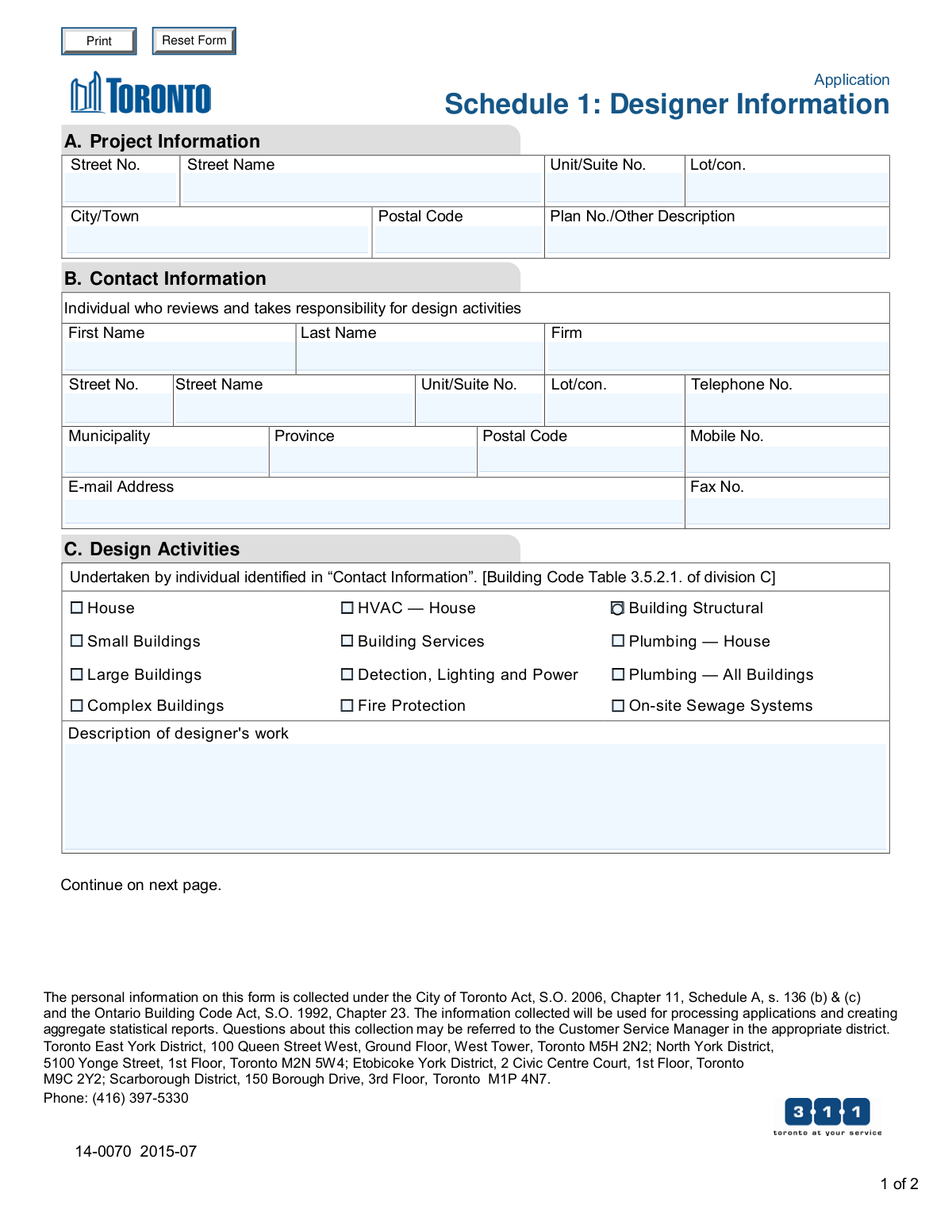
- Application Schedule 1: Designer Information (City of Toronto Building Permit Application): If you are working on a project in Toronto, Ontario, this form is a mandatory supplement for disclosing who is responsible for the design work. Use this to provide your Building Code Identification Number (BCIN) and to certify that the design complies with the Ontario Building Code. It is used by registered firms and independent designers to establish legal responsibility for the plans submitted to the city.
By selecting the form that matches your specific municipality and project type, you ensure that your application contains the correct legal declarations and technical data required for local zoning and building inspections.
Form Comparison
| Form | Primary Purpose | Project Scope | Key Information Required |
|---|---|---|---|
| Application Schedule 1: Designer Information (City of Toronto Building Permit Application) | Documents designer credentials and accountability for Ontario Building Code compliance. | Specific design-related schedule for Toronto building permit applications. | Designer BCIN, project scope, and professional liability declarations. |
| City of Manchester Application for Plan Review and Building Permit | Initiates building permit process and plan review for local construction. | Broad construction projects including new builds, renovations, and demolitions. | Project description, estimated costs, and involved contractor parties. |
| City of Raleigh Residential Permit Application (Revision 08-20-2025) | Authorizes residential construction, trade work, and site impact assessments. | Residential-specific construction, renovations, and utility service connections. | Impervious surface area, disturbed area, and licensed contractor info. |
Tips for city permit forms
Ensure the estimated cost and description of work are accurate to avoid delays in the review process. Discrepancies between your architectural plans and the permit application can lead to permit denials or unexpected fee adjustments.
Many city permits require specific credentials, such as a BCIN in Toronto or state-specific license numbers for trades in Raleigh. Always confirm your contractor's current license status before filling out the trade sections to ensure the application is legally valid.
For residential permits, municipalities often require exact measurements of disturbed areas and impervious surfaces to manage local stormwater requirements. Providing inaccurate data in these sections can trigger additional environmental reviews that significantly slow down your project timeline.
City permits often require attachments like site plans, floor layouts, and utility requests. Organizing these files digitally alongside your filled application makes it easier to upload everything at once to the municipal portal or submit via email.
AI-powered tools like Instafill.ai can complete complex city permit forms in under 30 seconds with high accuracy. Your data stays secure during the process, providing a massive time-saving advantage for developers or homeowners dealing with multiple municipal forms.
Before submitting, ensure your project description aligns with the specific zoning laws mentioned in the form instructions. Even minor renovations may require specific disclosures regarding change of use or the addition of accessory structures.
Missing a designer declaration or a contractor signature is a leading cause of application rejection. Always review the final checklist to confirm every necessary schedule, such as Toronto’s Schedule 1, is signed and attached before submission.
Frequently Asked Questions
City permit forms are official documents used by local governments to regulate construction, renovations, and land use within their jurisdiction. They ensure that all projects comply with safety codes, zoning laws, and environmental regulations to protect both the property owner and the community.
Typically, the property owner is responsible for ensuring a permit is obtained, though they often delegate the actual filing to a licensed contractor or architect. Certain forms, such as the Designer Information schedule used in Toronto, must be completed by the specific professional responsible for the project's design and code compliance.
Yes, you can fill out city permit forms using AI tools like Instafill.ai. These tools can accurately extract data from your project notes or existing documents and place it into the correct fields in under 30 seconds, significantly reducing manual data entry.
Permits are generally required for any work that involves structural changes, new construction, additions, or modifications to electrical, plumbing, and mechanical systems. Simple cosmetic repairs, such as painting, flooring, or replacing a faucet, usually do not require a formal application, but requirements vary by municipality.
Completed forms are usually submitted to your local city or county Planning and Development department. Many modern municipalities, such as Raleigh or Manchester, offer online submission portals, while others may require you to submit physical copies at a permit office.
While manual entry for complex permit applications can take significant time, using AI-powered services like Instafill.ai allows you to complete these forms in less than 30 seconds. The AI automatically maps information from your source files to the appropriate sections of the PDF.
In addition to the application form, you will often need to provide site plans, architectural drawings, and contractor licensing information. Some cities also require specific calculations, such as the amount of impervious surface area or disturbed soil on a residential lot.
It depends on the scope of the project and local regulations. While many cities allow homeowners to apply for permits for work on their own primary residence, major structural or trade-specific work (like electrical or gas) often requires the signature and license number of a qualified professional.
Starting work without an approved permit can result in stop-work orders, double permit fees, or legal penalties. Furthermore, the city may require you to uncover or remove completed work so that it can be properly inspected for code compliance.
Yes, most city permit applications and their associated documents are subject to public records laws. This means that information regarding the project address, the owner, the contractor, and the estimated cost of the work can be viewed by members of the public upon request.
Glossary
- Form Complexity Index
- Instafill’s 0–100 measure of how much effort a form takes to complete, calculated deterministically from the form’s own structure rather than estimated. It combines the number of fillable fields (the largest factor), how difficult those fields are to complete based on their type, the number of pages that contain fields, the amount of conditional “fill-only-if” logic, and how many sections the form is divided into, then adds modifiers for tables and repeating lists, bundled instruction pages, and dense page layouts. A higher score means the form is harder to fill out by hand. The forms in this category have a median Form Complexity Index of 70/100 (Complex). See exactly how it is calculated.
- Building Code
- A set of local or provincial regulations that establish minimum safety and structural standards for construction projects to protect public health.
- Plan Review
- The formal process where city officials examine submitted construction drawings to ensure they comply with all relevant codes and regulations before a permit is granted.
- Zoning
- Municipal laws that divide land into different areas to control how property is used, such as residential, commercial, or industrial, and where buildings can be placed.
- Impervious Surface
- Any ground covering that prevents water from soaking into the soil, such as roofs, pavement, or decks, often used to calculate stormwater impact.
- BCIN (Building Code Identification Number)
- A unique identification number assigned to qualified designers and firms in Ontario to verify they are registered and insured to take responsibility for design work.
- Single-Trade Permit
- An application specifically for one type of specialized work, such as electrical, plumbing, or mechanical installations, rather than a general building permit.
- Change of Use
- A legal designation for when a building's function changes, such as from a warehouse to a retail space, which usually requires a new permit to ensure the building meets different safety standards.
- Disturbed Area
- The total square footage of land where the natural soil or vegetation is cleared, graded, or excavated during the construction process.