Fill out credit union forms
with AI.
Credit unions provide a member-focused alternative to traditional banking, offering services ranging from personal loans to commercial financing. The forms associated with these institutions are critical for maintaining regulatory compliance and ensuring that lenders have a comprehensive understanding of an applicant's financial health. Whether you are applying for a mortgage, a personal line of credit, or adjusting your membership details, these documents serve as the formal record for your financial requests and disclosures.
By continuing, you acknowledge Instafill's Privacy Policy and agree to get occasional product update and promotional emails.
About credit union forms
These forms are typically required by individuals and joint applicants who are navigating major life milestones, such as buying a home or starting a small business. For example, documents like the Personal Financial Statement are essential for summarizing assets, debts, and income sources, helping the credit union verify net worth and repayment capacity. Because these financial forms often require detailed schedules of real estate, investments, and liabilities, accuracy is paramount to avoid delays in the underwriting or approval process.
Completing these detailed financial documents manually can be a time-consuming and repetitive task. Tools like Instafill.ai use AI to fill these credit union forms in under 30 seconds, handling your sensitive data accurately and securely. This automated approach ensures that your loan application forms and disclosures are completed precisely, allowing you to focus on your financial goals rather than the manual data entry.
Every form on this page can be completed without typing. Instafill is form filling software that reads a PDF and fills it for you — including flat and scanned documents that carry no fillable fields at all.
Forms in This Category
The forms in this category have a median Form Complexity Index of 81/100 (Very Complex), measured across 2 forms by field count, input difficulty, length, conditional logic and structure. See how it is calculated.
| Form Name | Pages | FCI | |
|---|---|---|---|
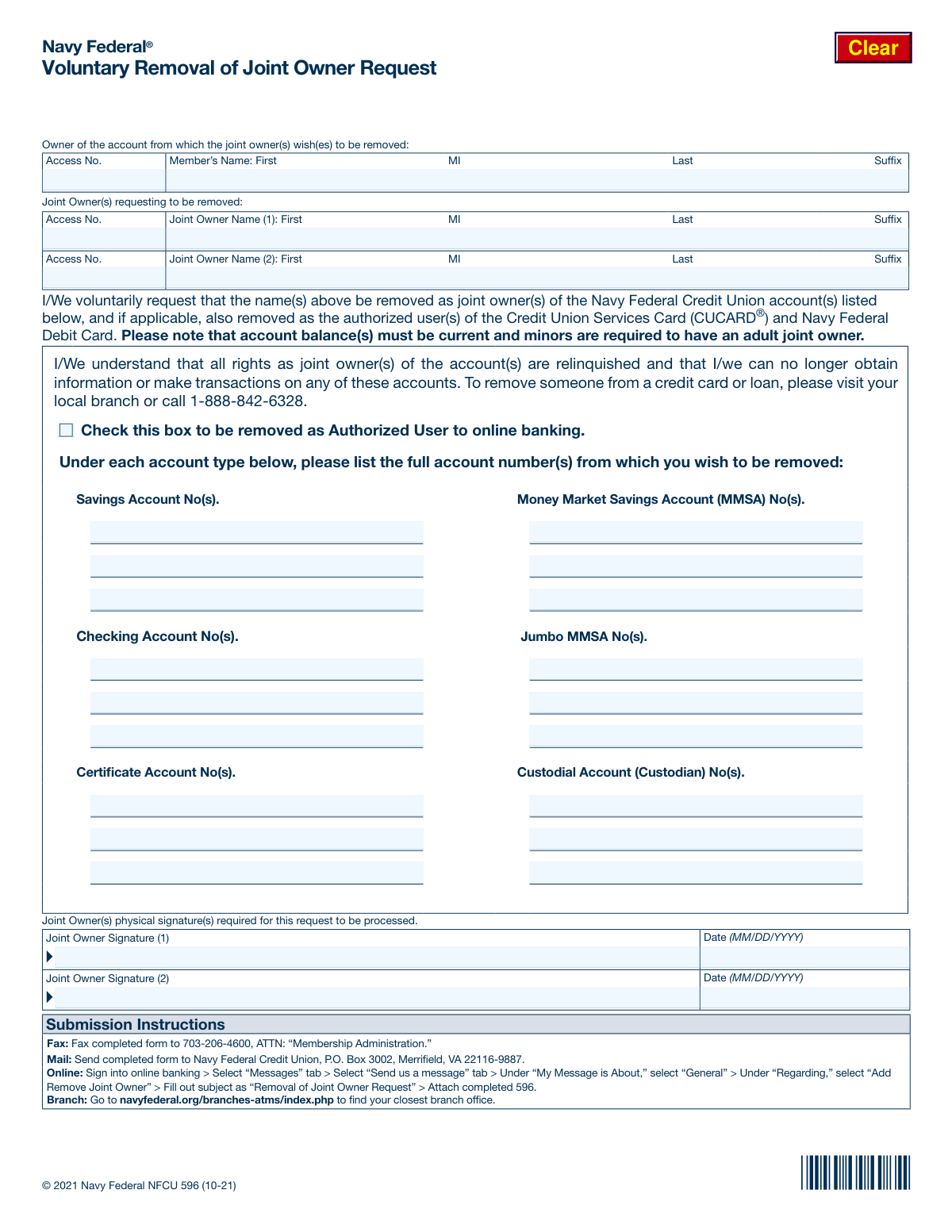
| 1. | Navy Federal Voluntary Removal of Joint Owner Request | 1 | Moderate 58 |
| 2. | Personal Financial Statement (REV 06/2018) – Northwest Federal Credit Union | 4 | Very Complex 81 |
- Enterprise-grade security & data encryption
- 99%+ accuracy powered by AI
- 1,000+ forms from all industries
- Complete forms in under 60 seconds
How to Choose the Right Form
Navigating financial documentation can be complex, especially when applying for credit or managing your relationship with a credit union. While specific requirements vary by institution, the forms in this category are designed to help you present a clear, accurate picture of your financial health to your lender.
Assessing Your Financial Position
If you are applying for a substantial loan—such as a mortgage, a large personal loan, or business financing—the credit union often needs more than just a credit score. The Personal Financial Statement (REV 06/2018) – Northwest Federal Credit Union is the primary tool used for this purpose.
You should choose this form if you need to:
- Summarize Assets and Liabilities: List your cash on hand, real estate holdings, retirement accounts, and investments alongside any outstanding debts or mortgages.
- Verify Net Worth: Provide a calculated snapshot of your total value to support high-value credit applications.
- Disclose Income Sources: Detail your monthly or annual earnings from salaries, bonuses, commissions, or rental properties.
When to Use the Northwest Federal Credit Union Form
While this form is specifically branded for Northwest Federal Credit Union, its comprehensive structure makes it an excellent template for anyone needing a detailed personal financial summary for lending purposes. It is particularly useful for:
- Joint Applicants: The form includes dedicated sections for co-applicants to ensure a complete household financial profile is captured for the lender.
- Underwriting Support: Use this to provide the detailed schedules (such as real estate descriptions, notes payable, and unpaid taxes) that underwriters require to approve complex loan files.
- Legal Compliance: Ensure you are meeting federal disclosure standards, as this form includes the necessary legal warnings and authorizations required for official financial reviews.
Before you begin filling out the Personal Financial Statement (REV 06/2018), gather your latest bank statements, investment portfolio summaries, and current debt balances to ensure the information you provide is accurate and verifiable.
Form Comparison
| Form | Primary Purpose | Who Files It | Key Sections |
|---|---|---|---|
| Personal Financial Statement (REV 06/2018) – Northwest Federal Credit Union | Summarizes an applicant's complete financial position to verify net worth and repayment capacity. | Individual or joint loan applicants seeking credit from the credit union. | Assets, liabilities, income sources, real estate schedules, and legal history questions. |
Tips for credit union forms
Have your most recent bank statements, investment portfolios, and property tax assessments ready before you begin filling out credit union forms. This ensures you can provide exact figures for assets and liabilities without having to pause your progress to search for documentation.
When completing a financial statement with a co-applicant, be careful to separate individual assets from those held jointly. Accurately categorizing ownership prevents confusion during the underwriting process and helps the credit union calculate your net worth correctly.
Avoid the common mistake of only filling out the summary page; ensure the detailed schedules for real estate, stocks, and notes payable are fully populated. Lenders use these schedules to verify the liquidity and stability of the assets you are claiming.
When listing property assets, use the most recent fair market value rather than the original purchase price. Providing outdated valuation data can lead to an inaccurate net worth assessment, which may negatively impact your creditworthiness during the loan review.
AI-powered tools like Instafill.ai can complete these complex credit union forms in under 30 seconds with high accuracy by mapping your data directly to the PDF. This is a significant time-saver for those managing multiple financial forms, and your sensitive data stays secure throughout the entire process.
Don't forget to list potential debts such as loan guarantees, co-signed notes, or pending legal claims. Omitting these contingent liabilities is a frequent oversight that can lead to delays or denials if the credit union discovers them during a background check.
Double-check that the sum of your individual schedules matches the total assets and liabilities reported on the main summary page. Mathematical errors are a common reason forms are returned for correction, which can significantly slow down your loan application.
Frequently Asked Questions
Credit union financial forms are designed to provide lenders with a comprehensive overview of an applicant's financial situation. These documents help the institution assess creditworthiness, verify assets, and determine the risk associated with a loan or line of credit.
This form is generally required for individuals applying for significant loans, such as mortgages, business loans, or large personal lines of credit. It may also be required for co-signers or joint applicants to establish the combined net worth of all parties involved in the application.
You will typically need to list all assets, including cash, real estate, and investments, alongside all liabilities like mortgages, credit card debt, and unpaid taxes. The form also requests details on annual income sources and any contingent liabilities where you might be responsible for someone else's debt.
Yes, modern AI tools like Instafill.ai can automatically populate these complex forms by extracting data from your source documents. These systems can typically complete a standard credit union form in under 30 seconds, ensuring that data is placed accurately in the correct fields.
While manual entry can take 30 minutes or more due to the detailed schedules required, using an AI-assisted platform reduces the time to less than a minute. The AI handles the heavy lifting of mapping your financial data to the specific lines on the form.
Detailed schedules allow the credit union to verify the current market value and ownership status of your assets. This granularity helps underwriters understand the liquidity of your net worth and the stability of your collateral.
This depends on the specific credit union's policy, but many forms allow for joint filing where both individuals' financial data is combined on a single document. If assets are held separately, the credit union may request individual statements to get a clearer picture of each person's financial standing.
Providing false information on a financial statement is a serious matter and may lead to the denial of your application or legal prosecution. Many forms include an explicit warning that false statements are punishable under federal law, such as 18 U.S.C. § 1001.
Completed forms should be submitted directly to the credit union department handling your application, often through a secure online portal or in person at a branch. Because these forms contain sensitive personal and financial data, it is important to use encrypted or secure delivery methods.
Yes, credit unions often require proof of the figures listed on your statement, such as recent bank statements, tax returns, or brokerage account summaries. Keeping these documents organized makes it easier for AI tools to extract data and for the lender to verify your claims.
If you have an ongoing credit relationship or a revolving line of credit, the credit union may request an updated statement annually. This ensures they have current information regarding your financial health and continued ability to meet repayment obligations.
Glossary
- Form Complexity Index
- Instafill’s 0–100 measure of how much effort a form takes to complete, calculated deterministically from the form’s own structure rather than estimated. It combines the number of fillable fields (the largest factor), how difficult those fields are to complete based on their type, the number of pages that contain fields, the amount of conditional “fill-only-if” logic, and how many sections the form is divided into, then adds modifiers for tables and repeating lists, bundled instruction pages, and dense page layouts. A higher score means the form is harder to fill out by hand. The forms in this category have a median Form Complexity Index of 81/100 (Very Complex). See exactly how it is calculated.
- Net Worth
- The total value of all your assets minus all your liabilities, representing your overall financial standing at a specific point in time.
- Underwriting
- The process a credit union uses to evaluate your financial information and credit history to determine the level of risk involved in approving a loan.
- Contingent Liabilities
- Potential financial obligations that may become actual debts depending on the outcome of future events, such as co-signing a loan for someone else or pending legal claims.
- Liquid Assets
- Resources that can be quickly converted into cash with little to no loss in value, such as funds in a checking account, savings account, or certain stocks.
- Notes Payable
- Formal written promises to pay a specific amount of money to a creditor or lender at a future date, often including a set interest rate.
- Schedules
- Detailed tables or lists within a financial form that provide specific breakdowns for items like real estate holdings, unpaid taxes, or investment portfolios.
- 18 U.S.C. § 1001
- A federal law cited on financial forms that makes it a criminal offense to knowingly provide false, fictitious, or fraudulent statements to a financial institution.
- Creditworthiness
- A lender's valuation of your ability and willingness to repay a loan, based on your income, debt levels, and past repayment history.