Fill out customs forms
with AI.
Customs and export forms are the backbone of international shipping, ensuring that goods move across borders legally, accurately, and without unnecessary delays. These documents communicate critical information — from the nature and value of shipments to routing instructions and export compliance details — between shippers, freight forwarders, customs authorities, and carriers. Getting them right matters: errors or omissions can lead to shipment holds, fines, or liability issues.
By continuing, you acknowledge Instafill's Privacy Policy and agree to get occasional product update and promotional emails.
About customs forms
Anyone involved in sending goods internationally will encounter these forms, whether you're a small business exporting products for the first time or an experienced logistics coordinator managing regular freight shipments. A key example in this category is the U.S. Shipper's Letter of Instruction (SLI), which exporters use to relay essential shipping and export data to their freight forwarder — including information needed to file Electronic Export Information (EEI) through the Automated Export System (AES). These forms require precise, consistent data entry, and even small mistakes can create compliance headaches down the line.
Because accuracy is so important, tools like Instafill.ai use AI to help fill these forms in under 30 seconds, reducing the risk of manual errors while keeping your data secure — a practical time-saver whether you're handling a one-time shipment or processing forms regularly.
Every form on this page can be completed without typing. Instafill is form filling software that reads a PDF and fills it for you — including flat and scanned documents that carry no fillable fields at all.
Forms in This Category
The forms in this category have a median Form Complexity Index of 60/100 (Moderate), measured across 2 forms by field count, input difficulty, length, conditional logic and structure. See how it is calculated.
| Form Name | Pages | FCI | |
|---|---|---|---|
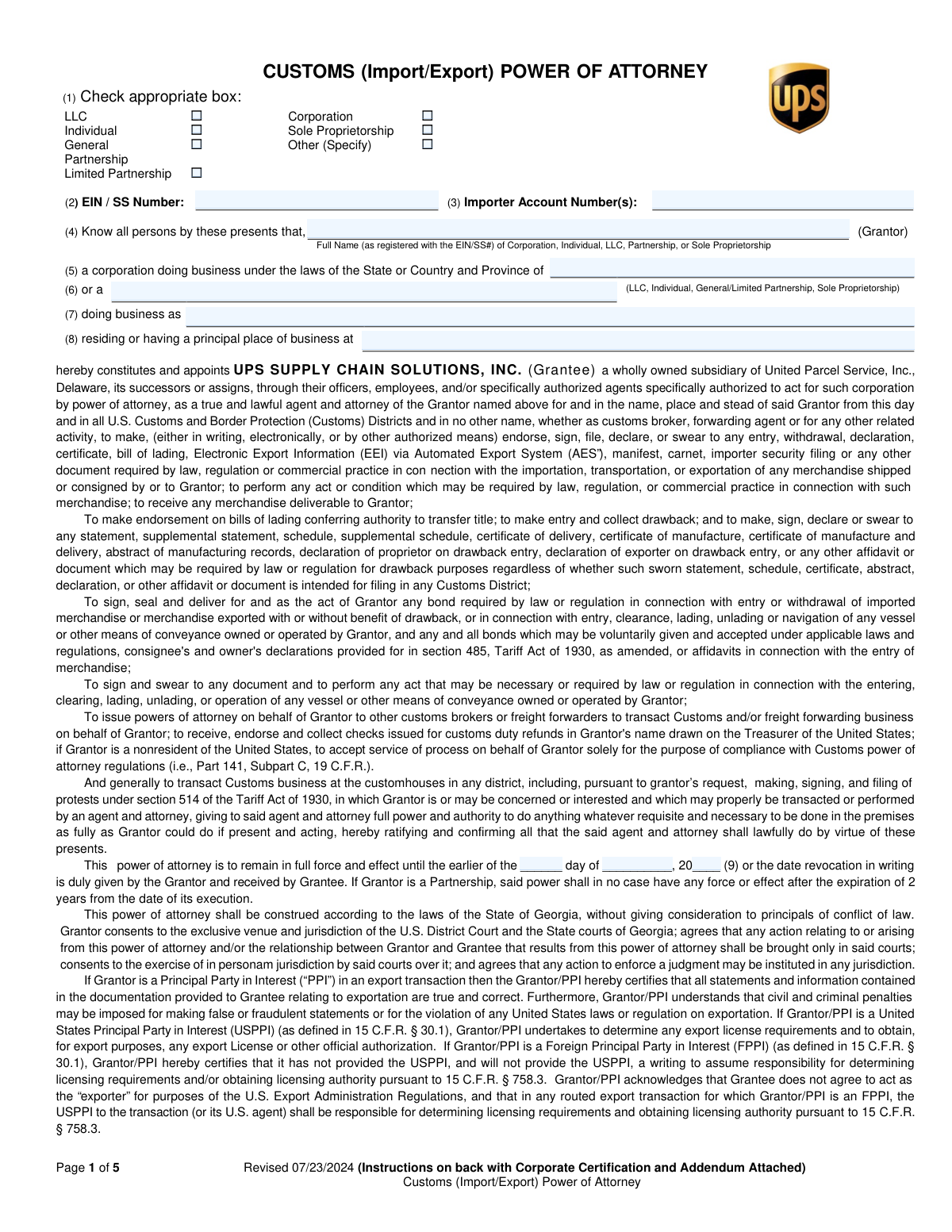
| 1. | Customs (Import/Export) Power of Attorney | 5 | Moderate 53 |
| 2. | Form BSF189, Canada Customs Invoice / Facture des douanes canadiennes | 1 | Moderate 60 |
- Enterprise-grade security & data encryption
- 99%+ accuracy powered by AI
- 1,000+ forms from all industries
- Complete forms in under 60 seconds
How to Choose the Right Form
With only one form in this category, the decision is straightforward — but it's worth understanding exactly when and why you need the U.S. Shipper's Letter of Instruction (SLI) before you fill it out.
Who Should Use the SLI?
The SLI is designed for U.S.-based exporters and shippers sending goods internationally through a freight forwarder or customs agent. You'll need it if:
- You're exporting goods and need to relay shipment details (commodity info, routing, terms of sale) to your forwarder
- Your shipment requires Electronic Export Information (EEI) to be filed in the Automated Export System (AES)
- You want to authorize your forwarder to act on your behalf without issuing a separate Power of Attorney
- You're shipping air cargo and need to provide consent to screening
- You want to specify insurance coverage or declared value instructions for your shipment
When You Don't Need It
The SLI may not be required if:
- Your shipment is domestic only (no international component)
- Your forwarder already has a standing Power of Attorney and handles documentation independently
- The shipment value and commodity type fall below EEI filing thresholds and no special instructions are needed
Tips for Filling It Out
- Have your Schedule B or HTS commodity classification code ready before starting
- Double-check your Incoterms (e.g., FOB, CIF) — these affect liability and cost responsibility
- If you're unsure about AES filing requirements, consult the Census Bureau's Foreign Trade regulations
- Accuracy is critical — errors on the SLI can cause customs delays, fines, or incorrect routing
The U.S. Shipper's Letter of Instruction is the right form for virtually any U.S. exporter working with a freight forwarder on an international shipment.
Form Comparison
| Form | Purpose | Who Files It | When to Use |
|---|---|---|---|
| U.S. Shipper's Letter of Instruction (SLI) | Conveys export and shipping instructions to freight forwarder or agent | U.S. exporters or shippers sending international cargo | Before international shipment to prepare export documents and EEI filing |
Tips for customs forms
Errors in shipper, consignee, or freight forwarder details are among the most common mistakes on export documentation. Verify full legal names, addresses, and contact information before submitting, as discrepancies can cause shipment delays or compliance issues at customs.
Every item being exported needs a correct Schedule B or Harmonized System (HS) code, as this determines duties, restrictions, and whether an Electronic Export Information (EEI) filing is required. Using the wrong code can trigger audits, fines, or shipment holds, so consult the U.S. Census Bureau's Schedule B search tool if you're unsure.
Not every shipment requires an EEI filing in the Automated Export System (AES), but many do — particularly for high-value goods or controlled items. Review the current thresholds and exemptions before completing your SLI so your forwarder has clear, accurate instructions on how to proceed.
The SLI includes optional fields for insurance and declared value that shippers often leave blank or fill out vaguely. Clearly state whether you want the forwarder to arrange insurance and specify the declared value, since ambiguous instructions can leave your shipment underinsured or uninsured in transit.
The SLI can grant your forwarder limited authorization to act on your behalf, but only when structured correctly and when a separate power of attorney is not already in place. Confirm with your forwarder whether the SLI alone is sufficient for your specific shipment type, especially for air cargo screening consent.
Filling out export forms like the SLI manually is time-consuming and error-prone, especially when managing multiple shipments. AI-powered tools like Instafill.ai can complete these forms in under 30 seconds with high accuracy, and your data stays secure throughout the process — a real time-saver for frequent exporters or logistics teams.
If you regularly ship the same goods to the same destinations, create a standardized SLI template with pre-filled recurring details like shipper information, commodity descriptions, and HS codes. This reduces re-entry errors and speeds up the documentation process for routine exports.
Your freight forwarder may have specific formatting preferences or additional data requirements beyond the standard SLI fields. A quick pre-submission check ensures the form meets their needs and reduces the chance of having to resubmit corrected documentation under time pressure.
Frequently Asked Questions
Customs and shipping instruction forms provide freight forwarders, carriers, and customs agents with the key details they need to move goods across international borders legally and efficiently. They capture information such as shipper and consignee details, commodity descriptions, declared values, and routing instructions, helping ensure export compliance and proper handling throughout the shipment lifecycle.
Any U.S.-based exporter or shipper who is working with a freight forwarder or export agent to ship goods internationally typically needs to complete an SLI. It is especially important when the forwarder will be filing Electronic Export Information (EEI) in the Automated Export System (AES) on the shipper's behalf, as it provides the forwarder with the data and authorization needed to do so.
The SLI should be completed and submitted to your freight forwarder or export agent well before the scheduled shipment date, ideally at the time of booking or as soon as shipment details are confirmed. Submitting it early gives your forwarder enough time to prepare export documentation, file any required EEI, and arrange proper routing or cargo screening.
The SLI itself is not a standalone government-mandated form, but the information it contains is often required to fulfill legal export obligations, such as filing EEI through AES for qualifying shipments. It also serves as a contractual instruction to the forwarder and can grant limited power of attorney, making it an essential document in many international shipping transactions.
You will generally need details about the shipper and consignee (names, addresses, contact information), a description of the goods being exported (including HS/Schedule B commodity codes), the declared value, country of origin, destination country, and preferred routing or carrier information. For regulated commodities, you may also need export license numbers or exemption citations.
In many cases, yes — the SLI can include an authorization clause that grants the forwarder limited authority to act on the shipper's behalf, including filing EEI and, for air cargo, consenting to cargo screening. However, for ongoing or complex relationships, a separate formal power of attorney may still be recommended. Always confirm with your forwarder what level of authorization they require.
Yes, the SLI typically includes optional sections where the shipper can declare the value of goods for insurance purposes and provide instructions regarding cargo insurance coverage. Completing these sections accurately helps establish liability limits and ensures the forwarder arranges appropriate coverage if requested.
The completed SLI is submitted directly to your freight forwarder or export agent — it is not filed with a government agency. Your forwarder then uses the information to prepare export documentation and, when required, to file EEI with U.S. Customs and Border Protection through the Automated Export System (AES).
Yes — AI-powered tools like Instafill.ai can fill out forms such as the Shipper's Letter of Instruction in under 30 seconds by accurately extracting and placing data from your source documents, such as commercial invoices or packing lists. This reduces manual entry errors and speeds up the documentation process, which is especially valuable when managing time-sensitive international shipments.
Manually completing an SLI can take anywhere from 10 to 30 minutes depending on the complexity of the shipment and how readily available your export data is. Using an AI tool like Instafill.ai, the form can be populated in under 30 seconds by pulling data directly from existing shipping or commercial documents, significantly reducing preparation time.
Inaccurate or incomplete information on the SLI can lead to delays in export documentation, incorrect EEI filings, compliance violations, or improper routing and handling of your shipment. It is important to review all entries carefully — particularly commodity codes, declared values, and authorization clauses — before submitting to your forwarder.
While the core data elements are standardized based on U.S. export regulations and AES requirements, the specific layout and format of an SLI can vary between freight forwarders and industry organizations. Most versions capture the same essential information, so it is worth confirming with your forwarder whether they have a preferred template or will accept a standard industry form.
Glossary
- Form Complexity Index
- Instafill’s 0–100 measure of how much effort a form takes to complete, calculated deterministically from the form’s own structure rather than estimated. It combines the number of fillable fields (the largest factor), how difficult those fields are to complete based on their type, the number of pages that contain fields, the amount of conditional “fill-only-if” logic, and how many sections the form is divided into, then adds modifiers for tables and repeating lists, bundled instruction pages, and dense page layouts. A higher score means the form is harder to fill out by hand. The forms in this category have a median Form Complexity Index of 60/100 (Moderate). See exactly how it is calculated.
- Electronic Export Information (EEI)
- The electronic record filed with U.S. Customs and Border Protection to document exports leaving the United States. It is required for most shipments valued over $2,500 per Schedule B commodity or for items requiring an export license.
- Automated Export System (AES)
- The U.S. government's electronic system used to collect and process export shipment data. Exporters or their agents use AES (now part of ACE) to file EEI before goods leave the country.
- Freight Forwarder
- A licensed agent or company that arranges the shipment of goods on behalf of an exporter, handling logistics, documentation, customs filings, and coordination with carriers.
- Schedule B Number
- A 10-digit commodity classification code used by U.S. exporters to identify and categorize goods for export reporting purposes. It is required when filing EEI in AES.
- Harmonized System (HS) Code
- An internationally standardized numerical code used to classify traded products for customs and tariff purposes. HS codes are recognized by most countries and form the basis for Schedule B numbers.
- Power of Attorney (POA)
- A legal authorization that grants a freight forwarder or customs broker the authority to act on behalf of the shipper for export or import transactions. An SLI can sometimes serve this function when a separate POA is not on file.
- Incoterms
- Internationally recognized trade terms (e.g., FOB, CIF, DDP) that define the responsibilities, costs, and risk transfer points between buyer and seller during shipment. The chosen Incoterm affects who pays for freight, insurance, and customs duties.
- Declared Value
- The shipper-stated monetary value of a shipment used to determine carrier liability limits and, when applicable, cargo insurance coverage. It may differ from the commercial invoice value.
- Export License
- A government-issued authorization required to export certain controlled goods, technologies, or commodities to specific destinations or end-users. Shipments requiring a license must reference it in export documentation including the SLI.
- Air Cargo Screening Consent
- Authorization given by a shipper allowing their air freight to be physically screened or inspected for security purposes, as required by TSA regulations for cargo transported on passenger aircraft.